How to Rank in AI Overviews: A Guide for Treatment Centers
Learn how to improve your treatment center’s visibility in Google AI Overviews and become a trusted source for families researching care. This guide from Behavioral Health Partners breaks down nine practical steps, from indexing and clear answers to clinical expertise, consistent business information, and credible citations. Discover how SEO supports AI visibility, which content mistakes undermine your efforts, and how to measure progress. Built for addiction treatment, mental health, and behavioral health providers ready to strengthen their presence in search.
To rank in Google AI Overviews, a page has to be indexed, eligible for a snippet, and already competitive in regular Google search results for the question being asked. From there, Google's AI cites the pages that answer the question directly in the first lines, carry clear structure and matching structured data, show real expertise, and are corroborated by trusted sources. This guide explains how AI Overviews choose sources and the steps that get a treatment center cited.
A father types "how long does inpatient rehab take" into Google at his kitchen table. Before he sees a single blue link, Google answers him in a paragraph, with three or four supporting links tucked beside it. He reads the answer, taps one of those links, and that center has just become the first voice he trusts. Your program pages could be that voice. Most are not, and the reasons are fixable. That is what this guide covers: how to rank in AI Overviews, step by step, for a treatment center.
Behavioral Health Partners is a generative engine optimization and AI search marketing agency for addiction treatment, mental health, and behavioral health providers. We run generative engine optimization services for treatment centers every day, and AI Overviews are the surface where AI visibility shows up first, because Google is still where most families start. Everything below is what we do, in the order we do it.
What Google AI Overviews Are, and How They Differ From AI Mode
Google AI Overviews are the AI generated summaries that appear at the top of Google search results for some queries, above the ten blue links, written by Google's Gemini models and followed by direct links to the pages the summary drew from. Google launched them in the United States in May 2024 and worldwide later that year. They do not show on every search. Google's own documentation says AI Overviews appear only when its systems decide the summary adds something beyond the classic results, so for many queries, including most "rehab near me" style searches where the map pack does the job, no AI Overview appears at all. They trigger most often on longer, question-style searches, which is exactly how families ask about treatment, and each one is generated from multiple high-ranking web pages rather than a single source.
AI Mode is different. It is a full conversational search experience, a separate tab where someone can ask a nuanced question, get a long AI generated response with supporting links, and keep asking follow-ups. Google says the two can use different models and techniques, so the links they show will differ, but they draw on the same index and the same ranking systems, and both use what Google calls query fan-out: the AI issues several related searches behind the scenes, pulls pages for each one, and assembles a response from what it finds.
That last detail matters more than anything else in this guide. An AI Overview is not a new search engine with new rules. It is Google Search, retrieving pages from Google's index the way it always has, and then reading them to write an answer. The same query that used to return ten blue links now returns an answer first, but the search engine underneath did not change. Google's guidance is direct on this point: there are no additional requirements to appear in AI Overviews or AI Mode, and no special optimization is necessary beyond the fundamentals. Rank for the question and its related questions, make the answer easy to lift, and prove you are a source worth trusting, and you are eligible. Skip any of the three and you are not.
Why AI Overviews Matter More for Treatment Centers Than for Most Businesses
Treatment is a your-money-or-your-life category, and Google is conservative with health answers by design. That cuts two ways. It means AI Overviews for treatment questions lean harder on trust signals than they do for a recipe or a product review, so thin pages rarely make it in. It also means the centers that clear the bar get cited on the exact questions families ask before they are ready to call anyone: what detox feels like, how long residential lasts, whether insurance pays, what happens on the first day, how to tell if someone needs help.
Those are the questions that start the journey. A center that is the cited source for "what happens in the first 48 hours of detox" has introduced itself to a family days or weeks before that family searches for a program, and it has done it as the trusted explanation rather than as an ad. Google also reports that when people click from a results page that includes an AI Overview, those clicks tend to be higher quality, with visitors spending more time on the site. Zero click searches are real, and organic traffic on broad informational pages has fallen for many sites, but the traffic quality of what remains is higher and the brand visibility of being the cited source starts earlier in the journey. Fewer clicks, better clicks, and a head start on trust. For a treatment center, that trade is worth making on purpose. Centers that ignore it are losing ground to the two or three competitors the AI already cites.
There is one more reason to take it seriously. AI answers have inertia. Once Google's systems settle on the handful of pages they trust for a question in a category, those pages keep getting retrieved, cited, and clicked, which reinforces the trust. Displacing an established citation is harder than earning one while the field is still open, and in behavioral health the field is still open.
How Google Decides Which Pages an AI Overview Cites
Google has not published a scoring formula, and anyone who claims to have one is guessing. What Google has published, plus what we see when we analyze content patterns across the treatment pages that get cited, is enough to work from.
Retrieval comes first. AI Overviews use retrieval-augmented generation, which Google also calls grounding: the AI relies on the core Search ranking systems to retrieve relevant, current pages from the index, then reads those pages to generate the response and shows links to the ones that support it. If your page does not rank for the question, or for one of the multiple sub queries the AI fans out to on its own, it is not in the pool the AI reads from when generating answers. This is why a page that ranks fourth for "does insurance cover rehab" can be cited while a page that ranks first for "rehab" is not: the AI is pulling for the specific question, not the head term.
Extraction comes second. Once the AI has a set of pages, AI systems favor content they can lift a clear answer from. Extractability and contextual authority matter more than holding an exact keyword position. Direct answers near the top of the page, headings that match the questions people ask, short paragraphs, and lists or tables for comparisons all make a page easier to summarize accurately. Google says you do not need to rewrite content in a special style for AI systems, and that is true, but a page that resolves its core question in the first 80 words is easier to cite than one that buries it under four paragraphs of brochure copy.
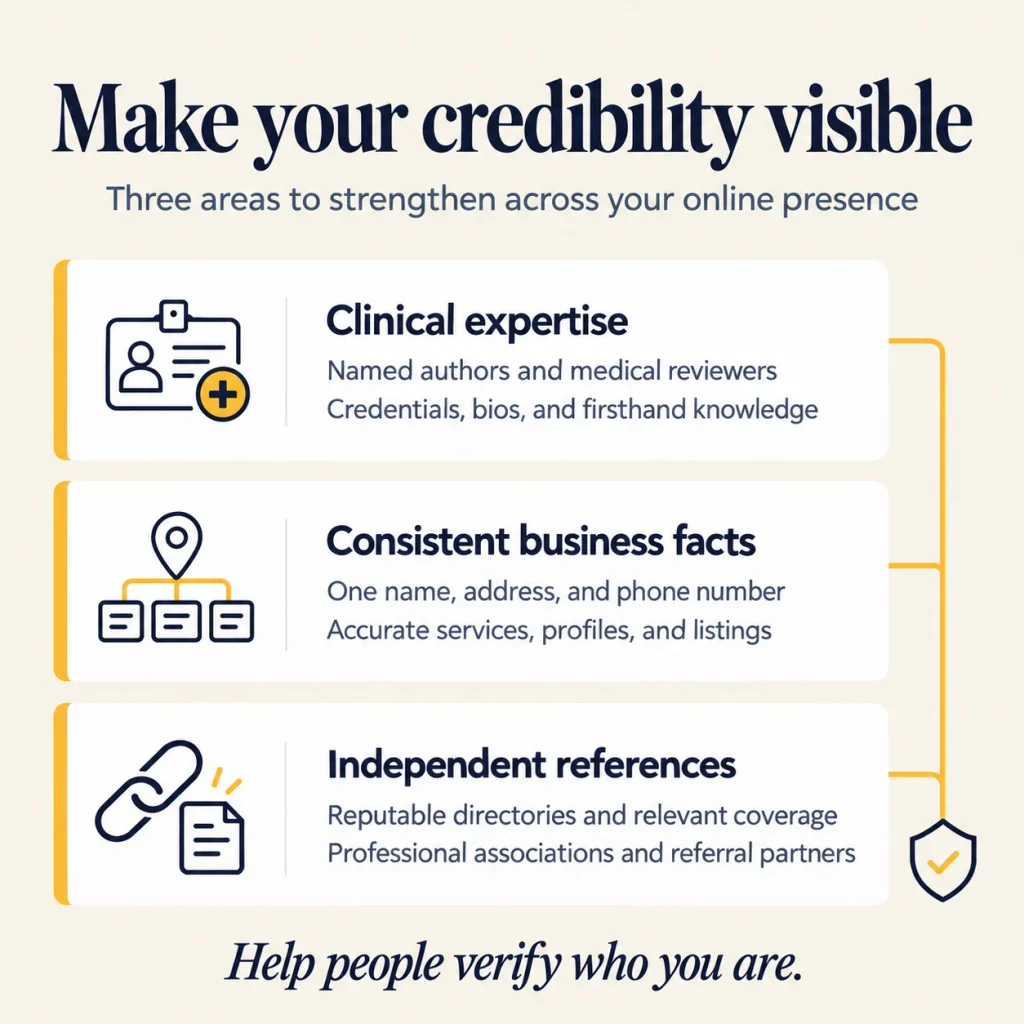
Trust decides ties. E-E-A-T, Google's shorthand for experience, expertise, authoritativeness, and trustworthiness, is not a switch you flip. Google's AI models inherit the same E-E-A-T standards its human raters apply, and entity recognition, meaning whether Google's Knowledge Graph and AI systems recognize your organization as a real, consistent entity, sits underneath all of it. It is the sum of named authors with real credentials, first-hand content and original data that could only have come from someone who does the work, an organization whose facts match everywhere it appears online, and corroboration from other sites that Google already trusts. Pages with strong E-E-A-T signals are simply stronger citation candidates, and topical authority, meaning a site that covers its subject comprehensively rather than in isolated articles, compounds it. In a health category, this is where most treatment center pages fall short, and it is where the rest of this guide spends its time.
How to Rank in AI Overviews, Step by Step
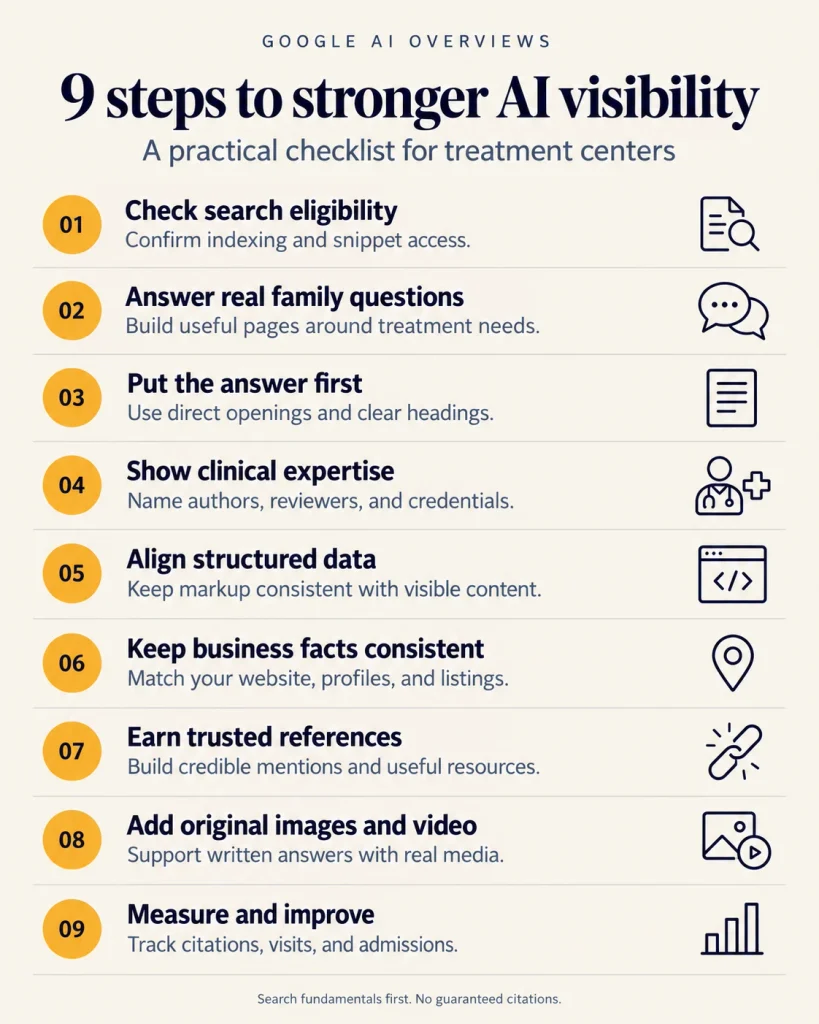
Nine steps, in the order we run them for clients. The first two are technical SEO and regular search optimization, because nothing after them works without them.
Step 1: Make Sure Your Pages Are Eligible
Before any content work, check the plumbing. A page must be indexed and eligible to show in Google Search with a snippet to be a supporting link in an AI Overview, and a surprising number of treatment center pages fail one of those two tests without anyone noticing.
Crawlable and indexed. Confirm Googlebot is allowed in robots.txt and is not being blocked by a CDN, a firewall, or a bot-protection rule. Check the page in Google Search Console with the URL Inspection tool and make sure it shows as indexed.
Snippet-eligible. A page carrying nosnippet, a tight max-snippet, or data-nosnippet on its main content cannot be cited, because Google uses those same preview controls to limit what AI features show. If a developer added them years ago to protect content, they are now keeping you out of the answer.
Included in generative AI features. Search Console now has a setting that controls whether a site is included in Google's generative AI features. Confirm it is on. Note that blocking Google-Extended in robots.txt does not remove you from AI Overviews; that control governs other Google systems, not Search.
Rendered content. If your program pages load their text with JavaScript, make sure Google can render it. Text that only exists after a script runs on a slow page is text the AI may never read.
Mobile optimization and page experience. Most of these searches happen on a phone at a bad hour. A page that is slow, cluttered with popups, or hard to read on mobile is a page Google is less inclined to send anyone to, in the classic results or the AI ones.
Google says plainly that you do not need llms.txt files, special AI markup, or Markdown versions of your pages to appear in its AI features. Google Search ignores them. Spend that time on the checks above instead, and if the checks turn up a site that cannot pass them, start with our guide to website design practices for rehabs and the shorter piece on how to fix your treatment center website.
Step 2: Rank for the Question, Not Just the Keyword
Because AI Overviews retrieve through the same ranking systems, the pages most likely to be cited are the ones that already rank for the question being asked and for the questions Google fans out to. That changes how you plan content.
Start with the actual questions families ask at each stage, and the search intent behind each one (our guide to the best drug rehab SEO keywords shows how to find them): recognizing a problem, understanding levels of care, paying for treatment, choosing a center, and what happens once someone is admitted. Informational pages and guides carry most of this weight; a blog post about mental health can answer one question well, a guide can own a whole cluster, and your service pages have to answer the questions about your own programs. Then build a page, or a section of a page, that answers each one fully. Group them so that a family reading about medical detox can move naturally to how long it takes, what medications are used, and what comes after, and link those pages to each other with plain, descriptive internal links. That site structure helps Google understand the cluster, builds link authority and topical authority into the pages that matter, and helps the AI find the specific sub-answer it needs for a fan-out query. Comprehensive content on one strong page beats scattered fragments, and comprehensive topic coverage across the cluster beats a lone article.
Two cautions. First, do not spin out a separate page for every phrasing of the same question. Google's guidance is explicit that creating many near-duplicate pages to chase variations or fan-out queries violates its scaled content policy and does not work anyway, because its systems understand synonyms and related meanings. One strong page per real question beats twenty thin ones. Second, this step is regular search optimization, and organic search results are the foundation everything else stands on. Our drug rehab SEO practice exists because a center with no rankings has nothing for an AI Overview to cite, and our behavioral health SEO guide walks through that foundation in full. Outpatient therapy practices and mental health clinics follow the same playbook, covered in our therapy SEO guide.
Step 3: Lead With the Direct Answer
This is the single highest-return change most treatment centers can make, and it costs nothing but a rewrite.
Every page that targets a question should resolve that question in its first 80 words, in plain language, before it elaborates. Not a mission statement. Not "at Summit Recovery, we believe healing is a journey." The answer. If the page is about how long inpatient rehab takes, the first paragraph says that most residential programs run 30, 60, or 90 days, what determines which one a person needs, and that the length is set by clinical assessment rather than by a calendar. Then the page explains the rest. Our guide to the cost of addiction treatment is built that way on purpose: the number families came for is in the first paragraph, and the explanation follows.
From there, structure the page the way a careful reader, and an AI, would want it: a heading for each real sub-question, written as the question people ask rather than as a clever phrase; short paragraphs; a numbered list for anything sequential, like admission steps; a table for anything comparative, like levels of care side by side; and a real FAQ section at the bottom that answers the follow-ups in one or two sentences each. Where a specific number or a credible citation strengthens the answer, include it. Researchers who published the first study on generative engine optimization at KDD 2024 found that adding relevant statistics, quotations, and cited sources to a page measurably raised its visibility in generative responses (GEO: Generative Engine Optimization, Aggarwal et al.). In behavioral health, that means a real figure from SAMHSA or a peer-reviewed study, not a number from a marketing deck.
Step 4: Prove Expertise the Way Google Reads It
Google's clearest signal about what influences AI Overview citations in health topics is its emphasis on helpful, reliable, people-first content and on E-E-A-T. For a treatment center, that translates into specific, checkable things on the page.
A named author and a named medical reviewer on every clinical page, with credentials, a real bio, and a link to a profile page that lists their license and role. "Reviewed by our clinical team" is not a reviewer.
First-hand content, original insights, and unique data. Google calls it non-commodity content: a unique point of view that could not have been produced by summarizing what is already online. What actually happens during intake at your center, how your medical team manages the third night of alcohol withdrawal, what your family program does on visiting day. Written by people who have done it, in their words.
Credentials where the AI can see them. Your state license, Joint Commission or CARF accreditation, and LegitScript certification if you hold it, stated plainly in text on the page, not only as badges in an image the AI cannot read.
An about page and team page that match reality. Names, photos, licenses, roles. AI systems check whether the organization behind a page is real and consistent, and the team page is often the first place they look.
Evidence of care in the writing. Dignity, plain language, no fear-based copy, no label language. Google's raters are instructed to judge whether a health page could cause harm, and its AI inherits that caution.
If you use AI tools to help draft, that is allowed, but the output has to meet the same standard as anything else: unique, accurate, reviewed by a clinician, and useful to the person reading it. Generic AI-written program pages are exactly the commodity content Google says its AI features are least interested in.
Step 5: Add Structured Data That Matches the Page
Google says structured data is not required for AI Overviews and there is no special schema you must add. It also says to keep using it, because it helps Google understand pages and makes them eligible for rich results, and because structured data that matches the visible text is one of the fundamentals it lists for AI features. For a treatment center, the useful schema markup implementation is small and specific.
Organization or MedicalOrganization markup on the site, with the same name, address, phone, and credentials that appear in text and in your listings.
LocalBusiness markup for each physical location, with hours, geo, and the same details.
Person markup for clinicians and reviewers, linked from the author and reviewer bylines, with credentials and profile URLs.
Article schema or MedicalWebPage markup on clinical guides, with author, reviewer, and dates.
FAQPage markup only where the questions and answers are visible on the page, word for word.
The one rule Google repeats is that schema markup must match what a person sees. Schema that describes an FAQ section that is not on the page, or a reviewer who did not review it, is worse than none.
Step 6: Keep Your Facts Identical Everywhere Google Looks
Google's guidance for AI features says to make sure your Google Business Profile information is up to date, because generative AI responses can include information about local businesses drawn from it. In practice, the AI is checking you against yourself: your name, address, phone, levels of care, accreditations, and accepted insurance on your website, your Business Profile, the SAMHSA treatment locator, Psychology Today, your state licensing database, and the directories in your category. When those sources disagree, the AI hedges, and a hedged answer usually leaves the center out.
This is local SEO work, and it matters because Google says its AI can draw on Business Profile information for local queries about local businesses. Audit every listing and profile until there is one version of the truth, keep your Google Business Profile complete and active with categories, services, hours, and photos, and make sure your website states the same facts in text. Our guides to optimizing a rehab website for local SEO and to company directories cover the listing work step by step. This is unglamorous work and it moves the needle faster than almost anything else, because it fixes the eligibility problem at the entity level rather than one page at a time.
Step 7: Earn Corroboration From Sources Google Already Trusts
For AI Overviews, as for search in general, what others say about you carries more weight than what you say about yourself. Google warns specifically that seeking inauthentic mentions across the web does not help and can trigger its spam systems, so this is not about buying placements. It is about being genuinely referenced.
High-quality external citations and brand mentions are what let the AI cite you without relying on your own site alone. The sources that matter for a treatment center are the ones Google already retrieves for treatment questions: reputable directories with accurate listings, local and trade press that covers your program or quotes your clinicians, association and referral partner pages that describe your work, and reviews from real families that are recent, specific, and answered. The same standards apply to links: our guide to high-quality backlinks for rehab SEO explains which ones help and which ones get a center flagged. Content that other sites cite because it is useful, like a clear guide to your state's involuntary commitment process or an explainer on a level of care, earns the same kind of corroboration. Every one of those is a link or a mention that tells Google's systems the entity on your page is real, trusted, and worth citing.
Step 8: Add Images and Video That Carry Their Own Weight
Google's AI features can bring in relevant images and video alongside a response, and Google lists high-quality images and video as one of the ways to support textual content for these features. AI systems favor original media over stock, because original media is a resource worth citing. For a treatment center that means real photographs of the facility, the rooms, the grounds, and the team, with descriptive file names and alt text that says what is in the picture. It means short videos that answer the same questions the page answers: a clinician explaining what medical detox involves, a walkthrough of the first day, a family program overview, and client testimonials told with dignity. Our video content ideas guide has a full list. Host them where families can watch them, embed them on the matching page, and add video markup so Google can index them. A page with a credible video answer on it is a page with two chances to be the source instead of one.
Step 9: Measure Whether It Is Working
You cannot manage what you cannot see, and until recently AI visibility inside AI Overviews was hard to see. That has changed.
Search Console. Sites that appear in AI Overviews and AI Mode are included in the overall search traffic in the Performance report under the Web search type, so AI Overview impressions are already in your numbers, and Google has added a Generative AI performance report that shows how people discover your content through its generative AI features. Start there. It is the only source of Google's own numbers.
Citation tracking. Third-party tools like Semrush and Ahrefs Brand Radar can tell you which of your pages are being cited in AI Overviews, for which queries, and how that compares to competitors. Google notes that no outside tool has access to its internal systems, so treat these as a workflow aid, not a scoreboard from Google.
The numbers that matter. AI overview citation rates on the questions you care about, share of voice against the competitors named beside you, clicks and time on site from AI-influenced results pages, and, for a treatment center, the calls and admissions those visits produce. Our guide to analytics for behavioral healthcare shows how to wire those numbers together, and the admissions funnel guide shows where AI answers fit in it. Referral traffic from AI answers is a small number today; the admissions it produces are not. Report AI visibility next to admissions or it will drift into vanity.
Run the same set of family questions every month, record whether your center is cited and how the AI describes it, fix the gaps, and repeat.
The Mistakes That Keep Treatment Centers Out of AI Overviews
We see the same handful of problems on almost every audit.
Burying the answer. The page ranks, but the first 300 words are about the center's philosophy, so the AI cites the competitor whose first sentence answers the question.
Brochure program pages. Beautiful, warm, and empty of the specifics a family asked for: length, cost, insurance, what happens day to day.
Contradictory listings. Three phone numbers, two addresses, and a level of care the center stopped offering two years ago, spread across the web.
Accidental preview controls. A nosnippet or max-snippet tag left on templates from a redesign, quietly excluding every page it touches.
Blocked crawlers. A CDN or security setting that challenges Googlebot, so half the site never gets indexed.
Content only in images or PDFs. Admissions criteria, insurance lists, and program schedules that exist as a PDF or a graphic the AI cannot read.
No named people. Clinical pages with no author, no reviewer, and a team page with first names only.
Stale pages. Insurance lists and program details that have not been touched in years, on a topic where Google favors current information. Regularly updating content is one of the few things that reliably improves visibility in AI generated search experiences.
Chasing hacks. llms.txt files, artificial chunking, keyword-stuffed rewrites for AI, and paid mentions, all of which Google says it ignores or penalizes.
Scaled thin content. Dozens of near-identical city or condition pages generated to catch every variation, which Google treats as spam.
How Long It Takes
Eligibility and entity fixes can change AI Overview citations within weeks, because the AI re-retrieves pages constantly and a page that was excluded can be included as soon as Google recrawls it. Content and corroboration take longer, usually a few months, because they depend on rankings improving and on other sites picking up what you publish. Centers with a solid search foundation move faster. Centers starting from no rankings need the SEO layer first, and any agency that promises AI Overview citations without it is selling a shortcut that does not exist.
AI Overview Optimization, AEO, and GEO: One Foundation Serves All of Them
You will hear this work called AI overview optimization, answer engine optimization, or generative engine optimization, depending on who is selling it. Everything in this guide is aimed at Google, because Google is still where most families start. But the same work is what gets a center named by ChatGPT, Claude, Gemini, Perplexity, and Microsoft Copilot when a family asks any of them where to send someone they love. Entity clarity (which starts with consistent branding), direct answers, structured data, named expertise, and third-party corroboration are the inputs every AI engine weighs, in slightly different proportions, and the same work earns featured snippets and other SERP features on Google along the way. That is the whole premise of generative engine optimization, and it is why we run AI Overview work and the broader GEO program as one system rather than two.
When to Bring in Help
Many centers can do Step 1, Step 3, and Step 6 in-house with a good developer and an admissions director who knows the questions families ask, and in-house SEO teams that already own the site can carry more of it. Paid media does not substitute for any of it, because ads never appear inside the answer; our SEO vs PPC guide explains where each one belongs. The harder parts are the ones that take a specialist: rebuilding a site's program pages around real questions without losing rankings, implementing schema across a site correctly, earning corroboration in a category where inauthentic tactics get penalized, and measuring citations across every AI engine every month.
That is what our generative engine optimization services cover, for addiction treatment, mental health, and behavioral health providers only. The first step is a free GEO audit: we pull up what Google's AI Overviews and the other AI engines actually say about your center today, show you the gaps, and tell you plainly what it would take to close them. Nothing is pitched on that call.
Frequently Asked Questions About Ranking in AI Overviews
How do I get into Google AI Overviews?
Make sure the page is indexed and eligible for a snippet, rank for the question being asked and its related questions, answer that question directly in the first lines of the page, prove expertise with named authors, reviewers, and credentials, keep your business facts identical across the web, and earn references from sources Google trusts. Google states there are no additional requirements beyond its normal search fundamentals.
Do I need to rank number one organically to appear in an AI Overview?
No. AI Overviews retrieve pages through query fan-out, so a page that ranks well for a specific sub-question can be cited even when it is not in the top three for the main term. What you do need is to rank somewhere in the retrievable set for the question the AI is answering.
Which questions trigger AI Overviews for treatment centers?
Informational questions: what a level of care is, how long it takes, what it costs, whether insurance covers it, what to expect, and how to recognize a problem. Searches with clear local intent, like "rehab near me," usually show the local pack instead, and Google says AI Overviews often do not trigger when classic results already do the job.
Can I pay Google to appear in an AI Overview?
No. Ads can appear on or around results pages that include AI Overviews, but the sources cited inside the overview are chosen by Google's ranking and AI systems, not sold. The only way in is to be the page the AI retrieves and trusts.
Does schema markup help you appear in AI Overviews?
Google says structured data is not required and there is no special schema for AI features, but it recommends continuing to use it because it helps Google understand your pages and makes them eligible for rich results. The markup must match the visible text.
Is AIO SEO the same as AIOSEO?
No. AIO SEO is shorthand for optimizing content to appear in Google's AI Overviews. AIOSEO is the name of a WordPress SEO plugin. The plugin can help with technical settings on a WordPress site, but installing it does not put a page in an AI Overview.
Is AIO replacing SEO?
No. AI Overviews are built on top of Google's core search ranking systems, so search optimization is the prerequisite for AI Overview citations, not a competitor to them. AI overview optimization is a layer on top of SEO, not a replacement for it. Google's own guidance calls optimizing for generative AI features "still SEO."
Where can I see clicks from AI Overviews?
In Google Search Console. Traffic from AI Overviews and AI Mode is included in the Performance report under the Web search type, and the Generative AI performance report shows how people are discovering your content through Google's generative AI features.
Can I opt out of AI Overviews?
Not separately from Search. Google treats AI as part of Search, so the controls are the same: noindex removes a page from Search entirely, and nosnippet, data-nosnippet, and max-snippet limit what Google shows from a page, in AI features and in classic results alike.
Does Google allow AI-generated content for SEO?
Yes, if it is helpful, accurate, original, and meets Google's spam policies. Using AI to draft is fine; publishing generic AI content at scale to chase rankings is not, and in a health category every clinical claim still needs a qualified human reviewer.
Is SEO still worth it in 2027?
Yes, and more than before, because every AI answer on Google is assembled from pages the search index already ranks. A center without rankings has nothing for the AI to cite. The work has simply expanded from earning a position to earning a citation.
How is AI Mode different from AI Overviews?
AI Overviews are a summary at the top of a normal results page. AI Mode is a separate conversational search tab that produces longer responses and handles follow-up questions. Both use query fan-out and the same index, and Google says the pages and links they surface can differ.
How long does it take to see results after optimizing for AI Overviews?
Eligibility and entity fixes can show up in weeks. Content rebuilt around direct answers, expertise signals, and corroboration typically takes a few months to change citations, because it depends on rankings and on other sites referencing your work.
How do you rank in AI search results in 2027?
The same way you rank in Google AI Overviews, extended to every engine: one consistent entity, pages that answer real questions directly, structured data that matches the page, named clinical expertise, and references from trusted third parties, measured monthly across Google, ChatGPT, Claude, Gemini, Perplexity, and Copilot.
Adam Vibe GuntonFounder and Managing Partner, Behavioral Health Partners
Adam Vibe Gunton is an addiction recovery expert, entrepreneur, marketer, brand strategist, and speaker dedicated to advancing the behavioral health industry. As Founder and Managing Partner of Behavioral Health Partners, he has worked across treatment-center development, operations, branding, PR, SEO, advertising, and growth strategy. Combining professional experience with his own lived experience in recovery, Adam brings a unique perspective on how treatment organizations can build trusted brands, reach more people, and create a greater impact.
Thirty minutes on video with Adam directly, camera on, screen-sharing your own online presence and your top three local competitors. If we are not the right partner, we will tell you that too.