Behavioral Health SEO Company: The Complete Guide for Providers
The complete organic playbook for behavioral health providers. We cover what behavioral health SEO is, and why one field serving families, referring clinicians and payers needs three different approaches. We cover the core strategies, why Google grades this category harder under E-E-A-T, the compliance work general SEO firms miss, how to measure rankings in admissions rather than positions, and how to choose a partner.
Search is where behavioral health growth lives now. Families search before they call, referring clinicians search before they refer, and payers search before they partner. This guide is the complete map of behavioral health SEO, mental health seo included: what it is, how it differs across the industry, the seo strategies that actually move rankings, and how to evaluate help when you want it. We wrote it as builders, not commentators; our own drug rehab SEO work is how Behavioral Health Partners fills programs for partners across the country, and everything below is the same playbook we run inside partners' full digital marketing programs.
Behavioral health SEO is really three disciplines, one each for addiction treatment, mental health practices, and therapists in private practice, so seo for mental health organizations never looks exactly like seo for a rehab, and the strategies focus differently for each. The fundamentals never change: keyword research built on real searcher language, dedicated care pages that answer intent, local seo anchored to a complete Google Business Profile, content that earns trust, and links that earn authority. Google holds the healthcare vertical to a higher standard than most industries, so expertise and compliance are ranking inputs, not afterthoughts. And because search engine optimization is an ongoing process, measurement decides everything: track rankings to inquiries to admissions, and judge every seo effort by what it earns.
What Is Behavioral Health SEO?
Behavioral health seo is search engine optimization for organizations that treat mental health and substance use conditions: treatment centers, mental health practices, psychiatric providers, and therapy practices. Done well, it builds clinical authority in the eyes of both the algorithm and the searcher, and it increases inquiries without increasing spend. You will hear it called mental health seo or rehab seo depending on who is searching; the discipline is the same, tuned to different rooms. It is a specialized branch of healthcare seo, and the specialization matters, because this corner of the healthcare vertical carries rules, ethics, and competitive dynamics that general seo strategies never account for.
The demand side explains the stakes. The CDC reports that 23% of U.S. adults live with a mental health condition, and nearly all of them, or someone who loves them, will type their struggle into a search engine before they ever call a provider. When your pages answer those searches, you connect with people at the exact moment they are ready for mental health support. When they do not, someone else does, and in this industry the someone else is often a directory selling your would-be admissions back to you as leads.
Behavioral health SEO differs from general digital marketing in three ways. First, Google treats health content as YMYL, "Your Money or Your Life," and holds it to elevated quality standards, so thin content that ranks in other industries dies here. Second, privacy law follows your marketing: analytics and ad pixels touch protected health information in ways an e-commerce store never worries about. Third, paid channels are gated: LegitScript certification governs Google Ads for treatment providers, while organic seo has no gatekeeper, which is one more reason it compounds and steadily reduces reliance on paid advertising. And finally, the searches themselves are crisis searches; the person on the other side of "detox near me" at 2 a.m. deserves better than a keyword-stuffed page, and Google increasingly agrees.
One Field, Three Different Audiences
Here is what most guides get wrong: they treat the mental health field as one audience. It is three, from rehab marketing realities to mental health marketing realities, and the seo strategies focus differently for each. This hub covers what they share; the dedicated resources below go deep on each.
SEO for Addiction Treatment Centers
Addiction treatment is the most competitive corner of behavioral health search, with national operators, aggregators, and directories all fighting for the same admissions. Winning requires the full stack: dedicated pages by level of care, location authority, review velocity, and content depth that proves expertise. That discipline has its own name and its own economics, and the drug rehab SEO service page linked above is where treatment centers should start; the chapters of this guide break the tactics down one by one.
SEO for Mental Health Practices
Mental health seo serves a different reality: mental health practices and mental health providers compete locally, insurance drives client choice, and the searcher is usually the client themselves rather than a family member. For mental health professionals running clinics and group practices, the highest-leverage work is local: a page for each specialty, a complete profile on Google Maps, and content that answers common mental health concerns in plain language. Mental health marketing as a whole, paid, organic, and referral, is its own silo of our work, and mental health seo is its compounding core; the mental health services layer of a website earns most of it. The mental health professionals inside those practices rarely have time for digital marketing, which is why seo for mental health practices usually fails by neglect rather than by error. The fix is focus: mental health services get one page each, the profile stays current, and content answers what mental health clients actually ask. Done consistently, mental health seo becomes the steadiest source of new clients a practice can own, and the right clients at that, because search matches intent to specialty. The same fundamentals carry mental health seo to psychiatric practices and larger mental health services organizations; only the scale changes.
SEO for Therapists and Private Practice
Mental health professionals in private practice do not need to outrank national brands; they need to own their city and their specialties. SEO for mental health clinicians at this scale is beautifully simple: one page per service, real photos, consistent citations, and steady client reviews. Our complete guide to SEO for therapists walks through every step, from choosing keywords for trauma therapy, couples counseling, grief counseling, and child counseling, to the technical seo basics a solo practice actually needs. Therapy practices that execute even half of it outrank most of their market, because most of their market executes none of it, and nothing makes a small practice stand out faster.
The Core SEO Strategies for Behavioral Health
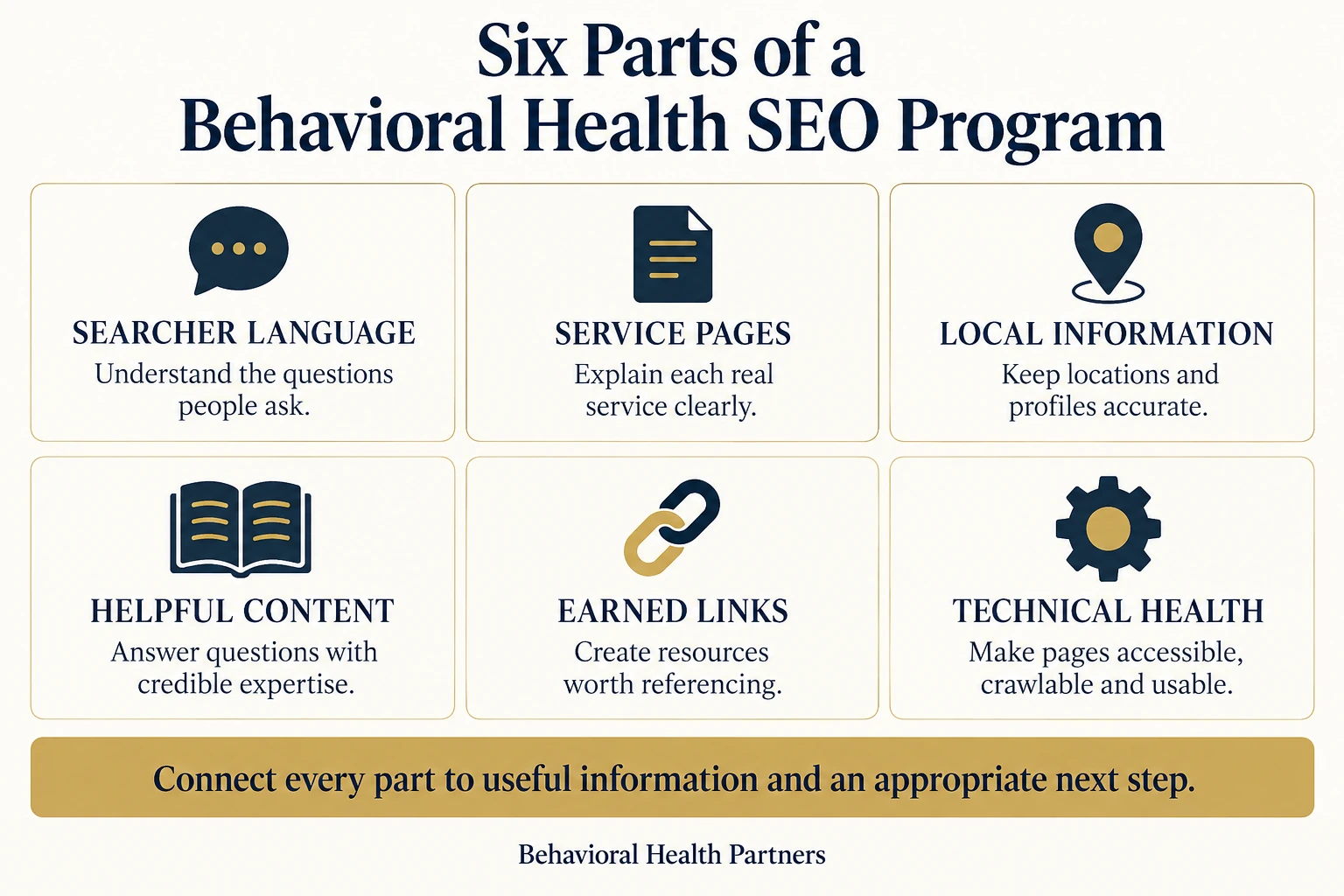
These are the six seo strategies that produce rankings in the mental health field, in the order we build them for partners. They are expert strategies, but none of them requires an expert to start. Every one links to a deeper chapter of this guide.
1. Keyword Research: Start With Searcher Language
Effective seo starts with the words real people type, not the words your clinical team uses. "Dual diagnosis IOP" is a program name; "depression and drinking help" is a search. Map keywords by intent: crisis terms, research terms, insurance terms, comparison terms, even program-level searches like intensive outpatient group therapy, then build pages to match. Long tail keywords win disproportionately in behavioral health because specific searches signal readiness. Our chapter on drug rehab SEO keywords shows the full research process, including the keyword sets most treatment centers miss.
2. Service Pages: One Page, One Promise
Service pages are where rankings become admissions, and they are the most under-built asset in the industry. Every level of care, every specialty, every audience gets its own page, written for the searcher and structured for the search engine, and each one aimed at your target audience's exact intent. A keyword rich page is not a stuffed page; it is a page that fully answers one intent. Our chapter on service pages for rehab SEO includes the exact template we use, and it translates directly to mental health practices and private practice sites.
3. Local SEO: Own Your Map
For most providers, local search is the shortest path to new clients. The pillars: a complete Google Business Profile with real photos and current hours that potential clients can trust, consistent name, address, and phone data across local directories and local listings, location pages that read like a human wrote them, and reviews that never stop. Google Maps is often the first page of results a searcher ever sees, and local seo decides who appears there for mental health providers and treatment programs alike. Start with our guide to Google Business Profile optimization, use our scripts for how to get more Google reviews, and go deep with our chapter on local SEO for rehab centers. Reviews from satisfied clients are a ranking factor and a conversion factor at once; client reviews are the rare asset that does both jobs, and few assets bring more clients per hour invested.
4. Content: Answer Questions Before They Are Asked
Content is how a provider builds online authority and how a site earns rankings beyond its core money pages. The winning pattern in the mental health field is unglamorous: publish genuinely helpful answers to the questions potential clients actually search, written or reviewed by clinicians, on a schedule you can sustain. Blogs that ramble about awareness days do nothing; blogs that answer "does insurance cover trauma therapy" fill caseloads, which makes disciplined content the cheapest digital marketing a provider will ever run. One more shift matters here: AI search. Google's AI Overviews and the answer engines now summarize results directly, and they favor pages with clear structure, direct answers, and verifiable authorship, especially for the conversational, high-intent questions people ask about care. Write every section so it can be quoted whole, because increasingly it will be. Our chapter on mental health blogs covers topic selection, structure, and the clinical review layer, and our content marketing team runs this engine for partners who want it built for them.
5. Backlinks: Authority You Cannot Fake
Links from reputable websites remain one of the strongest signals in the search engine results, and the healthcare vertical is unforgiving about shortcuts: paid link schemes and directory spam get ignored or penalized. High quality backlinks in behavioral health come from real relationships: local organizations, universities, journalists covering recovery, professional associations, and the content itself being worth citing. Our chapter on how to get high quality backlinks lays out the outreach system, and it works for a solo therapist as well as a hundred-bed program.
6. Technical SEO and the Website Itself
None of it works on a broken site. Technical seo for behavioral health is mostly discipline: fast mobile pages, clean site structure, on page optimization that matches one keyword to one page, meta descriptions and title tags written to earn the click in the search results, and mobile optimization treated as the default rather than the afterthought. Clear navigation and a smooth user experience keep visitors reading, and Google rewards both: fast pages rank better, and confused visitors leave. Structured data deserves special attention because it helps search engines understand what your organization is, where it operates, and what questions your pages answer; Google's own documentation shows how rich results earn more engagement than plain listings. The website carrying all of this is a conversion asset too, and our list of rehab website design best practices covers the build side.
E-E-A-T: Why Google Grades Behavioral Health Harder
Google evaluates health content for experience, expertise, authoritativeness, and trustworthiness, and its SEO starter guide is blunt that helpful, people-first content is the entire game. In practice that means author bylines from mental health professionals with real credentials, clinical review on medical claims, an about page that proves the organization exists, transparent contact information, and citations to primary sources. This is where deep expertise becomes a ranking advantage: a page written by someone who has actually run a program reads differently than one assembled from other blog posts, and Google has gotten alarmingly good at telling the difference. Boost visibility by being verifiably real; there is no shortcut that survives a core update.
Compliance: The Part General SEO Companies Miss
Behavioral health digital marketing lives inside privacy law. HHS has published guidance on online tracking technologies that treats analytics and advertising pixels on provider websites as a HIPAA question; a federal court narrowed parts of it in 2024, but the direction is unmistakable, and the safe posture is deliberate: know what your pixels collect, sign business associate agreements where required, secure every contact form, and keep tracking off authenticated patient pages. Add 42 CFR Part 2 sensitivity for substance use records and state-level marketing rules, and the lesson is simple: your seo services provider needs to know this terrain, because a rankings win that creates a compliance loss is not a win.
Measure What the Rankings Earn
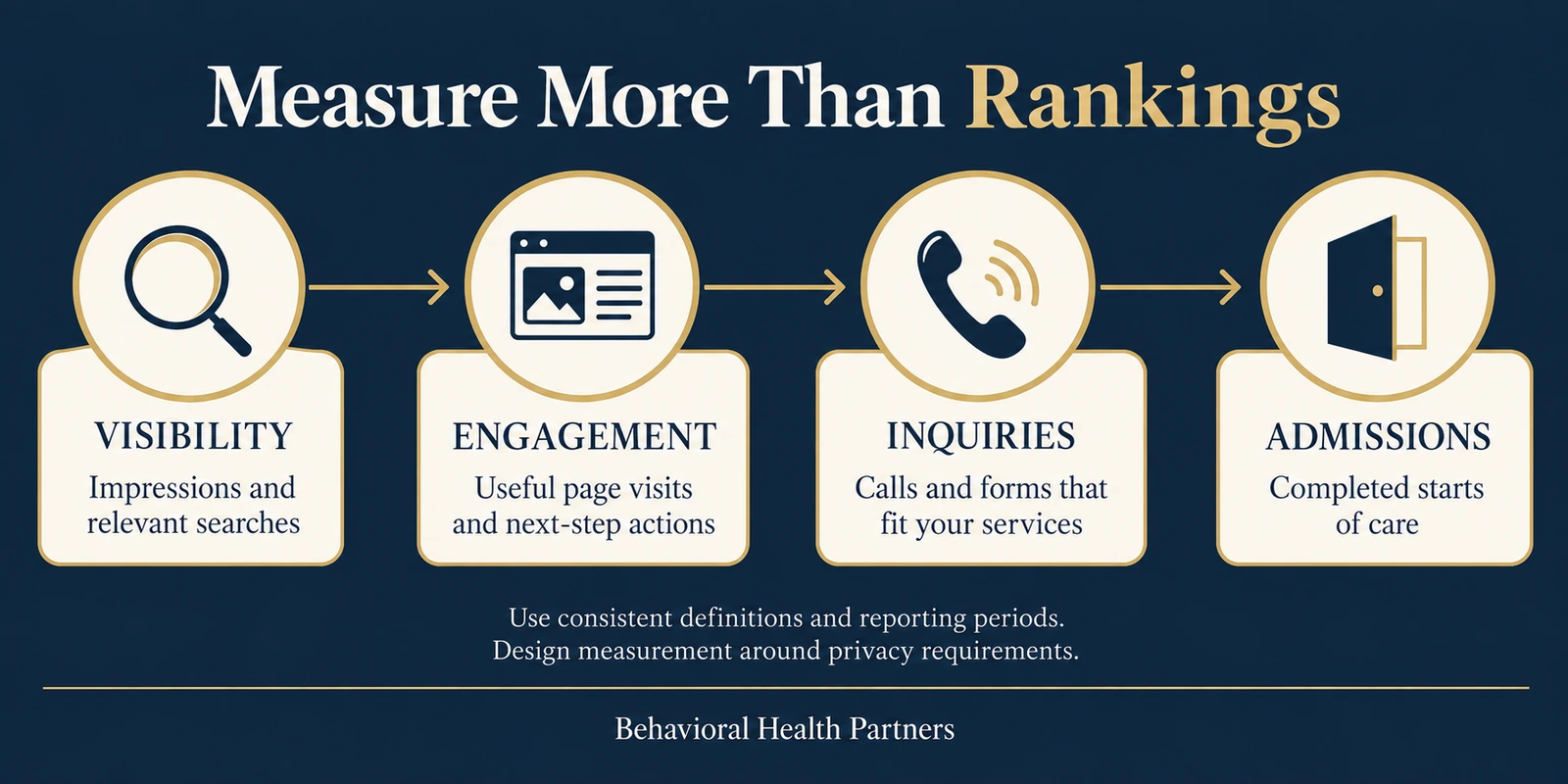
Rankings are the scoreboard, not the prize, whether you run mental health seo for a counseling office or full-stack seo for mental health treatment systems. Wire measurement so you can follow a searcher end to end: Google Search Console for visibility, Google Analytics for behavior, call tracking and form attribution for inquiries, and your CRM for admissions. Then judge every page and every seo effort by qualified leads and admissions, not website traffic alone. This is an ongoing process: search demand shifts, algorithms update, competitors publish, and the behavioral health practices that review the data monthly compound while everyone else guesses. Digital marketing without measurement is theater. Our guide to behavioral health analytics builds the full measurement stack, from dashboards to the metrics that belong in a board deck. Measurable results are the entire point; a strong online presence that produces no inquiries is a museum.
How to Choose a Behavioral Health SEO Partner
Some providers build this in-house, and this guide plus its chapters is enough to do it well. Others want it run by specialists. If you evaluate seo services or a dedicated mental health seo retainer, ask five questions. Does the team work in behavioral health specifically, with proof, or is your practice their first patient? Do they show measurable results as admissions and clients, not just rankings? Do they understand the compliance terrain above? Will they build assets you own, your site, your content, your profiles, rather than renting you visibility? And will they tell you no when something is wrong for your practice's specific goals?
Be careful with the label on the door. A full service digital marketing agency can be excellent or can be a generalist selling the same seo strategies to a dentist and a detox; a niche mental health seo specialist in Kansas City can outperform a national firm, or vanish in a year. Judge the evidence, not the category. For what it is worth, our own shop is BBB Accredited, Clutch Verified, and a DesignRush Verified Agency, we only work in behavioral health, and our seo efforts are measured in admissions. If a conversation would help, Schedule Your Free Discovery Call; we will look at your search presence together and tell you honestly whether you need help at all, and the discovery call costs nothing but the half hour.
Behavioral Health SEO FAQs
What is SEO in mental health?
SEO in mental health is the practice of optimizing a provider's website and online profiles so they appear when people search for care: therapy, psychiatry, counseling, or treatment. Mental health seo serves mental health providers of every size, from solo clinicians to hospital systems. It covers keyword research, specialty pages, local optimization, content, links, and technical health, all adapted to healthcare privacy rules and Google's elevated quality standards for health content.
What does SEO mean in healthcare?
Healthcare SEO means earning visibility in search results for medical, mental health, and behavioral health services. It differs from general digital marketing because Google classifies health content as "Your Money or Your Life" and rewards demonstrated expertise, because HIPAA constrains tracking and advertising, and because the searcher is often in crisis, which raises the bar for honest, genuinely useful pages.
How much do SEO services typically cost?
Pricing varies with scope: a solo private practice needs far less than a multi-state treatment organization, and one-time audits, monthly retainers, and project builds are all common models. Published 2026 market guides for this niche put boutique, SEO-only engagements around $2,000 to $8,000 monthly, full-service specialist retainers around $8,000 to $25,000, and enterprise multi-facility programs at $25,000 to $100,000 and beyond. The number that matters is not the fee but the return: divide the cost by admissions or clients attributed to organic search. A cheap retainer that produces nothing is the most expensive option on the market.
What is the 80/20 rule in SEO?
Roughly 80% of results come from 20% of the work. In behavioral health, that vital 20% is almost always the same: complete your Google Business Profile, build one strong page per service, earn reviews continuously, and publish content that answers real questions. The same seo strategies appear on every winning site because they are the 20%. Most providers who feel stuck simply never finished it; finish it and more clients follow.
What are some good SEO keywords for therapists?
The best mental health seo keywords for therapists pair a specialty with a location or an intent: "trauma therapist in [city]," "couples counseling near me," "EMDR therapy [city]," "child counseling that takes [insurance]." Specific beats broad; mental health professionals win by letting one page target one clear search instead of a homepage chasing ten. Build one page per specialty and let each own its term.
What are the four main types of SEO?
On-page SEO (content and keyword alignment), off-page SEO (links and mentions from other sites), technical SEO (site speed, structure, and crawlability), and local SEO (profiles, citations, reviews, and map visibility). Behavioral health providers need all four, but local usually pays first.
How long does behavioral health SEO take?
Meaningful movement in behavioral health and mental health seo typically shows in three to six months, with compounding results after that; competitive addiction treatment markets sit at the long end. Anyone promising page one in thirty days is describing a scheme, not a strategy. Our video on how long SEO takes explains the timeline honestly, phase by phase.
Adam Vibe GuntonFounder and Managing Partner, Behavioral Health Partners
Adam Vibe Gunton is an addiction recovery expert, entrepreneur, marketer, brand strategist, and speaker dedicated to advancing the behavioral health industry. As Founder and Managing Partner of Behavioral Health Partners, he has worked across treatment-center development, operations, branding, PR, SEO, advertising, and growth strategy. Combining professional experience with his own lived experience in recovery, Adam brings a unique perspective on how treatment organizations can build trusted brands, reach more people, and create a greater impact.
Thirty minutes on video with Adam directly, camera on, screen-sharing your own online presence and your top three local competitors. If we are not the right partner, we will tell you that too.