Analytics for Behavioral Healthcare: A Guide to Using Data to Improve Care
Data does not replace clinical judgment, but it shows you things judgment alone cannot. We cover what behavioral health analytics is and why it differs from analytics elsewhere in healthcare, the types of data programs already hold, and where analysis genuinely changes outcomes. We cover the tools worth using, the privacy, HIPAA and ethics ground rules that come first, and how to get started.
Behavioral health has always run on relationships and clinical judgment. Data does not replace either. Used well, though, data analytics gives behavioral healthcare providers and leaders a clearer picture of who they serve, how their behavioral health treatment is working, and where to focus next to support patient well-being. This guide explains what data analytics means for behavioral healthcare providers, the kinds of data involved, the unique challenges involved, the use cases that matter most, and how to do it all while keeping patient data secure.
It is written for the people who run treatment centers and behavioral health programs, and it pairs with the operational work in our behavioral health consulting, because good decisions start with good data.
What Is Behavioral Health Analytics?
Behavioral health analytics is the practice of collecting, organizing, and interpreting data to improve clinical outcomes, operations, and access to mental health, substance use, and behavioral health services. It is data analytics applied to the realities of behavioral healthcare. It turns the information a healthcare program already generates, in its EHR, its billing, its assessments, its schedules, into actionable insights that help clinicians, providers, and leaders make better decisions across their services. For healthcare organizations in this field, that behavioral data becomes a practical tool for improving outcomes, not an academic exercise.
The goal is not data for its own sake. It is a deeper understanding of your patients and your program: which treatments help which patients, where care falls short, and how to meet patient needs in the early stages, reaching people sooner and serving them better.
Why Analytics Is Different in Behavioral Healthcare
Behavioral healthcare carries unique challenges that general healthcare data does not fully address, and healthcare providers in this field feel them daily. Progress is often measured through self-reported symptoms and functioning rather than a single lab value. A mental health condition is complex and frequently co-occurs with substance use, physical and behavioral health are deeply intertwined, mental illness rarely appears in isolation, and the data is unusually sensitive. Any data effort in this field has to respect that complexity and treat patient privacy as non-negotiable.
These unique challenges are exactly why this work is worth doing here. When behavioral health data is handled with care, it helps you identify subtle patterns that individual healthcare providers, carrying full caseloads, cannot see on their own, across whole patient populations.
The Types of Data Behavioral Health Programs Use
A strong data practice, built on careful analysis, draws on several kinds of data across your healthcare services.
Clinical and EHR data captures diagnoses, assessments, medications, and progress notes that reflect patient health. Claims data and billing data reveals utilization, payer mix, and the financial health of the program, and the same discipline informs how you measure addiction treatment marketing, and it connects to the work in our chapter on how treatment centers make money. Outcomes data, gathered through repeated standardized measures, shows whether patients are actually improving. Engagement and operational data covers attendance, no-shows, wait times, and census, all signals of patient engagement. And population-level data from national sources, like SAMHSA's behavioral health datasets, provides context for the communities you serve.
Brought together, these sources, once you integrate them with outside research, let a program see clinical, financial, and operational reality in one place.
Where Analytics Makes a Difference
A few use cases deliver most of the value for behavioral health programs.
Measurement-based care and clinical outcomes. The foundation of behavioral health analytics is measurement-based care: using validated assessments at regular intervals to track whether patients are improving in their mental health and recovery. Providers see, at a glance, which patients need attention. This turns clinical outcomes into data you can act on, so healthcare teams can build personalized treatment plans, measure treatment effectiveness, and use simple measures that drive engagement, adjusting what is not working and reinforcing what is. It is the single most practical starting point for most programs.
Predictive analytics and earlier risk identification. Predictive analytics uses historical data, patient data, and predictive models to help care teams proactively identify at risk individuals, including those whose social factors raise their suicide risk, so a clinician can reach a specific patient sooner. Used this way, risk stratification helps teams focus on the highest-risk patients first. Applied responsibly, this is one of the most promising areas in the field, and even NIMH has explored how technology and data can support mental health care. The critical caveat: predictive models and predictive tools support clinical judgment and the providers who exercise it, they never replace it. A model can surface patterns and red flags in the data; a clinician decides what to do about it, and every alert must lead to a caring human response.
Population health and program improvement. Aggregated behavioral data helps leaders see across entire patient populations: which specific conditions are rising across the populations they serve, where access gaps exist, for example in rural areas, and how outcomes for specific conditions vary across programs. This supports proactive outreach to specific patient populations, smarter allocation of resources, and continuous quality improvement across all of your behavioral health services. The patterns in this population view increasingly inform how health plans and the wider healthcare industry design solutions for the patients and communities they serve.
Operations and value-based care. Data analytics also runs the business side, from census and staffing to demonstrating outcomes to payers and health plans, and leading programs learn to read millions of individual data points as a single operational picture. As reimbursement shifts toward paying for results, the ability to measure, prove, and keep improving outcomes becomes essential, which is why this data connects directly to value-based contracting and to the financial planning behind a feasibility study.
Tools for Behavioral Health Analytics
It is a powerful tool, but only if your team actually uses it. You do not need an enterprise platform to start. Most healthcare programs begin with the reporting built into their EHR, integrate a dashboard or business intelligence tool to visualize key measures for their behavioral health services, and standardize a small set of outcome assessments. The tools leading programs rely on are the ones your healthcare team will actually use, presented simply enough that providers and administrators across your services can read them at a glance. Start small, prove value on a few metrics, and expand from there.
Privacy, HIPAA, and Ethics Come First
In behavioral healthcare, how you handle data matters as much as what you learn from it. Behavioral health and mental health information is among the most sensitive data there is, and protecting it is an essential legal duty and a matter of trust.
Every healthcare data effort must comply with HIPAA, and the HHS Security Rule sets the administrative, physical, and technical safeguards required to protect electronic protected health information. Beyond the law, treat this data ethically: minimize the data you collect to what you genuinely need, guard against bias in your predictive models, protect the safety of every record, be transparent with patients about new data you collect, and remember that behind every data point is a person seeking help. Data should always serve the patient, never the other way around.
How to Get Started
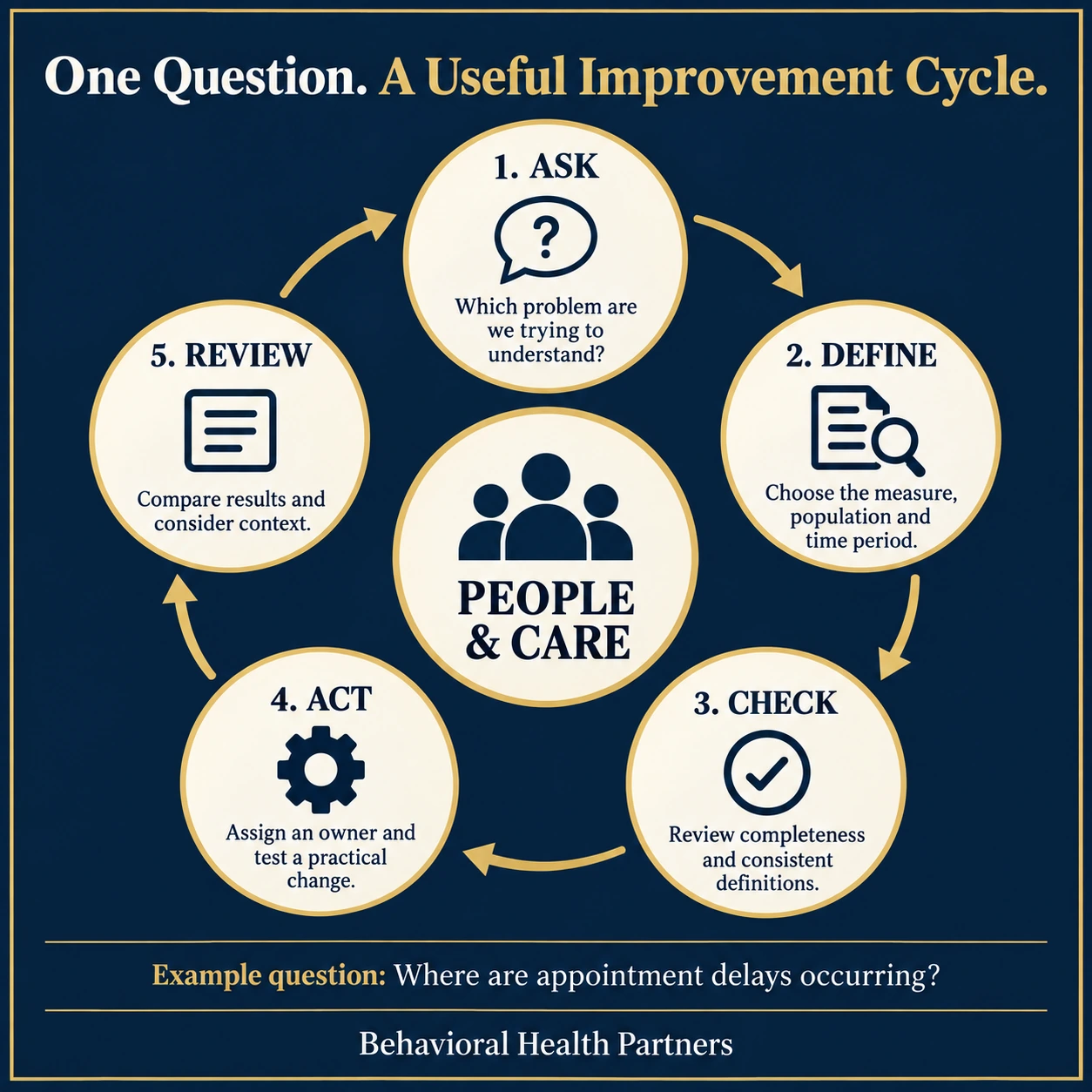
Begin with a clear question, not a pile of data. Pick one outcome you want to improve, for example reducing no-shows or tracking symptom improvement, and identify the few data points that measure it. Standardize how that data is collected, build a simple report your team reviews regularly, and act on what it shows. Once that loop is working, add the next question. This becomes a virtuous cycle: better data leads to better decisions, which produce better outcomes for patients and, in turn, better data.
Behavioral Health Partners approaches this work as a partner, not a vendor, helping programs use data to improve care and sustainability without ever losing sight of the people behind the numbers. Our founder, Adam Vibe Gunton, a bestselling author, TEDx speaker, and international recovery advocate featured on NBC News Daily, CBS News, and ABC News, built this company on one belief: the more people who can find and stay in quality treatment, the more lives are saved.
Frequently Asked Questions
What does behavioral health analytics mean?
Behavioral health analytics is the collection and analysis of data, from EHRs, assessments, claims, and operations, to improve clinical outcomes, access, and the running of a behavioral health program. It turns everyday information into insights that help clinicians and leaders make better, faster decisions while protecting patient privacy.
What are the main types of data used in behavioral health analytics?
The core types are clinical and EHR data (diagnoses, assessments, notes), outcomes data from standardized measures, claims data and billing data, engagement and operational data (attendance, census, wait times), and population-level data from national sources like SAMHSA. The most valuable programs combine these to see clinical, financial, and operational reality together.
Is predictive analytics safe to use in behavioral health?
It can be, when used responsibly. Predictive analytics should support clinicians, never replace their judgment, and every risk flag must lead to a caring human response. It also has to meet HIPAA's privacy and security requirements and be checked for bias. Used ethically and with care teams in the loop, it can help teams reach people who need support sooner.
Do small treatment centers need analytics, or is it only for large systems?
It scales down. A small program can start with the reporting already built into its EHR and a handful of outcome measures, with no enterprise platform required. Beginning with one clear question and a simple, consistent report delivers real value quickly, and even leading programs began exactly this way.
Turn Your Data Into Better Care
Behavioral health analytics, done well, is not about dashboards for their own sake. It is about building a deeper understanding of your patients and your program, protecting their privacy, and using what you learn to deliver better care. Start with one question, measure what matters, keep care teams at the center, and let the insights compound.
If you want a partner to build a practical, compliant analytics practice with you, reach out to work with us and we will help you turn your data into better outcomes.
Adam Vibe GuntonFounder and Managing Partner, Behavioral Health Partners
Adam Vibe Gunton is an addiction recovery expert, entrepreneur, marketer, brand strategist, and speaker dedicated to advancing the behavioral health industry. As Founder and Managing Partner of Behavioral Health Partners, he has worked across treatment-center development, operations, branding, PR, SEO, advertising, and growth strategy. Combining professional experience with his own lived experience in recovery, Adam brings a unique perspective on how treatment organizations can build trusted brands, reach more people, and create a greater impact.
Thirty minutes on video with Adam directly, camera on, screen-sharing your own online presence and your top three local competitors. If we are not the right partner, we will tell you that too.