How to Get More Google Reviews for Your Treatment Center (Ethically)
Reviews shape where you rank locally and are often the last thing a family reads before calling. We cover why they matter, and the ethical and compliance rules that come before any tactic. We cover building your review link and QR code, how to ask in a way that works, responding to every review, handling fake and unfair ones, displaying them, and running this as an ongoing program.
Google reviews are one of the most powerful trust signals a treatment center has. They shape where you rank in local search, and they are often the last thing a family reads before they decide to call. Learning how to get more Google reviews, the right way, and how to keep getting more Google reviews month after month, is one of the highest-return things a treatment center can do, but in behavioral health it comes with rules that most businesses never have to think about.
This chapter of our Google Business Profile optimization guide shows you how to build a steady stream of genuine Google reviews while protecting client privacy and staying inside Google's, the FTC's, and HIPAA's boundaries. It pairs with the broader organic strategy in our work on drug rehab SEO, because more Google reviews lift your local rankings and your admissions at the same time.
If you would rather watch, our Google reviews for rehabs video covers the essentials. Then use the steps below to build a review program that compounds.
Why Google Reviews Matter for Treatment Centers
Google reviews do three jobs at once. They help families find you in local search, because review volume, star ratings, and quality are among the strongest local ranking factors that decide who appears in the map pack and higher in local search results. Strong Google reviews lift your business name in the search results families see first. They build credibility, because positive reviews and a strong average rating on your Google Business Profile tell a scared family that real people trusted you. A healthy set of recent, positive reviews tells a scared family that real people trusted you and were glad they did. And they collect honest feedback that helps your program improve, the kind of customer experience insight that no survey captures as well.
For a treatment center, the stakes are higher than for most local businesses. A family choosing where to send a loved one is making one of the most important decisions of their lives, and your Google reviews and overall Google reviews rating are a big part of how they judge whether to trust you. Like most small businesses, treatment centers live and die by local trust. That is exactly why the reviews have to be genuine, and why the way you ask for them has to be careful. Unlike other small businesses, though, a treatment center also has to protect the privacy of the very people whose great service and great care it wants reviewed. Its business name and reputation depend on getting this right.
Start With the Rules: Ethical, Compliant Reviews
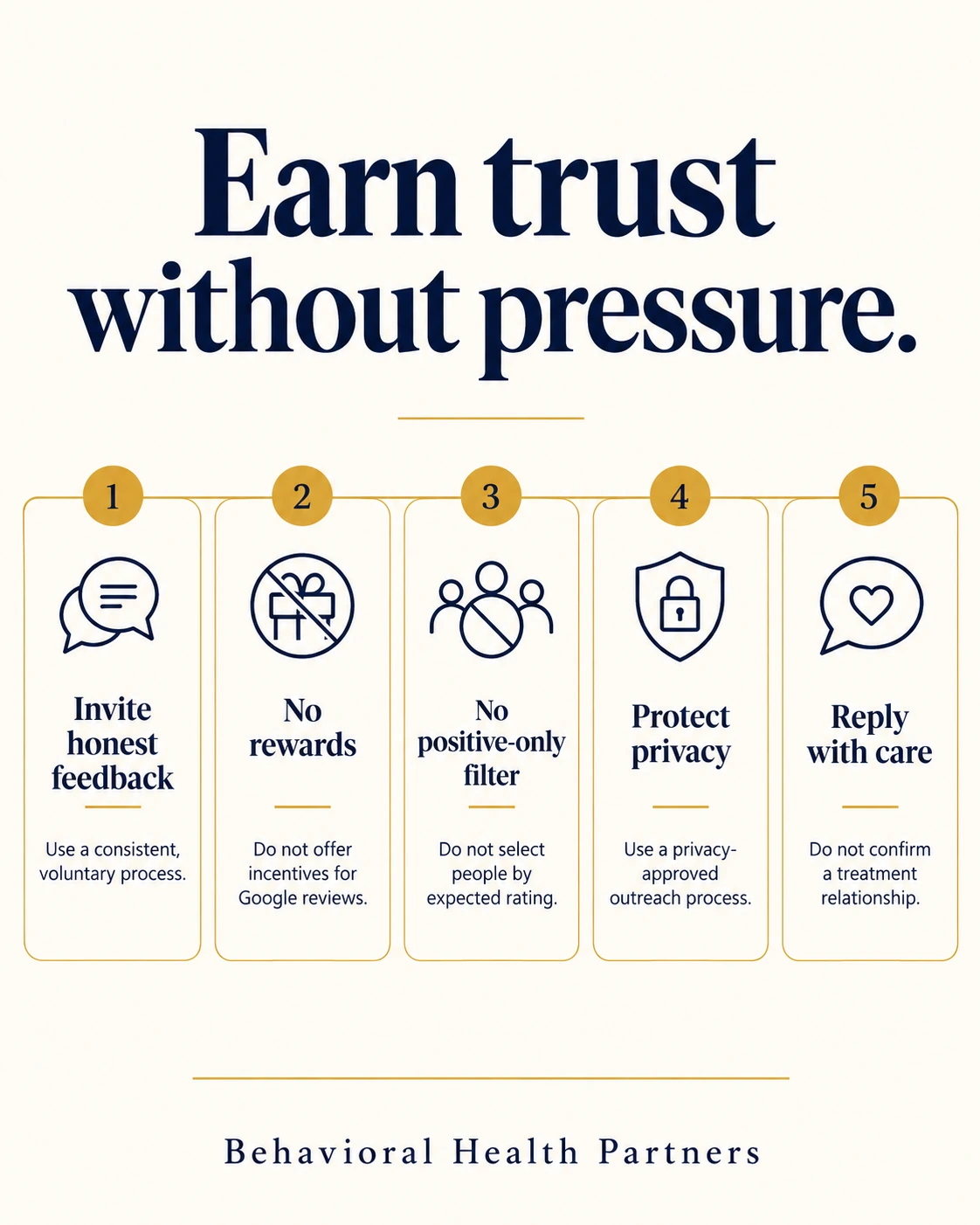
In behavioral health, how you get Google reviews matters as much as how many Google reviews you get. Get this wrong and you can violate Google's policies, the FTC's rules, or HIPAA, and you can damage the trust you are trying to build. So before any tactics, the boundaries.
Never incentivize reviews
Do not offer anything in exchange for a Google review. Google is explicit that incentivizing reviews, by giving free or discounted goods or services in exchange for a review, is considered fake and misleading content and is strictly prohibited. Do not offer a gift card, a free drink, a discount, or any reward for a review. The FTC's rule banning fake reviews goes further, prohibiting compensation conditioned on a review that expresses a particular sentiment. Ask for honest feedback, never a five-star Google review in exchange for anything.
Never buy, fake, or write your own reviews
Never buy reviews, never create fake reviews, and never have staff post reviews without disclosing they work for you. Google's content policy removes content that is not based on real experiences, and the FTC rule specifically bars fake and undisclosed insider reviews with civil penalties behind it. One honest Google review is worth more than fifty fabricated ones, and the fabricated ones put your whole profile at risk.
Never gate or cherry-pick reviews
Google also prohibits review gating, the practice of selectively asking only the people you expect to leave positive reviews while steering unhappy ones elsewhere. Ask everyone who had a genuine experience for honest feedback, not just the ones likely to praise you. Cherry-picking who gets a review request is against Google's fake engagement policy and undermines the trust real reviews are meant to build.
Protect client privacy above everything
This is the rule unique to behavioral health. You may not use a person's protected health information for marketing without their authorization, and HHS is clear on HIPAA and marketing. In practice: never publicly confirm that a specific person was a client, never disclose any detail about someone's care in a review response, and never solicit reviews in a way that reveals someone received treatment. When you reply to a review, thank the person warmly without acknowledging the clinical relationship. Protecting confidentiality always comes before any marketing goal.
Build the Foundation: Your Review Link and QR Code
Once the rules are clear, make it easy for people to leave a review as often as possible. Friction is the single biggest reason people who want to leave a review never do.
First, make sure your Google Business Profile is claimed and verified, because the Google review link comes from your Business Profile. Our chapter on the full Google Business Profile guide covers the claim and verification process if you have not done it yet.
Then generate your Google review link, the direct link that opens the Google review form with your business preloaded. Shorten it so it is easy to share, and turn it into a QR code you can print. Some centers also create a simple review page on their website, a Google review page that explains how to leave reviews and links straight to the form and back to their Google Business Profile. A QR code on a discharge folder, a business card, or a thank-you note lets someone leave a review in seconds from their phone. The direct link, the QR code, and a simple review page are the tools every review request you send should use, so families can leave reviews in a tap, because every extra tap costs you reviews.
How to Get More Google Reviews by Asking the Right Way
The best Google review requests are simple, well-timed, and personal. Here is how to ask without being pushy and without crossing any lines.
Ask at the right moment
Timing is everything. The best time to ask someone to leave a review is right after a genuinely positive interaction, when someone has expressed gratitude and is glad to leave a review for the help they or their loved one received. A request that arrives in that moment feels natural. Aim to ask within about 24 hours of a positive experience, while the gratitude is fresh, because timing is one of the biggest factors in whether someone actually leaves a Google review. In treatment settings, family members and alumni who are proud of their progress and comfortable being public are often the most willing, and asking them respects the privacy of current clients.
Make the ask personal and specific
A generic blast underperforms a personal review request every time. Train your team with a short, warm script they can use in person, and keep any written request for more reviews conversational. Tell the person their honest feedback and positive reviews help other families find hope, and give them the direct link or QR code on the spot.
Use passive channels too
Not every review request needs to be a direct ask. Add your Google review link to your email signature, to a follow-up email or text message after a family expresses thanks, and to the footer of your website. Text messages in particular have high open rates, so a short, respectful text with your review link can gently prompt more Google reviews. These passive channels quietly collect more reviews over time without anyone feeling pressured, because they make it easy for families to leave reviews whenever they are ready. A simple, standing call to action, "share your experience," does a lot of work when it is always visible.
Respond to Every Review
Responding to reviews is not optional. Responding to your existing Google reviews also keeps your Google review page and Business Profile active. It signals to Google and to families that your treatment center is attentive and cares, and it is one of the clearest trust signals you can send.
Respond to your existing Google reviews, and to every new one. Reply to positive reviews with a short, warm, personal thank you, never confirming that the reviewer was a client and never adding clinical details. Keep it human and brief. For a family that praised your team's great service, a genuine thank you for trusting you with something so important is enough.
Respond to negative reviews with even more care. Stay calm and professional, never argue, and never reveal any private information to defend yourself, because doing so would violate confidentiality and make things worse. Acknowledge the person's experience, express that you take concerns seriously, and offer to continue the conversation privately through a general contact channel. A thoughtful response to a hard review often impresses future readers more than a wall of perfect ones.
Handle Fake and Unfair Reviews
Treatment centers sometimes receive fake or malicious reviews, from competitors, from people who were never clients, or from a difficult moment taken out of context. You cannot delete reviews yourself, but you can act.
Report the reviews that violate Google's content policy, such as fake content, off-topic posts, or personal attacks, and ask Google to have those reviews removed. Negative reviews that are genuine, though, you simply answer with care. Respond professionally in the meantime so future readers see a measured, caring business rather than a defensive one. And keep earning genuine Google reviews, because a steady flow of real, positive Google reviews is the best protection against the occasional unfair one. Volume and recency of your Google reviews dilute the damage a single bad review can do.
Display and Amplify Your Reviews
Your reviews can work harder than just sitting on your profile. With care for privacy, put them to use.
Share standout positive Google reviews through your social media and, where appropriate, on your website, so the social proof reaches families who have not found your profile yet. A Google reviews widget in your website footer keeps fresh Google reviews visible to every visitor, and a steady stream of review requests keeps them coming. Just make sure anything you republish protects the reviewer's privacy and that you are comfortable the content is genuine. A strong website that showcases real reviews turns your reputation into a conversion engine, and pairing it with deliberate conversion rate optimization turns that trust into admissions inquiries.
Build a Program to Get More Google Reviews Over Time
Getting more Google reviews is not a one-time campaign, it is a habit. Like the best small businesses in any field, the treatment centers that consistently get more Google reviews build a simple system and run it every week, treating existing Google reviews and new ones as one ongoing program. The treatment centers that win make review generation a standing part of how they operate, the same way they maintain the rest of their addiction treatment marketing.
Send your review requests consistently rather than in occasional bursts, because a steady cadence of new reviews signals to Google that your business is active, and review recency carries real weight. Make it someone's job, automate a respectful follow-up so review requests go out soon after a positive experience, give your frontline team the review request scripts and tools they need, and track your Google reviews count, your average rating, and your star ratings as a real metric you review every month. Watching these numbers is how you turn happy customers and grateful families into a growing base of new customers. Small, consistent effort compounds into a reputation that fills beds, and centers that are opening a new location should start building genuine reviews from day one. This work sits inside your broader behavioral health SEO and your local SEO for rehab centers, and the directories covered in our chapter on local citations reinforce the same trust your Google reviews build.
Common Google Review Mistakes to Avoid
A few errors show up again and again, and in behavioral health some of them carry real risk.
The first is incentivizing reviews, which violates Google and FTC rules. Never trade anything for a review.
The second is buying or faking reviews, which risks penalties and destroys trust the moment it is discovered.
The third, and the most serious for a treatment center, is breaching client privacy, by confirming someone was a client or sharing any care detail in a response. Never do it.
The fourth is asking too late or too generically, long after the moment of gratitude has passed, with a message that feels like a form letter.
The fifth is ignoring reviews, especially the negative ones. Silence reads as indifference to every future reader.
Frequently Asked Questions
What is the fastest way to get more Google reviews for a treatment center?
Make it effortless and ask at the right moment. Generate a direct Google review link and a QR code, then ask family members and alumni for honest feedback right after they express gratitude. Add the link to your email signature and website so requests keep arriving passively. You get more Google reviews by removing friction and asking consistently, never from incentives, which are prohibited.
How many Google reviews does a treatment center need?
There is no magic number, and chasing one leads to shortcuts. What matters is a steady flow of genuine, recent reviews and a healthy average rating, because recency and consistency carry real weight in local ranking. A treatment center that steadily gets more Google reviews, even a modest but growing set of authentic ones, will outperform one with a large pile that suddenly stopped, and it will always beat one that bought them.
Can I offer clients a discount or gift for leaving a review?
No. Offering any incentive in exchange for a review violates Google's policies and the FTC's rule against compensated reviews. Ask only for honest feedback, with no reward attached. In behavioral health there is an added reason: soliciting reviews in exchange for anything can also pressure vulnerable people, which is the opposite of the trust you want to build.
How do I handle a fake or unfair Google review?
Do not delete it yourself, because you cannot, and do not argue in the response. Report it to Google if it violates the content policy, such as fake content or a personal attack, and reply professionally without revealing any private information. Then keep sending review requests and earning genuine reviews, because volume and recency are the best defense against an unfair one, and consistent review requests are how you get more Google reviews safely.
Turn Reviews Into Trust and Admissions
More Google reviews mean higher local rankings, more trust, and more families choosing your treatment center, as long as every review is genuine and every request protects the people you serve. Set up your review link and QR code, ask at the right moments, respond to everyone, and make it a steady habit. Do it ethically, keep asking, and you will get more Google reviews that become one of the most durable advantages your program has.
If you want a partner to build and manage an ethical, compliant review program with you, schedule your free discovery call and we will help you turn genuine reviews into steady admissions.
Adam Vibe GuntonFounder and Managing Partner, Behavioral Health Partners
Adam Vibe Gunton is an addiction recovery expert, entrepreneur, marketer, brand strategist, and speaker dedicated to advancing the behavioral health industry. As Founder and Managing Partner of Behavioral Health Partners, he has worked across treatment-center development, operations, branding, PR, SEO, advertising, and growth strategy. Combining professional experience with his own lived experience in recovery, Adam brings a unique perspective on how treatment organizations can build trusted brands, reach more people, and create a greater impact.
Thirty minutes on video with Adam directly, camera on, screen-sharing your own online presence and your top three local competitors. If we are not the right partner, we will tell you that too.