Backlinks remain one of the strongest ranking signals, and in behavioral health they are among the hardest to earn honestly. We cover why they matter for rehab SEO and what actually makes a link high quality. We cover six link building strategies that work, the rules that keep a profile safe from penalties, a simple repeatable workflow, and how to measure a backlink profile properly.
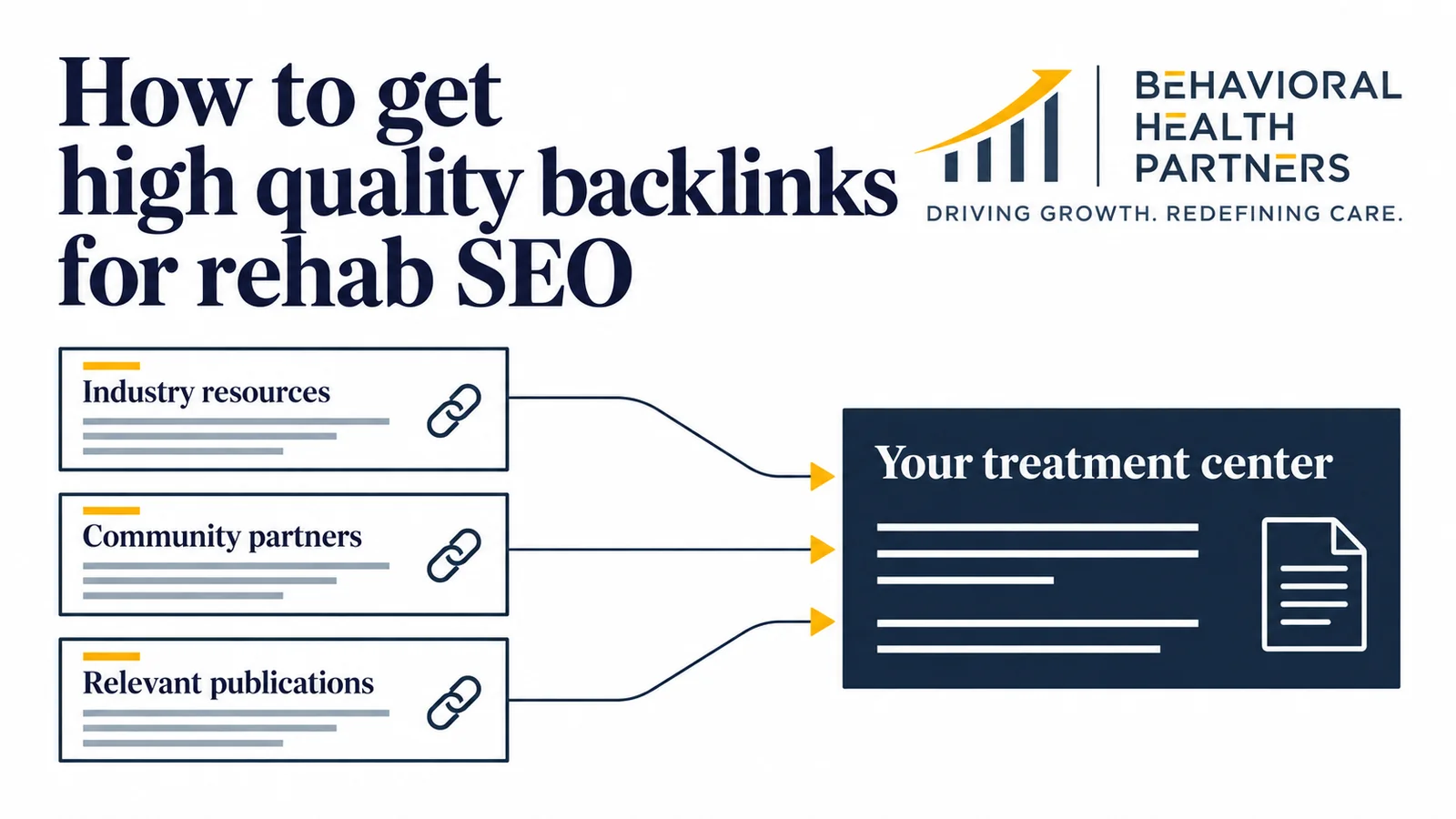
Backlinks, the links that point from other sites to yours, are still one of the strongest ranking signals in search, and in behavioral health they are also one of the hardest to earn honestly. A backlink is a link from third party sites to yours, and search engines read each one as a vote: when reputable websites link to your treatment center's website, Google treats your website as more trustworthy and ranks it higher. This SEO chapter of our guide to behavioral health SEO covers building high quality backlinks the right way, the white-hat way that survives every Google update, without buying links or gaming the system. It is the complete link building playbook for a healthcare website and any behavioral health website, from strategy to measurement, and it treats link building as a core pillar of SEO rather than a bolt-on tactic. The buyer-intent terms for a done-for-you program live on our rehab link building page; this is the how-to you can run yourself. Every strategy here builds links to your site the way search engines want them built.
Quality backlinks beat quantity every time: one link from a high authority website worth citing outweighs a hundred from link farms, and Google actively neutralizes the cheap ones. The link building efforts that work in healthcare are relationship-driven, not transactional: create linkable assets worth referencing, earn guest posts on relevant websites, become a source for reporters, reclaim unlinked brand mentions, and build local and organizational links. Never buy backlinks; Google's spam policies prohibit it, and paid links that pass ranking credit can get your site penalized. Measure your backlink profile by relevance and authority, not raw count, and treat link building as an ongoing process that compounds with your content.
Why High Quality Backlinks Matter for Rehab SEO
Search engines use links from other websites as a signal of importance. Google's own guidance tells site owners that if no one links to you, you should earn links from other sites, while warning in the same breath not to pay for them. That tension is the whole game: links are powerful precisely because they are supposed to be earned, and Google works hard to ignore the ones that are not.
For a treatment center, high quality backlinks do three things. They lift your search engine rankings, because relevant backlinks from reputable websites pass authority, sometimes called link equity, to your website's pages and help them rank higher in search results. They send referral traffic and organic traffic, because a link in a genuinely read article brings real people, not just crawlers, and the organic traffic compounds as rankings climb. And they build authority online, because in a field Google and the other search engines treat as high-stakes, having other websites and healthcare providers cite your website is exactly the kind of proof its systems reward. Backlinks are also the hardest signal for a competitor to fake, which is why they still matter so much in healthcare SEO. A treatment center can publish articles all day, but a competitor cannot easily manufacture links from reputable websites, so a strong backlink profile is a durable edge.
Healthcare link building is also different from link building in other industries, and pretending otherwise is how treatment centers get burned. General link building services often lean on volume, spammy directories, and paid networks; that approach is poison for a healthcare website that Google already scrutinizes under its highest quality standards. Link building for a healthcare practice, and healthcare SEO more broadly, has to be cleaner, slower, and more relevant than link building for an e-commerce store, because the search engines hold healthcare companies and healthcare services to a higher bar and because your target audience is making a life decision, not buying a gadget. Every strategy in this chapter is built for that reality.
What Makes a Backlink High Quality
Not all backlinks are equal, and chasing the wrong ones wastes months. A high quality backlink has three traits. It is relevant: a link from a healthcare website, a recovery organization, or a local community group is a relevant backlink that means far more to search engines than one from an unrelated blog. It comes from a website with real authority: measured loosely by metrics like domain authority score, domain rating, or authority score, and more honestly by whether the website has real organic traffic and a real audience. For healthcare services especially, a backlink from a website with genuine healthcare traffic beats a backlink from a high-score website with no relevance. And it is editorial: placed inside genuine content because your page was worth citing, not bought, swapped, or stuffed into a footer.
Think of every link pointing at your site as a vote, and think of link building as the work of earning good votes. The best links come from sites your own audience trusts, and the worst links come from sites built only to sell links. Search engines have spent two decades learning to tell the two apart, so the entire craft of link building now comes down to earning links no algorithm would ever discount.
The opposite, low quality links from link farms, paid networks, and spammy directories, does nothing at best and harms you at worst. Google neutralizes those links automatically and can penalize sites that lean on them. So the target is not more backlinks; it is more relevant backlinks from high authority websites that rank higher and drive organic traffic, earned honestly. A single link from a respected medical or recovery publication carries more weight than a hundred link insertions on sites nobody reads.
It helps to know the types of backlinks you are actually trying to earn. Editorial links, placed inside articles because your page is a linkable asset, are the gold standard. Guest post links, earned by contributing genuine articles to relevant sites, come next, and these high quality links do double duty by reaching a new audience. Brand mentions turned into links, local and organizational links, and legitimate resource-page links round out the list of links worth pursuing. One more distinction matters: dofollow versus nofollow. A dofollow link passes link equity and lifts your rankings and domain rating; a nofollow link does not pass that authority but still signals relevance and sends real traffic. A healthy mix of links naturally contains both, so do not chase only dofollow links or panic over nofollow ones. The links to avoid are just as important: paid link insertions, private blog networks, and low quality directory links do nothing for your domain authority and can trigger a penalty. When you audit your links, you are really sorting the links that build authority from the links that put your website at risk.
6 Link Building Strategies That Actually Work
These are the link building strategies we actually use, ordered roughly by return on effort. None of them require you to pay for a single link, and all of them compound.
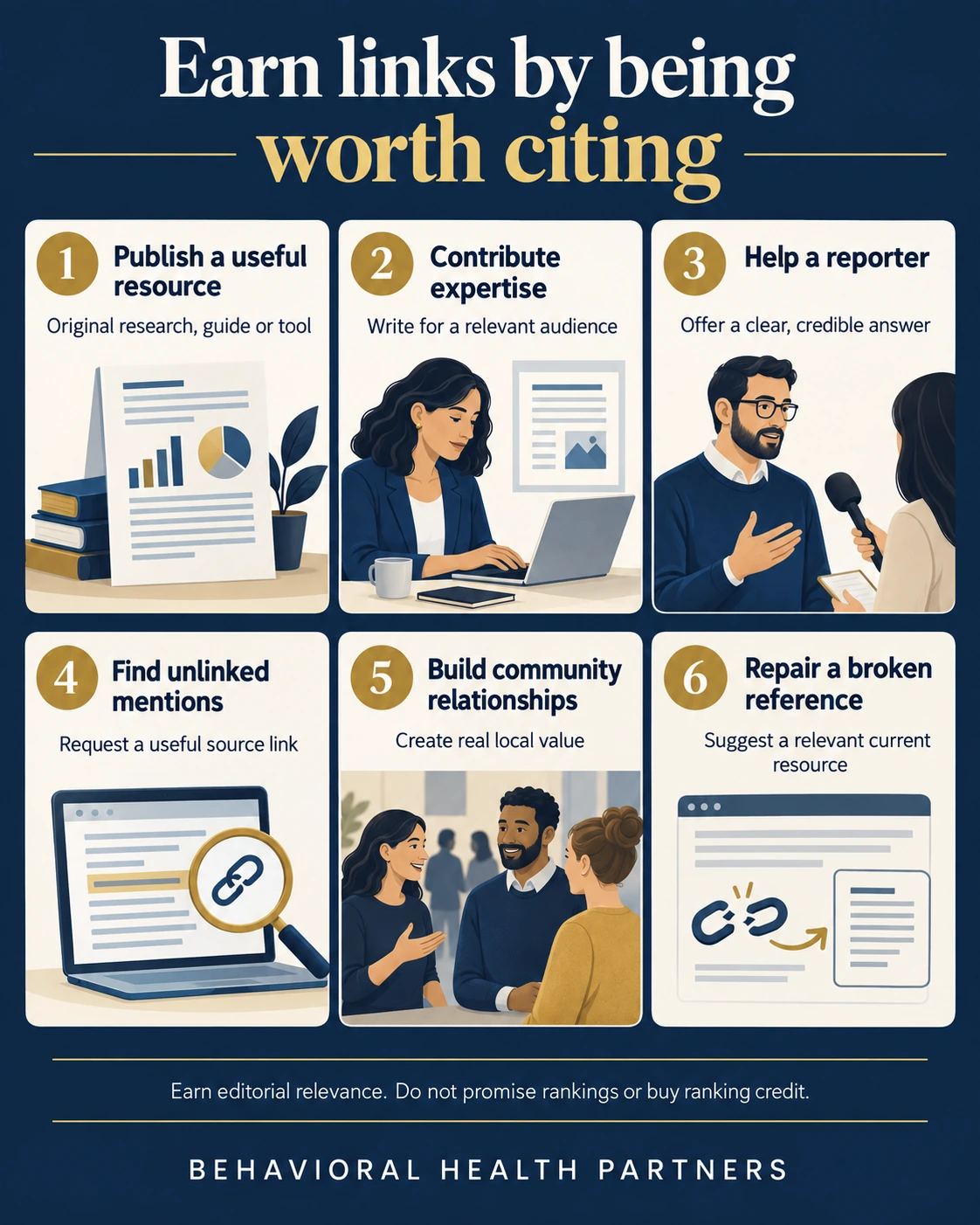
1. Create Linkable Assets Worth Citing
The foundation of building backlinks is having something worth linking to. Before any outreach, create content other people want to reference: an original data report on local treatment outcomes, a genuinely useful guide, a set of free tools or templates, or research papers and data nobody else has published. A great blog post, a data study, or a free tool becomes a linkable asset that earns backlinks passively, for years, because writers and other websites add links to the best available source, and those links keep flowing long after you publish. Original research and helpful articles that answer real questions are the strongest link magnets in behavioral health, where good primary sources are scarce. Depth helps: linkable assets tend to run long, often 1,500 words or more, because thorough resources give other writers more to cite. As an example, one well-researched data page can earn dozens of links and a steady stream of referral traffic for years. Build the asset first; the outreach that follows is ten times easier when you are offering valuable backlinks in exchange rather than asking for a favor. As an example, a treatment center that publishes original research on regional overdose trends gives every local reporter, blogger, and health organization a reason to link, and each of those backlinks points at a single page on your website that then lifts the whole website. This is how content and link building compound: the content earns the backlinks, the links lift the rankings, and higher rankings send more organic traffic to more pages.
2. Earn Guest Posts on Relevant Websites
Guest blogging remains one of the most reliable ways to gain backlinks when it is done for reach rather than for links. Identify sites your target audience actually reads, recovery blogs, healthcare publications, local news, wellness sites, then pitch a specific, useful article, not a thinly veiled ad. Write for usefulness, place one natural contextual link back to your website where it genuinely helps the reader, and let a real author bio carry your credibility. Guest posts for rehabs and a healthcare practice work because they put your expertise in front of a new audience and earn a relevant backlink at the same time. The moment guest posting becomes mass-produced link insertions, it stops working and starts risking penalties, so keep it selective and genuinely valuable. A handful of guest posts on genuinely relevant websites each year does more for your website than dozens of generic placements, because the search engines weigh the relevance and quality of each link, not the raw number of links. Expect a low hit rate: you might pitch several sites to land a single guest post, and that is normal, because the selective placements are exactly the ones worth having.
3. Become a Source for Reporters and Bloggers
Journalists and bloggers need expert sources constantly, and recovery is a topic they cover often. Guest blogging and digital PR both improve your SEO and your visibility at once, which is why they sit near the top of this list. Respond to reporter queries through services like HARO and its successors that connect sources to writers, offer the expertise people search for, and when your quote runs, you earn a link from a high authority news site that would never sell one. This is one of the fastest ways to earn medical backlinks and news links from domains far stronger than your own, and each of those links sends real traffic as well as authority. The key is to respond directly, quickly, and with genuine insight rather than a pitch; other writers can spot a self-promoter instantly. This is the heart of a real digital PR strategy, and digital PR earns some of the most authoritative backlinks available. Adam's own media background, featured on NBC News Daily, CBS News, and ABC News, is proof that recovery expertise is in demand; expert interviews and expert quotes are among the highest value links a provider can earn; reporters want credible voices, and a treatment provider with real experience is exactly that.
4. Reclaim Unlinked Brand Mentions
Sometimes a site mentions your organization by name without linking to you. Each of those unlinked mentions is a backlink waiting to happen. Find where your brand shows up unlinked using a simple search or a monitoring tool, then reach out and politely ask the author to turn the brand mention into a link. This is among the easiest links to earn, because the site already chose to reference you; you are only asking them to turn the mention into a link back to your website. Brand mentions convert to links at a high rate precisely because the relationship and the relevance already exist.
5. Build Local and Organizational Links
Local and community links are undervalued and very much on-brand for a treatment center. Sponsor a local event that your target audience attends, join the chamber of commerce, partner with recovery nonprofits, present at a community college, or support a local charity, and a backlink from their website often follows naturally. Health organizations, universities, and local directories tend to have strong, trusted domains, and their backlinks carry real weight for healthcare companies and healthcare services of every kind, and any healthcare website. These relationships also feed referrals and goodwill, so the same outreach efforts that earn a link earn a partner and reach your target audience where they already are. Legitimate directory and local listings help too, though they matter more for local SEO than for authority; treat them as table stakes, not a strategy. For a local treatment center or a therapy practice, these community links often outperform anything a national link building service could sell, delivering higher value per link than any paid placement, because they are relevant, trusted, and impossible to fake.
6. Broken Link Building: Find and Replace Dead Links
Across the web, healthcare pages link to resources that have since died or gone stale. Find a broken or outdated link on a relevant healthcare website, create the better, current resource on your own page, and email the website owner offering your page as the replacement link. You are doing them a favor by fixing their page, which makes this outreach welcome rather than pushy. It is slower than the other strategies, but the backlinks are high value because they sit inside established, relevant content, and each link is genuinely earned.
The Rules That Keep Your Backlinks Safe
Two rules protect everything above. First, never buy backlinks for ranking. Google's spam policies explicitly prohibit exchanging money, goods, or services for links that pass ranking credit, and paid or sponsored links must be marked with the proper rel attribute so they do not manipulate rankings. Websites that ignore this get caught: Google's systems are built to neutralize spammy links and can lower rankings or remove offenders from search results entirely. In behavioral health, where trust is everything, a link scheme is not worth the risk.
Second, get the mechanics right. When you do earn links, and when you link out from your own content, Google's guidance on crawlable links and anchor text is clear: use real HTML links with descriptive, relevant anchor text, keep the links concise, and never stuff keywords into your links. The same discipline that governs your internal links applies to the backlinks pointing at your website: relevance and clarity win. Build to those standards and your backlink profile stays an asset instead of a liability.
A Simple Link Building Workflow
If all of this feels like a lot, run it as one repeatable link building workflow. Start by auditing your website: know your website's current backlink profile, your best pages, and where the backlinks are thin. Next, create content worth linking to, because link building without a linkable asset is just asking strangers for favors. Then write content and articles that reporters and other websites will want to cite, and pitch them with personalized outreach rather than a template. Track every conversation, send polite follow ups, and log each new link. Repeat monthly. This is the entire link building engine: audit the website, create content on the website, earn the links, measure, repeat.
The workflow scales with your team. A solo therapy practice might earn two or three backlinks a month this way and still outrank a competitor who buys links; a larger treatment center running the same link building process across more of its website simply earns more backlinks faster. Either way, the compounding is the point: every article you publish and every link you earn makes the next round of link building easier, and the whole website rises with it.
Here is a concrete example of the workflow in action. Say a treatment center publishes an original data report and three helpful articles in a quarter. Those four pages become the linkable assets. The team pitches ten relevant websites, lands three guest posts, reclaims two brand mentions, and answers four reporter queries. That is roughly nine new backlinks in ninety days, all relevant, all earned, all safe, and the search engine rankings for the pages those links point to climb accordingly. Do that for a year and the website's authority is transformed.
Measure Your Backlink Profile the Right Way
Track the right things and you will keep improving; track vanity metrics and you will chase the wrong links. Watch the growth of relevant, high authority backlinks and your domain authority over time, not the raw count. Watch referral traffic to see which links and which pages send real people to your website, and which people search terms those visitors used. Watch the keyword rankings and organic traffic those links help lift, because more traffic and higher rankings are the actual goal of any SEO and link building program. Note which pages earn the most links, and build more articles and pages like them. Analyzing a competitor's links is one of the fastest ways to find link opportunities, because any site that links to them may link to you. SEO tools like Ahrefs and Semrush make this measurement straightforward: they show your backlink profile, your domain authority, domain rating, or authority metrics over time, the pages and articles on your website earning the most high quality links for a given target audience, and the competitor backlinks you have not yet matched. A backlink audit every quarter, comparing your current backlink profile to competitor backlinks, shows where the gaps are and where the next links should come from. Watch for lost links too, and disavow the rare toxic link that appears, because maintaining a clean link profile matters as much as growing it. Point your link building efforts at the relevant websites already linking to competitors but not to you, because those pages have proven they will link to a treatment center like yours, and a link from a site that already links to your niche is an easy win. Steady, honest link building compounds: each relevant link makes the next one easier, every page on your website a little stronger, the whole website more authoritative, and your SEO program more resilient to Google updates. This is why link building sits at the core of behavioral health SEO and healthcare SEO alike, alongside content and technical SEO: the three reinforce each other, and backlinks are the signal that is hardest to fake and slowest to decay. Measured in relevant backlinks earned, organic traffic gained, and rankings won, honest link building pays back for years.
If building this yourself is more than your team can carry, link building is one of the services we run for partners, ethically and measured in rankings and admissions, never in raw link counts. Our rehab link building page covers the done-for-you program, and our full drug rehab SEO approach shows where links fit in the larger picture. Schedule Your Free Discovery Call if a conversation would help, no pitch on the first call.
High Quality Backlinks FAQs
How can I generate high quality backlinks for free?
Earn them with time instead of money. Create a linkable asset worth citing, pitch genuinely useful guest posts to relevant sites, respond to reporter queries as an expert source, reclaim unlinked brand mentions, and build links from local partners and organizations. Every one of these link building strategies is free; they cost effort and consistency, which is exactly why they produce links Google trusts and paid links it ignores. Free link building is slower than paying for links, but it is the only kind that keeps your site safe.
How many backlinks do I need to rank?
There is no magic number, and chasing one leads you toward low quality links. A handful of relevant backlinks from high authority websites will outrank a competitor with hundreds of weak ones. Focus on relevance and authority, build steadily, and let the count take care of itself. One link from a respected recovery or healthcare publication can move the needle more than fifty links from directories. In link building, the quality of the site linking to you matters more than the number of links.
Should I ever buy backlinks?
No. Buying backlinks for ranking violates Google's spam policies and can get your site penalized or removed from search results. If you pay for a placement for traffic or branding, it must be marked as sponsored so it does not pass link equity or ranking credit. Every link worth having in behavioral health can be earned honestly, and earned links are the only ones that stay valuable through algorithm updates.
What are the best backlinks for a rehab or therapy website?
The best backlinks are relevant and authoritative: links from healthcare publications, recovery organizations, universities, local news, and community partners all pass strong authority to your site. A relevant backlink from a trusted site in your niche, medical backlinks, healthcare links, backlinks for therapists from professional associations, carries far more weight than a generic link from an unrelated high-traffic site. Relevance plus authority is the formula. As one more example, a single .edu or news link often outperforms months of low quality link building, because those sites almost never link out and search engines know it.
How long does link building take to work?
Link building is a slow compound, not a quick win. Expect the first earned links within weeks of consistent outreach, and meaningful ranking movement over several months as your site's authority accumulates. This is why link building belongs inside a long-term SEO program: the links you earn this quarter keep lifting your site for years, and SEO built on earned links is far more durable than SEO built on anything you can buy. The treatment centers that win treat it as an ongoing process tied to their content, not a one-time campaign, and they measure progress in relevant links earned and rankings gained rather than in raw totals.
Adam Vibe GuntonFounder and Managing Partner, Behavioral Health Partners
Adam Vibe Gunton is an addiction recovery expert, entrepreneur, marketer, brand strategist, and speaker dedicated to advancing the behavioral health industry. As Founder and Managing Partner of Behavioral Health Partners, he has worked across treatment-center development, operations, branding, PR, SEO, advertising, and growth strategy. Combining professional experience with his own lived experience in recovery, Adam brings a unique perspective on how treatment organizations can build trusted brands, reach more people, and create a greater impact.
Thirty minutes on video with Adam directly, camera on, screen-sharing your own online presence and your top three local competitors. If we are not the right partner, we will tell you that too.