Local SEO for Rehab Centers: The Complete Playbook for Filling Beds From Local Search
When a family searches at two in the morning, they call whoever shows up first. We cover why local search matters more for treatment centers than almost any other business, and how search engines rank local results. We cover Google Business Profile optimization, NAP consistency and citations, reviews as both a ranking signal and a closing tool, trust signals, geo-targeted content, and the technical work underneath.
When a family types "detox near me" at two in the morning, they are not comparing brochures. They are scared, they are ready, and they will reach out to whichever addiction treatment center shows up first with a map pin, a few reassuring reviews, and a clear way to get help. Local SEO for rehab centers is the work of making sure your program is the one they find in that moment.
It is the difference between treatment centers that fill beds from their own city and ones that pay for every admission through a call aggregator, and it is a core part of how modern rehab centers grow.
This guide is the tactical companion to our broader work on drug rehab SEO, which covers the full drug rehab SEO strategy that earns rankings and admissions for treatment centers. Here we narrow the lens to local search: the Google Business Profile, the map pack, the local citations, the reviews, and the location pages that decide whether search engines surface your rehab center to the families searching a few miles away. Everything below is built for how search engines actually rank local results in 2026, and it is written so most rehab centers can execute it without hiring anyone.
If you prefer to watch first, our complete rehab SEO playbook video walks through the same tactics at a high level. Then come back here for the step by step that turns local visibility for rehab centers into admissions.
Why Local SEO Matters More for Rehab Centers Than Almost Any Other Business
Most people looking for treatment start the same way: they open a search engine and type where they are and what they need. Search engines are the front door to addiction treatment, and for local intent that front door is the map pack, the three business listings that sit at the top of local search results with a map beside them. Ranking in that map pack is the single highest leverage position in local rankings, because it appears above the traditional organic results and captures the searcher at the exact moment of decision.
Rehab centers have a structural advantage and a structural risk here. The advantage is that addiction treatment is inherently local for a large share of searchers. Families want a treatment center they can drive to, visit, and reach quickly, so their intent is geographic, and local SEO is built to serve geographic intent. The risk is that the behavioral health space is crowded with directories and national brands that spend heavily to dominate search engine results.
A focused local SEO strategy is how independent rehab centers compete with those national players without matching their budgets, because the local algorithm inside search engines weighs proximity and prominence in ways that favor the drug rehab centers that are genuinely nearby and genuinely well regarded.
There is a second reason local visibility deserves the attention of drug rehab centers. Search engines increasingly answer questions directly, and AI driven results pull from the same signals that power the map pack: a complete Google Business Profile, consistent local citations, strong reviews, and location relevant website content.
When rehab centers build a strong local SEO foundation, they are not only ranking in traditional search results, they are feeding the systems that decide which treatment centers get recommended in AI answers too. A durable local SEO strategy pays off across both.
How Search Engines Rank Local Results for Treatment Centers
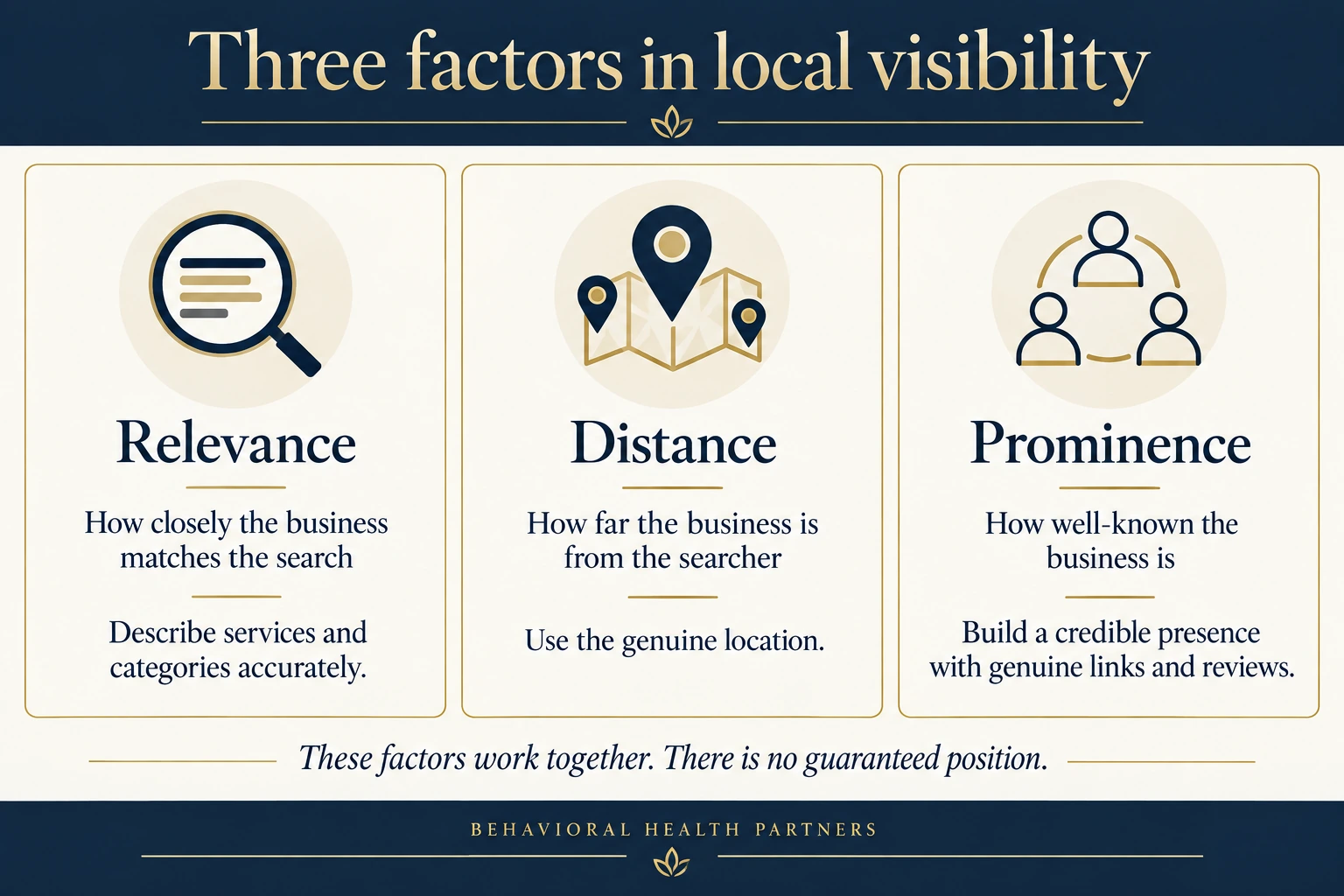
Before the tactics, understand the model. Google has said for years that local search rankings come down to three things working together: relevance, distance, and prominence. Relevance is how well your rehab center matches what someone searches. Distance is how close your addiction treatment center is to the searcher or the location they name.
Prominence is how well known and well regarded your treatment center is, measured through reviews, citations, links, and overall web presence.
You cannot change distance, but you influence the other two constantly, and that is where a real SEO strategy lives. The relative weight of these signals is not a guess. Whitespark's biennial Local Search Ranking Factors study, a primary survey of dozens of local search experts running since 2008, consistently finds that your primary Google Business Profile category, proximity, keywords in your business title, and review signals sit at the very top of what moves local search rankings.
In the most recent editions, review signals and behavioral signals have grown in importance while raw citation volume has declined. That tells rehab centers where to spend their time: profile completeness, category precision, and a steady flow of genuine reviews matter more than blasting your name across hundreds of low quality local listings.
The rest of this drug rehab SEO playbook follows that priority order, and every step below feeds one coherent local SEO strategy. We start with the Google Business Profile because it is where local rankings are won, then move outward to your website, your citations, your reviews, and your links.
The Foundation: Google Business Profile Optimization
Your Google Business Profile is the most important asset in local SEO for rehab centers, full stop. It is the listing that feeds the map pack and Google Maps for treatment centers, and it is often the first impression a family gets of your addiction treatment center.
Google Business Profile optimization is not a one time setup. It is an ongoing practice, and the rehab centers that treat it that way pull ahead of the ones that claim a listing and forget it.
Claim and verify the profile
Nothing works until your profile is verified. Verification is how search engines confirm you own the business and grant you the ability to edit your information and respond to customers. Google's guidance on verifying your business walks through the available methods, including phone, email, video, and postal mail.
Complete this first, because an unverified listing cannot rank in Google Maps the way a verified, actively managed one can.
Choose the right primary category
Category selection is one of the highest impact decisions any treatment center will make, and it is the factor Whitespark's experts rank number one. Google's own category guidance is clear: use as few categories as possible, and choose the one that best completes the sentence "this business is a." For most drug rehab centers the primary category is Addiction treatment center or Rehabilitation center, with secondary categories added for the specific services you provide, such as Mental health clinic or Alcohol rehab center.
Do not stuff categories as keywords. Pick the primary category that describes your core business, because search engines automatically associate related broader categories for you.
Complete every field
Search engines favor complete profiles. Fill in your hours, your service area, your attributes, your services, and a business description that accurately explains who you help and how. A complete, accurate profile gives search engines more to work with and gives families more reasons to trust your treatment center.
Incomplete listings leave ranking signals on the table and quietly hand the map pack to more thorough drug rehab centers nearby.
Add real photos and keep them current
Photos are a trust signal families actually look at, and search engines give profiles with real, current imagery an edge in engagement. Google's help on adding photos and videos covers the formats and standards. Show your actual facility, your common spaces, your exterior so people recognize it when they arrive, and your team where privacy allows. Investing in professional photography of your treatment center pays off here, because these are the first images families judge you by.
Avoid stock imagery. Short facility videos help too, and a thoughtful video production process gives you assets that work on the profile and the website alike. Authentic photos of your addiction treatment center do more for conversion than any amount of polish, and they help your rehab center's website and profile feel like the same trustworthy program.
Post regularly
Profiles that are updated regularly signal active management to search engines. Use Business Profile posts to share program updates, admissions information, and helpful content about your treatment centers. This is a freshness signal most treatment centers ignore, which is exactly why it belongs in your Google Business Profile optimization routine.
NAP Consistency and Local Citations
NAP stands for name, address, and phone, and consistency across the web is a core local ranking factor. When your business information appears identically everywhere search engines find it, they gain confidence that your addiction treatment center is legitimate and correctly located. When it appears three different ways across different local listings, that confusion erodes your local search rankings.
Local citations are the places your NAP appears: healthcare directories, local business listings, and authoritative databases. The goal in 2026 is quality over quantity. A handful of local citations on authoritative, relevant platforms outperforms hundreds of scraped listings. Prioritize the directories that matter for behavioral health and healthcare, including government and provider databases like the CMS NPPES NPI Registry, where treatment centers and providers are listed and searchable by name and location.
Reputable healthcare directories reinforce your legitimacy with search engines in a way that generic local listings cannot.
Auditing Your Local Citations
Audit your existing citations first. Find every place your addiction treatment center is listed, correct any inconsistencies in name, address, or phone, and remove or fix duplicate listings. Then build new local citations deliberately on platforms that serve your field.
This is unglamorous work, but NAP consistency is one of the quiet foundations of local visibility for rehab facilities, and getting it right compounds over time.
Reviews: The Ranking Signal That Also Closes Admissions
Reviews do double duty. They are one of the strongest local ranking signals, and they are often the last thing a family reads before they reach out. Whitespark's experts have moved review signals to the top of the local search ranking factors, and it is easy to see why: search engines treat a steady flow of genuine, positive reviews as evidence that your addiction treatment center is prominent and trusted.
Building a Steady Review Engine
Build a review engine that runs continuously rather than in bursts, because reviews compound for rehab centers over time. Ask for reviews at natural moments, such as when a client or family expresses gratitude, and make the process simple. A consistent trickle of new reviews signals ongoing activity far better than a sudden pile of them followed by silence.
Never incentivize or fabricate reviews, and be mindful of privacy: in behavioral health, protecting client confidentiality comes before any marketing goal, so let people choose whether and how they participate.
Responding to Every Review
Respond to reviews, all of them. Search engines explicitly encourage businesses to reply, and Google's guidance on managing reviews notes that responding shows customers you value their feedback. Thank people for positive reviews, and respond to critical ones with professionalism and care, never disclosing that someone was a client.
Responding is a prominence signal that many treatment centers neglect, and it demonstrates the accountability that families look for when they choose where to send a loved one.
Trust and Expertise Signals Search Engines Reward
Behavioral health is a field where search engines apply extra scrutiny. Healthcare related websites are held to high standards for expertise, authoritativeness, and trustworthiness, and the treatment centers that demonstrate those qualities earn an advantage in both local and organic search results. For rehab centers, that means making your credentials, licensing, accreditations, and clinical team visible on your website, and backing every claim with accurate, honest content rather than marketing gloss.
Ethical review management belongs in this category too, because how a treatment center earns and responds to reviews signals real trustworthiness to both families and search engines.
Structured data reinforces this, because it lets search engines understand exactly what your addiction treatment center offers and where it operates. When search engines can read your services, your location, and your credentials cleanly, they can match your rehab center to the families searching for precisely what you provide. Pair that technical clarity with genuine subject authority, and your drug rehab center becomes the kind of result search engines are comfortable surfacing, including in the AI generated answers where trust signals carry even more weight.
This is the quiet backbone of a durable SEO strategy for any addiction treatment center.
On Page SEO and Geo Targeted Content
Your Google Business Profile gets you into the map pack. Your website is what ranks in the organic local search results beneath it and what converts the click into a call. On page SEO for local intent means telling search engines, clearly and honestly, where you are and who you serve, so your rehab center's website earns the search engine rankings its program deserves.
Location pages that actually rank
Every physical location deserves its own page, and for treatment centers a single generic page trying to serve every city will underperform a set of specific ones. A location page that ranks names the city and region naturally in the title, headings, and body, describes the services offered at that location, includes the address and local details, and reads like it was written for the people who live there rather than assembled from a template. Location specific pages also prevent the duplicate content problem that comes from spinning up near identical pages for every nearby town, and they give search engines clean signals about where your rehab facilities operate.
Geo targeted keyword research
Local keyword research is where local SEO strategies start earning their keep, so treat keyword research as the first move in your local plan. Families search with geo targeted keywords, combining a service with a place: "medical detox in" a city, "inpatient rehab near me," "dual diagnosis treatment" in a region. Map these targeted keywords to specific pages, and prioritize the high intent keywords that signal someone is ready to act over broad informational terms. The companion rehab SEO keywords video is a quick primer, and our chapter on the best drug rehab SEO keywords goes deep on building that keyword list for addiction treatment.
For the tactical writing of the pages that target those terms, the companion chapter on service page optimization covers how to structure service pages so search engines and families both understand them. Matching each page to real search intent is what separates rehab centers that rank from those that publish and disappear.
Page Titles, Meta Descriptions, and Search Intent
Write descriptive page titles and meta descriptions that include the location and the service, use a single clear H1 per page, and organize your content around real search intent so on page SEO and technical SEO reinforce each other. Strong meta descriptions do not directly move search engine rankings, but they lift the clicks that do. Add local business structured data so search engines can read your name, address, hours, and services directly.
Google's documentation on LocalBusiness structured data explains how this markup helps your pages appear with richer detail in local search results. Good on page optimization is not about tricks, it is about making your relevance unmistakable to the search engines trying to interpret your website content.
Technical SEO, Site Speed, and Mobile
Families in crisis are almost always searching from a phone, and a treatment center's website that loads slowly or breaks on mobile loses them before the content ever gets a chance. Technical SEO is the layer that makes sure search engines can crawl your site and that visitors have a fast, stable experience once they arrive.
Site Speed and Mobile Experience
Search engines evaluate page experience as part of ranking, and Google's guidance on page experience covers Core Web Vitals, mobile friendliness, and secure connections. Practically, that means your rehab center's website should load quickly, respond smoothly on mobile devices, run on HTTPS, and avoid intrusive pop ups that block the content someone came for. Site speed is both a ranking factor and a conversion factor: every extra second of load time costs rehab centers the families who will simply go back and click the next result.
Crawlability and Internal Links
Make sure search engines can crawl and index your key pages, that your important location and service pages are internally linked so they are easy to discover, and that nothing critical is hidden behind scripts a crawler cannot read. Technical SEO rarely gets credit when it works, but it is the ground everything else stands on. Treatment centers serious about performance often pair this work with deliberate conversion rate optimization so the organic traffic local SEO earns actually turns into admissions inquiries, and with intentional rehab website design so the mobile experience holds up under real conditions.
A fast, well built website also protects the organic traffic you have already earned.
Local Link Building and Community Authority
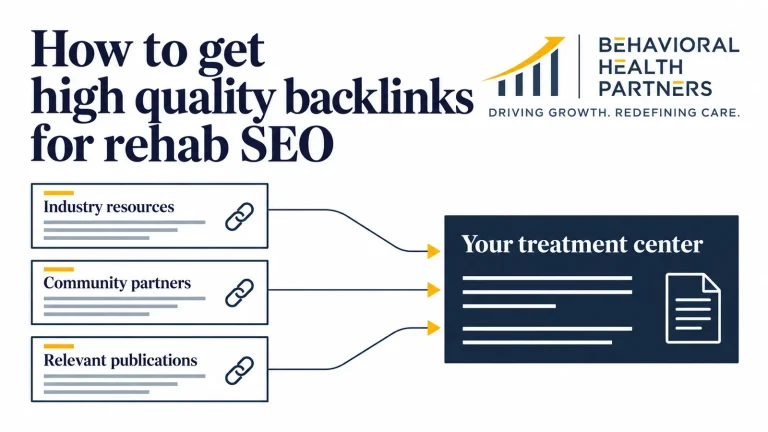
Links remain a meaningful local ranking factor, and the best links for drug rehab centers are local and relevant. Backlinks from local organizations, community partners, and reputable healthcare websites signal to search engines that your addiction treatment center is an established, trusted part of its community. This is not about buying links, it is about earning them through the genuine relationships drug rehab centers build in their communities and the useful resources they publish.
Where Treatment Centers Earn Local Links
The behavioral health ecosystem gives rehab centers natural link sources: local recovery organizations, community health coalitions, sober events your treatment center sponsors, and healthcare partners who refer to you. Creating genuinely useful local resources, like guides to recovery support in your area, gives other sites a reason to link to you, and sharing them through steady social media marketing helps those resources reach the local audiences who cite them. Because link earning is a specialized discipline of its own, our chapter on how to get high quality backlinks covers the full approach to earning high quality backlinks, and the dedicated rehab link building service exists for treatment centers that want that work handled for them.
For local SEO specifically, prioritize links that carry geographic and topical relevance over generic high volume link schemes, which do more harm than good.
Multi Location Local SEO for Drug Rehab Centers
If your treatment center operates in more than one city, the architecture matters. Each location needs its own Google Business Profile, verified and optimized independently, and its own location page on your website. Do not try to rank multiple locations from one profile or one page, because search engines tie local rankings to specific, verifiable places.
A Profile and Page for Every Market
The drug rehab centers that scale local SEO well treat each location as its own local SEO project while sharing the authority of the parent domain. Consistent NAP for each location, location specific reviews, location specific citations, and location pages written for each community are the non negotiables. And when you are opening a new facility, the operational discipline that governs opening new drug rehab centers and how to open a rehab center should extend to its local rankings from day one, so the Google Business Profile and location page are ready the moment the doors do. Programs that want hands on help to open a new location can bring that local search groundwork into the plan from the start.
Done right, a multi location addiction treatment center compounds its local visibility, with each new market benefiting from the domain authority the others have built.
How Smaller Rehab Centers Compete With National Brands in Local Search
One of the quiet advantages of local SEO for rehab centers is that it lets smaller treatment centers outrank far larger competitors in the searches that matter most.
National drug rehab brands and directories spend heavily to dominate broad search engine results, but the map pack rewards proximity and prominence, not budget. A single well run addiction treatment center with a complete Google Business Profile, consistent local citations, and genuine reviews can sit above a national chain in its own city, especially when its local work sits on a strong foundation of rehab SEO.
This is why local SEO is the great equalizer for independent rehab centers. Search engines want to show families the most relevant nearby treatment centers, and a focused local SEO strategy makes your program unmistakably the most relevant option in your area. You do not have to outspend the national brands. You have to be more clearly local, more complete, and more trusted than they are in the specific communities you serve.
For most drug rehab centers, that is a winnable fight, and it is exactly where a small team's effort produces outsized returns in local rankings.
Local SEO and AI Search: Where Families Find Treatment Centers Now
Search engines are changing how families discover addiction treatment. AI generated answers and overviews increasingly sit at the top of the results, summarizing options before a searcher ever clicks.
The good news for rehab centers is that these AI systems draw on the same signals that power the map pack. A complete Google Business Profile, strong reviews, consistent local citations, structured data, and authoritative content all feed the models that decide which treatment centers get named in an AI answer.
Structured data matters more than ever here, because it helps search engines understand exactly what your addiction treatment center offers and where. The rehab centers that invest in a clean, well marked up website and a genuine local SEO strategy are the ones AI search is most likely to surface. Our drug rehab SEO video walks through how these signals fit together. Building for local search and building for AI search are no longer separate projects for treatment centers. They are the same work, and the drug rehab centers doing it well are compounding their visibility across both.
Local SEO and Paid Media Work Together
Local SEO is the durable engine, but it takes time to build. Paid media fills the gap while a treatment center's organic and local presence matures, and the two reinforce each other. A treatment center that shows up in the map pack, in the organic results, and in a well run paid campaign occupies more of the page and earns more of the trust that comes from appearing everywhere a family looks.
For treatment centers, the relationship is complementary, not competitive. Paid search buys immediate visibility for your highest intent keywords while local SEO builds the compounding asset that lowers a treatment center's cost per admission over time. Many rehab centers run drug rehab PPC alongside their local SEO for exactly this reason, and coordinate both within a broader addiction treatment marketing strategy so the messaging, the landing pages, and the tracking all line up.
Consistent content across the site ties the whole SEO strategy together, which is where ongoing content marketing earns its place in the plan.
Common Local SEO Mistakes Rehab Centers Make
A few errors show up again and again, and each one quietly caps a treatment center's local visibility.
The first is not mentioning the city enough. If your pages never name the places you serve, search engines struggle to connect your rehab center to local searches. The fix is natural, specific geographic language throughout your website content, not keyword stuffing.
The second is an incomplete or neglected Google Business Profile. A profile that was claimed years ago and never updated cannot compete with an actively managed one. Treat the profile as a living asset.
The third is inconsistent NAP across local listings. Three versions of your address confuse the search engines you need to trust you. Audit and standardize.
The fourth is ignoring reviews, both by failing to generate them and by never responding. Reviews are too strong a ranking signal to leave to chance.
The fifth is building a website that fails on mobile. Since most families search from phones, a slow or broken mobile experience undoes everything else. Site speed and mobile usability are not optional for rehab facilities that want to rank.
Measuring Local SEO Performance
You cannot improve what you do not track. Watching the right local SEO metrics tells you whether your strategy is working and where to adjust. Track your search engine rankings for your priority geo targeted keywords, your visibility in the map pack and Google Maps, the calls and form submissions coming from the map pack, and the direction requests and profile actions on your Google Business Profile.
The Local SEO Metrics That Matter
Pay attention to qualified admissions inquiries, not just organic traffic. A treatment center can gain organic traffic while missing the families who are ready to act, or lose some raw traffic while capturing far more of the high intent local searchers who actually call. The metric that matters is whether local search optimization is producing conversations with people who need treatment and are ready to start.
Set up proper tracking early, review it monthly, and let the data guide where you invest next. Over time, this is how rehab centers turn local search optimization into a predictable admissions channel.
Where This Fits in Your Larger SEO Strategy
Local SEO for rehab centers is one discipline inside a complete search engine optimization strategy. It works best when it sits on top of a strong website, a clear keyword map, well written service pages, and a healthy backlink profile. The behavioral health SEO guide connects all of those pieces, and the local tactics in this post are how treatment centers claim the nearby searches happening closest to their doors. If your program also serves clients through content and mental health resources, the chapter on mental health blogs shows how editorial content supports the same authority that local rankings reward.
And because the fundamentals of SEO for rehab centers apply whether you serve one city or twenty, local search should always be built on that broader foundation rather than in isolation.
A Search Engine Optimization Checklist for Treatment Centers
Treatment centers that want a repeatable process can run local SEO as a simple sequence. Start with keyword research to map the geo targeted keywords and high intent keywords families actually use. Handle on page SEO next, writing page titles, meta descriptions, and location pages that match search intent. Layer in technical SEO so search engines can crawl the site and site speed holds up on mobile.
Then build the off page signals that lift search engine results: local citations, genuine reviews, and relevant local links. For drug rehab centers and other treatment centers alike, this search engine optimization sequence turns scattered effort into a coherent drug rehab SEO strategy, and it applies whether you run one location or a network of rehab facilities.
Behavioral Health Partners approaches this work as a partner, not a vendor. We have helped treatment centers build local search engines that fill beds from their own communities, and we do it with the accuracy and compliance that addiction treatment demands. Our founder, Adam Vibe Gunton, a bestselling author, TEDx speaker, and international recovery advocate featured on NBC News Daily, CBS News, and ABC News, built this company around one belief: the more people who can find quality addiction treatment at the right treatment centers, the more lives are saved.
Frequently Asked Questions
Can I do local SEO for my rehab center myself?
Yes, much of it. Claiming and fully optimizing your Google Business Profile, standardizing your NAP across local listings, generating and responding to reviews, and writing honest location pages are all within reach for an in house team. The specialized and time consuming work, like technical SEO audits, competitive keyword research, and local link building, is where many treatment centers bring in help.
A reasonable path is to handle the foundational Google Business Profile and review work yourself and get support on the parts that require tools and experience.
How long does local SEO take to work for a treatment center?
Local SEO is a compounding investment, not an overnight switch. Some improvements, like completing your Google Business Profile, can lift map pack visibility within weeks. The fuller gains from local citations, reviews, location pages, and links typically build over several months.
The drug rehab centers that commit to a consistent SEO strategy see local rankings become a steadily growing source of admissions rather than a one time bump.
How much should a rehab center pay for local SEO?
It depends on your market, your number of locations, and how much you handle in house. Because local visibility is often the highest intent traffic a treatment center can earn, the more useful question for treatment centers is cost per admission over time rather than monthly spend in isolation. A sound local SEO strategy usually lowers your blended cost per admission as the organic engine matures, which is why it pays to start early and build the asset.
What is the single highest impact local SEO move for a rehab center?
Fully optimizing and actively managing your Google Business Profile, with the correct primary category, a complete profile, real photos, and a steady flow of genuine reviews. It is the factor search engines weigh most heavily for the map pack, and it is the highest return hour any treatment center can spend on drug rehab SEO.
Does local SEO work differently for outpatient versus residential programs?
Somewhat. Outpatient programs draw from their immediate area, so the map pack and organic results are central for these rehab facilities, and proximity works in their favor. Residential drug rehab centers often draw from a wider region and lean more on organic search engine rankings and broader search engine results alongside their local presence.
Both benefit from a strong Google Business Profile and the location pages treatment centers rely on, but the balance of local versus broader search engine optimization shifts with how far a treatment center's clients travel.
Build a Local Search Engine That Fills Beds
Local SEO for rehab centers rewards the programs that do the fundamentals consistently: a complete and active Google Business Profile, consistent local citations, genuine reviews you actually respond to, honest location pages, a fast mobile website, and relevant local links. None of it requires tricks. It requires showing up, accurately and reliably, in the places families search when they are ready to find treatment centers they can trust.
If you want a partner to build that local search engine with you, schedule your free discovery call and we will map out exactly where your treatment center can win in local rankings.
Adam Vibe GuntonFounder and Managing Partner, Behavioral Health Partners
Adam Vibe Gunton is an addiction recovery expert, entrepreneur, marketer, brand strategist, and speaker dedicated to advancing the behavioral health industry. As Founder and Managing Partner of Behavioral Health Partners, he has worked across treatment-center development, operations, branding, PR, SEO, advertising, and growth strategy. Combining professional experience with his own lived experience in recovery, Adam brings a unique perspective on how treatment organizations can build trusted brands, reach more people, and create a greater impact.
Thirty minutes on video with Adam directly, camera on, screen-sharing your own online presence and your top three local competitors. If we are not the right partner, we will tell you that too.