What Is The Joint Commission? A Guide to TJC Accreditation
What The Joint Commission is, what it does, and what accreditation really means for a behavioral health program. We cover how the accreditation process works, the standards that apply to behavioral health, and deemed status and why it matters for Medicare. We also cover what accreditation changes for payers, referrals and families, and how to approach the survey with confidence.
If you have spent any time around health care, you have seen the Gold Seal of Approval or heard a facility described as "Joint Commission accredited." But what is The Joint Commission, and what does the joint commission actually do? For anyone opening or running a treatment center, the answer matters, because Joint Commission accreditation shapes reputation, reimbursement, and the quality of care itself.
This guide explains what The Joint Commission is, what it does, how accreditation works, and why it matters for behavioral health. It pairs with our video on TJC accreditation explained, and if you are pursuing the Gold Seal, our joint commission accreditation consulting can guide you through every step. Let us start with the basics.
What Is The Joint Commission?
The Joint Commission is an independent, not for profit organization that accredits and certifies healthcare organizations across the United States. Founded in 1951 and formerly known as the Joint Commission on Accreditation of Healthcare Organizations, or JCAHO, it is the oldest and largest body devoted to the accreditation of healthcare organizations in American health care. Today The Joint Commission accredits thousands of healthcare organizations, from hospitals and behavioral health programs to ambulatory and home care. Its work in the accreditation of healthcare organizations touches nearly every corner of the health care system, and the name Joint Commission on Accreditation of Healthcare Organizations still appears in older records and federal regulations.
At its core, The Joint Commission exists to improve healthcare quality and patient safety. As a national accrediting organization, it sets rigorous standards, evaluates organizational compliance through the accreditation process, and awards its Gold Seal of Approval to healthcare organizations that meet them. This objective evaluation process is what gives accreditation its weight, and it drives measurable quality improvement across the organizations it reviews. You can read more about the organization on the Joint Commission's own site.
What Does The Joint Commission Do?
The Joint Commission does three main things, and together they drive its mission of prioritizing patient safety.
First, it develops standards. Working with health care professionals and experts, The Joint Commission creates the performance standards that accredited organizations must meet, covering everything from medication management and infection control to patient care and continuous improvement. These joint commission standards are updated regularly to reflect new evidence and emerging risks.
Second, it sets National Patient Safety Goals. Each year The Joint Commission publishes national patient safety goals that target the most pressing risks to patients, such as accurate patient identification and reducing medical errors. These national performance goals give organizations clear, measurable priorities.
Third, it accredits and certifies. Through a rigorous survey process, The Joint Commission evaluates whether health care organizations meet its standards, then awards accreditation to those that do. Joint commission surveys, each a survey conducted on site, lead to accreditation and certification for organizations that demonstrate compliance. These joint commission surveys use standardized performance measures and track patient outcomes and health outcomes, helping healthcare facilities improve quality and improve safety, reduce adverse events, and advance health equity and patient advocacy across their healthcare services. Accreditation is not a one-time event; it is a commitment to continuous readiness and ongoing quality and patient safety.
How Joint Commission Accreditation Works
Joint commission accreditation follows a clear path, even if the work behind it is demanding, as The Joint Commission describes in its overview of what accreditation is.
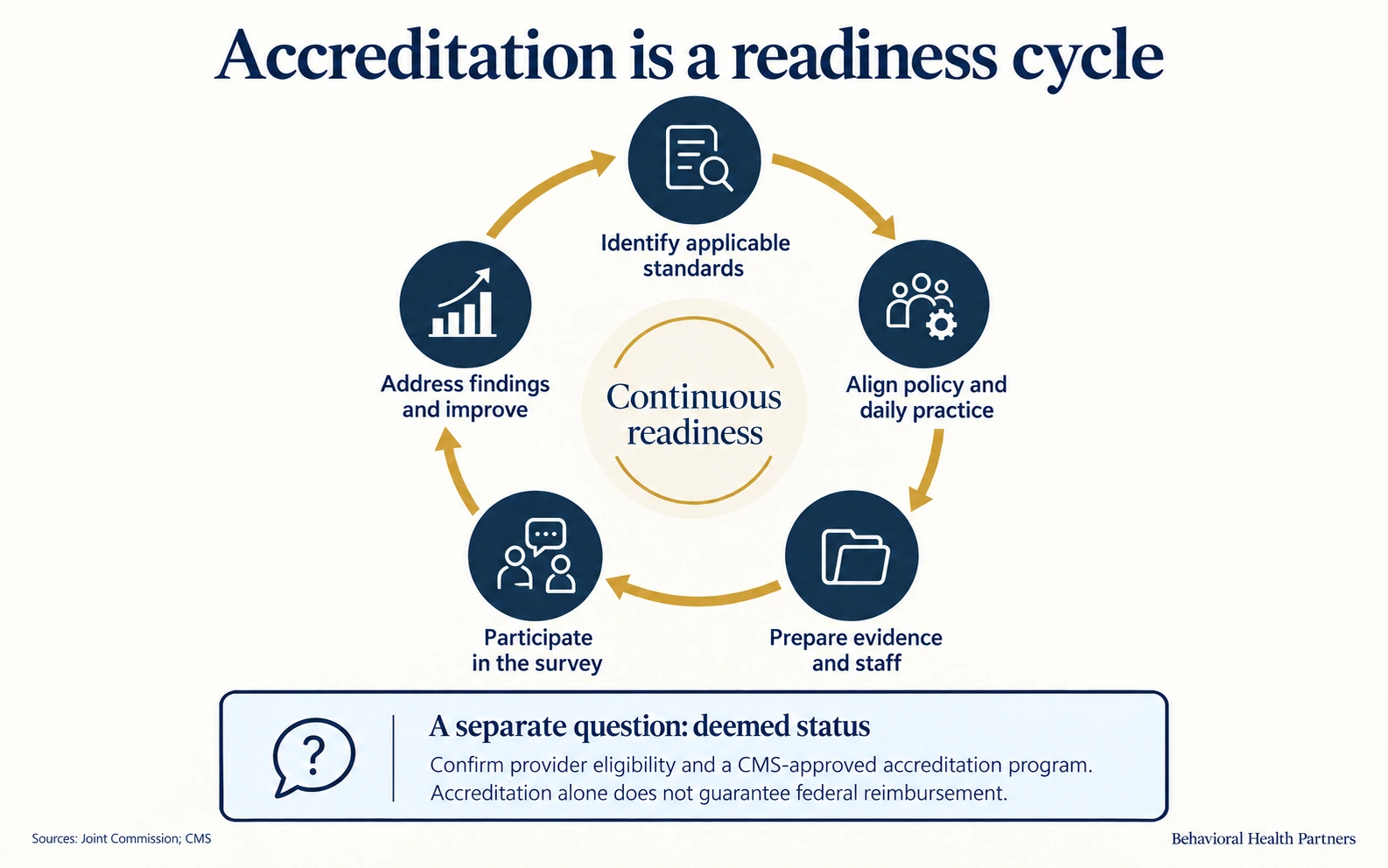
An organization first applies and prepares, aligning its policies, documentation, and practices with the relevant standards. When ready, it undergoes an on site survey, where Joint Commission surveyors conduct a comprehensive review of the organization's compliance with the standards. Surveyors observe care, review records, and talk with staff and patients to assess compliance in the real world, not just on paper.
Accredited organizations are typically resurveyed on a recurring cycle, often every three years, and many surveys are now unannounced. That is why the strongest programs treat accreditation as continuous readiness rather than a scramble before survey week. When an organization demonstrates compliance, it earns accreditation and the Gold Seal of Approval; when a survey finds gaps, the organization must correct them to maintain its status.
Joint Commission Standards and Behavioral Health
For behavioral health, The Joint Commission offers accreditation built specifically for behavioral health care and human services. Joint commission behavioral health standards address the realities of treatment programs: assessment and treatment planning, medication management, environment of care and safety, staffing and competency, and the rights of the people served.
For a treatment center, meeting these rigorous standards signals to families, referral sources, and payers that the program delivers high quality care. Accreditation is increasingly an expectation in behavioral health, not a nice-to-have, which is why so many programs pursue it as they open a treatment center. Our guide on how to build a behavioral health program folds accreditation readiness into the plan from day one.
Deemed Status: Why Accreditation Matters for Medicare
One of the most practical reasons behavioral health organizations seek Joint Commission accreditation is deemed status. Under federal rules, a provider accredited by a CMS-approved accrediting organization can be "deemed" to meet the Medicare and Medicaid conditions of participation, as the Centers for Medicare and Medicaid Services explains. In plain terms, Joint Commission accreditation can let an organization achieve Medicare certification and receive federal payment without a separate state survey, which is why accreditation is tightly linked to behavioral health billing and reimbursement.
Because The Joint Commission's standards meet or exceed Medicare's requirements, accreditation is a recognized path into Medicare and Medicaid programs. This pathway into Medicare or Medicaid programs means accreditation can satisfy Medicare and Medicaid requirements, so an accredited program meets the federal government's health and safety requirements called conditions of participation, and qualifies for program participation and federal reimbursement without a duplicate state survey. That single accreditation survey doubles as a route to delivering high quality care under federal rules, which is why the accreditation journey is worth the effort. For many treatment centers, that access to federal dollars is reason enough to pursue accreditation, on top of the quality and safety benefits.
Why It Matters for Your Program
Joint Commission accreditation is demanding, and that is the point. The rigor is what makes the Gold Seal mean something to patients, payers, and referral partners. Accreditation signals that a program has been measured against national standards and delivers care that meets them.
The accreditation process holds health care organizations to national standards, and by pushing health care organizations toward better care quality and safer patient care, it raises quality and safety across the field. The legacy name, the Joint Commission on Accreditation of Healthcare Organizations, reflects how central the accreditation of healthcare organizations has always been to its mission, and the Joint Commission on Accreditation of Healthcare Organizations shaped modern healthcare organizations for decades.
It also builds better organizations. The discipline of meeting Joint Commission standards, tracking outcomes, and pursuing continuous improvement makes a program safer and stronger, survey or no survey. That is the real value: accreditation is less a certificate on the wall than a way of running a treatment center.
Frequently Asked Questions
What does TJC stand for?
TJC stands for The Joint Commission. It was formerly known as the Joint Commission on Accreditation of Healthcare Organizations, abbreviated JCAHO, so you may see both names used. The organization is an independent, not for profit accrediting body for health care organizations in the United States.
Is JCAHO the same as The Joint Commission?
Yes. JCAHO, the Joint Commission on Accreditation of Healthcare Organizations, is the former name of the organization now called The Joint Commission. The name was shortened in 2007, but the accreditation and the standards come from the same body. People in health care still use both terms.
Who pays for The Joint Commission?
The Joint Commission is a nonprofit funded largely by the fees that accredited organizations pay for surveys and accreditation, along with related products and services. Organizations choose to seek accreditation and pay for the survey process, which is separate from any government funding.
What happens if an organization fails a Joint Commission survey?
A survey rarely ends in a simple pass or fail. When surveyors find that an organization does not meet certain standards, the organization receives findings it must correct within a set timeframe to earn or keep accreditation. Serious, unresolved problems can lead to loss of accreditation, which can also affect deemed status and federal payment.
Pursue Accreditation With Confidence
The Joint Commission is the standard-setter for quality and patient safety in American health care, and its accreditation is a powerful signal that a program delivers high quality care. For behavioral health organizations, accreditation opens doors with payers, supports Medicare participation through deemed status, and builds a stronger, safer program.
If you are ready to pursue the Gold Seal, reach out to work with us and we will help you prepare for and achieve Joint Commission accreditation with confidence.
Share this guideLink copied
Adam Vibe GuntonFounder and Managing Partner, Behavioral Health Partners
Adam Vibe Gunton is an addiction recovery expert, entrepreneur, marketer, brand strategist, and speaker dedicated to advancing the behavioral health industry. As Founder and Managing Partner of Behavioral Health Partners, he has worked across treatment-center development, operations, branding, PR, SEO, advertising, and growth strategy. Combining professional experience with his own lived experience in recovery, Adam brings a unique perspective on how treatment organizations can build trusted brands, reach more people, and create a greater impact.
Thirty minutes on video with Adam directly, camera on, screen-sharing your own online presence and your top three local competitors. If we are not the right partner, we will tell you that too.