What Is a Company Directory? Local Citations for Treatment Centers
Local citations are the mentions of your center across directories and listing sites, and they quietly decide local rankings. We cover what a company directory and a local citation are, why they matter for treatment centers, and why NAP consistency is the whole game. We cover structured versus unstructured citations, the wider citation ecosystem, how to build them, and why quality beats quantity.
If you have ever searched for a business and seen it listed on a site you did not expect, a directory, a review site, a local business listing, you have seen a local citation in action. For a treatment center, these local citations are one of the quiet forces of local SEO that decide whether families find you in local search. This chapter explains what a company directory and a local citation actually are, why they matter, and how to build them the right way.
It is part of our Google Business Profile optimization guide and works hand in hand with the broader organic strategy in our drug rehab SEO service, because consistent citations are one of the foundations local search rankings are built on.
What Is a Company Directory?
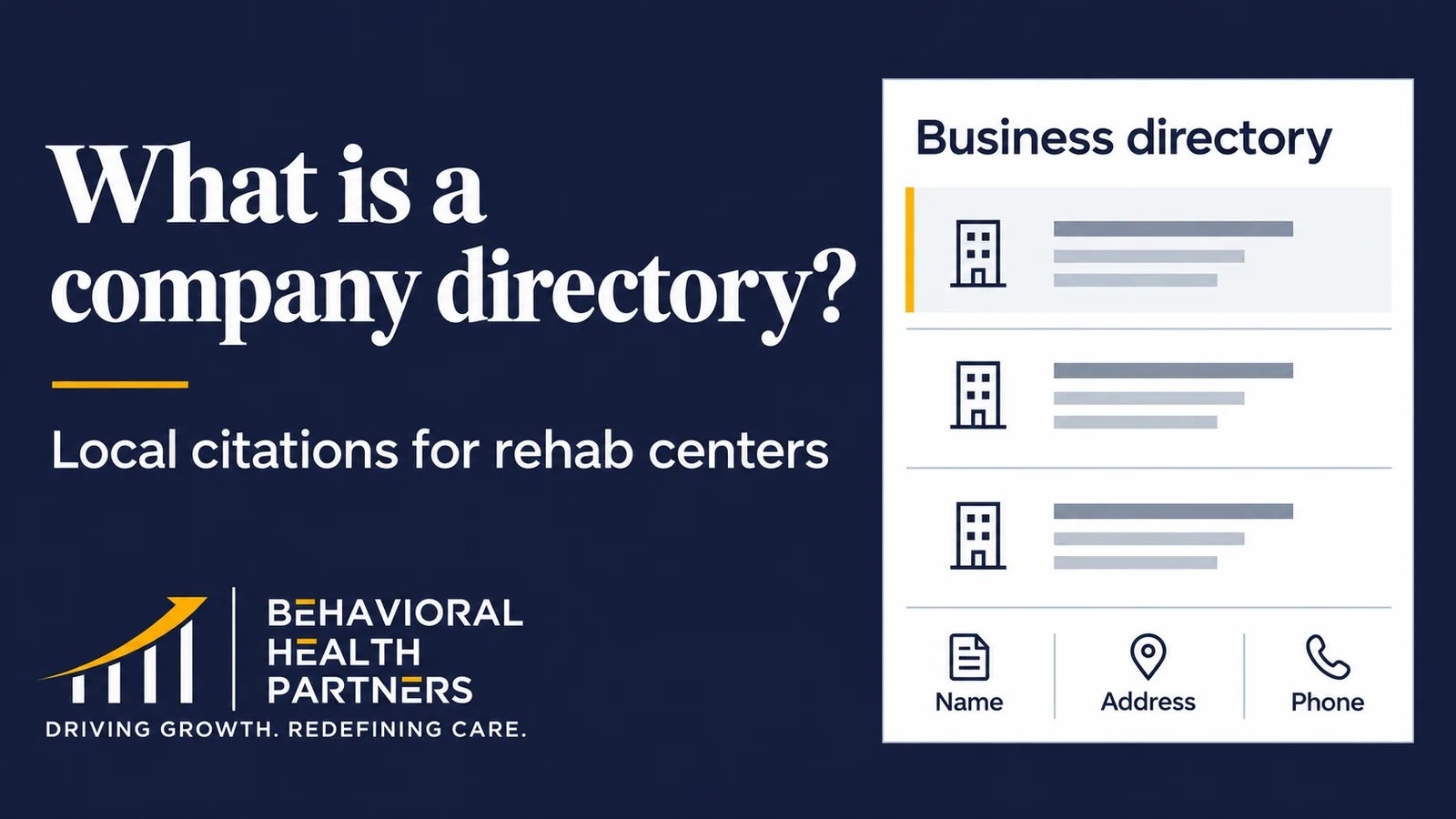
A company directory is an online platform that lists businesses along with their core details: name, address, phone number, website, hours, and category. Think of the yellow pages, moved online and multiplied across hundreds of sites. Some are broad local directories and local business directories that list local businesses of every kind, and some are specific to an industry, like healthcare or behavioral health directories. For local businesses in behavioral health, both types matter.
When your treatment center appears in one of these directories with accurate information, that listing is a local citation.
What Is a Local Citation?
A local citation is any online mention of your business's name, address, and phone number, your NAP. Your name, address and phone must be identical everywhere. It can be a full structured listing in a business directory, or an unstructured mention on a blog, a news site, or a community page. Search engines use these citations to confirm that your business is real, that it operates where it says it does, and that it can be trusted.
For local businesses, and especially for treatment centers competing for high-intent local searches, local citations are a genuine local ranking factor and a pillar of any local SEO strategy. Search engines lean on local citations to sort real, established local businesses from the rest, so local citations do quiet but real work for local businesses in local search. The more consistent, accurate local citations you have across reputable sites, the more confident search engines are in surfacing your business to nearby families. This is why local SEO for treatment centers treats citation building as foundational work.
Why Local Citations Matter for Treatment Centers
Local citations do three things for a treatment center at once.
They improve local search rankings
Consistent local citations across trusted sites are one of the ranking factors that help search engines rank your business in local search results and the map pack, and they are one of the clearest local SEO wins available to local businesses. They reinforce the same trust your Google Business Profile and reviews build, which is why citations, your profile, and your reviews work best together.
They build trust and online visibility
Every accurate business listing is another place a family or potential customers can find you and confirm you are legitimate. Accurate business information across local business directories signals a real, established business. Strong online visibility across the directories people actually use makes your treatment center feel established and trustworthy to search engines and families, which matters enormously in behavioral health.
They drive more traffic and inquiries
Citations are not only a ranking signal, they are discovery channels. A family browsing a healthcare directory or a review site can find your listing and reach you directly, so good citations bring more traffic and more admissions inquiries on their own, feeding your conversion rate optimization efforts.
NAP Consistency Is Everything
The single most important rule of local citations is consistency. Your business name, address and phone number must appear identically everywhere online. When your address and phone number match on every listing, search engines trust you. "Suite 200" in one listing and "Ste 200" in another, or an old phone number left on a directory you forgot about, creates confusion that erodes your local search rankings.
Search engines cross-reference your business data across every citation and every business listing they find, and consistency across those local citations is what earns their trust. When it all matches, they gain confidence. When it conflicts, that doubt costs you rankings. Getting your NAP right, and keeping it right, is the foundation of citation building. Google's own guidance on how to establish your business details covers claiming your business and keeping its information accurate everywhere Google looks.
Structured vs. Unstructured Citations
There are two kinds of local citations, and a treatment center wants both.
Structured citations
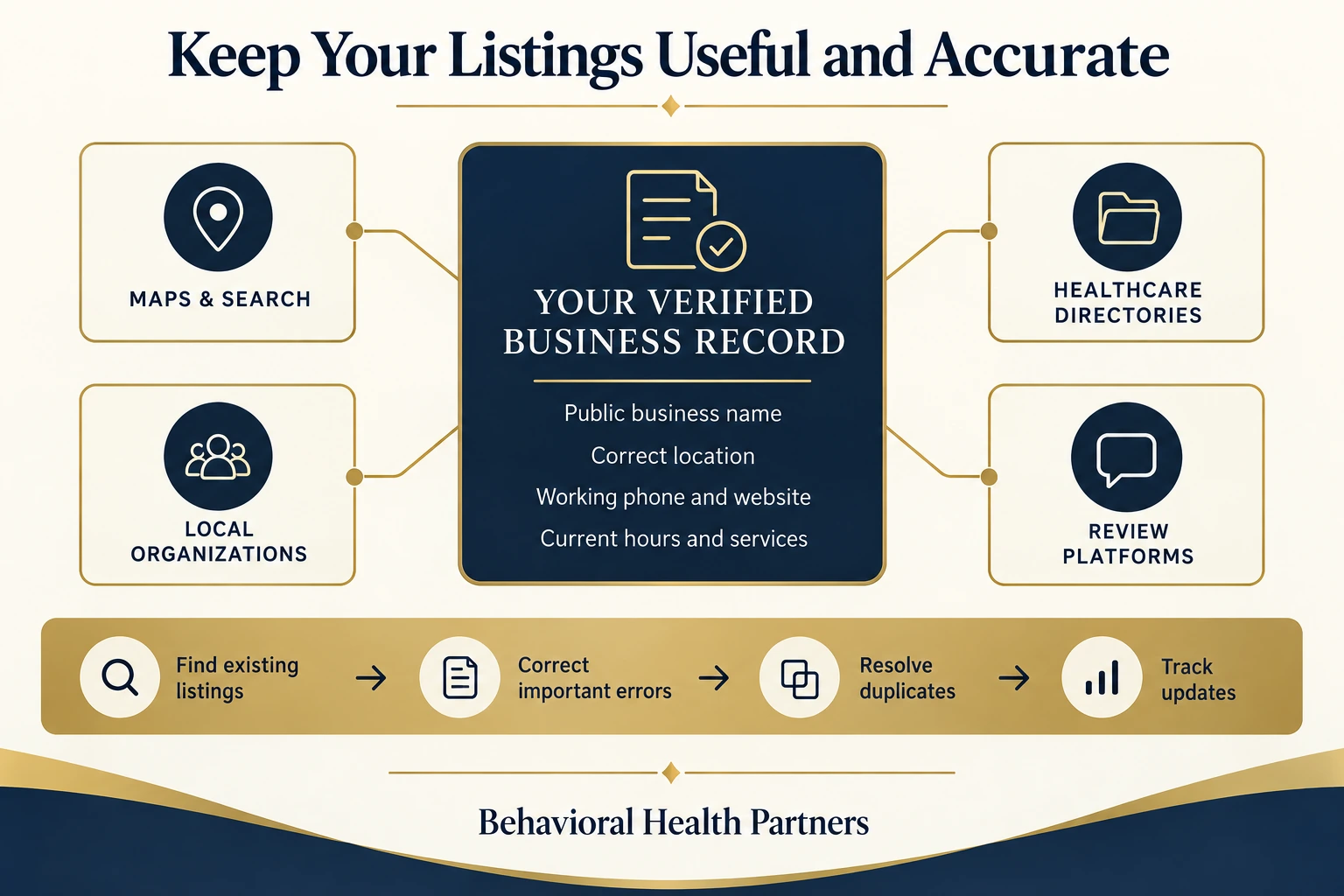
These are full business listings in business directories and business listing sites, with your NAP in defined fields, and they are the citation sources most local businesses start with. Your Google Business Profile, Apple Maps, Bing, Yelp, and healthcare directories are all structured citations. These structured listings, with your business name and details in fixed fields, are the backbone of your citation profile and your local SEO citations.
Unstructured citations
These are mentions of your business in the flow of other content: a local news article, a community organization's page, a blog post that references your center. They carry real weight too, because they show your business is part of its community.
Adding Organization structured data to your website, as described in Google's documentation on organization structured data, helps search engines read your official business details clearly and match them to your local citations across the web.
The Local Citation Ecosystem
Citations come from a few distinct kinds of sources, and a healthy citation profile draws from all of them.
Core sites
Start with the platforms almost every searcher and search engine relies on: your Google Business Profile first, then Apple Maps through Apple Business Connect, Bing, Yelp, and Facebook. These core sites carry the most weight and belong at the top of your list.
Data aggregators
Data aggregators are companies that collect and distribute business data to hundreds of downstream directories and apps. Getting your information correct with the major data aggregators helps accurate citations propagate across the web, and helps stop incorrect listings from spreading. Data aggregators are one of the most efficient citation sources, because a single correction can reach many business listings at once.
Industry and healthcare directories
For a treatment center, industry specific directories matter as much as the general ones. Reputable healthcare and behavioral health directories, provider registries, and treatment locators reinforce your local relevance in local search and your local SEO and your credibility with both search engines and families. These industry specific websites are where high-intent searchers often look, and they are some of the most valuable citation sources a treatment center has.
Review sites
Review sites are citations too, and they double as trust signals. A consistent presence on the review sites families use adds to your citation profile while giving prospective clients and potential customers the social proof they are looking for. Ongoing reputation management on those review sites keeps that profile strong. Our chapter on getting more Google reviews covers that side in depth.
How to Build Local Citations
Citation building is straightforward, but it rewards care over speed. Here is the process for a treatment center.
Audit your existing citations
Start by finding every place your treatment center is already listed. You will usually find duplicates, outdated phone numbers, and inconsistent addresses. This audit is the map for everything that follows.
Standardize your NAP
Decide on the exact format of your name, address, and phone number, and write it down. This consistent NAP, your name address and phone in one fixed format, becomes the single source of truth for every listing you touch. Consistent citations start with this step.
Claim and correct the core sites first
Claim your listings on the core sites, fix any inconsistent business information, and remove or correct duplicates. Getting the highest-authority citations right first delivers the most ranking power for the least effort, and it sets the tone for the rest of your citation building.
Submit to relevant directories
Then build new business listings on relevant business directories and the healthcare directories that fit your services, using manual submissions to keep quality high. Manual submissions to hand-picked, reputable directories beat bulk automated dumps into low-quality sites every time. A careful local citation building process, using manual submissions to quality citation sources, protects your business listings and your reputation. Building local citations this way, on relevant business directories and local directories that fit behavioral health, is slower but far safer.
Keep everything up to date
Citations are not a one-time project. When your hours, address, or services change, update them everywhere. Ongoing citation management keeps your business data accurate and your rankings protected.
A simple local citation building routine
Effective local citation building comes down to a repeatable routine. Confirm your business name, address and phone number match everywhere, keeping a consistent NAP, your name address and phone in one format, as your reference. Fix your business information on the core sites, then work outward to local directories and local business directories. Track your local SEO citations, local business listings, and business listings in a simple sheet so nothing goes stale, and revisit your local citation building notes each quarter. Building local citations this way, and keeping your address and phone number current, keeps citations, ranking factors, and reputation management pulling in the same direction, and it protects your local search results over time.
Citation Quality Beats Quantity
It is tempting to chase a big number, but citation quality matters more than raw volume. A listing on a reputable, relevant directory is worth far more than dozens on scraped, low-trust sites. Prioritize authoritative general directories, the core sites, and industry specific directories that serve behavioral health, and let the number of local citations grow naturally from there. For local businesses, a smaller set of strong local citations beats a big pile of weak ones. Consistency and quality, not quantity, are what move your rankings.
Common Local Citation Mistakes
A few errors quietly undermine a treatment center's citation profile.
The first is inconsistent NAP, the most common and most damaging. Even small differences confuse search engines.
The second is ignoring duplicates and incorrect listings, which split your ranking power and mislead families.
The third is chasing volume on low-quality sites instead of building accurate citations on the ones that matter.
The fourth is treating citations as a one-time task and letting them go stale after a move or a phone change.
Where Citations Fit in Your Local Strategy
Local citations are one pillar of local visibility, working alongside your Google Business Profile, your reviews, and your website. The tactics in our chapter on local SEO for rehab centers show how local citations, location pages, and on-page signals reinforce one another in a complete local SEO program, and the broader behavioral health SEO guide connects it all. Because citations and links are related but distinct, our chapter on earning high quality backlinks explains where the two overlap and where they differ.
Behavioral Health Partners approaches this work as a partner, not a vendor, with the accuracy and compliance behavioral health demands. Our founder, Adam Vibe Gunton, a bestselling author, TEDx speaker, and international recovery advocate featured on NBC News Daily, CBS News, and ABC News, built this company on one belief: the more people who can find quality treatment, the more lives are saved.
Frequently Asked Questions
What does a local citation mean?
A local citation is any online mention of your business's name, address, and phone number, whether as a full listing in a business directory or a mention in an article or community page. Search engines use citations to verify that your business is real and correctly located, which makes them a local ranking factor.
How do I check my local citations?
Start by searching for your treatment center's name, phone number, and address to see where you are already listed. Note any duplicates, outdated numbers, or inconsistent addresses. Citation audit tools can automate this, but a careful manual search of the core sites and the healthcare directories relevant to your services will surface most of what needs fixing.
What are some good local citation sites for a treatment center?
Begin with the core sites: your Google Business Profile, Apple Maps, Bing, Yelp, and Facebook. Then add reputable healthcare and behavioral health directories, provider registries, and treatment locators that fit your services. Prioritize accurate, consistent listings on authoritative and relevant sites over a large number of low-quality ones.
How many local citations does a treatment center need?
There is no magic number. Consistency and quality matter far more than quantity. A focused set of accurate citations on the core sites and reputable industry directories, all with identical NAP, will do more for your rankings than hundreds of listings on low-trust sites, especially if those listings conflict with one another.
Build a Citation Foundation That Ranks
Local citations are the quiet infrastructure of local search and a lasting local SEO asset for local businesses. As part of your Google Business Profile work and your wider local SEO, get your NAP consistent, claim and correct the core sites, add the reputable directories that serve behavioral health, and keep everything current. Do that, and your citations become a durable foundation under everything else your treatment center does to get found.
Citation building sits inside a complete addiction treatment marketing program, and if you want a partner to audit, build, and manage your local citations with you, schedule your free discovery call and we will build the citation foundation your treatment center needs to rank.
Adam Vibe GuntonFounder and Managing Partner, Behavioral Health Partners
Adam Vibe Gunton is an addiction recovery expert, entrepreneur, marketer, brand strategist, and speaker dedicated to advancing the behavioral health industry. As Founder and Managing Partner of Behavioral Health Partners, he has worked across treatment-center development, operations, branding, PR, SEO, advertising, and growth strategy. Combining professional experience with his own lived experience in recovery, Adam brings a unique perspective on how treatment organizations can build trusted brands, reach more people, and create a greater impact.
Thirty minutes on video with Adam directly, camera on, screen-sharing your own online presence and your top three local competitors. If we are not the right partner, we will tell you that too.