Mental Health Industry Trends: What Is Shaping Behavioral Health Now
Behavioral health is changing faster than it has in a generation. We cover the state of mental health in America and a growing market under real strain, the workforce shortage that constrains everything else, and telehealth as a permanent front door. We cover technology, data and AI in care delivery, emerging clinical approaches, integrated whole-person care, value-based payment reform, and what all of it means for providers.
The behavioral health field is changing faster than it has in a generation. Demand keeps climbing, technology keeps arriving, payment models keep shifting, and the workforce cannot keep pace. For the people who run treatment centers and behavioral health programs, understanding these industry trends is not an academic exercise. It is how you plan a program that is still standing, and still growing, three years from now.
This guide maps the trends shaping behavioral health care today and what each one means for providers on the ground. It reflects the strategic work we do every day in our behavioral health consulting practice, where the goal is always the same: help good programs read the landscape and act on it early. We refresh this guide as the data and the market move, so it stays a living picture rather than a snapshot.
A quick orientation before the trends. Behavioral health is the umbrella term for mental health and substance use together. Mental health care and substance use care were built as separate systems, but they are converging, in the data, in the clinic, and in the way payers think. Most of the trends below are, at heart, about that convergence and about a system straining to meet a level of need it was never designed for.
The State of Mental Health in America
Every trend starts with demand, and the demand for behavioral health services is high and broad. According to the Substance Abuse and Mental Health Services Administration and its 2024 National Survey on Drug Use and Health, 23.4 percent of adults, about 61.5 million people, had any mental illness in the past year, and 5.6 percent, roughly 14.6 million people, had serious mental illness. In the same national survey, 48.4 million people aged 12 or older, 16.8 percent, had a substance use disorder in the past year.
Those numbers describe a country where a mental health condition is common, not rare. Nearly one in four adults lives with some form of mental illness in a given year, and nearly half will meet the criteria for a diagnosable condition at some point in their lives. Mental health issues have moved from the margins of the conversation to its center, and more people seek treatment every year.
The range of conditions providers treat. Behavioral health spans a wide spectrum of mental health conditions and mental health disorders. The most prevalent are anxiety disorders, including generalized anxiety disorder, and mood disorders such as major depressive disorder. Anxiety disorders alone affect a large share of adults in any given year. Programs also treat a range of mental health disorders, from eating disorders and personality disorders to trauma-related conditions and serious mental illness, which the National Institute of Mental Health defines by the substantial functional impairment it causes across major life activities. No two people with the same mental disorder present the same way, and each mental disorder, from a common emotional disorder to more complex behavioral disorders, follows its own course and its own evidence base, which is one reason a field like clinical psychology keeps evolving. Research suggests that early, well-matched care can improve outcomes across nearly all of them.
Two features of this picture drive much of what follows. The first is co-occurring conditions. Mental illness and substance use disorder frequently travel together, a co-occurring pattern of mental illness and substance use that can include drug use disorder or a substance use disorder involving alcohol or illegal drugs alongside depression or anxiety, and behavioral health conditions often sit beside chronic physical illness. That co-occurring complexity shapes behavioral health care delivery, because a substance use disorder treated in isolation from the distress beneath it rarely resolves; effective SUD treatment and mental health treatment increasingly happen side by side. The second feature is the treatment gap. A large share of people who need care do not receive it. Even among those who have received mental health treatment, many wait months, drop out early, or reach a provider only in crisis, sometimes in hospital emergency departments that are not built for behavioral health. Closing that gap, and helping more people seek treatment sooner, is the compassionate care mission at the heart of the field.
Youth mental health is its own story
The demand picture is even sharper for young people. In the Centers for Disease Control and Prevention's 2023 Youth Risk Behavior Survey, 40 percent of U.S. high school students reported persistent feelings of sadness or hopelessness, down slightly from 42 percent in 2021 but still alarmingly high. Youth mental health has become a defining concern for schools, families, and providers, and it is reshaping demand across every level of care. Programs that once served mostly adults are building tracks for adolescents and young adults, because the need in those age groups is not slowing down.
Awareness is up, but access lags
Awareness has never been higher. Mental health is discussed openly in workplaces, schools, and families in ways it never was a decade ago, and that shift toward treating mental health issues as ordinary health issues is real progress. Yet access to mental health services has not caught up with demand. The Substance Abuse and Mental Health Services Administration tracks these mental health indicators through its national survey each year, and the pattern holds: many adults who needed mental health care in the past year did not get it, and only a fraction received mental health treatment that fit their needs. The gap is widest for people managing both mental health and substance use at once, where fragmented systems make it hard to get help for either.
For providers, this is the central opportunity and the central obligation. Every program that can expand access to quality mental health treatment and behavioral health services, and make it easier for people to reach mental health professionals, is meeting a need the system is failing to meet. Strong clinical outcomes and genuinely compassionate care are what turn that access into trust. Demand for mental health services is not in question. Whether people can get to good care is.
A Growing Market Under Strain
The rising prevalence of mental illness and rising public awareness have together made behavioral health one of the fastest-growing corners of health care. The mental health market and the broader behavioral health market have expanded steadily as stigma falls, more people seek treatment, and payers cover more services. Spending has grown to match. SAMHSA's projections of national expenditures for the treatment of mental and substance use disorders estimated that spending from all public and private sources would reach 280.5 billion dollars, up from 171.7 billion dollars roughly a decade earlier, a trajectory that has only continued as demand has climbed. Independent analyses of the behavioral health market size tell the same story, placing the U.S. behavioral health market in the tens of billions of dollars and growing at mid-single-digit annual rates.
That growth is real, and it is also uneven. Capital is flowing into behavioral health, from private equity to health systems to national platforms, and new facilities open every month. At the same time, many programs operate on thin margins, wait on slow reimbursement, and struggle to hire. The behavioral health market is growing and straining at once, which is exactly why strategy matters more now than it did when the field was smaller and simpler. Understanding where the money and the demand are moving in the behavioral health market is the difference between riding the growth and being squeezed by it. A clear-eyed feasibility study before you commit capital, and a realistic view of how much treatment centers make, keep that growth from turning into overreach.
The Workforce Shortage Is the Defining Constraint
If demand is the engine, the workforce is the brake. There are not enough clinicians to meet the need, and the gap is widening. The Health Resources and Services Administration, through its National Center for Health Workforce Analysis, projects behavioral health workforce shortages through 2038 that are hard to overstate: a shortfall of roughly 99,840 psychologists, 99,780 mental health counselors, 77,050 addiction counselors, and 43,810 psychiatrists. And those figures reflect only current patterns of use. Factor in the unmet need already in the population, and the true gap is larger still.
The behavioral health workforce shortage runs across every discipline. Mental health professionals of every kind, psychiatrists, psychologists, counselors, and social workers, are in short supply, and the behavioral health providers who do the daily work of care are carrying heavier caseloads than ever. Like healthcare providers across the health care system, they are stretched thin, and the mismatch between the health care services people need and the people available to deliver them keeps growing.
Workforce shortages shape everything else. They lengthen waitlists, they push burnout higher among the clinicians who remain, and they cap how fast any program can grow no matter how strong its demand. For behavioral health leaders, staffing is now the central operational question. Recruiting, retention, supervision, and clinician workload are not back-office concerns; they decide whether you can say yes to the next admission.
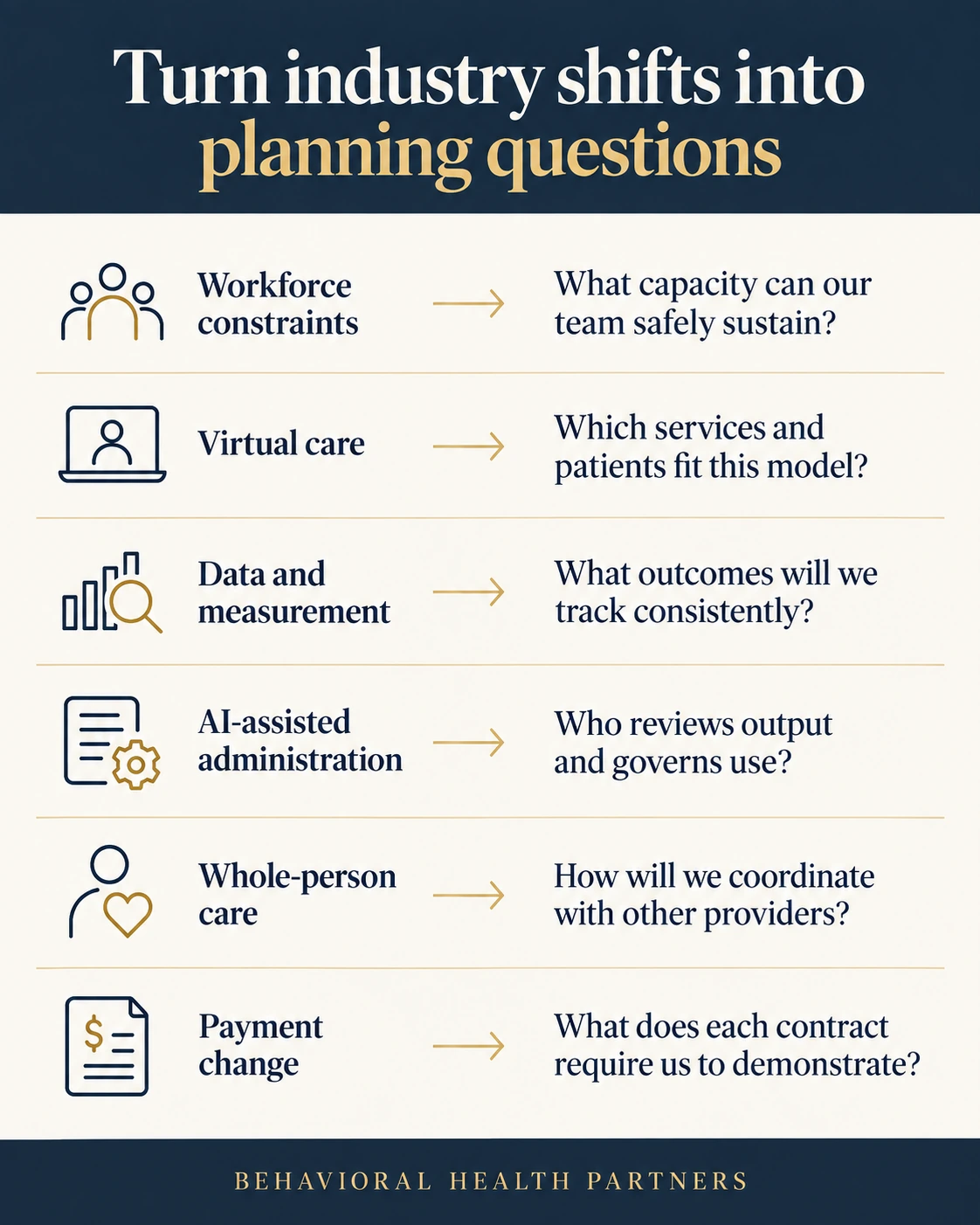
This single constraint explains why so many of the other trends exist. Telehealth, digital tools, measurement-based care, and task-shifting to a broader range of behavioral health providers are, in large part, responses to a workforce that cannot expand fast enough. When you cannot add clinicians quickly, you look for ways to extend the reach of the ones you have.
Telehealth and Virtual Care Are Now Permanent
Telehealth moved from the margins to the mainstream during the pandemic, and it did not go back. Telehealth is now a standard channel for behavioral health, not an emergency substitute, and for many mental health conditions it delivers outcomes comparable to in-person care while reaching people who could never make a weekly office visit.
For providers, telehealth is one of the clearest levers available to expand access. It stretches a scarce workforce across a wider geography, cuts no-shows, and meets younger clients where they already live. It also opens new lines of service, from virtual intensive outpatient programs to hybrid models that blend in-person and remote care. The programs winning here treat virtual care as core infrastructure, with the licensing, technology, and care workflows to match. Our chapter on telehealth and mental health goes deep on adding telehealth to an existing practice and doing it well.
Technology, Data, and AI Reshape How Care Gets Delivered
Behavioral health has historically lagged the rest of health care in technology. That gap is closing fast. Three shifts stand out.
The first is measurement-based care. More programs now use validated assessments at regular intervals to track whether patients are improving, turning clinical impressions into data that care teams can act on. Measurement-based care is quietly becoming the expectation, from payers and from clinicians who want to know what is working. Peer-reviewed work in journals like Health Affairs, and guidance from the National Institute of Mental Health, increasingly frames this kind of measurement as central to good clinical care and stronger care delivery across many health topics.
The second is data and analytics. Programs are learning to use the information they already generate, in the EHR, in billing, in assessments, to improve outcomes and run the business more intelligently. This is the discipline we cover in our guide to analytics for behavioral healthcare, and it is moving from a nice-to-have to a competitive necessity.
The third is artificial intelligence. AI and digital tools are starting to take on administrative tasks, drafting documentation, streamlining clinical workflows, and easing the paperwork burden that drives so much clinician burnout. Used carefully, these tools give clinicians back time for care. The critical caveat is the same one that applies across the field: technology supports the clinician and never replaces clinical judgment. A tool can surface a pattern or draft a note; a person delivers the care.
Digital therapeutics, app-based support, and remote monitoring are maturing alongside these shifts, extending care between sessions. None of it removes the human relationship at the center of behavioral health. All of it, used well, helps a stretched workforce reach more people with better information.
Emerging Clinical Approaches
Alongside the structural shifts, the clinical toolkit is widening. A few developments are worth watching.
Digital therapeutics and app-based programs are increasingly used to support people with lower-severity needs, extending care between sessions and freeing clinicians to focus on higher-acuity cases. Virtual reality is moving into clinical settings for exposure-based therapy, giving clinicians a controlled way to help people work through anxiety and trauma. Psychedelic-assisted therapy, still under active research and regulatory review, is drawing serious attention for treatment-resistant conditions, though it remains early and tightly supervised.
Just as important are shifts in how care is delivered. Peer support and lived experience are increasingly recognized as core parts of recovery, not add-ons. Trauma-informed and culturally responsive care are becoming baseline expectations rather than differentiators. And the field is leaning toward preventive, proactive strategies that reach people earlier, before a manageable problem becomes a crisis. For providers, the throughline is the same as everywhere else in this guide: the innovations that last are the ones that widen access and improve outcomes without losing the human relationship at the center of care.
Integrated, Whole-Person Care Becomes the Standard
For decades, behavioral health and physical health lived in separate buildings, separate records, and separate budgets. That separation is ending. The clearest structural trend in the field is integration: bringing behavioral and physical health together so the whole person is treated, not just one part.
The logic is simple. Behavioral health conditions and chronic conditions feed each other. Depression worsens diabetes; chronic pain fuels substance use; untreated anxiety complicates recovery from nearly any illness, and many patients are managing chronic conditions alongside a mental health condition. Integrating behavioral health into primary care, and primary care into behavioral health, improves outcomes on both sides and supports better medication adherence and chronic disease management. Whole-person care also catches problems earlier, before they land someone in the emergency departments that already absorb too much untreated behavioral health.
For providers, integration is both an opportunity and a demand from payers. Programs that can coordinate across behavioral and physical health, share data safely, and demonstrate results are better positioned for the partnerships and contracts that increasingly reward exactly that. Building that kind of program from the ground up is the work behind our guide on how to build a behavioral health program.
Value-Based Care and Payment Reform
How behavioral health gets paid is changing, slowly but unmistakably. The field is moving away from pure fee-for-service and toward models that pay for results. Value-based care ties reimbursement to outcomes and total cost, which rewards programs that can measure their results and prove them. That shift is a direct reason measurement-based care and data analytics matter so much: you cannot get paid for outcomes you cannot demonstrate. Our chapter on value-based contracting walks through what these arrangements look like in practice.
Policy shifts are pushing in the same direction. Parity enforcement has strengthened. In 2024, federal regulators issued final rules under the Mental Health Parity and Addiction Equity Act requiring health plans to collect and evaluate data on the limits they place on mental health and substance use care, and to fix those limits when the data shows access falls short. Reimbursement rules, telehealth coverage, and coverage requirements continue to evolve, and every change ripples through provider economics. Reimbursement and billing sit at the center of this, which is why we treat behavioral health billing as a strategic function, not a clerical one.
The through-line across payment and policy is accountability. Payers and regulators increasingly want proof that care is accessible, appropriate, and effective. Programs that can show their work will do well as these rules tighten. Programs that cannot will feel the pressure.
What These Trends Mean for Providers
Read together, these behavioral health trends point in one direction: the behavioral health programs that thrive will be the ones that are strategic, measurable, integrated, and built to last. A few practical implications follow.
The common thread is that behavioral health care is becoming more accountable, more connected, and more data-driven. Behavioral healthcare organizations that once competed only on beds now compete on outcomes, access, and experience. The behavioral health market rewards programs that deliver measurable behavioral health services and coordinate them with the wider health care services a person needs. For anyone providing mental health services, the message is consistent: quality, measured and shared, is the new currency. Mental illness and substance use disorder are not going away, and neither is the demand for quality mental health care and behavioral healthcare that actually works.
Build for demand you can actually serve. The need is enormous, but the constraint is your workforce and your systems. Growth that outruns your ability to deliver quality behavioral health care is fragile. Plan capacity around clinicians, technology, and workflows together, not admissions alone.
Make measurement a habit early. Value-based contracts, parity data requirements, and payer expectations all reward programs that can prove their outcomes. The programs that start measuring now will be ready when it becomes mandatory, and better at care in the meantime.
Treat telehealth and technology as infrastructure. Virtual care, data analytics, and AI-assisted workflows are how a small team extends its reach. The programs that adopt them deliberately, with attention to privacy and clinical quality, expand access without burning out their people.
Think whole-person. The future rewards programs that can coordinate behavioral and physical care and demonstrate results across both. Integration is where the partnerships and the contracts are heading.
Above all, plan ahead of the curve. Whether you are opening a new center, adding a level of care, or repositioning an existing program, the moves that matter are the ones made before the trend fully arrives. That is the strategic work behind opening and scaling a behavioral health program, and it is where an experienced partner earns its keep. Strong demand also means competition for the families you serve, which is why smart operators pair clinical excellence with real visibility through behavioral health SEO, thoughtful addiction treatment marketing, and a deliberate approach to rehab lead generation.
Frequently Asked Questions
What are the top three trends in the mental health industry?
The three that touch every provider are the workforce shortage, the shift to telehealth and technology-enabled care, and the move toward value-based, integrated care. Rising demand sits underneath all three. Together they are pushing behavioral health toward measurable, whole-person care delivered by a workforce stretched further with digital tools.
How big is the mental health market?
Behavioral health is a large and growing part of U.S. health care. SAMHSA has projected national spending on the treatment of mental and substance use disorders in the hundreds of billions of dollars, and independent market analyses put the U.S. behavioral health market in the tens of billions and growing at mid-single-digit annual rates. The exact figure depends on how the market is defined, but every credible source agrees on the direction: the behavioral health market is large and climbing, and demand for mental health care is climbing with it.
What are the key mental health trends for the year ahead?
Expect continued growth in telehealth and remote care, wider adoption of AI for administrative tasks and clinical workflows, deeper integration of behavioral and physical care, stronger parity enforcement, and steady movement toward value-based payment. The workforce shortage will remain the central constraint shaping how fast the rest can happen.
What are the largest behavioral health companies?
The field includes large national provider platforms, telehealth-first companies, health-system behavioral divisions, and thousands of independent and regional programs. Consolidation and investment have created several sizable national players, but behavioral health remains highly fragmented, which means well-run independent and regional programs still have real room to compete on quality and access.
Turn Trends Into a Plan
Trends are only useful if they change what you do. The behavioral health landscape is being reshaped by rising demand, a workforce that cannot keep pace, telehealth and technology, integration of behavioral and physical health, and a payment system that increasingly rewards measurable results. None of these is slowing down. The providers who read them early and build accordingly will define the next decade of care.
Behavioral Health Partners approaches this work as a partner, not a vendor, helping programs turn the trends shaping the field into a concrete plan for growth and sustainability. Our founder, Adam Vibe Gunton, a bestselling author, TEDx speaker, and international recovery advocate featured on NBC News Daily, CBS News, and ABC News, built this company on one belief: the more people who can find and stay in quality treatment, the more lives are saved.
If you want a partner to help you read the landscape and build ahead of it, reach out to work with us and we will help you turn these trends into your next move.
Adam Vibe GuntonFounder and Managing Partner, Behavioral Health Partners
Adam Vibe Gunton is an addiction recovery expert, entrepreneur, marketer, brand strategist, and speaker dedicated to advancing the behavioral health industry. As Founder and Managing Partner of Behavioral Health Partners, he has worked across treatment-center development, operations, branding, PR, SEO, advertising, and growth strategy. Combining professional experience with his own lived experience in recovery, Adam brings a unique perspective on how treatment organizations can build trusted brands, reach more people, and create a greater impact.
Thirty minutes on video with Adam directly, camera on, screen-sharing your own online presence and your top three local competitors. If we are not the right partner, we will tell you that too.