The 7 Biggest Healthcare Marketing Challenges for Behavioral Health (and How to Solve Them)
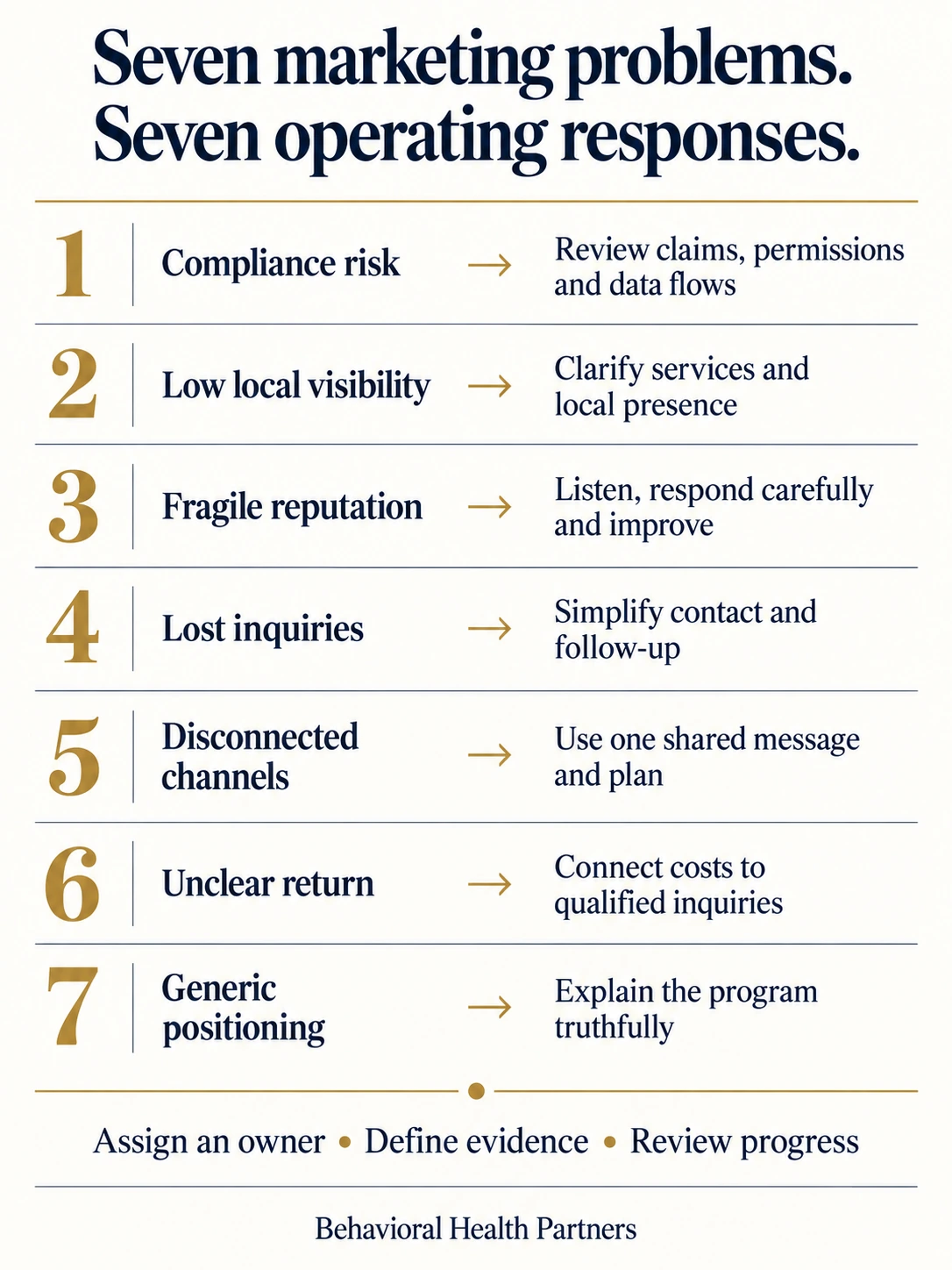
The seven problems that make marketing a treatment center harder than almost any other business, and what to do about each. We cover ad platform restrictions and the compliance gate, patient acquisition in a crowded market, reputation and reviews, turning visitors into admissions, coordinating channels, measuring real return instead of vanity metrics, and standing out when every competitor makes the same promises.
Marketing a treatment center is harder than marketing almost anything else. Behavioral health sits at the intersection of strict regulation, intense competition, and one of the most sensitive decisions a family ever makes, which means the usual healthcare marketing playbook does not fully apply. This article breaks down the biggest marketing challenges behavioral health providers face and the solutions that actually work. If you would rather hand the whole problem to specialists, our addiction treatment marketing team solves these challenges every day, but even if you market in-house, understanding these healthcare marketing obstacles is the first step to overcoming them.
The stakes are real. Rising costs, evolving patient expectations, and a crowded digital era make it hard for healthcare organizations and providers to run effective marketing campaigns that produce measurable results, justify their marketing efforts, and protect their healthcare services and marketing techniques. Across the healthcare industry and its many healthcare organizations, marketing teams struggle to balance digital marketing with compliance, and behavioral health providers and other healthcare organizations feel that pressure most acutely. Below are the most common marketing challenges and healthcare marketing challenges in addiction treatment, and how the best healthcare marketers turn each one into an advantage, protecting service quality and improving the patient experience for the people they provide services to.
1. Navigating Strict Regulations and Ad-Platform Restrictions
Compliance is the single biggest of the healthcare marketing challenges behavioral health providers face. Healthcare marketing is bound by rules that other industries never think about, and behavioral health adds an extra layer on top.
Start with HIPAA. The HIPAA Privacy Rule protects patient data and restricts how protected health information can appear in any marketing content, so a testimonial, photo, or story cannot be used without documented authorization. HIPAA also effectively rules out standard remarketing ads that follow patients around the web, and the uncertainty leaves nearly half of healthcare marketers wary of audience targeting at all. On top of HIPAA compliance, addiction treatment advertisers must be LegitScript certified before Google or Meta will run their ads at all, a hurdle that stops many providers cold. And the FTC requires that any health claim be truthful and substantiated. Its health products compliance guidance sets a standard of competent and reliable scientific evidence, which means marketing that overstates success rates is not just unethical, it is illegal.
The solution is to build compliance into your marketing from the start. Follow HIPAA guidelines and prioritize data security, use HIPAA-compliant tools, exclude protected health information and patient data from campaigns, secure written consent for every patient story, complete your LegitScript certification, and keep claims honest and evidence-based. Strong HIPAA compliance is far cheaper than a violation, and experienced healthcare marketers treat regulatory compliance and maintaining compliance as a design constraint rather than an afterthought.
2. Acquiring New Patients in a Competitive Market
Patient acquisition is a challenge for every treatment center, because health-related searches are intensely local and intensely competitive. For healthcare providers, ranking on Google is not enough when families search for help near them in a moment of crisis.
Strong local visibility is the answer. A well-optimized behavioral health SEO foundation and a complete Google Business Profile put your center in front of prospective patients and potential patients exactly when they are searching. Digital advertising matters too, but relying on digital ads alone is a trap: once the spending stops, so do the results, and generating leads grinds to a halt. The healthcare providers who win balance paid campaigns with consistent healthcare content that builds organic patient acquisition over time, so new patients keep arriving whether or not an ad is running. Video content is especially effective here, since it engages audiences and referral professionals far better than text alone. A data driven approach to keywords and content ensures your marketing efforts and marketing strategies reach the right target audience rather than burning budget on the wrong one.
3. Managing Reputation and Online Reviews
For a treatment center, reputation is everything. Online reviews are often the first touchpoint a family has with your brand, and they shape patient trust before anyone ever calls. Positive reviews build credibility, while unanswered negative ones quietly send potential patients to a competitor.
The solution is an active reputation strategy. Encourage satisfied patients and alumni to leave honest reviews, with consent, and respond to every review promptly and empathetically without ever confirming that someone was a client. Higher patient satisfaction shows up directly in your reviews, and strong reviews help you retain patients and referral partners alike. Our chapter on getting Google reviews walks through how to do this compliantly. Monitor patient sentiment across digital platforms, fold patient feedback into real service quality improvements, and treat reputation management as an ongoing part of your marketing rather than damage control after the fact.
4. Converting Website Visitors into Admissions
Traffic means nothing if it does not convert. Many behavioral health websites lose prospective patients to slow load times, confusing navigation, and a lack of trust signals. When a worried family lands on an outdated or unresponsive site, they leave and call the next healthcare provider.
Fixing conversion starts with the site itself. Patients now expect easy online scheduling and transparent, plain-language information, so a fast, mobile-friendly website design built for the patient journey, with clear calls to action, verified reviews, and accreditation badges, turns visitors into inquiries. Educational content that informs rather than aggressively sells earns far more trust than a hard pitch. Beyond design, conversion rate optimization refines the details that drive admissions: simplified contact forms, live chat, click-to-call, and strong trust signals throughout. Small improvements to the patient experience and evolving patient expectations compound into more admissions from the same traffic.
5. Coordinating Marketing Across Multiple Channels
Behavioral health marketing rarely lives on one platform. Between search, social media, email, paid ads, and direct mail, it is easy to send inconsistent messaging that confuses the exact families you are trying to reach. A one-size-fits-all strategy fails because patient needs and behaviors vary across every service line.
The fix is a connected, omni-channel approach where every touchpoint reinforces one consistent brand voice. Break down internal silos so cross-functional teams work from the same plan, be transparent about how you collect and use data since that transparency itself builds patient trust, and segment your target audience. Use marketing techniques like personalized engagement and highly targeted campaigns tailored to where each person is in the patient journey, and use retargeting to stay present with families still weighing their options. When your digital channels and digital platforms work together instead of competing, marketing performance improves and your healthcare brand feels trustworthy at every step. This kind of patient engagement is what successful organizations across the healthcare industry and healthcare systems rely on to grow.
6. Tracking ROI and Measuring Marketing Success
Proving what works is one of the most common healthcare marketing challenges providers face. Unlike most businesses with instant purchases, the behavioral health patient journey is long and winding: families and prospective patients research many healthcare providers, consult several sources, and often wait weeks before reaching out. That makes attribution genuinely hard.
The solution is disciplined measurement. Most healthcare campaigns report clicks and impressions instead of real return on investment, which tells leadership almost nothing. Implement call tracking and conversion tracking so you can see which campaigns generate real inquiries, and track both digital and offline interactions so nothing falls through the cracks. Connect your analytics for behavioral healthcare to the full patient journey, watch the metrics that matter, and let the data guide decision making. Cost per lead, cost per admission, inquiry-to-admission rate, and patient lifetime value tell you far more than vanity metrics, and they let you move budget toward whatever actually fills beds. This matters most because many treatment centers work with limited marketing budgets, and a data-driven approach lets a smaller team compete by focusing only on the channels that deliver measurable returns.
7. Standing Out in an Oversaturated Market
The addiction treatment market is crowded, and to a struggling family many providers look identical. Standing out is one of the biggest and most common marketing challenges in the field, and it is rarely solved with louder advertising.
Branding is the answer, and branding is far more than a logo. It is the story, voice, and promise that shape how patients perceive you and whether they trust you with a loved one's life. A clear, authentic brand that communicates both expertise and genuine compassion creates the emotional connection that generic outreach never will. Build a consistent visual identity, tell honest stories about your mission and outcomes, and make sure every touchpoint reinforces the same message. In a saturated market, the treatment center with the clearest, most trusted brand becomes the first call.
Why Expert-Led Behavioral Health Marketing Wins
Few healthcare marketing challenges in any part of the healthcare industry are as demanding as these, and many treatment centers attempt to solve all of it in-house, believing a few ads and social posts will drive growth and carry their marketing efforts. More often, do-it-yourself marketing leads to wasted budget, inconsistent messaging, and compliance risk, because behavioral health marketing rewards deep, specific expertise that takes years to build.
Expert-led marketing changes the equation. A team of healthcare marketers and healthcare professionals that lives in this space brings proven marketing strategies, a healthcare marketing strategy tuned to your goals, modern tools, and hard-won knowledge of the regulations and patient behavior unique to addiction treatment. Dedicated healthcare marketing teams handle the work of implementing marketing strategies and digital marketing strategies that generic agencies get wrong, so your healthcare services reach more families without adding headcount. Where traditional methods fall short of modern expectations, the right partner delivers timely care in your messaging, protects service quality, and helps healthcare professionals across your organization stay focused on quality care instead of campaigns. Many healthcare organizations and healthcare practices reach a point where providers struggle to keep up, and that is exactly when expert help pays for itself. If you are tired of fighting these healthcare marketing challenges alone, our team is ready to help. See what we can do and request a strategy conversation through our rehab marketing team.
Frequently Asked Questions
What are the biggest challenges in healthcare marketing for behavioral health?
The biggest healthcare marketing challenges for behavioral health are strict regulations and ad-platform restrictions like HIPAA and LegitScript certification, patient acquisition in a competitive local market, managing online reviews and reputation, converting website visitors into admissions, coordinating consistent messaging across multiple marketing channels, tracking ROI across a long patient journey, and standing out in an oversaturated market. Compliance is usually the hardest, because behavioral health carries rules most other industries never face.
What are the 4 P's of healthcare marketing?
The 4 P's of healthcare marketing are product, price, place, and promotion. For a treatment center, product is your programs and services, price is the cost and insurance experience, place is how and where patients access care, and promotion is how you reach prospective patients. Many marketers add a fifth P, people, since staff and patient experience shape a healthcare brand as much as any campaign.
Why is healthcare marketing so complex?
Healthcare marketing is complex because it combines strict regulatory compliance, a long and emotional patient journey, difficult attribution, and intense competition all at once. In behavioral health, providers also face ad-platform certification requirements and a duty to handle sensitive stories with care. Success requires balancing effective marketing campaigns with compliance and genuine patient trust, which is why many organizations turn to specialists.
What are effective marketing ideas for a rehab facility?
Effective marketing ideas for a rehab facility include building a strong local SEO and Google Business Profile presence, earning honest online reviews, running LegitScript-compliant paid campaigns, publishing helpful behavioral health content, maintaining an active and compliant social media presence, and optimizing the website for conversions. For most healthcare organizations, the most effective approach pairs consistent organic marketing with targeted paid advertising, all built on a clear, trusted brand.
Share this guideLink copied
Adam Vibe GuntonFounder and Managing Partner, Behavioral Health Partners
Adam Vibe Gunton is an addiction recovery expert, entrepreneur, marketer, brand strategist, and speaker dedicated to advancing the behavioral health industry. As Founder and Managing Partner of Behavioral Health Partners, he has worked across treatment-center development, operations, branding, PR, SEO, advertising, and growth strategy. Combining professional experience with his own lived experience in recovery, Adam brings a unique perspective on how treatment organizations can build trusted brands, reach more people, and create a greater impact.
Thirty minutes on video with Adam directly, camera on, screen-sharing your own online presence and your top three local competitors. If we are not the right partner, we will tell you that too.