
Healthcare Business Valuation for Behavioral Health Owners
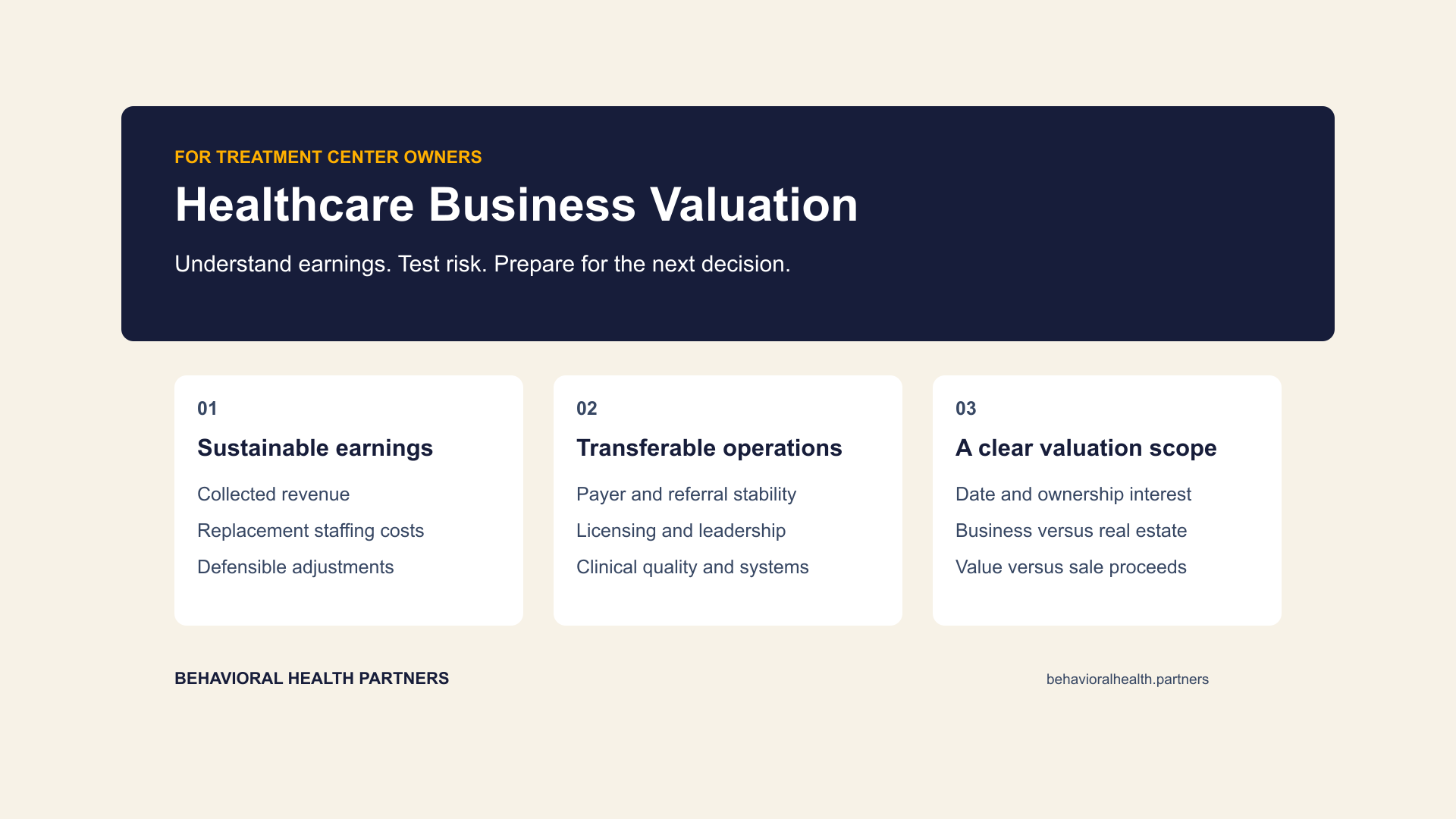
Healthcare business valuation estimates what a healthcare company or ownership interest is worth on a specific date. For an addiction treatment center, that means examining sustainable earnings, payer contracts, clinical operations, and the risks a new owner would inherit. Revenue alone cannot tell you what your center is worth.
If you are considering a sale, partnership, financing, or succession, the number matters. An offer that looks generous can leave you carrying debt, transition costs, or an earnout you cannot control. This guide explains the methods, market context, and preparation work that help addiction treatment and mental health owners evaluate the next decision.
At Behavioral Health Partners, we build, launch, and scale treatment centers. We look at the business behind the care: who gets admitted, what gets collected, whether staffing works, and whether the operation can keep its promises. Those same questions belong in your valuation.
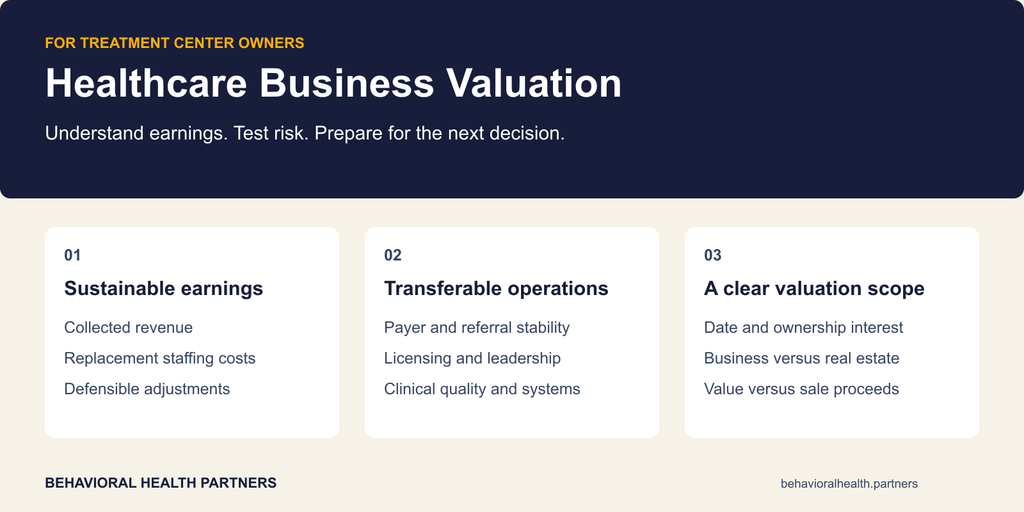
Treatment center value depends on sustainable earnings, transferable operations, and a clearly defined assignment.
What a healthcare business valuation should answer
Before anyone quotes a number, define the assignment: the valuation date, purpose, ownership percentage, and assets included. A whole-company sale and a minority partner buyout are different questions. Buy sell agreements may also specify their own valuation procedures.
Fair market value versus a buyer's offer
Fair market value generally considers a willing, informed buyer and seller acting without compulsion. A particular buyer may see additional value from combining your center with its existing operations. That strategic value does not automatically establish fair market value.
The IRS business valuation guidelines explain why scope, financial adjustments, and the selected methods matter. A useful valuation analysis makes its assumptions visible.
Enterprise value versus your proceeds
Enterprise value describes the operating business before the agreed adjustments for debt and cash. Equity value reflects those adjustments. Your eventual proceeds also depend on transaction costs, taxes, working capital terms, and whether part of the price is deferred.
A $5 million headline price is not necessarily a $5 million check. Compare cash at closing, seller financing, contingent earnouts, rollover equity, and your required transition work. Two offers at the same price can leave you with very different outcomes.
Three valuation approaches for healthcare businesses
Evaluators generally consider the income, market, and asset approaches, then select and reconcile methods appropriate to the business. There is no single formula that produces reliable results for every addiction treatment business.
Income approach and sustainable cash flow
The income approach connects value to expected earnings or cash flow. Evaluators often examine several years of results, including a three-year EBITDA lookback where available, alongside current performance. The historical period should fit the assignment. A stable operating history supports the assumptions; it does not remove the need to test them.
Discounted cash flow for changing operations
Discounted cash flow estimates the present value of future cash flows, including a terminal value beyond the explicit forecast. A five-year projection is one possible model, not a requirement. The discount rate must match the cash flow measure and reflect risk. Test the result when growth slows or the required return increases.
For a growing treatment center, test census, collected reimbursement, staffing, capital spending, and working capital. BHP's treatment center proforma services help build operating projections. A forecast supports a valuation; it does not substitute for one.
Capitalization of earnings
For sufficiently stable operations, an evaluator may capitalize a representative annual benefit stream by dividing it by a capitalization rate. This common method depends on sustainable performance and a rate consistent with the earnings measure used.
Market approach and comparable transactions
The market approach uses completed M&A transactions and, where appropriate, publicly traded healthcare companies. An outpatient therapy practice, an opioid treatment program, and a residential treatment campus are not interchangeable comparables. Adjust benchmarks for size, payer mix, margins, geography, growth, and deal structure.
Completed transaction multiples reflect historical sale prices, not current asking prices. Public-company multiples provide context, but scale, liquidity, and diversification differ from a privately held center. Ask which comparisons survived differences in facility size and why.
Asset approach and real estate
The asset approach estimates the fair market value of relevant tangible and intangible assets less liabilities. It can suit underperforming treatment centers or liquidation scenarios, but an asset-only result may miss a going concern's earning power. Review equipment, leasehold improvements, property, and operational infrastructure rather than relying on book value.
Clarify whether real estate is included or separately owned. Normalize related-party rent, then avoid counting the property's value twice. Our guide to behavioral health real estate explains the operating considerations behind the building.
Normalize earnings before applying valuation multiples
EBITDA means earnings before interest, taxes, depreciation, and amortization. Adjusted EBITDA attempts to show sustainable operating earnings. It is not the same as cash available to distribute: equipment, debt service, taxes, and working capital still require cash.
Owner compensation and defensible adjustments
An owner working as executive director cannot simply add back their entire salary. The business still needs someone to do that job. Adjust owner compensation to a defensible replacement cost, and document genuine one-time expenses separately.
For smaller owner-operated healthcare businesses, an evaluator may consider seller's discretionary earnings. Do not apply an EBITDA market multiple to that different measure. Valuation adjustments must be evidence-based, reflect market conditions, and preserve expenses a buyer would actually incur.
An illustrative addiction treatment center calculation
Consider a hypothetical addiction treatment center business with $600,000 in reported EBITDA. Add back a documented $40,000 nonrecurring expense, then subtract $90,000 for underpaid management replacement costs. Normalized EBITDA becomes $550,000.
At an assumed 5x multiple, illustrative enterprise value is $2.75 million. With $700,000 of debt and $100,000 of eligible excess cash, illustrative equity value is $2.15 million before other deal adjustments, fees, and taxes. The 5x assumption demonstrates the math. It is not a market benchmark or an estimate for your center.
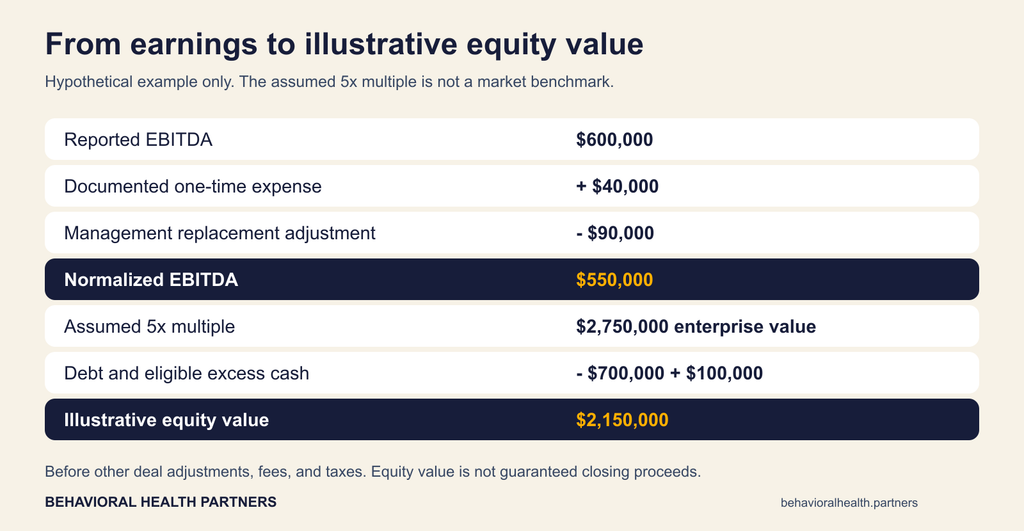
Hypothetical example only. The assumed 5x multiple is not a market benchmark. Equity value is before other adjustments, fees, and taxes.
What published valuation multiples actually tell you
Published ranges are useful starting points when you know what they describe. Scope Research's 2026 addiction treatment analysis, updated August 24, reports 3x to 8x EBITDA for single facilities or small portfolios typically below $10 million in revenue, and 5x to 10x for established regional chains above $10 million. Its broader behavioral health database includes 90 deals with reported EBITDA multiples; those are not all small SUD operators.
HealthFMV's June 2026 guide describes 4x to 8x EBITDA for small to midsized SUD operators. Different groupings produce different ranges. The same guide reports 2.85x to 5.67x cash flow at the 25th and 75th percentiles of current and recently removed sale listings. Those are listing-based observations, not confirmed transaction prices, and the owner's work changes what “cash flow” means.
Before using a multiple range, ask for completed comparable transactions, consistent earnings definitions, and disclosed deal terms. Platform premium multiples do not automatically apply to one facility. Use these typical multiples as context, then have your evaluator establish what fits your business.
Behavioral health acquisitions and the current market
Scope's 2026 report describes lower announced addiction treatment deal activity since 2019, with a substantial exception in 2021. It identifies BayMark as the largest acquirer in its tracked set, with 29 announced deals since 2019. That describes the researcher's coverage, not every private transaction or a guaranteed buyer for your center.
Private equity and strategic buyers remain active in its analysis. However, “multiples have stabilized in 2026” needs stronger evidence than that market commentary. The useful question for an owner is whether current buyers have paid for businesses with comparable earnings, risk, and growth.
What changes addiction treatment business value
The behavioral health sector combines clinical responsibility with reimbursement and staffing complexity. In the addiction treatment industry, these specific factors determine whether earnings are transferable and likely to continue after ownership changes.
Payer mix and reimbursement risk
Payer mix is the share of revenue or collections from each payer category and individual payer. State clearly which measure your report uses. Single payer concentration can expose a center to contract termination, rate changes, or delayed collections.
In-network contracts and a diversified payer mix can support a higher multiple when they make earnings more dependable. Check rates, authorization rules, renewal terms, and assignment or change-of-control provisions. Out-of-network billing requires collection and denial analysis. More contracts do not help if their rates fail to cover care costs.
Use collected revenue, receivables aging, denial trends, and recoupment history to test reimbursement risk. BHP's behavioral health billing guide explains the revenue cycle behind those numbers.
Reimbursement pressure and changes in state policy
Low reimbursement can constrain staffing and margins. MACPAC's provider payment overview explains Medicaid's state fee-for-service and managed care structures and notes that physicians cite low rates as a reason for limiting participation. Value your center using its actual contracts and state payment rules, not a national assumption about Medicaid profitability.
Commercial reimbursement disparities also have evidence behind them. RTI International's 2024 study, using 2019 to 2021 claims data, found average in-network office-visit reimbursement for medical/surgical clinicians was 22% higher than for behavioral clinicians. This is historical office-visit evidence, not a current rate estimate for residential treatment.
Illinois shows why a forecast must distinguish enacted policy from cash already collected. Public Act 104-0446 establishes behavioral health reimbursement floors for covered policies amended, delivered, issued, or renewed from January 1, 2027. It uses a statutory benchmark formula and excludes Medicaid plans. Confirm applicable rates and timing before adding a projected increase to earnings.
Census stability and clinically appropriate retention
High, stable occupancy can demonstrate dependable demand and support predictable earnings. It cannot prove effective care delivery on its own. For residential treatment, compare monthly average daily census with staffed capacity across seasons. Licensed beds that cannot be safely staffed are not usable capacity.
For outpatient programs, patient retention metrics include attendance, recurring visits, and completion of the planned episode. Track referral-source strength separately. Average length of stay needs clinical context: longer stays do not automatically mean better care. Treatment for substance use disorders should follow patient need and medical necessity.
Clinical outcomes data and services offered
Clinical outcomes data should show what was measured, when it was measured, and how many patients completed follow-up. Completion rates alone cannot establish treatment effectiveness. Our behavioral healthcare analytics guide offers a practical starting point.
A full continuum of behavioral health services can support patient retention through appropriate transitions, reduce gaps in care, and increase revenue across an episode. It also adds staffing, licensing, and coordination costs. Report SUD services separately from mental health services when reimbursement and costs differ. Expansion earns its place when patient need and service-line economics support it.
Programs offering medication assisted treatment should document clinical governance and applicable requirements. SAMHSA's guidance on medications for opioid use disorder provides a credible clinical reference. Patient care determines the service model; a hoped-for multiple should not.
Regulatory compliance and ownership changes
Review licenses, surveys, corrective actions, payer audits, referral arrangements, and pending disputes. Joint Commission or CARF accreditation can matter to partners and payers, but it does not replace state authorization. Confirm transaction requirements early with state regulators and qualified counsel. BHP's state licensing team helps operators navigate program requirements.
The HHS-OIG overview of fraud and abuse laws covers the Anti-Kickback Statute and physician self-referral law, commonly called Stark Law. Their applicability differs. Healthcare transactions can face additional fair market value and commercial reasonableness requirements beyond ordinary business pricing, especially in compensation or referral-related arrangements. A fair price alone does not establish compliance; qualified counsel must assess the arrangement, including applicable addiction-treatment and state laws.
Protect records during diligence. HIPAA and, where applicable, 42 CFR Part 2 affect how information can be shared. HHS states that compliance with the 2024 Part 2 final rule was required by February 16, 2026. Start with aggregated information and have counsel review any patient-level disclosure.
Leadership and referral dependency
Key-person dependency creates operational risk and reduces transferability. If admissions depend on one physician, therapist, or founder, a departure can interrupt patient volume and earnings. Identify who owns referral relationships, clinical supervision, prescribing, and payer negotiations. Document replacement costs and a transition plan. Buyers need evidence that the operation can function when you leave.
Technology matters too. An outdated EHR, unreliable reporting, or unsecured systems can create replacement costs. Include necessary investments in operational infrastructure and physical assets in the forecast. Cosmetic improvements should not take priority over safe, functional clinical operations.
Personal goodwill versus enterprise goodwill
Personal goodwill is value tied to an individual's reputation, relationships, and capabilities. Enterprise goodwill is value associated with the organization, including its brand, systems, team, and durable relationships. If every referral partner calls your personal phone, ask what would remain after your exit. Have the evaluator and counsel assess ownership and transferability rather than assigning a goodwill premium yourself.
Prepare your addiction treatment center for valuation
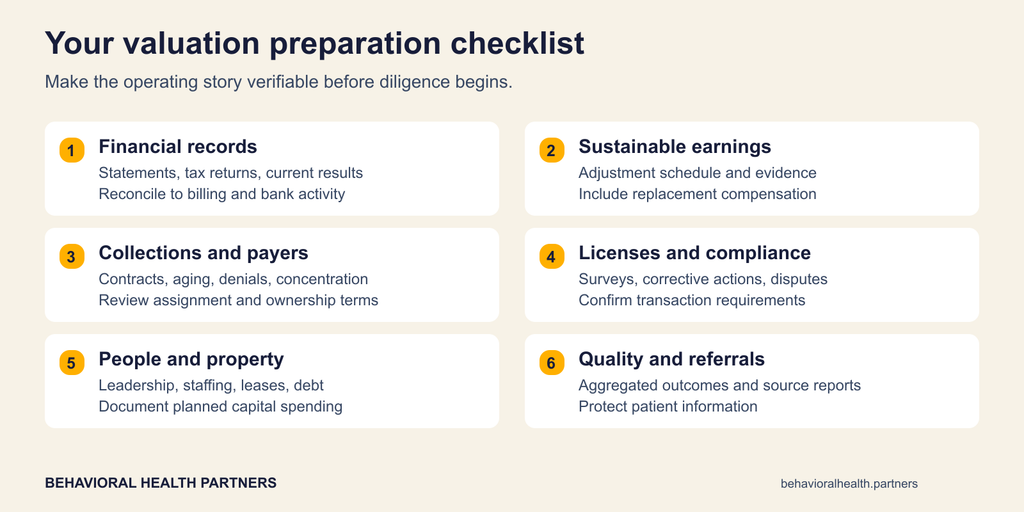
Prepare a verifiable operating story and protect patient information throughout diligence.
Build a secure diligence folder before you approach buyers. Reconcile the financial statements to tax returns, billing reports, and bank activity. Explain differences instead of leaving an evaluator to guess.
Include:
- Three years of financial statements and tax returns, if available, plus current year-to-date results.
- Monthly revenue, collections, census, and profitability by site and level of care.
- An EBITDA adjustment schedule with invoices and replacement compensation support.
- Payer contracts, concentration reports, receivables aging, denials, and repayment obligations.
- Licenses, accreditation records, surveys, corrective actions, and material legal matters.
- Staffing and compensation schedules, leadership responsibilities, leases, debt, and capital expenditure plans.
- Aggregated outcomes and referral reports, with privacy controls for any further disclosures.
For a newer center, disclose the shorter operating history. Do not present an annualized strong month as proven annual earnings. Ask the evaluator what additional history and forecast support the assignment needs.
Improve business value through better operations
Give each improvement an owner and a deadline. In the first 30 days, reconcile accounts and document EBITDA adjustments. Next, review payer concentration, denials, clinical-provider dependency, and licensing obligations. By day 90, test the operation's ability to run without the founder and review admissions-to-collections reporting. Keep a record of resolved issues so diligence can verify the work.
For strategic planning before expansion, commission a treatment center feasibility study. Local demographics, treatment need, workforce availability, insurance coverage, and competition shape patient volume and business value. A national behavioral healthcare market growth story cannot establish demand for your specific location.
Healthcare business valuation questions owners ask
How long does a valuation take
Timing depends on scope, record quality, and unresolved questions. Ask for a written schedule from complete records to draft findings and final report, including who answers follow-up questions. A simple internal planning estimate and a multisite transaction require different work; a universal four-to-eight-week promise would hide that distinction.
Who should provide healthcare valuation services
Choose an independent professional with relevant valuation credentials and behavioral health experience. Ask about methods, comparable transaction access, conflicts, and report use. For investors and lenders, a credible valuation can support financing discussions alongside cash flow, collateral, and underwriting. It does not guarantee funding. A broker's pricing opinion serves a different purpose from a formal appraisal.
Does strong revenue mean a higher valuation
Only if the economics support it. Growth with weak collections, high staffing costs, or recurring compliance problems can leave little sustainable cash flow. A buyer needs transferable earnings, not just a larger revenue number.
Can BHP help before a valuation or sale
BHP supports the operational work behind a stronger treatment center: financial modeling, feasibility, licensing, accreditation preparation, and marketing. Engage an independent evaluator for a formal valuation and qualified legal and tax advisers for transaction decisions.
If you need to understand where your operation is strong and where it needs work, schedule a free consulting call with Behavioral Health Partners. Bring your level of care, location, payer mix, and next decision. We will start with the business you actually have and the people it exists to serve.

Adam Vibe Gunton is an addiction recovery expert, entrepreneur, marketer, brand strategist, and speaker dedicated to advancing the behavioral health industry. As Founder and Managing Partner of Behavioral Health Partners, he has worked across treatment-center development, operations, branding, PR, SEO, advertising, and growth strategy. Combining professional experience with his own lived experience in recovery, Adam brings a unique perspective on how treatment organizations can build trusted brands, reach more people, and create a greater impact.
More about Adam