Service Pages for Rehab SEO: How to Build Pages That Rank and Fill Beds
Service pages are where rehab SEO turns into admissions. We cover what a service page is and why it carries more weight than any blog post, how to target one intent per page, and the on-page work that makes search engines understand it. We cover the structure every service page should share, how to connect service pages to place, and how internal linking feeds them authority.
Service pages are where rehab SEO turns into admissions. Blogs build authority and location pages catch nearby searches, but the service page is the page a family lands on when they search "detox program" or "IOP for alcohol," and it is the page that either earns the call or loses it. Search engine optimization for treatment centers succeeds or fails one service page at a time. This is a chapter of our complete guide to behavioral health SEO, and it goes deep on one thing: how to write service pages for rehab SEO that rank in the search engines and convert visitors once they arrive. The head terms for hiring an agency belong to our drug rehab SEO page; this page is the on-page playbook you can run yourself.
Every level of care gets its own service page, because search engines rank pages, not websites, and one page cannot rank for detox, PHP, and IOP at once. A service page for rehab SEO wins on search intent first: match what the searcher actually wants, structure the page so search engines understand it and rank it in the search results, and give a prospective family one obvious next step. Keyword research sets the target, on-page optimization earns the ranking, internal links pass authority from your blog posts and pillar into the page, and conversion design turns the visit into a call. Do this across every program and every location and your treatment center stops depending on a single page to carry the whole site. This is the on-page core of search engine optimization for any rehab, the heart of a working SEO strategy, and it is the part a busy team can execute without a full agency.
What Is a Service Page for Rehab SEO?
A service page is a single web page dedicated to one service you offer: medical detox, residential, partial hospitalization, intensive outpatient, outpatient, medication assisted treatment, dual diagnosis. In rehab SEO, the service page is the workhorse. It targets the relevant keywords for that specific program, it answers the questions a searcher has about that level of care, and it gives the search engines a clean, single-topic page to rank in the search results for those search queries. For addiction treatment centers, the service page is where a broad target audience of families, referrers, and searchers narrows to the one program that fits, and where potential clients decide you are the right call. Every service page you create adds to an online presence built for that target audience.
The mistake that sinks most treatment facilities is one page trying to describe everything. A single page listing "detox, residential, PHP, IOP, and outpatient" tells the search engines and their algorithms nothing specific, so it ranks for nothing specific in the search results. Create separate pages, one per service, and each one becomes a focused entry point into your site. More service pages, built well, means more doors into your online presence, more keyword rankings, more organic traffic, and more prospective clients and potential clients arriving on the exact page that matches their need. Each page you create separates one intent from the rest, which is why multiple pages beat one crowded page every time.
This is not unique to healthcare. An accounting firm builds a page per service, a plumber builds a page per service, every serious service based business does the same, because service based businesses all win the same way, one strong page per offering. Any business that offers services online lives or dies by how well those service pages are built, and treatment is no different. When you create content this way, one page per service, you enhance online visibility with every page you add. What makes rehab different is the stakes and the compliance layer around them; what stays the same is the structure.
Why Service Pages Are Critical for Drug Rehab Centers
Service pages do three jobs at once for drug rehab centers, and each one compounds.
First, they win specific search queries. Someone searching "medical detox near me" has different intent than someone searching "what is a partial hospitalization program," and a dedicated page for each captures both instead of splitting the difference and losing both. Matching search intent is how search engines decide who ranks, and it is the single strongest lever in service page optimization; a page that answers exactly what the searcher wants is what search engines put first, and it earns the ranking and the click.
Second, they multiply your visibility. A treatment center with eight strong service pages has eight ranked entry points into the search engine results, not one. Each page can rank for its own cluster of keyword rankings, climb the search engine rankings on its own merits, pull its own organic traffic, and feed its own inquiries from potential customers. That is how drug rehab centers build an online presence and real online visibility that does not live or die by the homepage.
Improving your website's SEO this way also improves online visibility across every program at once. Third, they build authority and trust. When each program has a thorough, honest page, the whole website reads as a real provider with deep expertise, and both the search engines and families reward that. Thin or missing service pages read as a thin provider. In a field where a family is choosing where to send someone they love, the depth of your service page content is itself a trust signal.
Keyword Research: Target One Intent Per Page
Every service page starts with keyword research, and the goal is not the biggest keyword but the right one. For each program, map the terms real people use: "alcohol detox," "opioid detox timeline," "IOP for young adults," "dual diagnosis treatment." Group them by search intent and by the target audience behind each search, then assign one primary intent to one page. When two keywords mean the same thing to a searcher, they belong on the same page; when they mean different things, they need separate pages.
Favor keywords you can realistically win: a keyword difficulty around 40 or below is a sensible ceiling for most treatment center pages, and long-tail, specific searches are gold because they signal readiness and carry less competition. "Depression and alcohol treatment that takes Aetna" will never have the volume of "rehab," but the person typing it is far closer to a call. Our chapter on drug rehab SEO keywords walks through the full research process and the keyword sets most treatment facilities miss. Whatever tools you use, the output is the same: a keyword map that assigns one clear target and one search intent to every service page before a word is written. Align that map to your business goals, because the programs you most need to fill are the pages that most need to rank, and treatment facilities that skip this step optimize the wrong pages.
On-Page Optimization: Make Search Engines Understand the Page
Once the target is set, on-page optimization is what helps search engines understand what the page is about. Search engine optimization at the page level is not exotic; all of it is discipline.
Start with structure. One H1 that names the service and its intent, H2s that break the page into the questions a searcher asks, and H3s beneath them for detail. This header hierarchy is both a readability tool and a signal that helps search engines understand the page's organization, and search engines reward pages they can parse cleanly at a glance. Write in short paragraphs and scannable sections, because a family in crisis skims before they read.
Handle the metadata deliberately. Google generates the title link from your page, drawing on the title element, headings, and prominent text, so write a clear, descriptive title for each service rather than a vague or boilerplate one repeated across pages. For the snippet, Google usually pulls from page content but will use your meta description when it better matches the query, so write a unique meta description per page with page-specific detail instead of a keyword string. Get the URL right too: Google recommends descriptive, readable URLs with words separated by hyphens, so /detox/ and /intensive-outpatient/ beat /services?id=4. Clean site structure is part of technical SEO, so group your service pages logically under a services or programs directory so both humans and the search engines read the structure at a glance.
Then write the page for the searcher and place the relevant keywords naturally: in the H1, in an early paragraph, in a subheading or two, in the meta. Placing keywords is not stuffing keywords. High quality content that fully answers one intent will rank; a page packed with repeated phrases will not, and Google's systems increasingly treat keyword stuffing as a negative signal. Technical SEO carries the rest: fast load, mobile-first layout, and clean markup so the page is easy for the search engines to crawl and easy for people to use. Strong service page content is high quality content first and optimized content second; get the website content right for the reader, then let page optimization and technical optimization sharpen it. Consistent content creation across every program is what separates a full site from a placeholder.
Structure Every Service Page the Same Way
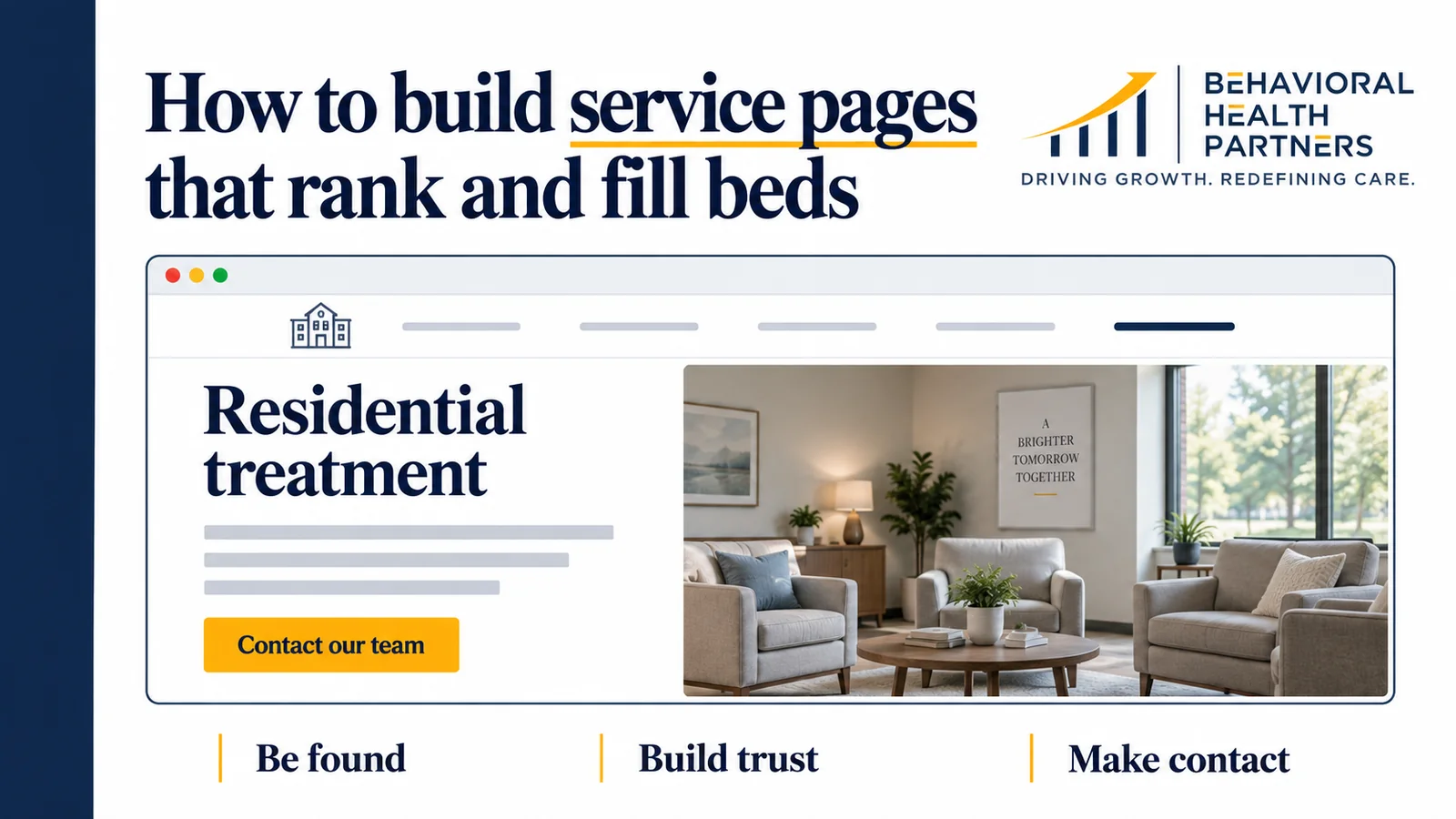
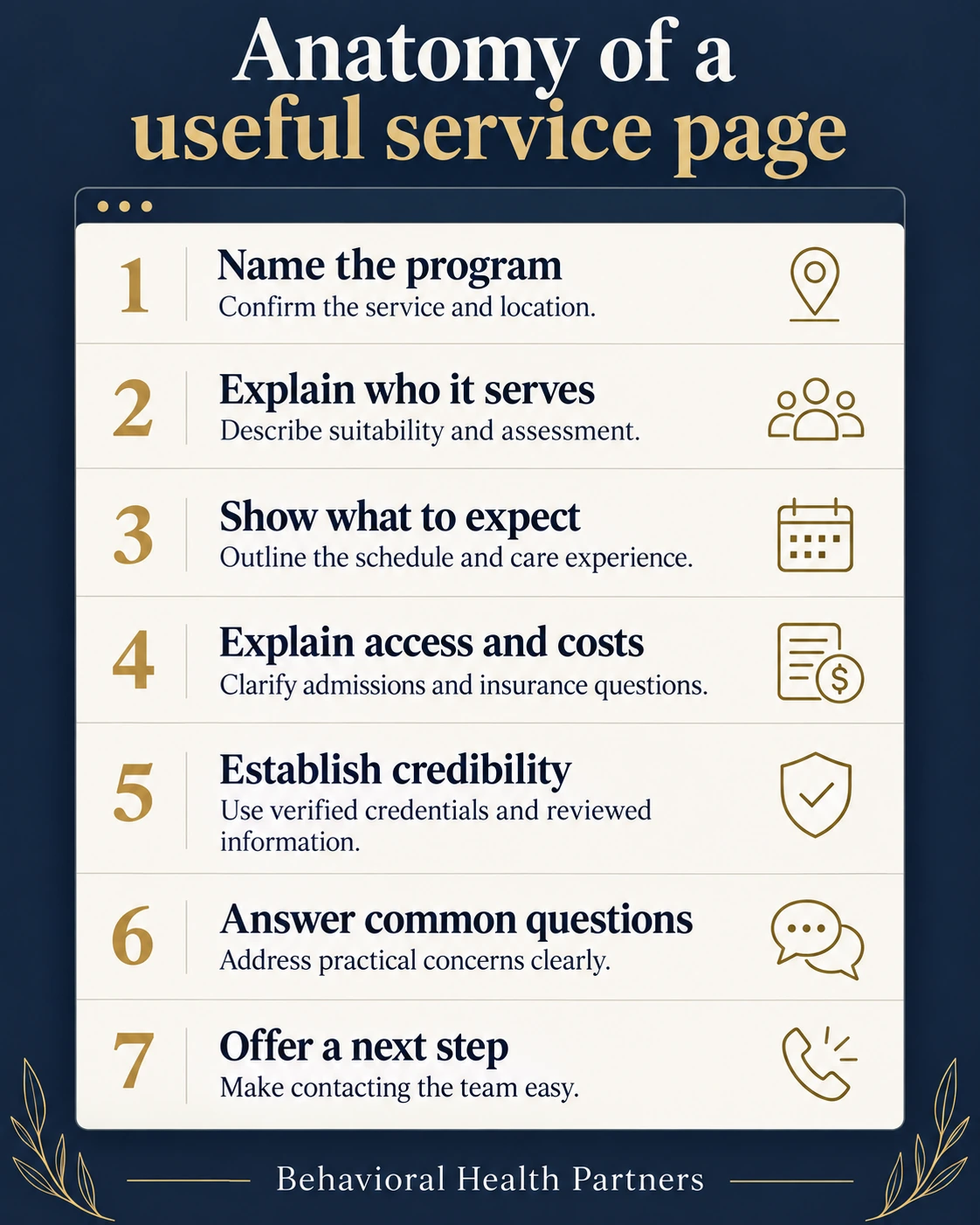
The strongest service pages follow a repeatable pattern, which also makes them faster to produce across a whole treatment center. A service page for rehab SEO generally moves through: a headline that names the program and the benefit, a short opening that confirms the searcher is in the right place, what the level of care is and who it fits, what a day or week in the program looks like, what conditions or situations it treats, how admissions and insurance work, proof in the form of credentials and outcomes, answers to the common questions, and a single clear call to action. Write it long-form and benefits-focused: comprehensive, descriptive copy that walks through the treatment process and options outperforms a thin page every time, and it gives search engines more to rank. Bullet points and short sections carry the scannable parts; prose carries the parts that build trust. Put the essential details a family needs, level of care, conditions treated, insurance, admissions, on the same web page rather than scattering them, because a single page that answers everything about one program outperforms three thin pages that each answer a fraction.
Every element earns its place by serving either the searcher or the search engine, usually both. The "who it fits" section captures long-tail search queries. The insurance section answers the question that stops most calls. The FAQ block earns featured placement in the search engines and increasingly gets pulled into AI answers. The proof section, real credentials, outcomes, and client testimonials or reviews, builds the trust that turns a reader into a call, and it reinforces the experience, expertise, authoritativeness, and trustworthiness (E-E-A-T) that Google demands of health pages. The call to action converts. A page missing any of these leaks either rankings or admissions.
Local SEO: Connect Service Pages to Place
Most rehab searches carry local intent, so service pages and local SEO work together, and location pages extend the reach. Search engines read geography as intent, so weave it into the page naturally, in the copy, the title, and the headings, so a program page also answers "medical detox in [city]" without reading like it was written for a robot. For multi-location providers, the cleanest structure pairs service pages with location pages: local SEO lives on the location pages, program detail lives on the service pages, so each location has its own page and each service has its own page, and the two link to each other where relevant.
Anchor all of it to a complete Google Business Profile, because for local search queries, Google Maps and the local search results are often the first thing a searcher sees on Google and the other popular search engines. Keep name, address, and phone consistent everywhere, keep the profile current, and earn reviews continuously. Our guide to Google Business Profile optimization covers the profile itself, and our chapter on local SEO for rehab centers covers how local SEO and local search results actually work, and how location pages earn them. Do not embed a video in the service page; link to the relevant video near the top instead, and keep the page fast.
Internal Linking: Feed Authority Into Your Service Pages
Service pages are closing rooms, and internal links are how you send traffic and ranking authority into them. Every relevant blog post should link to the service page it supports: a blog post on "signs you need detox" links into the detox service page, using descriptive anchor text that names the service, and every blog post you publish should point to the relevant pages it supports. Your pillar page links down to every service page, and each service page links up to the pillar and across to two or three genuinely related pages, so authority flows through related pages instead of pooling on one. This hub-and-spoke pattern concentrates authority where conversions happen.
Use descriptive, varied anchor text that tells both the reader and the search engines where the link goes, and link only when it genuinely helps the reader; a page stuffed with internal links helps no one. Done right, internal linking turns every piece of content you publish into a feeder for the service pages that actually book admissions, and it is one of the highest-return, lowest-cost moves in all of rehab SEO. Our list of rehab website design best practices covers how the site around these links should be built.
Design the Page to Convert
Search engines can send the traffic, but ranking is only half the job; converting the visitor is the other half. A service page that ranks but does not convert visitors is a leak, not an asset. Give the page real facility photos rather than stock, testimonials and reviews that prove the outcome, a clear and repeated call to action, transparent insurance and admissions information a family can find in seconds, and a mobile layout that works one-handed at midnight. Keep the primary next step obvious on every screen, because user engagement and a clear path are what convert visitors into prospective clients. The page should feel like the front door of a real place, because to a searching family, it is.
Build It Once, Then Build It Everywhere
The reason service pages are the backbone of rehab SEO is leverage. Get the pattern right on one program, and you can build it across every level of care and every location you serve. Each new page is a new ranked entry point, a new source of organic traffic, and a new door for a family who needs you. Measure each one in Google Search Console and Google Analytics, watch which pages produce inquiries against your business goals, and refine from there. Tracking your website's visibility in Search Console tells you which programs are winning and which need work, and steady iteration is what turns a business online into a durable source of admissions and long-term online success. That is how a treatment center stops hoping for traffic and starts engineering it.
When to Bring in Help
Most treatment centers can build strong service pages in-house with this chapter and a disciplined process. Others reach a point where the work outpaces the team, and that is when an SEO team or outside SEO company earns its keep. That is a real SEO strategy decision, not a reflex. A good first step is an SEO audit of your existing pages, the same audit that opens most SEO services engagements: it shows which programs already rank, which pages leak, and where the fastest wins hide. Professional SEO services and content marketing services then scale what the audit finds; the right SEO services turn a one-page site into a full library of ranked programs, and focused SEO efforts on the pages that matter beat scattered SEO efforts across the whole site, building and optimizing pages faster than an admissions team ever could between calls.
Choosing an SEO service provider follows the same test we cover in the behavioral health SEO hub: pick an SEO provider, SEO service provider, or SEO agency that works in behavioral health specifically, stays current with search engine algorithms and industry trends, backs its SEO strategy with reporting, and reports in admissions rather than vanity metrics. SEO services for treatment centers vary wildly in quality, so weigh the SEO strategy on offer, not the logo. Good SEO services start by improving your online presence where it converts, on the service pages, before chasing anything flashier. Ask any SEO provider to show the service pages they have built and the search engine rankings those pages earned; a strong SEO provider will have both, and a working SEO strategy always shows its work. The head terms for that decision, rehab SEO company, services, and agency, live on our drug rehab SEO page for a reason; this chapter stays focused on the pages themselves. Whether you build in-house or hire out, the business owner who owns the assets, the pages, the content, the profiles, wins in the long run.
Two more distinctions matter when you compare SEO services. Comprehensive search engine optimization services cover audit, strategy, on-page builds, content, and links as one program, while à la carte SEO services sell pieces; treatment centers usually need the program. And a page that ranks but does not convert is a failure of both design and strategy, so a real SEO strategy pairs rankings with the conversion work that turns a searcher into a call.
If you would rather have this built for you, service pages are one of the first things we build for partners, and we measure them in admissions, not rankings. Schedule Your Free Discovery Call and we will look at your current pages together, no pitch on the first call.
Service Pages for Rehab SEO FAQs
How do I make my rehab service page rank higher on Google?
Target one clear search intent per page, structure it with a descriptive H1 and logical headings, write high quality content that fully answers that intent, handle the title, meta description, and URL deliberately, and feed the page internal links from related blog posts and your pillar. Then earn local signals through a complete Google Business Profile and reviews. Higher search engine rankings and better placement on the search engine results page follow relevance and authority, and consistent SEO efforts compound them, in that order. This is the same on-page discipline that lifts addiction treatment centers past thin competitors.
How many service pages should a treatment center have?
One per distinct service or level of care, plus a page for each location if you operate in more than one. A center offering detox, residential, PHP, IOP, outpatient, and dual diagnosis needs six service pages, not one combined page. If two programs serve genuinely different searchers, they get separate pages; if they are the same thing by a different name, they share one.
What is the difference between a service page and a location page?
A service page describes one program, such as medical detox, and targets service search queries. A location page describes what you offer in one place and targets local search queries like "rehab in [city]." Multi-location providers build both and link them together, so each service and each location has its own optimized page.
How often should I update my service pages?
Review service pages at least twice a year, and update sooner when a program changes, insurance relationships change, or a page's rankings slip. The search engines favor accurate, current pages, and families deserve accurate information. Refresh outcomes, photos, and insurance details, re-check that each page still matches how people search for that program today, and confirm the page still signals to search engines which program it covers.
Do images really help service page SEO?
Yes, in two ways. Real photos of your facility and staff build the trust that converts a visitor into a call, and properly named, alt-texted images help search engines understand the page and give the search engines more context about it. Avoid generic stock imagery, which families spot instantly, and never let heavy images slow the page down, because page speed is a core piece of technical SEO and a ranking and conversion factor at once.
Adam Vibe GuntonFounder and Managing Partner, Behavioral Health Partners
Adam Vibe Gunton is an addiction recovery expert, entrepreneur, marketer, brand strategist, and speaker dedicated to advancing the behavioral health industry. As Founder and Managing Partner of Behavioral Health Partners, he has worked across treatment-center development, operations, branding, PR, SEO, advertising, and growth strategy. Combining professional experience with his own lived experience in recovery, Adam brings a unique perspective on how treatment organizations can build trusted brands, reach more people, and create a greater impact.
Thirty minutes on video with Adam directly, camera on, screen-sharing your own online presence and your top three local competitors. If we are not the right partner, we will tell you that too.