Behavioral Health Billing: The Complete Guide to Getting Paid for the Care You Provide
Clean claims are what turn care into revenue, and this is where most behavioral health practices quietly lose money. We cover what makes behavioral health billing different, the revenue cycle step by step, and the CPT codes this field runs on. We cover denial management, the honest comparison between in-house and third-party billing, and how to build a billing system that survives an audit.
Great clinical care does not pay the bills. Clean claims do. Behavioral health billing is where treatment turns into revenue, and it is where most behavioral health practices quietly bleed: published figures put denial rates anywhere from 15 to 30 percent, versus roughly 8 to 12 percent in general medical billing. That gap is not bad luck. It is the predictable result of stricter documentation standards, tighter privacy rules, and payer specific requirements that change from contract to contract.
This guide covers the entire discipline: what makes billing for behavioral health services different, the revenue cycle step by step, the CPT codes and per diem codes that matter at every level of care, denial management, and the honest tradeoffs between in-house and third-party billing. We work inside these systems every day through our behavioral health consulting engagements, and everything below is the standard we hold our own partners to. One rule sits above all of it: never cut corners. Bill your first claim through your last claim as if the auditor is already reading it, because someday one will be.
What Makes Behavioral Health Billing Different
Unlike general medical billing, where a lab result or an X-ray proves the service, behavioral health billing rests on clinical judgment that must be written down, session after session. A broken arm documents itself. A therapy session does not. That difference cascades through the codes, the documentation, the prior authorization workload, and the denial patterns. Behavioral health treatment also spans individual, group, and family therapy, plus detox, residential, and outpatient programs, so billing teams juggle multiple CPT and HCPCS codes with modifiers that general medical billing rarely touches.
Payer-to-payer variation compounds it. One insurance company covers 60 minute sessions without question; another audits every one. One payer wants weekly treatment plan updates; another wants monthly. Behavioral health providers who treat billing as an afterthought discover these differences one denial at a time.
Medical Necessity Is Proven Per Session, Not Per Episode
In behavioral health, medical necessity must be documented for every single session. Not once at intake. Every visit. The note has to establish what was treated, why the service was clinically necessary that day, what was done, and how long it took, because behavioral health claims depend on proving the service provided and its duration. This is also where the subjectivity problem lives: there is no lab value for progress in therapy, so payers scrutinize the narrative. Per-session documentation failures that never mention medical necessity are one of the largest single sources of claim denials in this field, and they are entirely preventable.
Privacy Rules Are Stricter: HIPAA Plus 42 CFR Part 2
Privacy regulations in behavioral health go beyond anything the medical side deals with. Substance use disorder treatment records are governed by 42 CFR Part 2, a federal confidentiality regulation that layers on top of HIPAA and restricts how SUD records can be disclosed, including to payers. The 2024 final rule aligned Part 2 more closely with HIPAA, but the standard remains higher, and SUD billing that ignores it creates compliance exposure no revenue is worth. Your billing workflow, your release forms, and your EHR system configuration all need to respect it from day one.
Mental Health Parity Laws: What They Protect and Where You Still Fight
Mental health parity laws, anchored by the federal Mental Health Parity and Addiction Equity Act, generally prohibit health plans from imposing more restrictive financial requirements or treatment limitations on behavioral health services than on medical and surgical benefits. In practice, mental health parity laws are a shield you have to raise yourself: visit limits, aggressive medical necessity criteria, and prior authorization walls still show up, and they are appealable when they violate parity. Every billing manager in this field should know these protections cold, because payers count on behavioral health providers not knowing them. Mental health parity laws do not enforce themselves; documentation and escalation do.
The Behavioral Health Revenue Cycle, Step by Step
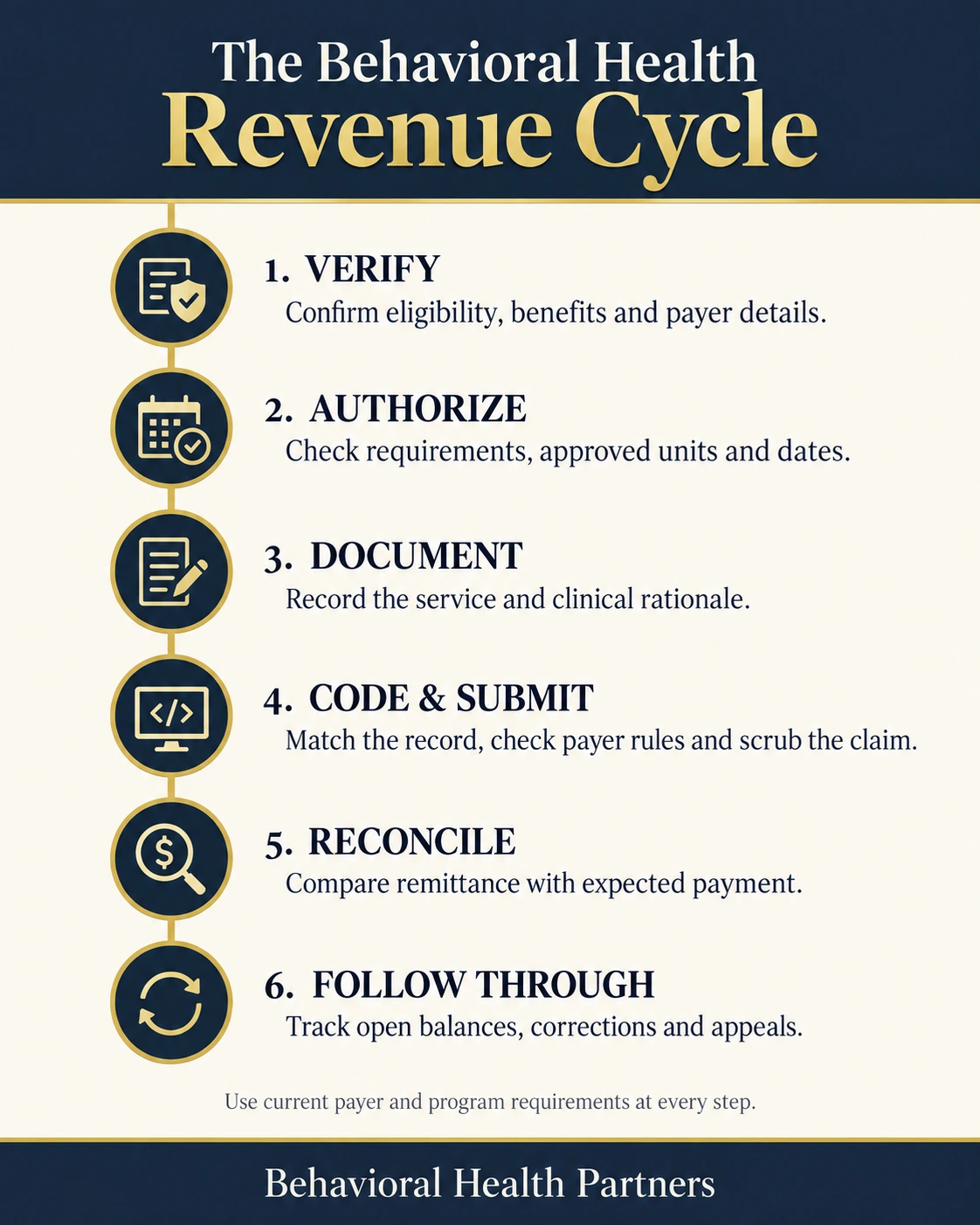
Revenue cycle management is the full financial life of a client encounter, from the first eligibility check to the final zero balance. Behavioral health billing involves genuinely complex revenue cycle management processes: more moving parts, more payer rules, and more places to leak money than almost any other specialty. The revenue cycle below is the sequence we hold every partner facility to. Skip a step and you will find it later in your denials.
Step 1: Insurance Verification and Client Eligibility at Intake
Eligibility verification must happen at intake for behavioral health services, before the first appointment, every time. Verify client eligibility, confirm behavioral health benefits specifically (they are often carved out to a separate payer), document the deductible, copay, session limits, and telehealth coverage, and log a reference number. Then re-verify at the start of every month, because coverage lapses quietly. Automated eligibility checks improve cash flow and first-pass accuracy at the same time, catching lapsed policies before the session happens instead of 45 days after the claim dies. Insurance verification is unglamorous, and it prevents more denials than any other single habit.
Step 2: Prior Authorization Before the First Billable Hour
Prior authorization is often required for mental health and substance use services, and it is close to universal for higher levels of care like detox, residential, and partial hospitalization. It is an administrative burden nobody escapes, so systematize it: get the authorization number, the approved units, the date span, and the level of care in writing before treatment starts. Track units burned against units approved in real time, and calendar the concurrent reviews, because an expired authorization does not just deny one claim. It denies every day of care delivered after it lapsed.
Step 3: Clinical Documentation That Proves the Claim
Clinical documentation is the load-bearing wall of behavioral health billing. High-quality documentation reduces claim denials more reliably than any appeal strategy, because the claim is only as strong as the note behind it. Incomplete documentation is a leading cause of claim denials across this entire industry. The standard: every note establishes medical necessity, ties the session to the treatment plan, records start and stop times for time-based codes, and is signed before the claim goes out. Proper documentation is the evidence file for money you have already earned, and the treatment plan it points back to should be current, measurable, and reviewed on each payer's schedule.
Step 4: Coding and Claim Submission
Coding turns the note into the correct CPT codes, HCPCS codes, and modifiers, matched to the right diagnosis and the payer's rules. Accurate coding here is everything: a 45 minute session billed under the 60 minute code is not a rounding choice, it is a false claim. Claim submission should run through automated claim scrubbing, which reduces human error before the payer ever sees the claim and measurably increases clean claim rates. Systems that pull codes directly from clinical documentation reduce manual data entry errors, which is where most human error hides. Submit daily, not weekly. Cash flow follows claim velocity.
Step 5: Payment Posting and Patient Billing
Post every remittance the day it arrives, reconcile the payment against the contracted rate rather than just accepting what came in, and move the patient responsibility to a statement immediately. Underpayments hide in plain sight when posting lags: payers processing millions of claims make errors too, and the only practice that catches them is the one comparing every payment to the contract. Patient billing deserves the same discipline: clear statements, sent promptly.
Step 6: Claim Tracking and Accounts Receivable Discipline
Every submitted claim gets a status within 14 days, no exceptions; revenue cycle management lives or dies in follow-up. Behavioral health practices are notorious for slow accounts receivable, and the cause is almost never the payer alone. It is submitted claims nobody followed, denials nobody worked, and appeals nobody filed. Work the aging report weekly by dollar value, not claim count. High appointment no-show rates make this discipline even more important in behavioral health practices, because every delivered session that goes uncollected compounds the no-show revenue you already lost.
CPT Codes for Behavioral Health Services
CPT stands for Current Procedural Terminology, the code set maintained by the American Medical Association that tells the payer exactly what service you delivered. Behavioral health services rely heavily on time-based psychotherapy codes, which means the clock in the note has to justify the code on the claim. Master the short list below and you have covered the overwhelming majority of outpatient behavioral health billing.
The Outpatient Psychotherapy Codes Every Biller Lives In
CPT code 90791 is the psychiatric diagnostic evaluation, billed at intake. The psychotherapy series is time-based: 90832 for 30 minutes, CPT code 90834 for a 45 minute session, and CPT code 90837 for a 60 minute session. Family work uses 90846 for family psychotherapy without the patient present and 90847 with the patient present, and 90853 covers group psychotherapy. The time thresholds are not suggestions. 90837 is among the most audited codes in this specialty precisely because it pays more than 90834, so if the documented time does not clear the threshold, bill the lower code. That is what billing as if you are being audited means in practice: the correct CPT codes are the ones the note can defend, not the ones that maximize the charge.
Telehealth Billing: Modifier 95 and Payer Specific Requirements
Telehealth is used constantly in this field, and telehealth behavioral health services carry their own payer specific requirements. Modifier 95 identifies synchronous telehealth sessions delivered over real-time audio and video, and place of service codes signal where the client was located. The codes themselves usually match the in-person service, but coverage does not: some payers reimburse telehealth services at parity with in-person care and some do not, and the rules change constantly. Verify telehealth benefits during insurance verification, per payer, per plan, and recheck them every January.
Per Diem Codes by Level of Care
Facilities do not bill by the session. They bill by the day, and per diem billing is where the largest checks and the largest clawbacks in behavioral health both live. Here is the working map of the most common per diem and program codes by level of care. Some payers want revenue codes on a UB-04 institutional claim; others want HCPCS on a professional claim. The table is your starting grid, and the contract is always the final word.
Level of Care
Common Codes
What to Know
Detox (sub-acute, residential)
H0010, rev code 0116/1002
Per diem. Medical necessity reviewed against ASAM criteria; daily nursing and physician documentation must support the level.
Detox (acute, residential)
H0011
Per diem. Acuity must be evident in vitals, protocols, and physician involvement, not just stated.
Residential SUD (short-term)
H0018
Per diem. Concurrent reviews decide length of stay; document daily clinical progress or expect a downgrade.
Residential SUD (long-term)
H0019
Per diem. Same rules, longer horizon. Weekly treatment plan updates are the norm.
Residential / program per diem (SUD)
H2036
Alcohol or drug treatment program, per diem. Some payers prefer this over H0018/H0019; the contract decides.
Partial hospitalization (PHP)
H0035, S0201, rev codes 0912/0913
H0035 covers mental health PHP under 24 hours per day; S0201 is the per diem PHP code some commercial payers require.
Intensive outpatient (SUD)
H0015, rev code 0906
Per diem. Requires a minimum of roughly 3 hours per day, 3 days per week of documented programming; attendance logs win these audits.
Intensive outpatient (psychiatric)
S9480, rev code 0905
Per diem for mental health IOP with commercial payers; Medicare uses different mechanics.
Now the part every veteran biller will tell you and every new facility ignores: never cut corners on per diem claims. A per diem code asserts that a full day of medically necessary behavioral health services happened, so the day has to exist on paper: the group notes, the individual sessions, the attendance record, the medication administration, the treatment plan review, for every billed day. Concurrent review can cut an authorization mid-stay, so your utilization review conversations need the same rigor as the notes. Bill your first claim through your last claim as if you are being audited, because in this industry the audit is not hypothetical. Payers run post-payment reviews on H-code claims specifically hunting for days the documentation cannot support, and a clawback letter three years later does not care how good the behavioral health treatment was. Facilities preparing for Joint Commission accreditation have a head start here, because survey-ready documentation and audit-proof billing are the same habit wearing two badges.
The 2026 Collaborative Care Changes, Explained Correctly
CPT codes for Collaborative Care Management changed on January 1, 2026, and half the internet got the change wrong. Here is what actually happened, straight from the Medicare contractor guidance: the legacy CoCM codes 99492, 99493, and 99494 remain active. CMS added three new optional HCPCS add-on codes, G0568, G0569, and G0570, for practices billing Advanced Primary Care Management in the same month, and it discontinued G0512 for federally qualified health centers and rural health clinics, which now bill the standard CoCM codes plus G2214. If a billing vendor tells you the 99492 series was retired, that is a misreading of the rule. Verify code changes against your Medicare contractor, not against whoever ranks first for the search.
Who Can Bill: LPCs, Counselors, and the Medicare Door That Opened
Licensed professional counselors became eligible Medicare providers on January 1, 2024, enrolling under the Mental Health Counselor category CMS created alongside marriage and family therapists, under the Consolidated Appropriations Act of 2023. That opened Medicare caseloads to hundreds of thousands of clinicians, and added a credentialing chore: licensed professional counselors and mental health counselors must enroll through PECOS before a single Medicare claim will pay. Credentialing and payer enrollment run on the same rail as state licensing: start both early, because behavioral health providers cannot bill their way around an enrollment that does not exist yet; retroactive windows are short and unforgiving.
Claim Denials and Denial Management
Every denied claim is revenue you earned and have not been paid, and for behavioral health services the volume is brutal: behavioral health claims are denied at nearly double the rate of general medical claims, with published estimates running from 15 to 20 percent in some analyses to 25 to 30 percent in others, against 8 to 12 percent for medical claims. Your payer mix and levels of care move that range. What does not move: denial management is the half of revenue cycle management most practices skip, and behavioral health practices without one leave five figures a month on the table.
Why Behavioral Health Claims Get Denied
Behavioral health claims are denied for three big reasons: eligibility, authorization, and coding. Eligibility denials mean nobody re-verified coverage before the session. Authorization denials mean the prior authorization lapsed, ran out of units, or never existed. Coding errors mean the wrong code, the wrong modifier, or a diagnosis that does not support the service. Behind all three sits documentation: thin records, and per-session notes that never establish medical necessity, quietly feed every category. An APA survey found 62 percent of psychologists battling preauthorization and administrative challenges, which is a polite way of saying the administrative burden in this field is structural, not a personal failing of healthcare providers.
Billing Errors and Claim Rejections: The Front-End Kill List
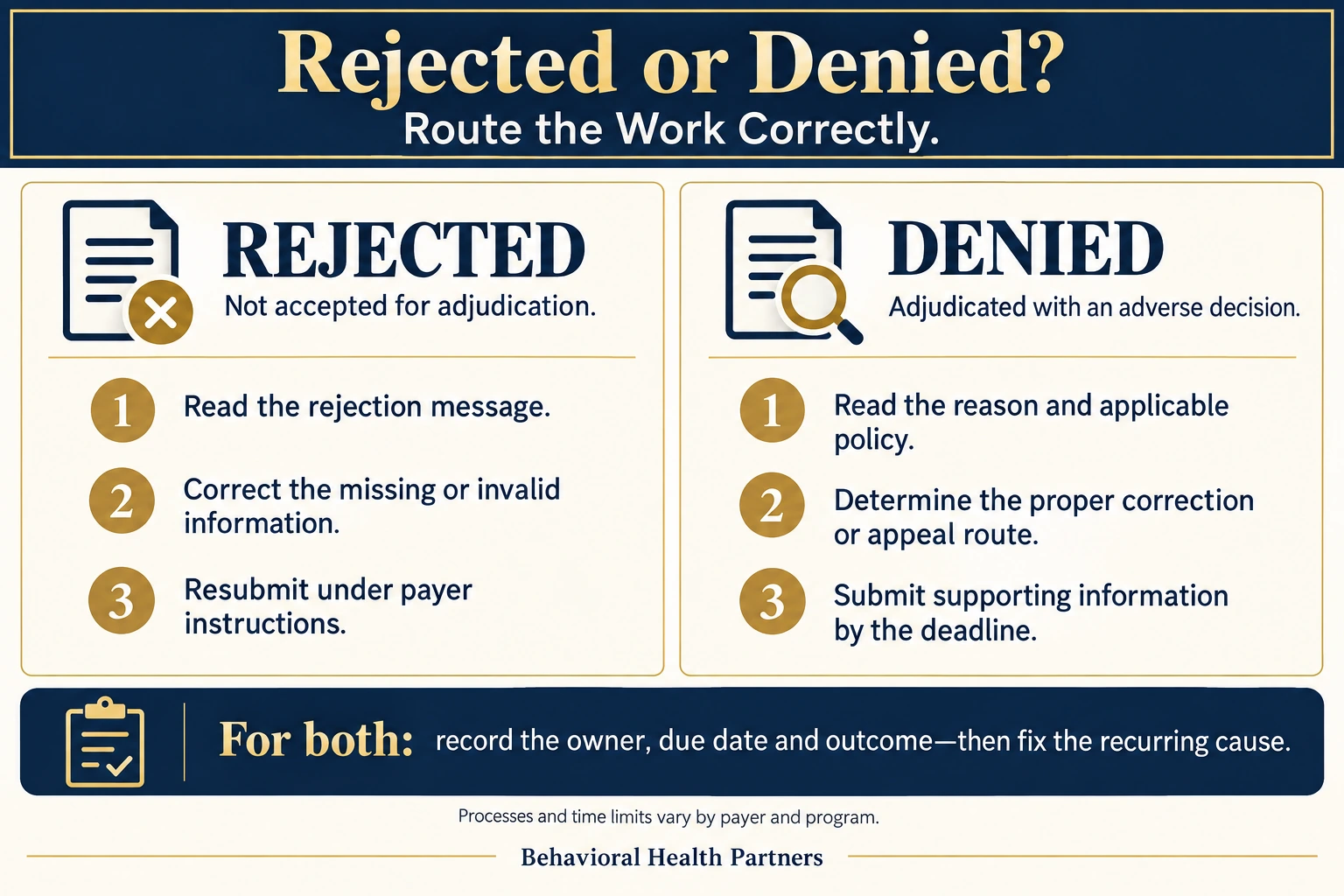
Claim rejections and denials are different animals. Rejections bounce before adjudication, usually for data problems: a transposed member ID, a missing taxonomy code, a date glitch. Denials are adjudicated refusals. Both trace back to billing errors that automated claim scrubbing catches for pennies: scrubbing software checks every claim against payer rules before submission, which reduces human error and pushes clean claim rates up. The fix for claim rejections is boring and absolute: scrub everything, correct same-day, and track rejection reasons monthly so the same billing errors stop recurring. Human error never reaches zero, but a billing workflow that assumes it, and catches it, gets you close.
The Denial Management Process That Recovers Revenue
A formal process for tracking denied claims improves recovery rates, full stop. The denial management loop: log every denial with its reason code the day it lands, triage it within 7 days, and route it correctly. Data errors get a corrected claim. Clinical denials get an appeal with the documentation attached. Parity-suspect denials, like visit limits or medical necessity standards harsher than the medical side, get escalated with MHPAEA on the table, because those denials are legally appealable and payers know it. File inside every payer's appeal window, respect timely filing limits on corrected claims, and measure your overturn rate. Then close the loop: every recovered denial is proper reimbursement plus a lesson, and mature denial management feeds each one back into the front end so the same denial never happens twice. Insurance payers profit from providers who do not appeal. Do not be that provider.
Want the shortcut? We help treatment centers and behavioral health practices build revenue cycle management systems that survive audits and payer games, alongside the marketing that fills the schedule. Book your free discovery call and we will look at your denial patterns together, live on screen.
In-House Billing vs Third-Party Billing: What to Expect From Each
Every practice hits this fork. Both roads work, both roads fail, and the variable is almost never the road. It is whether anyone owns the revenue cycle with real accountability. Here is the honest picture of each, from someone who has watched both succeed and both collapse.
What to Expect From In-House Billing
In-house billing means hiring billing staff, or training a billing manager, who work only your claims. Expect control and speed: same-room communication with clinicians, instant chart access, and a team that learns your payers deeply. Also expect the full administrative burden of it: salary and benefits, software licenses, training, and coverage gaps when your biller is sick, on vacation, or gone. In a small practice, one resignation letter can freeze the entire revenue cycle management operation. Budget roughly one full-time biller per 2,500 to 3,500 claims per year, invest in continuing education because payer rules shift constantly, and build documented processes so the knowledge lives in the billing system, not in one irreplaceable head.
What to Expect From a Third-Party Billing Company
A third-party billing company charges a percentage of collections, typically 4 to 8 percent for outpatient behavioral health and more for facility billing, and brings specialized revenue cycle management expertise: dedicated denial teams, payer relationships, certified coders, and coverage that never takes a vacation. The good ones improve cash flow within a quarter because they work denials your staff never had time for. You are outsourcing execution, not accountability: you still own credentialing decisions, fee schedules, and compliance, and a percentage-of-collections model means a vendor paid on volume needs your oversight on write-offs and appeal rates. Demand monthly financial performance reports on clean claim rate, denial rate, days in accounts receivable, and collections against contracted rates, insist on real-time access to your own data, and confirm behavioral health is their specialty, because a generalist medical biller will drown in H-codes and concurrent reviews.
How to Decide: The Questions That Settle It
Ask four questions. What is your claim volume, and can it justify dedicated payroll? How complex is your payer mix, and does anyone on staff genuinely know it? Which levels of care do you bill, because facility per diem billing punishes amateurs far harder than outpatient psychotherapy does? And what does your leadership bandwidth honestly look like? Startups usually outsource first and internalize later, and the math belongs in your business plan and your feasibility study before you sign either contract. Third-party revenue cycle management earns its percentage precisely in those gaps. Either way, there is only a clean revenue cycle or a leaking one.
Building a Billing System That Survives an Audit
Here is the mindset shift that separates the practices that thrive from the ones that get clawed back: stop billing to get paid and start billing to be audited. Ensuring accurate billing on every claim, from day one, costs less than any audit defense ever will. That is revenue cycle management as risk management. Financial sustainability in behavioral health is not built on clever coding. It is built on boring, compliant billing processes repeated ten thousand times, and it protects the mission, because a program that loses its payer contracts stops treating anyone.
Billing Accuracy Is a Culture, Not a Checkbox
Accurate billing starts with the clinician's note and ends with the posted payment, and every hand in between either protects it or degrades it. The culture test is simple: when a biller finds an overpayment, does the practice refund it as fast as it appeals an underpayment? When documented time supports the smaller code, does the smaller code go out without debate? Proper reimbursement means being paid fully and correctly for exactly what happened, nothing more and nothing less, and the practices that internalize this sleep well during audits. Train billing teams quarterly, audit a random sample of your own claims monthly, and treat every internal finding as a gift that arrived before the payer did. Financial responsibilities this serious deserve that respect.
The Technology Stack: EHR, Scrubbing, and Automation
The modern revenue cycle management stack has three load-bearing pieces. An EHR system with integrated billing, so codes flow from clinical documentation without manual re-entry, which is where data entry errors breed. Automated claim scrubbing, so every claim is checked against each payer's edits before submission instead of after denial. And automated eligibility checks that run before every visit, protecting cash flow at the exact moment protection is possible. None of this replaces judgment: technology executes the standard, and coding accuracy still comes from trained humans who know the payer contracts. But a practice running all three will improve cash flow within 60 days, and operational efficiency follows because staff time moves from data chasing to denial prevention.
The Metrics That Tell You the Truth
You cannot manage what you refuse to measure. Track five numbers monthly: first-pass clean claim rate, which should sit at 92 to 95 percent; initial denial rate; net denial rate after appeals, which shows what you actually lost; days in accounts receivable, ideally under 40; and collections as a percentage of contracted rates, which exposes silent underpayments. Review them with the same seriousness as clinical outcomes; they are the financial performance dashboard of the whole operation. These same numbers feed the financial proforma for any expansion decision, and they prove your financial stability to lenders, landlords, and payers on demand. That is how healthcare providers maximize revenue honestly: not by squeezing codes, but by collecting every dollar the care already earned. Mental health providers who master these metrics stop guessing, and the operational efficiency compounds.
FAQ About Behavioral Health Billing
What is behavioral health billing?
Behavioral health billing is the process of translating therapy, psychiatric, and substance use services into coded insurance claims and collecting payment for them. It differs from general medical billing because medical necessity is documented per session, privacy rules are stricter, and payer rules vary widely. Done well, it is a revenue cycle discipline that keeps a practice financially healthy.
Why are behavioral health claims denied so often?
Published figures put behavioral health denial rates anywhere from 15 to 30 percent, versus roughly 8 to 12 percent for general medical claims. The main drivers are eligibility problems, missing prior authorization, coding errors, and documentation that fails to establish medical necessity for each session. Most denials are preventable with front-end verification and disciplined clinical documentation.
Should I outsource my billing or keep it in-house?
It depends on volume, payer mix, and expertise. In-house billing gives you control and instant communication but carries salary, training, and turnover risk. A third-party billing company brings specialized expertise for a percentage of collections, typically 4 to 8 percent, but still requires your oversight. Many practices outsource early, then bring billing in-house as volume grows.
What are the most important CPT codes in behavioral health?
For outpatient work: 90791 for psychiatric diagnostic evaluations, 90832, 90834, and 90837 for 30, 45, and 60 minute psychotherapy, 90846 and 90847 for family therapy, and 90853 for group. Facilities bill per diem codes like H0015 for intensive outpatient, H0035 for partial hospitalization, and H0010 through H0019 for detox and residential levels of care.
What is a good clean claim rate for a behavioral health practice?
Aim for a first-pass clean claim rate of 92 to 95 percent. Below 90 percent usually means something upstream is broken: insurance verification, prior authorization, or coding. Track your initial denial rate and your net denial rate after appeals separately, and keep days in accounts receivable under 40. Those three numbers tell you the truth about your revenue cycle.
Get the Billing Side Right From Day One
Behavioral health billing rewards discipline and punishes shortcuts, and it does both with compounding interest. Verify eligibility before every visit, authorize before you treat, document like the auditor is reading, code what the note can defend, submit daily, and work every denial like the revenue it is. If you are still in the planning stage, our how to open a rehab center hub covers where billing fits in the launch sequence, and if you are ready to open a rehab with expert help on the whole operation, that is exactly what we build. Our blog and video library go deeper on individual pieces, and our reviews show what happens when the marketing engine and the revenue cycle finally pull in the same direction. Behavioral health billing done right is not exciting. It is just the difference between a mission that survives and one that does not.
Ready to stop leaking revenue? Book your free discovery call and we will walk through your billing operation, your denial patterns, and your growth plan together.
Adam Vibe GuntonFounder and Managing Partner, Behavioral Health Partners
Adam Vibe Gunton is an addiction recovery expert, entrepreneur, marketer, brand strategist, and speaker dedicated to advancing the behavioral health industry. As Founder and Managing Partner of Behavioral Health Partners, he has worked across treatment-center development, operations, branding, PR, SEO, advertising, and growth strategy. Combining professional experience with his own lived experience in recovery, Adam brings a unique perspective on how treatment organizations can build trusted brands, reach more people, and create a greater impact.
Thirty minutes on video with Adam directly, camera on, screen-sharing your own online presence and your top three local competitors. If we are not the right partner, we will tell you that too.