Why Is My Website Not Converting? How to Fix Your Treatment Center Website
Traffic but no calls is a conversion problem, not a traffic problem. We cover what converting actually means for a treatment center and the math that makes it urgent, then the six reasons sites fail: built for you rather than the person in crisis, too much friction before a human, asking for the call before earning trust, pages that do not match the search, optimising the wrong traffic, and speed, mobile and tracking.
If your treatment center has traffic but almost no calls or form fills, the problem is usually not how much traffic you get. It is what happens after the visitor arrives. A treatment center website that is not converting quietly wastes the most expensive thing you buy, which is the attention of a family in crisis. When you ask why is my website not converting, you are really asking where visitors drop off between landing on the page and reaching a human. This article walks through the real reasons drug rehab websites leak conversions, and how to fix your website without a full rebuild. If you want experts to run it for you, our conversion rate optimization team does exactly this for drug rehabs, and our companion video on why your treatment center website isn't converting covers the highlights.
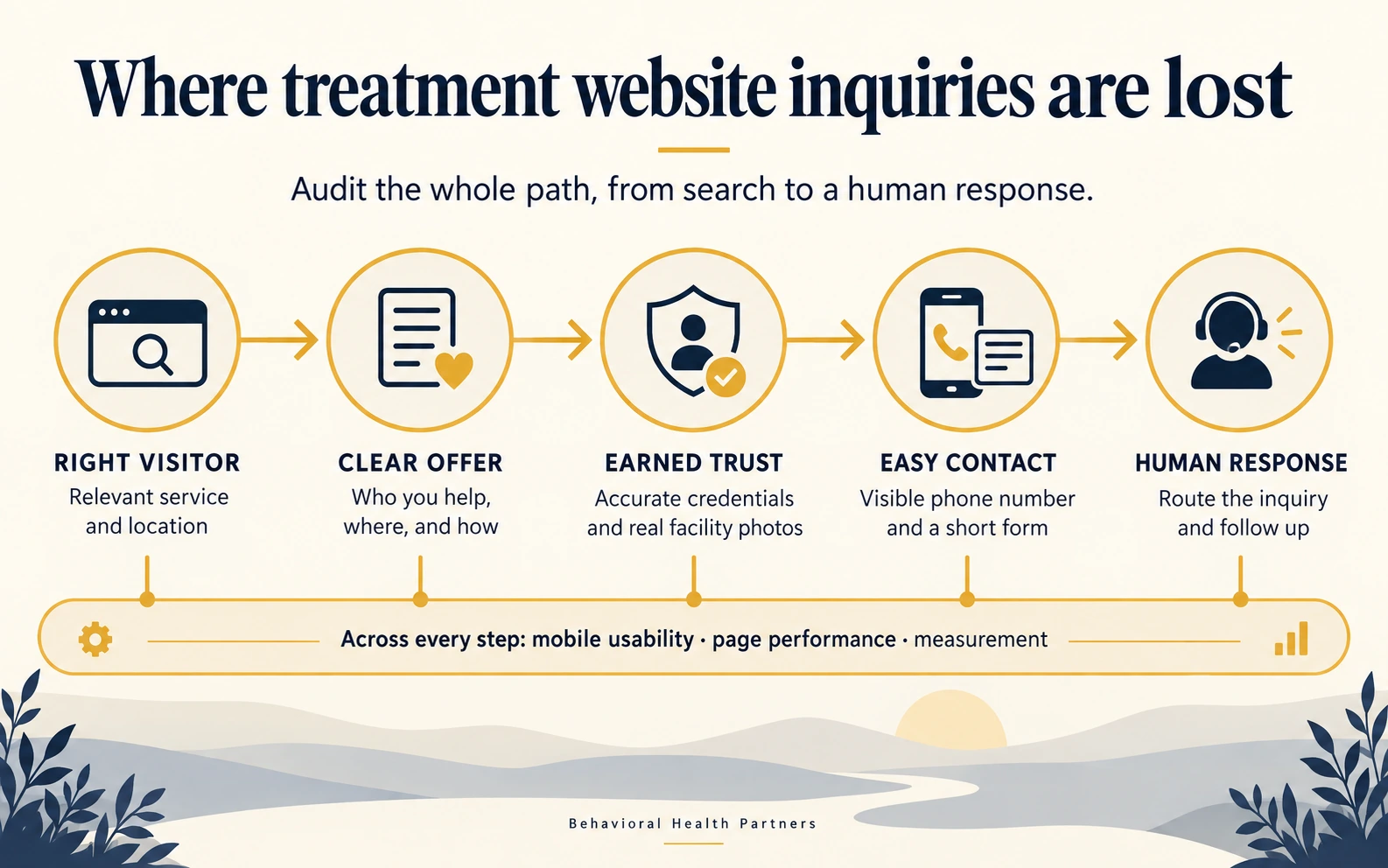
Conversion is a chain, not a single moment. A visitor has to understand who you help, trust you enough to reach out, find an easy path to contact, and get a fast response. Break any link and the whole thing fails. These leaks are common across drug rehabs of every size. Below are the most common mistakes we see on drug rehab websites, and the fixes that let addiction treatment centers focus on what converts, and the fixes that turn more visitors into conversions and admissions.
First, Understand What Converting Actually Means
Before you can fix a conversion problem, define your conversion goals and the meaningful actions that count. For most addiction treatment centers, a conversion is a qualified inquiry: a call, a form submission, or a chat, or a request for a free quote or insurance check from a potential client who could become an admission. Your conversion rates measure how many website visitors take that action. If a hundred people visit your site and two reach out, you have a two percent conversion rate.
That number matters more than most operators realize. Doubling your conversion rate from two percent to four percent on the exact same website traffic effectively halves your cost per inquiry, because you get twice the admissions from the same marketing spend. Converting visitors you already have is the goal, and this is why conversion rate optimization, the practice of converting visitors by improving the percentage of website visitors who take meaningful actions, so often beats simply buying more traffic. More traffic into a leaky funnel just wastes more money. Fixing the funnel makes every visitor worth more.
So the first question is diagnostic: do you have a traffic problem or a conversion problem? If plenty of people reach your site but few convert, buying more clicks will not help. You have a conversion problem, and the fixes below are where to focus your marketing strategies and attention.
The Math That Makes This Urgent
For drug rehabs, the stakes are unusually high because the traffic is expensive. A single paid click on a high-intent addiction treatment or drug rehab keyword can cost anywhere from $25 to $150 or more, depending on the term and the market. When you are paying that much for a visitor, a drug rehab website that converts poorly is not a minor issue. It is a direct, ongoing loss.
Picture two drug rehabs running the same Google Ads campaign to the same landing pages. One converts at two percent, the other at four percent. The second center pays half as much for every admission, simply because its website turns more visitors into clients. Over a year, that gap is for drug rehabs, the difference between a profitable business and one that quietly drains cash. Converting visitors you already paid to attract is almost always cheaper than finding new ones.
Think of your website as the storefront of your business. Like most small businesses, drug rehabs live or die by how well that storefront turns interest into conversions. Small businesses with a broken storefront lose walk-ins, and small businesses in addiction treatment are no different; a drug rehab with a website that does not convert loses conversions, loses admissions, and wastes marketing budget. Whatever marketing strategies you run, with marketing strategies from SEO to paid search to social media, every visitor funnels through the same pages, so for small businesses like treatment centers, the business case for fixing conversions is simple: better conversions mean more clients from the same spend, and fewer missed opportunities. For addiction treatment programs, where each admission is worth so much to the business, small gains in your conversion rates for a drug rehab compound fast across the whole business.
Reason 1: The Site Is Built for You, Not the Person in Crisis
The most common reason a drug rehab website is not converting is unclear messaging. Many websites open with a mission statement, a founder's story, or clinical language about modalities. A person searching at two in the morning for help for a loved one does not parse clinical paragraphs. This is the decision point where you win or lose them, so your pages must answer questions from the person in crisis within about five seconds, who you help, where you are, what services and level of care you offer, and how to reach you.
Your homepage hero is your first impression, and first impressions decide whether a visitor stays. If your value proposition is buried under jargon or a slow carousel, most users leave before they understand what you do. Many visitors never scroll far down the page, so put your most important message and primary call to action near the top, above the fold. Lead with clarity: use a clear call to action, and name the people you serve and the services you offer, state your location and programs, and levels of care, and make the next call to action obvious. Clear, benefit-first messaging and a strong value proposition, written for the person in crisis rather than for your team, is often the single biggest lever on your conversion rates.
Reason 2: There Is Too Much Friction Between the Visitor and a Human
Even a visitor who trusts your drug rehab will not convert if the path is hard. Too much clutter, confusing layouts, and long forms all add friction, and friction kills conversions. When a page offers ten competing links and no clear primary CTA, you create choice paralysis, and a confused visitor does nothing.
Reducing friction is one of the fastest ways to boost conversions. Give each page one obvious job and one clear call to action. Replace a generic button like "Submit" with a value-driven call to action such as "Verify My Insurance" or "Talk to an Admissions Counselor," because a CTA that communicates value converts far better than a vague one. Make your phone and contact options visible without scrolling. Shorten your forms to the few fields you truly need, because every extra field costs you conversions. A person ready to reach out should never have to hunt for how, and every removed obstacle turns more visitor clicks into conversions. Clear calls to action, a single primary CTA per page, and a clean layout that encourages visitors toward one next step will earn more conversions than a cluttered site with too many distractions.
Reason 3: You Ask for the Call Before You Have Earned Trust
Choosing a drug rehab is a high-trust addiction treatment decision, and weak trust signals are a top reason drug rehab and addiction treatment websites fail to convert. If nothing on the page helps a family feel confident, they will not call, no matter how good your care is. The vast majority of visitors who land on a site that feels untrustworthy leave and never return, so trust is not a nice-to-have.
Trust building is conversion infrastructure. According to Nielsen Norman Group, credibility comes from design quality, upfront disclosure of information, comprehensive and current content, and being connected to the rest of the web through external reviews. For a drug rehab, that means genuine testimonials and real customer testimonials from former clients, visible credentials like Joint Commission accreditation and LegitScript certification, and real, professional photography of your facility rather than stock images. Genuine testimonials paired with real photos of real people and places build an emotional connection that stock imagery never will. Displaying your credentials, your reviews, security and privacy badges that show your site is safe and HIPAA-aware, and honest information about your services and program all help a family feel confident enough to take the next step. That is the heart of building trust online.
Reason 4: Your Pages Do Not Match What People Searched For
Message mismatch is a silent conversion killer. If someone clicks an ad or a search result for medical detox in your city and lands on a generic homepage, the page does not match what they searched for, and they bounce. Every marketing campaign should send visitors to dedicated landing pages that continue the exact conversation the search started.
Your landing pages should mirror the searcher's intent. An ad for a specific program should lead to a page about that program, in that location, with a matching headline and a clear call to action. Stripping the main navigation and competing links off a dedicated landing page keeps the visitor focused on one action, which reliably lifts conversions. When your landing pages match the search, visitors feel understood and convert. When they do not, you pay for the click and lose the person. This ad-to-page match is one of the highest-leverage fixes in all of conversion rate optimization for addiction treatment centers, and it protects the conversions you paid for.
Reason 5: You Are Optimizing Conversion on the Wrong Traffic
Sometimes the website is fine and the traffic is wrong. If your marketing is attracting the wrong people, job seekers, curious researchers, or visitors from far outside your service area who were never potential clients, your conversion rates will look low no matter what you change on the page. You cannot convert visitors who were never potential clients.
This is where your traffic sources and your website have to work together. Strong behavioral health SEO and well-targeted Google Ads, plus local SEO, bring in the potential clients actually seeking treatment, so the potential clients and interested visitors arriving from search engines are the right ones. Our guide on SEO versus PPC for treatment centers explains how to balance the two. Before you blame the website, check which search engines and campaigns send your traffic and whether those visitors are potential clients at all. Fixing the traffic and the page together is what lifts conversions for good.
Reason 6: Speed, Mobile, and Tracking Are Quietly Sabotaging You
The majority of people seeking treatment search on mobile devices, so a poor mobile experience is one of the most expensive mistakes drug rehabs can make. If your site is slow, hard to tap, or breaks on a phone, you lose conversions before the visitor reads a word. A large share of visitors abandon a page that takes more than a few seconds to load, and on mobile that share is even higher. Mobile optimization, mobile usability, and a genuinely mobile friendly, mobile friendly design are not optional.
Speed matters too. According to Google, Core Web Vitals measure real-world user experience for loading, interactivity, and visual stability, and Google recommends a largest contentful paint under 2.5 seconds. Page speed is also a confirmed Google ranking factor, so a slow site costs you both conversions and visibility. Run your site through Google PageSpeed Insights to check website performance, and fix what drags it down. Google Search Console shows your impressions and clicks so you can see how visitors find you. Finally, connect Google Analytics and conversion tracking so you can focus on where visitors drop off. Without tracking, you are guessing. With it, you can find the exact pages and steps where conversions leak, and recover those lost conversions before they become missed conversions.
Reason 7: Nothing Good Happens After the Form Is Submitted
Your conversion does not end when the form is submitted. What happens next often decides whether an inquiry becomes an admission. If a potential client reaches out and waits hours for a callback, they will call the next treatment center on their list. Speed to lead, responding within minutes rather than hours, dramatically improves admissions.
This is where systems matter. A CRM built for substance abuse treatment routes every inquiry to the right support person instantly and makes sure no client or lead is missed. Fast, human follow-up and real support services after the form is what turns a converted visitor into a client who actually starts treatment. The best website in the world cannot save you if the response on the other end is slow.
The Conversion Audit You Can Run This Week
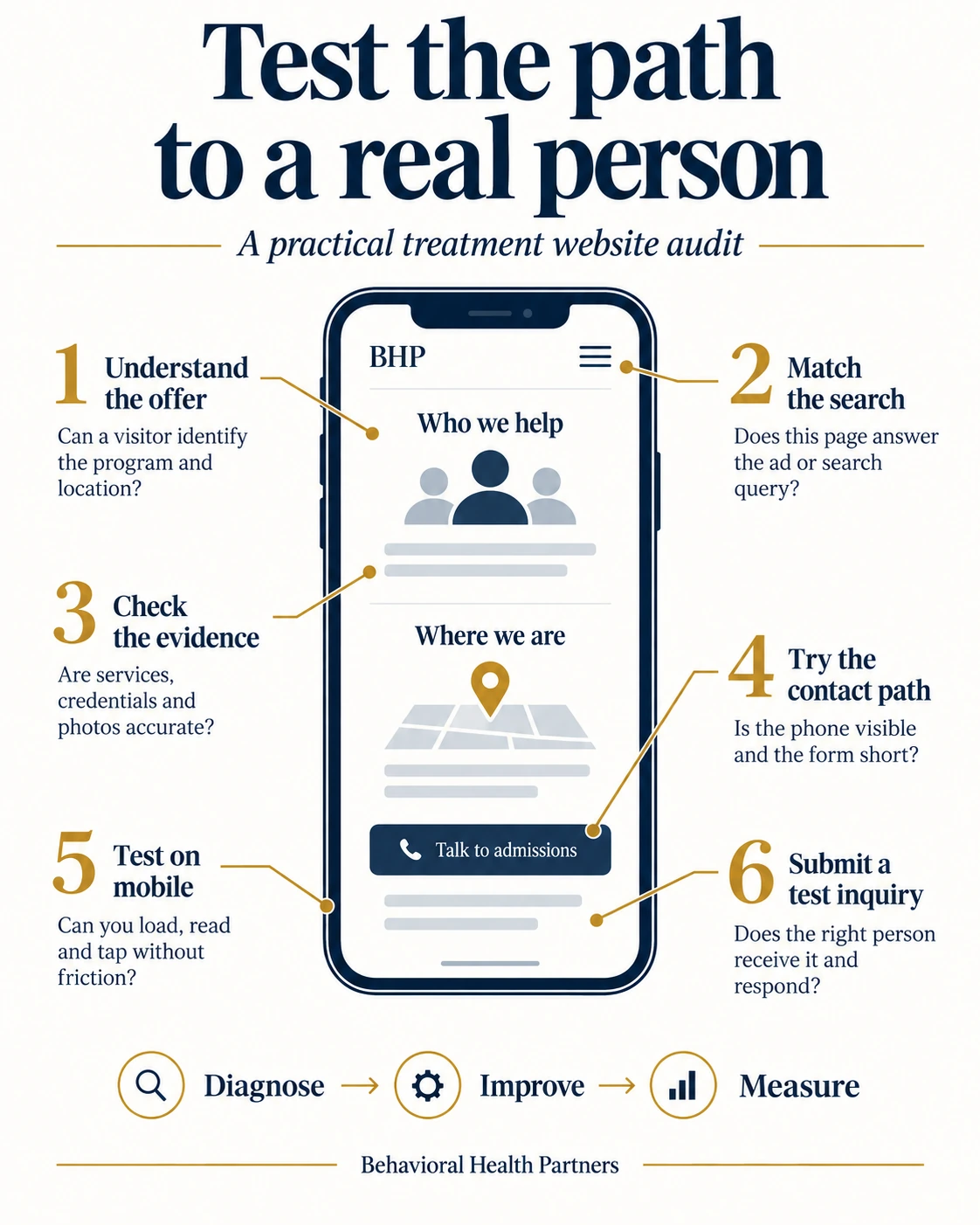
You do not need an agency to start. Open your own site on your phone and time how long it takes to understand who you help and how to reach you. If it takes more than five seconds, your messaging needs work. Check your load speed in Google PageSpeed Insights. Count the fields on your contact form and cut every one you do not truly need. Look at your landing pages and confirm each of your landing pages matches the search or ad that sends traffic to it. Open your Google Maps listing and analytics to confirm your location and reviews are consistent and visible. Finally, submit your own form and see how fast, and how human, the response is.
For example, each of these examples is a common mistake with a straightforward fix, and together they surface most of the reasons a drug rehab website is not converting. Fixing even two or three can significantly boost your conversion rates on the traffic you already have, and recover clients you were quietly losing.
How to Fix It Without Guessing
The centers that win do not redesign on a hunch. They diagnose, prioritize the fixes with the biggest impact, and A/B test changes against real data instead of guessing. Removing every unnecessary step, and never forcing a visitor to create an account just to reach you, keeps the path short. That is the discipline of conversion rate optimization: clear messaging, less friction, stronger trust signals, matched landing pages, the right traffic, fast mobile performance, and instant follow-up, each measured against conversion rates and conversions rather than opinions.
A strong treatment center website is the hub of your entire marketing program. Every dollar you spend on SEO, Google Ads, local SEO, and social media marketing flows through it, so improving how the website converts multiplies the return on everything else. Get the fundamentals right and the same traffic starts producing more admissions.
For drug rehabs, this is where marketing dollars are won or lost, and where the best drug rehabs pull ahead. The best-run addiction treatment centers treat their website as a conversion engine for the whole business: they watch their conversion rates weekly, test changes to their landing pages, and keep improving how the site turns visitors into clients. Drug rehabs that lift conversions are not just saving on marketing; it is reaching more clients who need help. When your website, your marketing, and your follow-up all pull toward conversions, the business grows on the traffic you already have, and every marketing channel returns more.
If you want a partner to audit and fix your drug rehab website, request a conversation with our rehab marketing team. With the right support, we help drug rehabs and addiction treatment centers turn existing website traffic into more clients, more conversions, and more admissions, without wasting the clicks you already pay for.
Frequently Asked Questions
Why am I getting clicks but no conversions?
Clicks with no conversions almost always point to a conversion problem on the website, not a traffic problem. The visitors are arriving, but something on the page stops them from reaching out: unclear messaging, weak trust signals, a slow or hard-to-use mobile experience, too much friction in the form, or landing pages that do not match what people searched for. Start by confirming the traffic is the right audience, then work through those on-page issues one at a time. Fixing the biggest leaks usually lifts conversions quickly.
What is a good conversion rate for a treatment center website?
There is no single number, because it depends on your traffic quality, your market, and how you count conversions. Rather than chasing a benchmark, put your focus on improving your own conversion rates and hitting your conversion goals over time and on your cost per admission. Even a small lift, for example from two percent to four percent, can halve what you pay for each inquiry on the same website traffic. The best conversion rate is the one that produces admissions at a cost your program can sustain.
Do I need a new website or just fixes?
Most drug rehabs do not need a new website. They need targeted fixes to messaging, trust signals, forms, mobile experience, and follow-up. A full rebuild is expensive and risky, and it often recreates the same conversion mistakes in a prettier package. Start with a conversion audit, fix the highest-impact issues on your current site, and measure the results. Only consider a full rebuild if the current one is fundamentally broken, unfixable on mobile, or impossible to update.
How do I know if my traffic or my website is the problem?
Look at the numbers together. If you have steady website traffic but very few conversions, you likely have a conversion problem on the site. If you have almost no traffic at all, you have a discoverability problem and need more of the right visitors first. Google Analytics shows you how many people arrive, where they come from, and where they drop off. Confirming whether the visitors are the right audience, and where they leave the page, tells you exactly where to focus.
Can conversion rate optimization work alongside SEO and Google Ads?
Yes, and it works best that way. SEO and Google Ads bring the right visitors to your treatment center website, and conversion rate optimization makes sure more of those visitors become clients. Improving conversion rates actually raises the return on your SEO and paid ads, because every campaign sends traffic to pages that convert better. Treat traffic and conversion as one system, and your whole marketing program produces more admissions from the same budget.
Share this guideLink copied
Adam Vibe GuntonFounder and Managing Partner, Behavioral Health Partners
Adam Vibe Gunton is an addiction recovery expert, entrepreneur, marketer, brand strategist, and speaker dedicated to advancing the behavioral health industry. As Founder and Managing Partner of Behavioral Health Partners, he has worked across treatment-center development, operations, branding, PR, SEO, advertising, and growth strategy. Combining professional experience with his own lived experience in recovery, Adam brings a unique perspective on how treatment organizations can build trusted brands, reach more people, and create a greater impact.
Thirty minutes on video with Adam directly, camera on, screen-sharing your own online presence and your top three local competitors. If we are not the right partner, we will tell you that too.