
How to Open a Mental Health Facility: The Complete Guide for IOP, PHP, and Inpatient Centers
Opening an IOP, PHP, or inpatient mental health center? One decision made in month one decides whether you ever open. Start here.
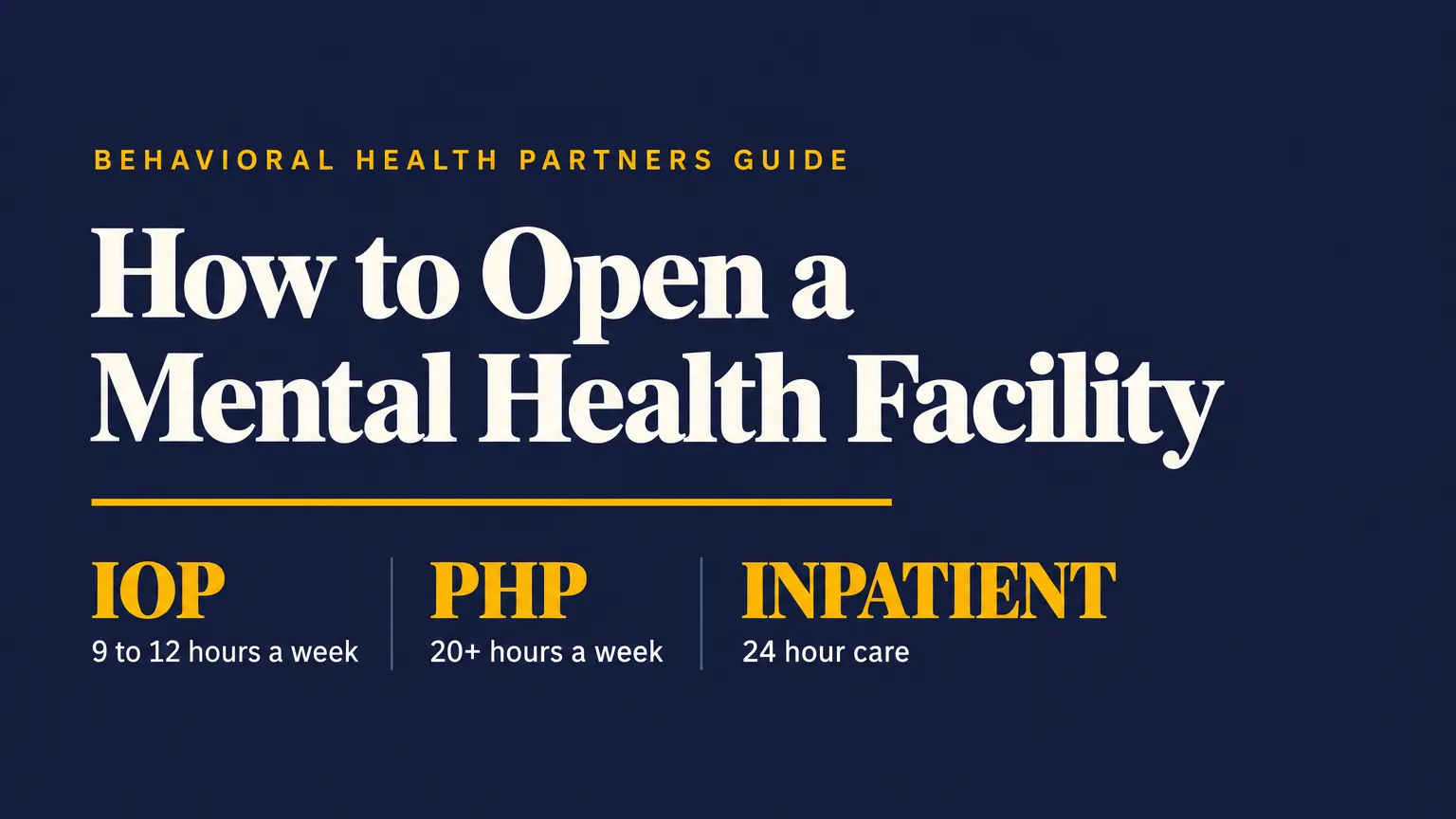
A mental health facility is a licensed program, not a bigger private practice. The moment you add a second level of care, a group room, or a bed, you are running a healthcare operation that a state licensing board, an accreditor, and every payer will inspect before a single patient walks through the door. That is the work this guide walks you through, in order.
Behavioral Health Partners builds, launches, and scales treatment centers across the United States and Canada. Our behavioral health consulting team has helped dozens of centers open, grow, and scale, and we have built centers of our own. We wrote this step guide for the founder planning an intensive outpatient program, a partial hospitalization program, or an inpatient mental health center, because that founder faces decisions a therapist renting an office never will. Private practices need a clinician's license. A facility needs a license of its own.
Demand for mental health services continues to outpace the supply of programs that treat people at the right intensity. The levels between weekly therapy and a psychiatric hospital are where new facilities fill a real gap, and where the regulatory weight lands hardest. Establishing a mental health facility requires strategic business planning and regulatory adherence from the first week, not after the lease is signed. Our video on how to open a rehab center covers the same sequence from the addiction treatment side, and most of it carries over.
What Counts as a Mental Health Facility: Levels of Care Explained
Decide which levels of care you will offer first, because the answer changes your license type, staffing, physical plant, and reimbursement. Clinicians use standardized tools to match a patient to a level; for adults, many states and payers rely on the Level of Care Utilization System (LOCUS), which rates six dimensions of need and recommends one of six service levels.
| Level of care | Typical schedule | Who it serves | Where it lives |
|---|---|---|---|
| Intensive outpatient program (IOP) | About 9 to 12 hours per week, usually 3 days | Needs more than weekly therapy, can live at home safely | Outpatient clinic, often paired with PHP |
| Partial hospitalization program (PHP) | 20 or more hours per week, usually 5 days | Stepping down from inpatient care or at risk of needing it | Outpatient clinic with medical oversight |
| Residential mental health | 24-hour care, days to weeks | Needs structure and supervision, not hospital-level medical care | Licensed residential facility |
| Inpatient psychiatric | 24-hour care with physician and nursing coverage | Acute crisis, needs a secured, medically staffed setting | Licensed hospital or psychiatric unit |
Intensive Outpatient Programs (IOP)
An IOP is a distinct, organized program of psychiatric services for people with an acute condition who do not need round-the-clock care. Under Medicare, which began covering IOP on January 1, 2024, a physician must certify that the patient needs a minimum of nine hours of IOP services per week, and commercial and Medicaid plans use similar thresholds. In practice that means three sessions a week built around group therapy, individual sessions, and medication management. For the virtual version, our chapter on virtual IOP covers how centers add telehealth without diluting care.
Partial Hospitalization Programs (PHP)
A PHP is an alternative to psychiatric hospitalization. The same CMS rule defines it as an intensive, structured outpatient program delivering a minimum of 20 hours of services per week, paid per diem. Patients attend most of the day, most days, then go home. Because PHP sits one step below inpatient, licensing boards expect physician involvement, nursing availability, crisis protocols, and a documented procedure for a patient who decompensates. Most new centers open PHP and IOP together so a patient can step down inside the same building with the same clinical team.
Residential and Inpatient Mental Health Centers
Beds change everything: 24-hour staffing, dietary services, medication storage, a medical director, emergency transfer agreements, and a building that passes life-safety inspection. Inpatient psychiatric care is generally licensed as a hospital or hospital unit under hospital conditions of participation. Residential sits below that and varies widely by state. If you are planning beds, expect licensing to take longer and construction to cost multiples of an outpatient clinic.
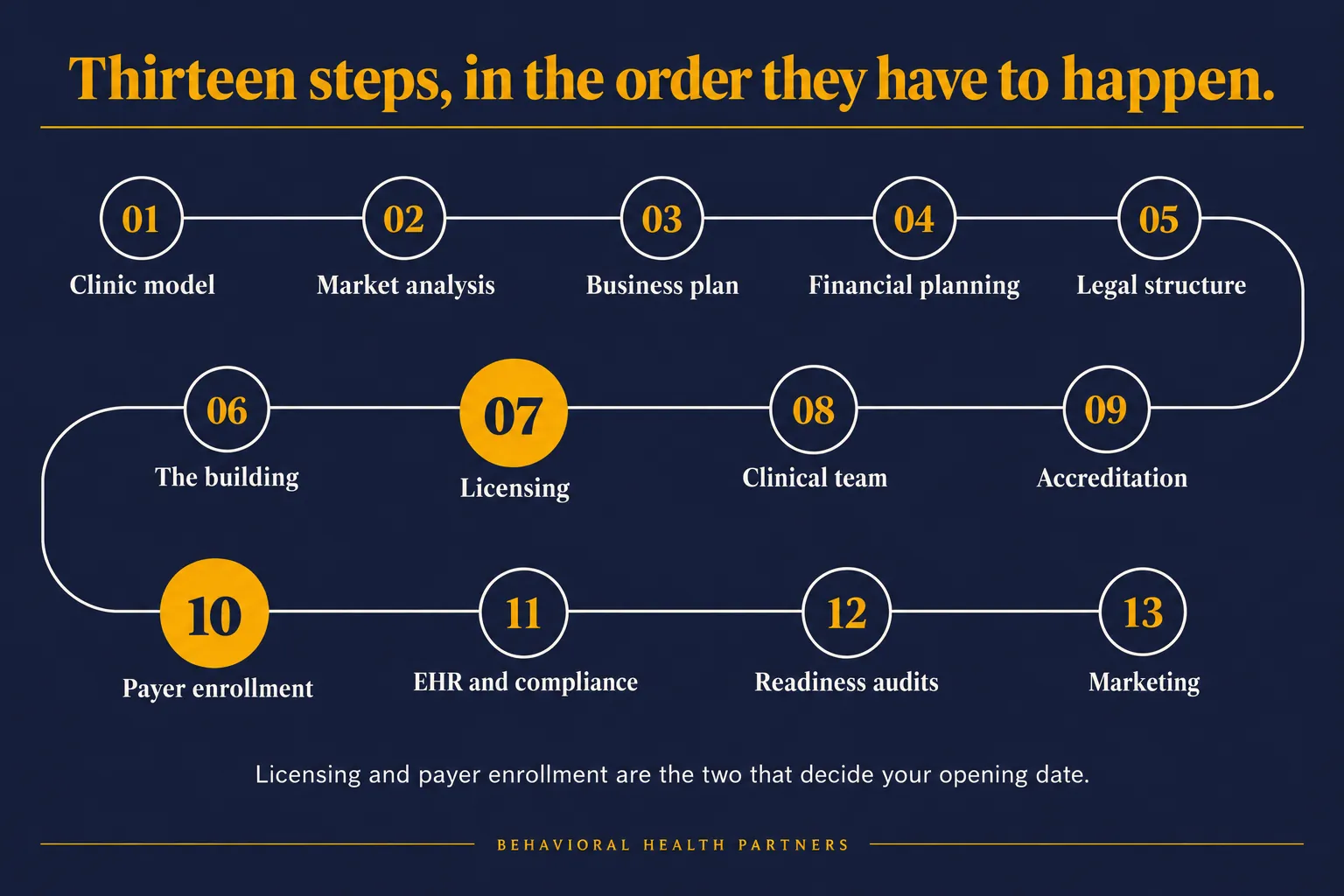
Step 1: Define Your Clinic Model and Scope of Services
Defining the clinic model and scope is the decision every later decision depends on. Write down, in one page, the specific mental health services you will offer, the populations you will and will not treat, the levels of care, the age range, and the payers you will accept. Decide now whether you will treat co-occurring substance use, because that may require a second license.
Then define your care delivery model: the modalities (CBT, DBT, group therapy, medication management, family work), who leads treatment planning, how a patient moves between levels, and what discharge looks like. Defining the model this way informs pricing and staffing decisions before you spend money on either. A center that tries to be everything to everyone ends up with a payer mix it cannot sustain and a brand nobody can describe.
Step 2: Run a Market Analysis Before You Sign Anything
A market analysis answers three questions: how many potential clients in your service area need your levels of care, who already serves them, and which payers cover them. The third question matters most, because your payer mix decides your keyword strategy, your reimbursement, and your break-even census.
This is the work a feasibility study does before capital is committed. It pulls prevalence data, counts competing programs by level of care, maps referral sources (hospitals, primary care, schools, courts, employers), tests reimbursement assumptions against real payer contracts in your state, and tells you plainly whether the market can support your center. We have told founders not to build. That is cheaper than finding out two years in.
Step 3: Write a Business Plan a Lender and a Licensing Board Both Accept
A solid business plan supports growth and decision-making, not only fundraising. Yours must satisfy two readers: the lender who wants a credible path to profit, and the licensing board that wants proof you understand the rules. Writing a simple version clarifies services and expenses; writing a complete one is how you get funded and licensed.
Include your clinical model and scope, the market findings, an organizational chart with licensed leadership named, staffing by level of care, the policies you will adopt, your compliance program, a marketing section, and the projections from Step 4. Our treatment center business plan consulting exists because the template a bank accepts is not the document a state surveyor accepts. Careful planning here saves months later.
Step 4: Financial Planning: Startup Costs, Reimbursement Rates, and the Proforma
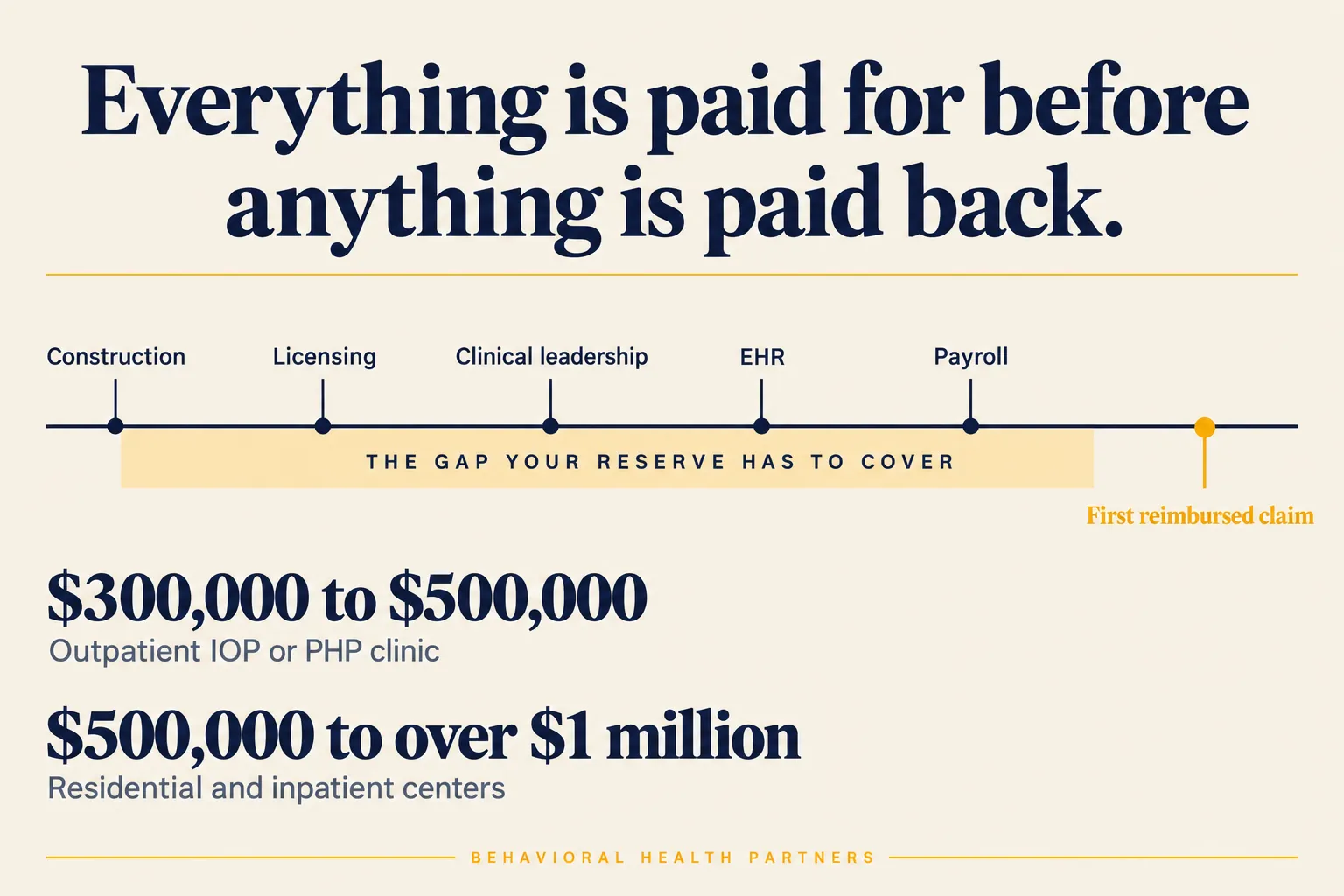
Financial planning for a facility starts with an uncomfortable fact: you will carry payroll, rent, and construction for months before your first reimbursed claim arrives. Startup costs for a therapy practice are lower than most businesses. Startup costs for a licensed facility are not, because licensure, accreditation, a medical director, nursing coverage, an EHR, and a compliant building all come before revenue. For a cost breakdown by level of care, read our guide to how much it costs to open a rehab center; the line items for a mental health center are nearly identical.
Reimbursement rates are the other half of the math. Model revenue per patient day by payer and level of care, using real rates from your state Medicaid fee schedule and actual commercial contracts. Diversifying reimbursement streams stabilizes cash flow for mental health facilities: a center dependent on one commercial payer is one contract renegotiation away from a cash crisis. Many facilities later pursue value based care behavioral health arrangements once they have outcome data, which rewards exactly the measurement an organized program produces.
Put all of it into a three-year monthly financial proforma with a conservative case and a base case: census ramp, payer mix, staffing, and the months of operating reserve you need to survive credentialing delays. A proforma is what a lender underwrites and what a licensing board reads as proof you can stay open.
Step 5: Choose Your Legal Structure, EIN, and Registrations
Choosing a business structure affects taxes and liability protection, and it affects who may own a healthcare entity in your state. A sole proprietorship offers no separation of personal assets, which rules it out for a facility. An LLC separates personal assets from business liabilities and is the most common starting point. Where states restrict ownership of clinical entities to licensed professionals, a PLLC may be required, and a PLLC offers extra malpractice insurance provisions for the clinicians who own it. As income grows, an S-corp election may be considered for tax purposes; owners paid through a pass-through entity should budget roughly 25 to 30 percent of that income for taxes.
Form the entity with your state first, because the IRS asks you to do that before you obtain an Employer Identification Number, which you will need for payroll, banking, and every license and payer application that follows. Register your name with state and local authorities for protection, secure the local permits your city and county require, and bind coverage: general liability, malpractice for the entity and its clinicians, property, cyber, and workers' compensation. The SBA's comparison of entity types is a useful first read before you sit down with a healthcare attorney.
Step 6: Find the Building and Plan the Build Out
Healthcare real estate is heavily restricted by local zoning boards. Before you sign, confirm the zoning permits your use, whether a conditional use permit is required, what occupancy classification the building carries, and whether the state has square-footage, room, or life-safety requirements the space cannot meet. Our blog on zoning for rehab facilities covers Fair Housing Act protections and the questions to ask a landlord, and all of it applies here.
Design physical spaces to ensure patient safety and acoustic privacy: group rooms where a conversation cannot be heard from the hallway, and sight lines that let staff see without hovering. Safety is also a regulatory requirement. The Joint Commission requires every accredited behavioral health organization, including residential, PHP, and IOP programs, to conduct an environmental risk assessment identifying anything a person could use to harm themselves, though only inpatient units must be fully ligature resistant. Run that assessment during design, not after the drywall is up, and budget the build out accordingly.

Step 7: Licensing Requirements for Mental Health Facilities
Two kinds of licensure run in parallel. Each state has specific licensing requirements for mental health professionals, and every clinician you hire must hold an active clinical license in your state. Separately, the facility needs a license from the state agency that regulates behavioral health programs, tied to your levels of care, your address, and your policies. You cannot run PHP on an outpatient counseling license, and you cannot add beds without a residential or hospital license.
A typical facility application includes the plan from Step 3, policies and procedures, a staffing roster with credentials, a floor plan, occupancy and fire inspections, a quality improvement program, infection control, medication procedures, and evidence of financial viability. Some states survey the building before issuing the license; some issue a provisional license and survey after you open. Timelines run from a few months to, in New York and New Jersey, 12 to 24 months.
Our state licensing consultants have secured over 100 licenses with a 100 percent success rate after application, across more than 20 states. The reason is not magic: the application goes in complete, the policies match the regulation word for word, and the surveyor finds what the application promised. Our fastest license came through in just over two months after application. If you are still deciding between a program and a full facility, our guide on how to start a mental health program covers the lighter path.
Step 8: Hire Licensed Clinicians and Build the Clinical Team
Your license application names your clinical leadership, so hire them before you file. A facility typically needs a medical director (a psychiatrist, or in some states a physician with psychiatric oversight), a clinical director with an independent license, licensed clinicians for individual and group work, nursing coverage matched to the level of care, and staff for intake and utilization review. Residential and inpatient settings add 24-hour staffing.
Every clinician on the treatment team needs a graduate degree from an accredited program, must pass the licensing examination their state requires (for counselors, usually the National Counselor Examination), and must hold an active clinical license before seeing a single patient. Each licensed provider also needs a National Provider Identifier, which they can apply for through NPPES at no cost, and the facility needs its own organizational NPI. Hire for the culture you want on the floor, because patient trust is built by the person who answers the phone and the clinician who runs the first group.
Step 9: Accreditation: TJC, CARF, and Mock Surveys
Accreditation is voluntary in most states and mandatory in practice, because many commercial payers will not contract with an unaccredited facility and some states tie higher reimbursement to it. The two accreditors in behavioral health are The Joint Commission and CARF. Both review your policies, clinical records, environment of care, and performance improvement program against published standards. Our blog on TJC accreditation explains what surveyors look for.
The difference between centers that pass the first survey and centers that spend a year on corrective action is preparation. Mock surveys, run by someone who has sat on the other side of the table, find the gaps before a real surveyor does: an unsigned treatment plan, a missing competency file, a medication room without a log. Our TJC accreditation consulting and CARF accreditation services are built around them. Start preparing during licensing, because the policy manual serves both, and most new facilities complete their initial survey within the first year.
Step 10: Payer Enrollment, Credentialing, and Billing
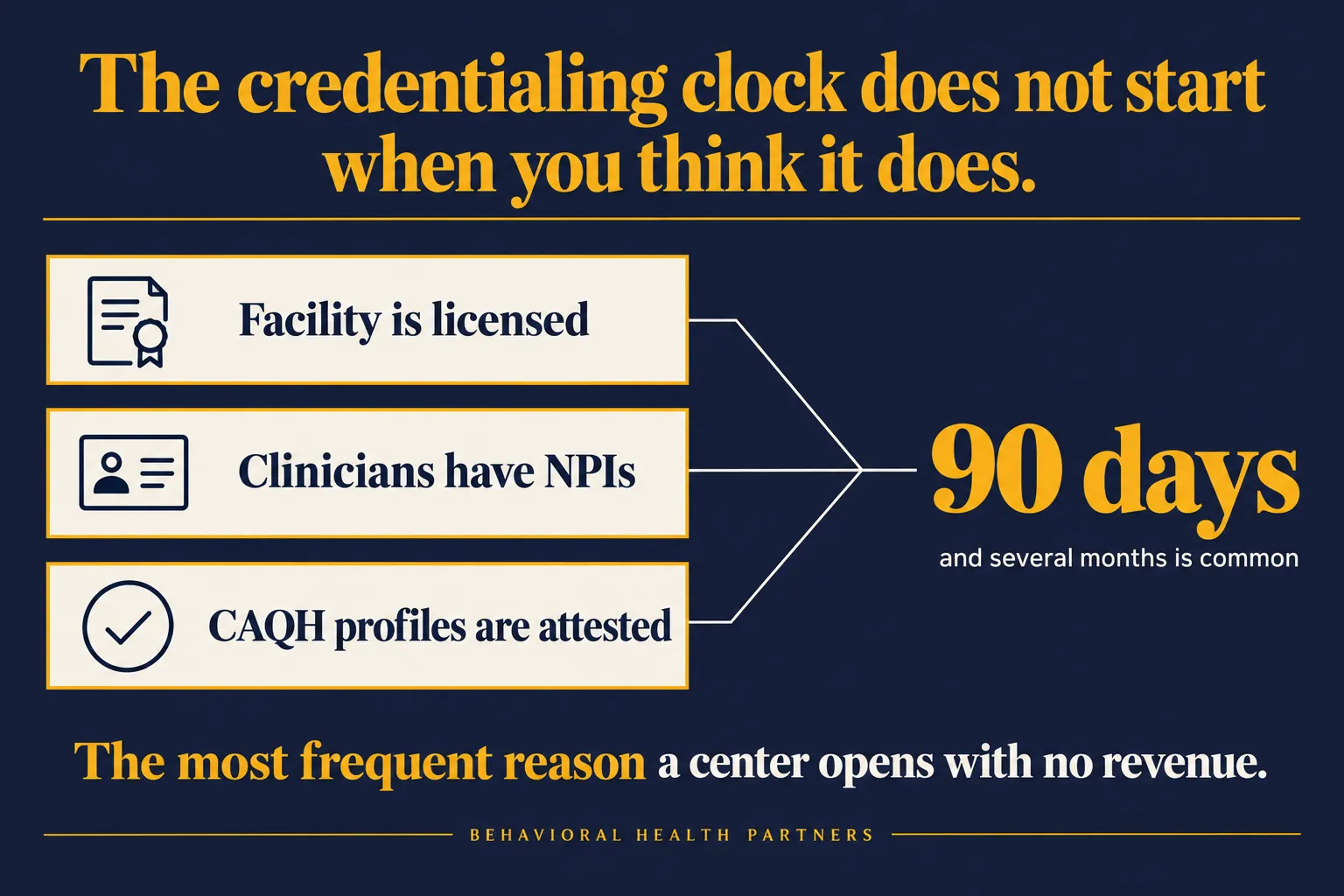
Credentialing with insurance can take 90 days or longer, and several months is common. That clock does not start until your facility is licensed, your clinicians have NPIs, and their CAQH profiles are attested, which is why payer enrollment is the most frequent reason a center opens with no revenue. Build the credentialing timeline into your proforma and start the paperwork the day the license is issued.
Payer enrollment is also where you set the contracts that determine your rates. Negotiate as a facility, not as a collection of individual providers, and get single-case agreement procedures in writing for out-of-network admissions. Then build the revenue cycle to match: verified benefits before admission, authorization tracking by level of care, daily charge capture, and a denial workflow. Our complete guide to mental health billing walks through codes, authorizations, and the denial patterns specific to PHP and IOP.
Step 11: Practice Management, EHR, and Compliance Systems
Practice management software streamlines administrative tasks like scheduling, eligibility checks, and claims, and an electronic health record centralizes patient information for every clinician on the team. For a facility, the two need to work as one system: group scheduling by program and level of care, treatment planning with signatures and review dates, progress notes that meet both payer and state documentation standards, and medication administration records. Automated appointment reminders reduce no-show rates, which in an IOP is the difference between a billable day and a wasted one. Our guide to the best behavioral health EMR options compares platforms built for programs.
HIPAA compliance is required for protecting patient health information, and mental health records carry additional protections, including the separate handling of psychotherapy notes. HHS publishes guidance on how HIPAA applies to mental health information, including when a provider may share information with family. Your compliance program should cover privacy and security policies, a risk analysis, business associate agreements with every vendor that touches patient data, documented staff training, and an incident response procedure. If you offer any remote sessions, a HIPAA-compliant telehealth platform is non-negotiable. Good compliance is also good operations: the systems that satisfy a surveyor keep clinicians out of paperwork, and that is where operational efficiency comes from. Build them on best practices from day one rather than retrofitting them after the first audit.
Step 12: Readiness Audits Before You Accept Your First Patient
Conducting readiness audits is essential before accepting patients at a mental health facility, and it is the step founders skip when the lease is burning cash. A readiness audit walks the whole patient experience before a patient lives it: the phone rings, benefits are verified, the intake assessment is signed, the treatment plan is written inside the required window, the first group runs on schedule, the progress note is filed, the claim goes out clean, and the discharge summary reaches the next provider. Run it with real staff, a fake patient, and a stopwatch.
Turn every gap into an action plan with an owner and a date. Pair the clinical audit with a compliance check and a facility walk against your environmental risk assessment. A center that opens after a readiness audit opens once. A center that skips it opens twice, and the second time is in front of a surveyor.
Step 13: Market the Facility Before the Doors Open
The process of opening a mental health facility follows a structured path, and marketing belongs near the start of it, not the end. Word-of-mouth referrals are not enough to fill a PHP census from day one, and referral partners will not send clients to a program they cannot find or verify online. We can have a website live three months before the license is issued, so by the time you open, the phone already rings. Our full mental health marketing services are built for exactly this launch window.
Your Website, Your Search Presence, and the First Call
A professional website explains your levels of care, your admissions process, the insurance you accept, your team's credentials, and how to reach you, all in the first screen. Families ask two questions: do you have what I need, and can I trust you. Answer both fast, with real photos of real staff and a path to a human being. Our guide to mental health website design covers the page structure and trust signals that work in this category, and our chapter on the admissions funnel prepares the person who answers the phone.
Educational, SEO-driven content outperforms traditional promotional tactics, because people in crisis and the families around them search before they call. A facility needs a page for every level of care and every condition it treats, an optimized Google Business Profile for every location, and content that answers the questions your intake team hears every day. Our mental health SEO service builds that authority before launch, and our guide on Google Business Profile optimization covers the local foundation.
Mental Health Advertising
Paid search and paid social fill the window while organic rankings mature. Campaigns in this category must respect platform healthcare policies and your own ethics: no fear-based creative, no promised outcomes, and landing pages that match the ad. Our mental health advertising team runs these campaigns with conversion tracking tied to admissions, not clicks. If your model includes interventional psychiatry, we also offer ketamine clinic marketing and TMS clinic marketing programs, because those treatments are searched for by name.
AI Search and Generative Engine Optimization
Families now ask ChatGPT, Claude, Gemini, Perplexity, and Google AI Overviews which program to call before they open a results page. Appearing in those answers requires structured, factual, well-cited content that AI systems can read and trust. Our generative engine optimization service builds that visibility alongside classic search, and our guide on how to rank in AI Overviews explains the mechanics.
If you would rather build the plan with us, schedule your free consulting call and we will walk through your market, model, and timeline on screen.
A Realistic Timeline for Opening a Mental Health Facility
| Phase | Typical duration | What happens |
|---|---|---|
| Feasibility and model | 1 to 2 months | Market research, levels of care, payer mix, go or no-go decision |
| Business plan and proforma | 1 to 2 months | Funding package, entity formation, EIN, coverage, legal counsel |
| Real estate and build out | 3 to 9 months | Zoning, lease or purchase, design, construction, inspections |
| Licensing | 2 to 24 months by state | Policies, application, survey, provisional or full license |
| Hiring and credentialing | Overlaps licensing; 3 to 6 months | Clinical leadership, staff, NPIs, payer enrollment, contracts |
| Marketing build | Starts 3 months before license | Website, SEO, GEO, Google Business Profile, referral outreach |
| Readiness and opening | 1 month | Mock surveys, readiness audits, soft launch, first admissions |
| Accreditation | 6 to 12 months after opening | Initial survey once records exist |
Most outpatient centers open in 9 to 18 months from decision to first admission. Beds take longer, and licensing is the line that moves most. Planning for growth preserves care quality and patient trust, so add the next level of care or location only after the first is stable, with the same readiness audit, and watch the forces shaping demand in our guide to mental health industry trends.
How Behavioral Health Partners Helps You Open a Mental Health Facility
We are one partner from feasibility to full census. On the consulting side, we run the feasibility study, build the proforma and plan, secure the state license, prepare you for accreditation with mock surveys, and help you hire your clinical leadership. On the marketing side, we build the website, search presence, AI visibility, and advertising that fill a program, and we start before the license is issued so the phone rings on opening day. Our clients include centers we opened from a bare lot and centers we came alongside at year three; the ones that follow the sequence above open faster and open once.
Adam Vibe Gunton, our founder and Managing Partner, is a person in long-term recovery, a bestselling author, a TEDx speaker, and a founding member of Radix Recovery in Cedar Rapids, Iowa, which had one of the most successful treatment center launches in history. If you are building something that will change lives, schedule your free consulting call, and if you want a partner with skin in the game, learn how we partner with operators to open centers together.
Frequently Asked Questions
How much does it cost to open a mental health facility?
An outpatient IOP or PHP clinic typically runs $300,000 to $500,000 before the first reimbursed claim, covering construction, licensing, an EHR, clinical leadership salaries, and reserves through credentialing. Residential and inpatient centers run from $500,000 to well over $1 million because of beds, 24-hour staffing, and hospital-grade construction. A proforma built on your state's rates is the only way to know your number.
Do I need a clinical license to open a mental health facility?
In most states you do not need a clinical license to own a facility, but the facility must employ licensed clinical leadership, and some states restrict ownership of clinical entities to licensed professionals. Every clinician on the treatment team needs an active clinical license, a graduate degree from an accredited program, and a National Provider Identifier before billing.
How long does it take to get a facility licensed?
It depends on the state and the level of care. Our fastest license came through in just over two months after application; most states take several months, and New York and New Jersey can take 12 to 24 months. Beds take longer than outpatient programs because of life-safety and occupancy inspections.
What is the difference between IOP and PHP?
Intensity. An IOP delivers a minimum of about nine hours of programming per week, usually three days, for people who can live safely at home. A PHP delivers 20 or more hours per week, usually five days, as an alternative to psychiatric hospitalization. Many centers offer both so patients can step down without changing providers.

Adam Vibe Gunton is an addiction recovery expert, entrepreneur, marketer, brand strategist, and speaker dedicated to advancing the behavioral health industry. As Founder and Managing Partner of Behavioral Health Partners, he has worked across treatment-center development, operations, branding, PR, SEO, advertising, and growth strategy. Combining professional experience with his own lived experience in recovery, Adam brings a unique perspective on how treatment organizations can build trusted brands, reach more people, and create a greater impact.
More about Adam
One Conversation. No Pitch.
Schedule Your Free Discovery Call
Thirty minutes on video with Adam directly, camera on, screen-sharing your own online presence and your top three local competitors. If we are not the right partner, we will tell you that too.
Schedule Your Free Initial ConsultWe take one client per level of care, per market. We confirm your market is open before partnering with you.