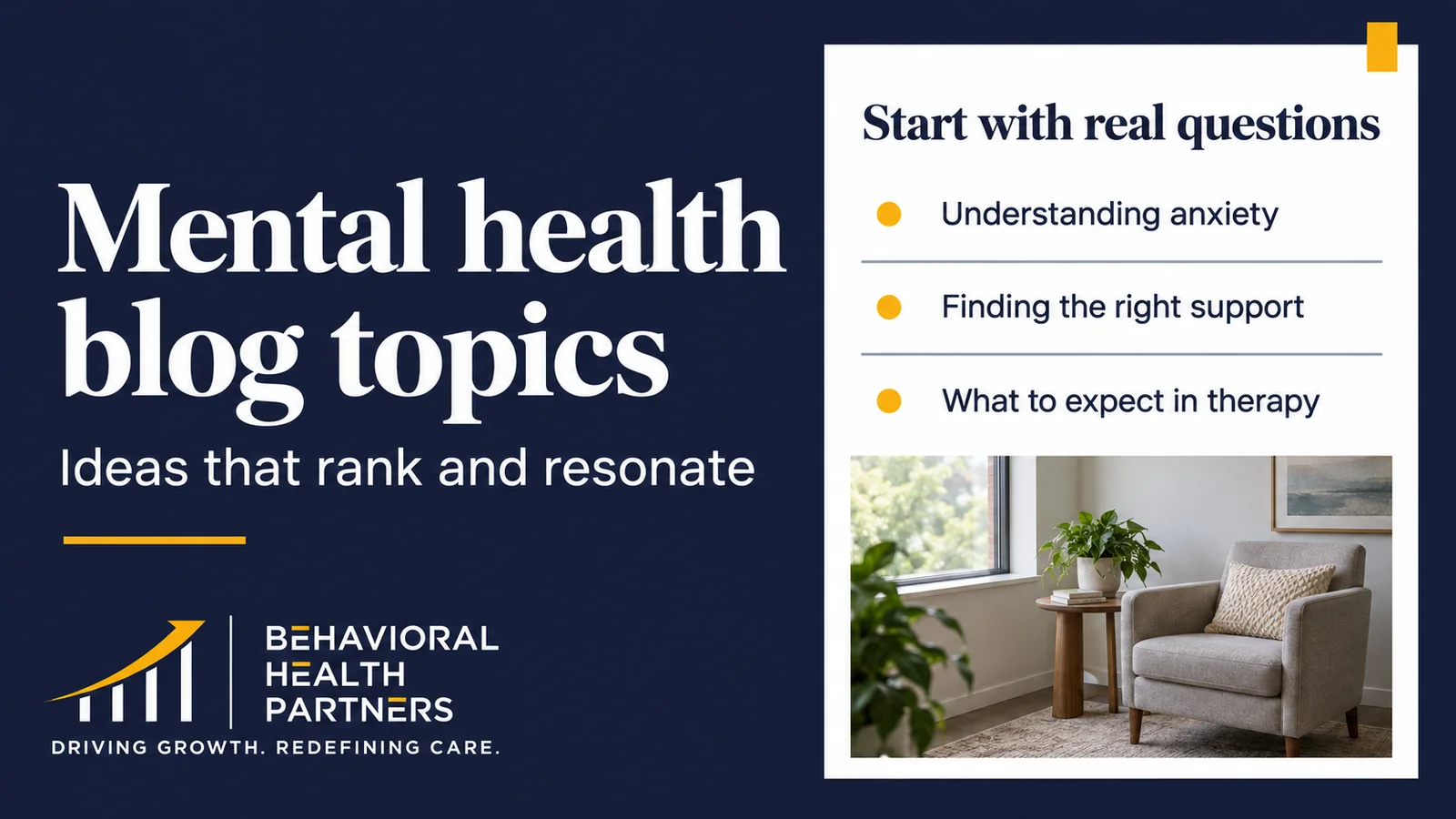
Mental Health Blog Topics: Ideas That Rank and Resonate
A blog builds trust before a first appointment and answers what people are already typing into Google. We cover why blogging works for a mental health practice and how to choose topics that both rank and resonate. We cover evergreen subjects, self care and wellness, relationships and family, awareness and stigma, the SEO basics behind each, and how to stay consistent without burning out.
A blog is one of the most powerful tools a mental health practice has. It builds trust before a first appointment, offers support to people who need it, answers the questions people are already typing into search engines, and shows prospective clients that real, caring humans are behind your practice. The hard part is rarely the writing. It is knowing which mental health blog topics are worth writing about in the first place.
This chapter gives you a running list of ideas that both rank in search and resonate, organized so you can plan a content calendar in an afternoon. Strong blog content is the engine of content marketing for any practice, and it is what turns a quiet website into a steady source of new clients. Pair these ideas with the SEO fundamentals in our behavioral health SEO guide and you have a plan.
Search engines reward websites that publish helpful, current content, and a consistent blog signals that your practice is active and authoritative. Every blog post is another door into your website, another chance to rank for a question a prospective client is asking, and another opportunity to demonstrate the expertise and warmth that make someone choose you. The benefit compounds: each post is a free, lasting asset that keeps working long after you publish it.
Blogging also serves your people directly. Someone quietly wondering whether their stress has tipped into anxiety, or whether their child needs support, often turns to a search engine long before they call anyone. A thoughtful post meets that person at the moment of need, offers real value, and gently shows them that help exists. That is good marketing and good care at the same time.
How to Choose the Right Blog Topics
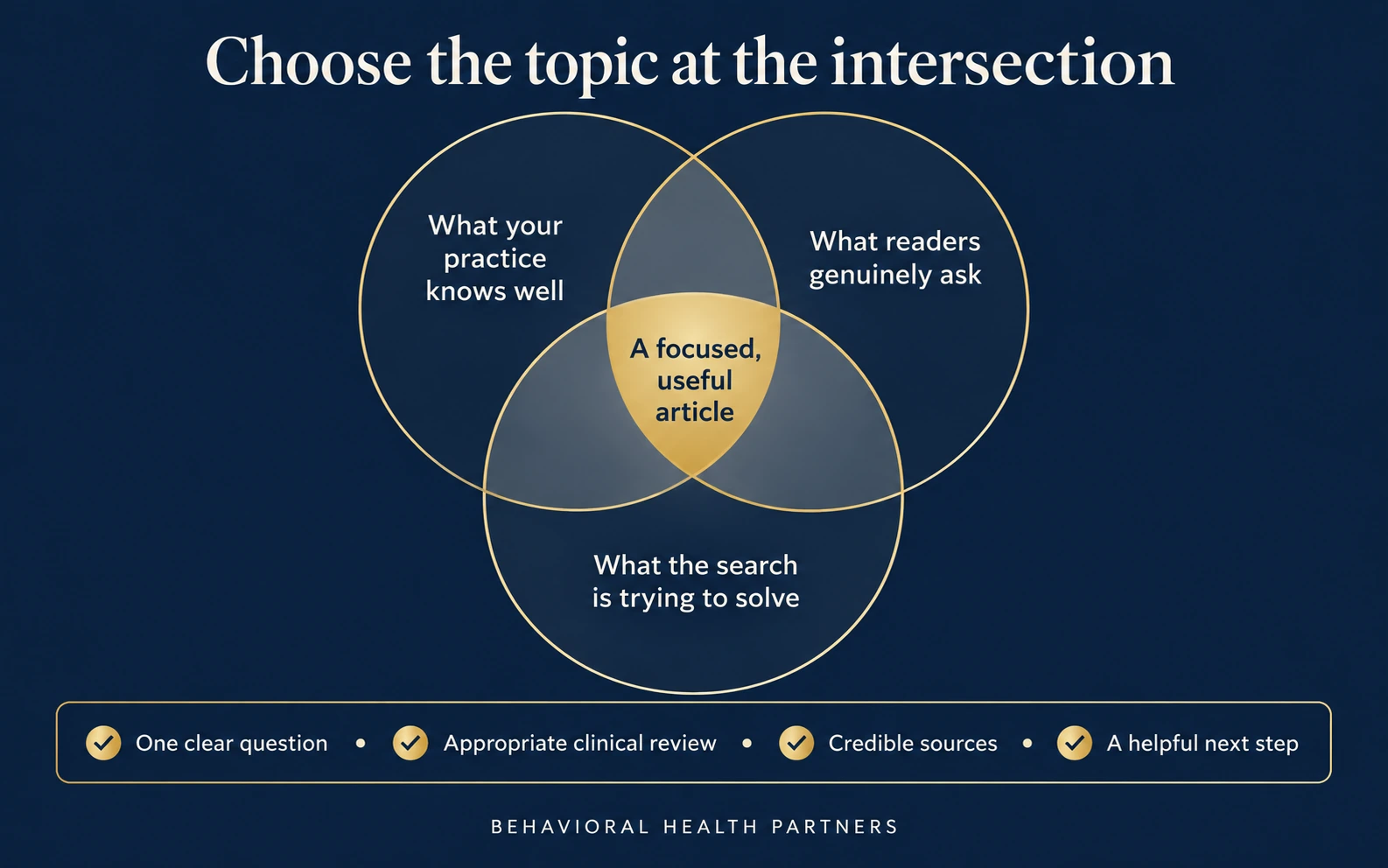
Before the list, a few principles keep your blog focused. Write about what you actually treat, because topics aligned with your expertise build genuine authority and attract the clients you are best equipped to help. Put yourself in your clients' shoes and answer the questions they ask in a first session. Watch search intent: a good mental health blog post answers a real question clearly rather than chasing a keyword. And keep a running list of ideas so you are never staring at a blank page.
The ideas below fall into a few reliable buckets: evergreen education, self care and wellness, relationships and family, awareness and stigma, and content that demystifies therapy itself. Mix them so your blog stays fresh.
Evergreen Mental Health Blog Topics
Evergreen topics stay relevant for years and quietly pull in traffic long after you publish them. They are the backbone of any content plan.
Understanding common mental health conditions
Clear, compassionate explainers on anxiety, depression, bipolar disorder, PTSD, and eating disorders are among the most searched mental health topics there are. Cover the symptoms of each mental illness, what those symptoms feel like day to day, how therapy can help, and when to seek support from a therapist, counselor, or other mental health professionals. The World Health Organization's overview of mental health is a solid authority to reference, and linking to sources like it strengthens your credibility with both people and search engines.
Recognizing the warning signs
A post on the early symptoms of a mental illness, or when everyday stress becomes something more, helps people name what they are feeling and understand when therapy might help. These pieces are gentle entry points that often lead a hesitant reader toward getting help.
How therapy actually works
Many people never book a first session because they do not know what to expect. A blog post that walks through a first therapy appointment, explains the difference between a therapist, a counselor, and other mental health professionals, or describes common therapy approaches like cognitive behavioral therapy, mindfulness-based methods, and art therapy removes a real barrier and builds trust. Explaining how each approach can benefit a specific condition, with a clear example, helps people picture the help available. Content that demystifies therapy gives anxious people the support to take the first step.
Self Care and Wellness Blog Topics
Wellness content performs well because it is practical, shareable, and hopeful. These posts give people something they can use today.
Self care and stress management
Practical self care and stress management techniques, self-compassion, and simple ways to cope with hard days are perennial favorites for a wellness blog and a real benefit to emotional well being. Free, trustworthy guidance from the National Institute of Mental Health's advice on caring for your mental health, which covers physical activity, diet, sleep, relaxation, and social support, and translate it into steps your readers can follow.
Sleep and mental health
The link between sleep and mental health runs both ways, which makes it a rich, evergreen topic. A post on building better sleep habits, or how poor sleep feeds anxiety, depression, and low mood, the symptoms to watch for, and simple ways to cope, helps your audience and showcases your practical knowledge.
Nutrition, exercise, and the mind body connection
The relationship between physical health and mental wellness, and the toll that loneliness and isolation take, are topics readers love. A post on nutrition and diet can note how balanced eating supports mood and eases some symptoms of illness. Blog posts on nutrition and diet, exercise and movement, and the mind body connection give practical wellness tips while reinforcing that mental and physical health are inseparable. A simple piece on how nutrition and exercise boost energy and support mood is easy to write and popular with your audience, and it offers real wellness tips people can act on.
Mindfulness and everyday coping
Short, actionable pieces on mindfulness, breathing exercises, and simple ways to cope with a hard day are highly shareable and give people immediate value.
Relationships, Family, and Life Blog Topics
Mental health lives inside relationships, and these topics connect with people navigating real life.
Parenting and child development
Parents search constantly for guidance on supporting their children's emotional well being. Post ideas on childhood development, talking to kids about feelings, or recognizing when a child needs to talk to a mental health professional are both useful and deeply relevant to families.
Nurturing healthy relationships
Content on communication, conflict resolution, setting boundaries, and building healthy relationships, plus finding supportive communities, resonates widely and reflects insights research consistently connects to well being, because almost everyone is working on a relationship somewhere in their life and looking for support.
Coping with grief and loss
Grief, trauma, and loss are universal and often searched in silence during hard seasons of life. A compassionate post on coping with loss offers comfort to people at their most vulnerable and shows the empathy at the heart of your practice.
Niche and audience-specific topics
Some of the best-performing posts speak to a specific audience. Write for college students managing stress away from home, for loved ones supporting someone in recovery, or for parents worried about childhood trauma and its effects. Trauma-informed content, for example, reaches people that generic posts miss. Explainers on specific conditions, from post traumatic stress disorder (PTSD) and eating disorders to bipolar disorder and schizophrenia, serve readers searching for exactly that topic. Sharing recovery stories, with consent and care, builds community and hope, and connects people to local communities of support. These niche posts also let you create content in your own unique voice, which is what makes a mental health blog memorable.
Awareness and Stigma Blog Topics
As the CDC explains, mental health stigma can prevent or delay people from seeking care, so content that reduces it does real good and tends to spread.
Overcoming stigma and starting the conversation
Posts on how to talk about mental health, how to speak with someone about substance use and mental health issues, how to support a loved one who is struggling, or how to challenge the stigma that keeps people silent are powerful. Point readers to trustworthy support resources like SAMHSA's mental health resources, including the 988 Suicide and Crisis Lifeline, so a person who needs help can find it. This kind of content gives readers language and the support to reach out to a therapist or another mental health professional.
Timely and awareness month content
Tie posts to current events and moments when attention is already high: Mental Wellness Month, Mental Health Awareness Month, Suicide Prevention Month, the holidays, back to school season, or the winter stretch when seasonal mood changes hit. Timely posts capture people exactly when they are searching.
SEO Tips for Mental Health Blogs
Great topics only rank if the SEO underneath them is sound. A few practices make every mental health blog post work harder.
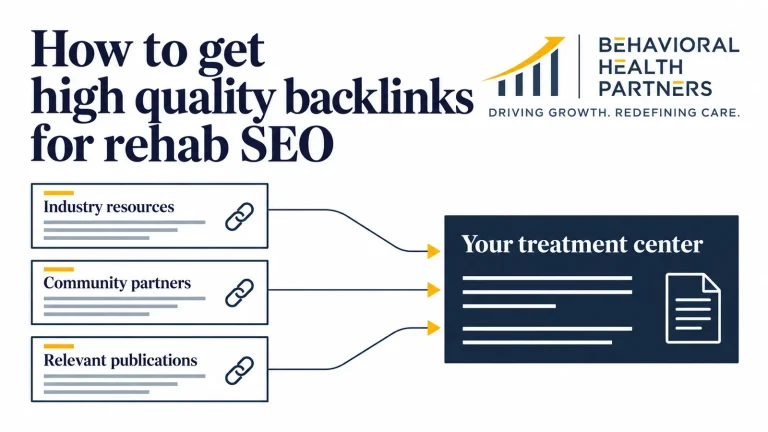
Start with light keyword research so each post targets a real question people search, then match the content to that search intent. Give every post a clear title and a single focus. Link each new blog post to related posts and to well-structured service pages so readers and search engines can navigate your site, and earn a few quality backlinks from reputable health sites, and cover your area with local SEO for your practice so nearby clients find you. Because mental health is a topic search engines hold to a high standard for trust, cite authoritative sources, share genuine insights, real examples, and practical benefits, keep information accurate and current, and make your credentials visible. For the full playbook on the keywords worth targeting, see our chapter on the best drug rehab SEO keywords, and route the commercial "mental health SEO" intent up to your core drug rehab SEO service so your blog stays focused on helpful topics while the service page earns the buyer terms.
Person-first, non-stigmatizing language matters here more than in almost any field. Write about a person experiencing depression, not a label, and your content will read as more trustworthy to readers and to search engines evaluating quality.
Staying Consistent Without Burning Out
A blog only works if you keep it going, so protect your consistency. Publish on a realistic schedule you can sustain rather than a heroic one you cannot. Keep that running list of blog topics so ideas are always waiting. Repurpose a single strong post into a newsletter, a social media snippet, or a short video. And remember that quality beats quantity: one genuinely helpful blog post a month will do more for your practice than four rushed ones.
If producing content consistently is the bottleneck, that is exactly where a partner helps, and our broader addiction treatment marketing work exists to keep the pipeline full while you focus on clients.
Frequently Asked Questions
What are some good mental health topics to blog about?
Strong, reliably searched topics include common conditions like anxiety and depression, self care and stress management, sleep and mood, healthy relationships, parenting and children's emotional well being, grief and loss, and overcoming stigma. The best topic for your practice is one that sits at the intersection of what you treat, what your clients ask about, and what people are actively searching.
How do I choose blog topics that will actually rank?
Start from real questions people search, then write the clearest, most helpful answer on the internet. Align each post with your expertise, match the content to the searcher's intent, cite trustworthy sources, and link it to related content on your site. Ranking follows genuine helpfulness, especially for mental health, where search engines reward accuracy and authority.
How often should a mental health practice publish blog posts?
Consistency matters more than volume. A steady rhythm you can sustain, even one quality post per month, signals an active, credible website and compounds over time. It is far better than a burst of posts followed by months of silence. Keep a running idea list so you always have a topic ready.
What is the 3-3-3 rule for anxiety?
The 3-3-3 rule is a simple grounding technique some people use in an anxious moment: name three things you can see, three sounds you can hear, and move three parts of your body. It is a popular self-help tip and makes an approachable blog topic, though it is not a substitute for care from a qualified mental health professional.
Turn These Topics Into a Content Engine
The best mental health blog topics are the ones that answer a real question, reflect your genuine expertise, and meet readers with warmth. Build a calendar from the ideas above, keep your rhythm steady, and let each post do double duty as both helpful content and a quiet invitation to reach out.
If you want a partner to plan, write, and optimize that content with you, schedule your free discovery call and we will map a blog strategy your practice can actually sustain.
Adam Vibe GuntonFounder and Managing Partner, Behavioral Health Partners
Adam Vibe Gunton is an addiction recovery expert, entrepreneur, marketer, brand strategist, and speaker dedicated to advancing the behavioral health industry. As Founder and Managing Partner of Behavioral Health Partners, he has worked across treatment-center development, operations, branding, PR, SEO, advertising, and growth strategy. Combining professional experience with his own lived experience in recovery, Adam brings a unique perspective on how treatment organizations can build trusted brands, reach more people, and create a greater impact.
Thirty minutes on video with Adam directly, camera on, screen-sharing your own online presence and your top three local competitors. If we are not the right partner, we will tell you that too.