Best Drug Rehab SEO Keywords: How to Find and Map the Terms That Fill Beds
Keyword research is where every rehab SEO program begins, before a single page is written. We cover what keywords decide, why behavioral health terms behave differently, and the treatment center keyword funnel. We cover the six categories every center should map, the research tools that genuinely help, the workflow to follow, where head terms belong, and how to read a competitor's keyword set.
Keyword research is where every successful drug rehab SEO program begins. Before a drug rehab center writes a single service page, earns a single backlink, or optimizes a single title tag, you have to know which search terms your future clients actually type when they are ready to get help. Choose the right drug rehab keywords and your entire drug rehab SEO effort compounds. Choose the wrong ones and you can publish for months without ever reaching the families who need you. For drug rehab centers, keyword research is the foundation the entire drug rehab SEO strategy is built on, and it is the part most treatment centers rush.
This chapter is the keyword companion to our broader work on drug rehab SEO, which covers the full organic strategy that turns rankings into admissions. Here we go deep on one discipline of drug rehab SEO: finding, evaluating, and mapping the best keywords for a rehab center, so your content program targets terms that convert instead of terms that only look impressive in a report.
If you would rather watch first, our rehab keywords video covers the essentials in a few minutes. Then come back here for the complete workflow. Our drug rehab SEO video covers how keywords fit the bigger organic picture.
What SEO Keywords Are and Why They Decide Everything
An SEO keyword is simply a word or phrase people type into search engines when they are looking for something. For a rehab center, that phrase might be "alcohol detox near me," "does insurance cover rehab," or "what is fentanyl withdrawal." Each one signals a different person at a different moment, and each one is an opportunity to be the answer.
Keywords matter because search engines match content to queries. Google explains in its documentation on how Search works that a page can be indexed but never ranked if its content is irrelevant to what people search. Relevance is the whole game for search engines, and keyword research is how a drug rehab center makes its relevance unmistakable to those search engines. When your pages are built around the exact terms your audience uses, search engines can confidently connect the two.
For a drug rehab center, keyword research is also how a limited budget beats a bigger one. You do not need to outrank national brands for every term. You need to own the specific, high intent keywords that the families in your market type into search engines right now, so search engines connect your drug rehab center to those searches. That focus is what lets a small drug rehab center compete with national drug rehab brands.
Why Behavioral Health Keywords Are Different
Keyword research for drug rehab is not the same as keyword research for a plumber or a software company. Three things make the behavioral health space unique, and ignoring them is the most common reason a keyword strategy fails.
These are your money, your life queries
Addiction treatment sits squarely in what search engines treat as your money or your life content, the category held to the highest standard for expertise and trustworthiness. That means your keyword targeting has to be matched by genuinely authoritative, accurate content. Chasing a keyword you cannot support with real clinical credibility will not rank, and in this field it should not.
Patient language and clinical language are not the same
The people searching for help rarely use clinical terms. A clinician writes "alcohol use disorder." A frightened parent types "help for a son who drinks too much." Both matter, but they serve different moments, and your keyword list has to bridge the gap. As you build patient-facing terms, follow person-first, non-stigmatizing language: NIDA's guidance in Words Matter explains why terms like "person with a substance use disorder" belong in your content even when raw search data is blunter. You can meet searchers where they are without adopting stigmatizing labels in your writing.
AI is reshaping which keywords are worth targeting
Search engines increasingly answer informational questions directly with AI generated overviews. That does not make keywords obsolete. It changes which keywords deserve a page and which deserve a paragraph. High intent, decision-stage terms still drive clicks and admissions. Purely informational terms are now often better treated as answer-engine content designed to be cited, not to win a click. A modern keyword strategy accounts for both.
The Treatment Center Keyword Funnel
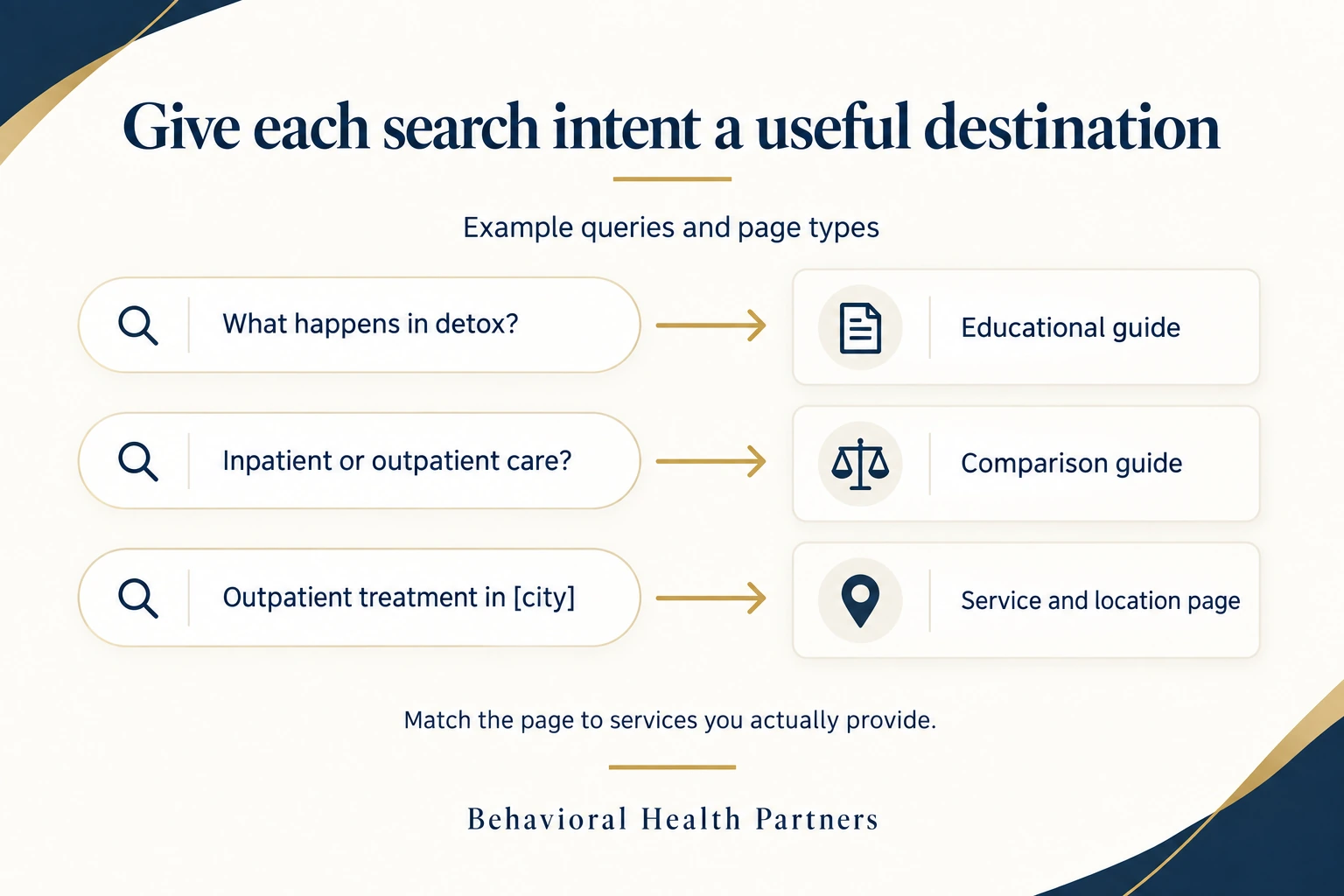
The most useful way to organize drug rehab keywords is by intent, the reason behind the search. Every query falls somewhere on a funnel from early awareness to ready-to-act decision.
Awareness keywords
These are informational: "signs of opioid addiction," "what happens in detox," "is my drinking a problem," "help for alcohol addiction." The searcher is learning, not yet choosing a facility. These terms build topical authority and feed AI answers, and they introduce families to your drug rehab center early, often long before they are ready to call an drug rehab center. Sharing this content through social media marketing extends its reach to the same local audiences your local SEO targets.
Consideration keywords
Here the searcher is comparing options: "inpatient vs outpatient rehab," "how long is alcohol detox," "best dual diagnosis treatment." Intent is rising. Content for these terms should educate and gently guide the searcher toward your alcohol rehab and drug rehab services, the way search engines expect a helpful drug rehab resource to.
Decision keywords
These are the terms that fill beds: "alcohol rehab in [city]," "drug detox near me," "residential drug rehab [state]," "alcohol rehab near me." The searcher is ready. These high intent keywords convert, and they belong on your strongest drug rehab service and location pages, where drug rehab centers turn a search into an admission. If you optimize nothing else, optimize these.
The Six Keyword Categories Every Rehab Center Should Map
Within that funnel, treatment center keywords cluster into six practical categories. Building your keyword list around these ensures you cover the full range of how families search.
1. Levels-of-care keywords
These describe the program itself: detox, residential, partial hospitalization, intensive outpatient, outpatient. Paired with a location, they are among the highest intent terms in addiction treatment, because someone searching "IOP in [city]" knows what they need, and search engines read that intent clearly.
2. Condition and substance-specific keywords
Alcohol addiction, opioid addiction treatment, fentanyl treatment, dual diagnosis, alcohol detox, and other substance terms all live here. Alcohol rehab searches, alcohol addiction and substance questions, and mental health co-occurring terms capture searchers organized around a specific substance or condition, and they let your rehab center speak directly to a family's situation. Many drug rehab centers underinvest in these condition-specific keywords, leaving easy rankings on the table.
3. Geographic and local keywords
City, county, and state combinations like "drug rehab [city]" or "alcohol rehab services near me." These local keywords carry strong purchase intent, drive local search, are the backbone of local SEO, and are among the least affected by AI overviews, because location signals that someone is ready to act nearby. Local search is where many admissions are won.
4. Insurance and payer keywords
"Does Blue Cross cover rehab," "in-network drug rehab [state]," "rehab that takes Medicaid." These are among the most underused and highest converting terms in the entire space, because a searcher checking coverage is close to a decision.
5. Demographic and modality keywords
"Women's addiction treatment," "veterans rehab," "trauma-informed treatment," "faith-based recovery," and "mental health and addiction treatment." Lower volume, but precisely targeted to the populations and approaches your drug rehab center actually serves. These terms help drug rehab centers reach families that broad keywords miss.
6. Informational and answer-engine keywords
"What is naltrexone," "how does withdrawal work," "stages of recovery." These informational keywords build the rehab center's online presence and authority for a drug rehab center and are increasingly optimized to be cited in AI answers rather than to win a direct click. They matter for visibility even when they do not drive immediate traffic, and they position a drug rehab center as an authority search engines trust.
Keyword Research Tools That Actually Help
You do not need an expensive stack to build a strong keyword list. A few tools, most of them free, cover the essentials.
Google Keyword Planner
Google's own Keyword Planner discovers keyword ideas from a seed term or a URL and shows search volume estimates and forecasts. It is built for advertisers, so it also informs your drug rehab PPC targeting, but it is one of the best free ways to find keywords and gauge demand for drug rehab terms. The same Google Ads keyword data that guides a paid campaign helps a rehab center prioritize its organic keywords.
Google Search Console
If your rehab center's website already gets any traffic, Google Search Console is your single most honest source of keyword data. Google Search Console's performance report shows the exact queries bringing your rehab facilities traffic, along with impressions, clicks, and average position in the search engine results. It reveals terms your rehab center already ranks for on page two of the search engine results, which are often your fastest wins.
Google Trends
Google Trends shows the relative popularity of search terms over time and by region. It will not give exact search volume, but it is excellent for spotting seasonality in alcohol rehab and substance searches and comparing which of two terms your market uses more.
Professional tools
Paid platforms like Ahrefs and Semrush add competitive data for treatment centers: which keywords your competitors rank for, keyword difficulty scores, search volume trends, and content gaps. They are worth it once your digital marketing program is serious, but any treatment center can build a strong first keyword list without them.
The Keyword Research Workflow
A repeatable workflow beats scattered guessing. Here is the sequence we use for treatment centers.
Step 1: Start with seeds and intent
List the services your treatment center actually provides and the substances and conditions you treat, from alcohol addiction and drug addiction to opioid treatment and co-occurring mental health conditions. These are your seed terms. For each, ask what the searcher wants, because matching intent is what turns a ranking into an admission for a drug rehab center. This is where many treatment centers lose potential clients, targeting terms that never signaled real intent. Search intent even shapes paid search, where Google's keyword match types control which queries a keyword triggers. A page targeting a decision keyword should look and read very differently from one targeting an awareness keyword, because search engines rank pages that match the searcher's intent for that drug rehab or treatment query.
Step 2: Expand with tools
Feed your seeds into Keyword Planner and pull your existing queries from Search Console to see what search engines already associate with your drug rehab center. Add the questions real people ask, the auto-complete suggestions Google surfaces, and the related terms your tools return. Aim for breadth first, then narrow. Effective keyword research means using Google Keyword Planner to check search volume, then letting your judgment identify keywords that fit your drug rehab center's actual services.
Step 3: Screen with a four-factor evaluation
For every candidate keyword, weigh four things: search volume, keyword difficulty, intent, and relevance to what you offer. A term with modest volume but high intent and low competition often beats a high-volume drug rehab head term you will never rank for in the search engines, especially for a newer addiction treatment center. Be honest about difficulty. If your domain is young, chase the long tail keywords first.
Step 4: Map one intent to one page
Assign each keyword or tight cluster of related keywords to a single page. Do not scatter the same term across five thin pages that compete with each other. One clear page per intent, organized into content clusters, is what builds durable rankings.
Where the Head Terms Belong
Some of the most searched terms in this space, like "drug rehab SEO" or a "drug rehab marketing agency," are commercial terms owned by dedicated service pages, not by a keyword-list article like this one. When your content touches those buyer-intent terms, the right move is to point readers to the pages built to serve them, such as our drug rehab SEO services and our broader addiction treatment marketing work. This is the same principle you will apply on your own site: let each page own one job, and link the supporting content up to the page that closes.
The same logic governs your treatment center's keyword map. Your levels-of-care and location pages should own the decision keywords. Your blog and guides should own the awareness and consideration keywords and link up to the service and location pages that convert. This is the core of the behavioral health SEO approach, and it works alongside the off-page effort covered in our chapter on earning high quality backlinks.
Analyzing Competitor Keywords
One of the fastest ways to build a keyword list for a drug rehab center is to study the treatment centers already ranking for the terms you want. Competitor keyword analysis shows you which drug rehab keywords are realistic, which intent each ranking page serves, and where the gaps are that your rehab center can fill.
Start by identifying three to five treatment centers that compete with you in the search engines, ideally a mix of national addiction treatment brands and local drug rehab centers in your market. Look at the pages that rank: what keywords are in their titles and headings, what intent each page targets, and how deeply they cover the topic. Tools like Ahrefs and Semrush make this faster by showing exactly which keywords a competing rehab center ranks for and how much traffic each term drives.
The goal is not to copy. It is to find the high-value drug rehab keywords your competitors rank for that you do not, and the terms they cover thinly that your treatment center can cover better. A drug rehab center with genuine clinical depth can out-rank a larger competitor on a specific condition, level of care, or local term simply by publishing better service pages than they do. Competitor analysis turns other treatment centers' search engine rankings into a map of your fastest opportunities, and it keeps your keyword research grounded in what actually ranks rather than what you hope will.
Mapping Keywords to a Content Architecture
A keyword list is only useful once it becomes a plan. Keyword mapping is the step where you turn a spreadsheet of terms into a website structure.
Group related keywords into clusters, give each cluster a home page, and surround that page with supporting content that links back to it. This content cluster model, a strong central page reinforced by related articles, is how treatment centers build topical authority that search engines reward. It is the backbone of a sustainable content marketing program for any drug rehab center. It is also how you avoid the most common mapping mistake: two pages targeting the same keyword and quietly cannibalizing each other.
Internal linking ties it together. Every supporting article should link to its cluster's main page using clear, relevant anchor text, passing authority toward the pages you most want to rank. Our chapters on service page optimization and local SEO for rehab centers show how those destination pages should be built once your keywords point to them.
Putting Keywords on the Page
Once a keyword is mapped, on page SEO is how you use it. Place your primary term in the page title, the main heading, the URL, the opening paragraph, and naturally through the body. Write the meta description to earn the click. Add the term to relevant image alt text where it fits honestly.
The rule that never changes: write for people first. Google's own Search Essentials is explicit that you should use search-relevant keywords in titles and headings while creating helpful, people-first content, not stuff keywords to game rankings. Keyword optimization and genuine helpfulness are not in tension. The pages that rank in behavioral health are the ones that answer the searcher's real question better than anyone else. On page SEO works best when the technical SEO underneath it is sound, so pair keyword optimization with a strong rehab website design, sound technical SEO, local citations, fast load times, and mobile optimization, since most families search from a phone.
Common Keyword Research Mistakes
A few errors show up constantly, and each one quietly limits a rehab center's growth.
Ignoring long-tail keywords
Chasing only high-volume head terms means competing with national brands for words you will not win. Long tail keywords, longer and more specific phrases, carry higher intent, face less competition, and add up to the majority of all searches. They are where a growing treatment center should start.
Neglecting local keywords
Addiction treatment is often a local decision. A drug rehab center that never targets its own city and region leaves its highest intent traffic on the table. Local keywords, consistent local citations, and a complete Google Business Profile work together in local SEO to capture nearby searchers, which is why local SEO belongs in every treatment center's keyword plan.
Keyword stuffing
Repeating a term unnaturally does not help and can hurt. Search engines are built to detect it, and readers feel it. Use your keyword where it fits and trust the content to carry the rest.
Targeting terms you cannot support
In a your money or your life field, chasing a keyword your program cannot back with real expertise wastes effort. Match your keyword ambitions to the services and credibility you genuinely have.
Measuring Whether Your Keyword Strategy Is Working
Keyword strategy is not a one-time decision. It is an ongoing loop of research, publishing, and measurement.
Use Search Console to track how your priority terms move over time in Google Search Console, which queries are gaining impressions, and which pages are climbing toward the first page. Watch the metric that matters most, qualified admissions inquiries, not just raw traffic. A handful of decision keywords that produce calls is worth more than thousands of informational visits that never convert, which is why keyword work pairs so closely with conversion rate optimization. Keywords bring the right potential clients to the page; conversion optimization turns those potential clients into admissions, which is the whole point of a drug rehab center's digital marketing.
Revisit your keyword research on a regular schedule. Search behavior shifts, new substances and treatment approaches emerge, and competitors move. Watching that search behavior is part of the job. The treatment centers that win treat keyword strategy as a living part of their digital marketing, not a project they finish once. A disciplined keyword-led SEO strategy steadily improves search engine rankings, lifts your standing in the search engine results and broader search results, and turns search engine optimization into a reliable stream of potential clients, which is the entire point of drug rehab marketing.
How Keyword Research Fits Your Whole Drug Rehab SEO Strategy
Keyword research is not a standalone task. It is the input that directs every other part of a drug rehab SEO strategy, and it shapes how treatment centers spend their entire digital marketing budget.
Once your keywords are mapped, they tell your writers what to publish, they tell your web team which service pages to build, and they tell your technical SEO work which pages to prioritize for speed and crawlability. They even guide local SEO, because the geographic keywords your families use decide which cities your Google Business Profile and location pages should target, so keyword research and Google Business Profile optimization go hand in hand, which is the heart of local SEO for rehab facilities. In this way, a single keyword list quietly organizes the work of an entire addiction treatment marketing program.
This is why the strongest addiction treatment centers treat keyword research as the first move in their digital marketing, not an afterthought. When a drug rehab center starts from a clear keyword map, its content, its search engine rankings, and its flow of potential clients all pull in the same direction.
Search engines reward focus. A treatment center that consistently publishes helpful, keyword-mapped content aimed at real search intent will, over time, out-rank larger competitors who publish more but plan less. That is the quiet advantage keyword research gives a drug rehab center, and it is available to any addiction treatment center willing to do the work.
Frequently Asked Questions
What are the best SEO keywords for a drug rehab center?
The best keywords are the high intent, decision-stage terms your potential clients search when they are ready to act: levels-of-care terms paired with your location, condition and substance-specific terms, and insurance and payer terms. These convert far better than broad, high-volume terms. A young or mid-sized rehab center should prioritize specific local and long tail keywords over competitive national head terms, then expand as the site gains authority.
How many keywords should a treatment center target?
There is no single number, but quality beats quantity. Most treatment centers are better served by mapping a focused set of high-value keywords to well-built pages than by chasing hundreds of terms thinly. Start with the decision and local keywords tied to your core services, add supporting awareness and consideration terms around them, and grow the list as you publish and earn authority.
How are rehab SEO keywords different from mental health keywords?
They overlap but diverge in intent and urgency. Addiction treatment searches often carry immediate, high-stakes intent and strong local signals, while many mental health searches are more informational and ongoing. Treatment centers that serve both should track them as separate keyword sets so each gets content matched to its intent. Our chapter on writing for mental health blogs covers that editorial side.
How often should I update my keyword research?
Review your keyword performance in Search Console monthly, and run a deeper keyword research refresh for your rehab facilities at least a couple of times a year. Search behavior, competition, and the treatment landscape all shift, and the drug rehab centers that revisit their keyword strategy and wider SEO strategy regularly stay ahead of the ones that set it once and forget it.
Do informational keywords still matter if AI answers them directly?
Yes, but their job has changed. Informational terms increasingly build authority and earn citations in AI generated answers rather than direct clicks. They still matter for visibility and trust, but your conversion-focused effort should concentrate on the decision and local keywords that AI overviews are least likely to satisfy on their own.
Build a Keyword Strategy That Fills Beds
The best drug rehab SEO keywords are not the ones with the biggest search volume. They are the ones your future clients actually search when they are ready for help, mapped cleanly to the SEO for rehab centers pages built to serve them. Start with intent, organize your terms into the six categories, screen for volume, difficulty, intent, and relevance, and map each keyword to one clear page. Do that consistently, and your keyword strategy becomes the engine of your drug rehab SEO strategy and a compounding source of admissions and new potential clients.
If you want a partner to build that keyword strategy and the content program around it, schedule your free discovery call and we will map the terms your treatment center can win.
Adam Vibe GuntonFounder and Managing Partner, Behavioral Health Partners
Adam Vibe Gunton is an addiction recovery expert, entrepreneur, marketer, brand strategist, and speaker dedicated to advancing the behavioral health industry. As Founder and Managing Partner of Behavioral Health Partners, he has worked across treatment-center development, operations, branding, PR, SEO, advertising, and growth strategy. Combining professional experience with his own lived experience in recovery, Adam brings a unique perspective on how treatment organizations can build trusted brands, reach more people, and create a greater impact.
Thirty minutes on video with Adam directly, camera on, screen-sharing your own online presence and your top three local competitors. If we are not the right partner, we will tell you that too.