How to Start a Sober Living Home: The Complete Guide
Sober living is the most accessible entry point in recovery housing: no clinical license in most states and a fraction of the startup cost of a treatment facility. We cover what a sober living home is and the demand behind it, the requirements including how they vary by state, the ten steps to opening one, startup costs, revenue and margins, and what daily operations actually involve.
Sober living is the most accessible entry point in the recovery housing industry. You do not need a clinical license in most states, the initial investment is a fraction of what a treatment facility costs, and demand has never been higher. Our behavioral health consulting practice has helped operators launch everything from a single sober living house to a full continuum of care, and this guide covers the entire build.
It also covers what most guides skip: the state-by-state rules, the real economics, and the growth path from one home to a licensed treatment operation.
What Is a Sober Living Home?
A sober living home is a substance-free residence where people in recovery live together, support each other, and rebuild independent lives. Residents pay rent, follow house rules, and stay accountable to the community while they work, attend outpatient treatment, and reconnect with family.
Sober living homes bridge clinical treatment and independent reentry into society. Someone leaves a residential treatment center with 30 days of stability; the sober living house gives them the next 6 to 12 months of structure while real life resumes. Our full breakdown of what is a sober living home covers the resident experience in depth.
The industry uses several names for the same category: sober living homes, sober houses, recovery residences, and recovery housing. NARR, the National Alliance for Recovery Residences, organizes recovery residences into four levels based on staffing, structure, and recovery support services. Most sober living operators run Level II recovery residences: peer-supported, monitored by a house manager, with no clinical services on site.
Sober Living Homes vs Halfway Houses
People use halfway houses and sober living interchangeably, but they differ. Halfway houses are often government-funded or court-connected, with time limits and mandated placement. A sober living home is typically private-pay, voluntary, and open-ended: residents stay as long as they pay rent and follow the rules.
The business models differ too. Halfway houses frequently depend on contracts with corrections systems, while a sober living home runs on resident fees. If the court-connected model interests you, our guide on how to start a halfway house covers that path.
Where Sober Living Fits in the Continuum of Care
Recovery care runs along a continuum: detox, residential treatment, partial hospitalization, intensive outpatient, then the sober living home as the final step before full independence. Sober living is where recovery gets road-tested against jobs, bills, and real relationships.
That position is a strategic advantage. The treatment centers above you on the continuum all need somewhere safe to discharge people. The operators who understand the continuum treat their homes as the last chapter of a larger story, and payers, families, and treatment providers reward that framing.
The Demand for Recovery Housing
The numbers behind this market are staggering. In 2024, 48.4 million Americans aged 12 and older had a substance use disorder, roughly 1 in 6 people. And 80% of the people who needed treatment for a substance use disorder did not receive it.
The opioid crisis turned recovery housing into a public health priority, and public money is following. Michigan committed $37.5 million in opioid settlement funds to create 3,467 new recovery housing beds by 2028. States across the country are directing opioid settlement funds toward recovery support services, and recovery community organizations are pushing for more certified recovery residences.
Meanwhile, thousands of people discharge from substance abuse treatment every month with nowhere stable to live. Only a fraction of those who complete treatment step into structured housing, which is the gap every sober living home fills. In competitive markets, sober living home operators report filling beds within 90 days of opening. Track mental health industry trends and you will see the same pattern everywhere: demand for structured, substance-free group living outruns supply.
Demand is not the question. Execution is.
Sober Living Home Requirements
Sober living home requirements come in four layers: federal fair housing law, state rules, local rules, and the standards of your certifying body. Understand all four before you open a sober living home or sign a lease.
The Fair Housing Act and Your Legal Foundation
Here is the legal foundation most new operators do not know they have: people recovering from substance use disorders are protected under the federal Fair Housing Act as individuals with a disability, and the Americans with Disabilities Act extends similar protections in other contexts. These protections cover people in recovery the same way they cover physical disabilities.
That matters because the Fair Housing Act protects sober homes from discriminatory zoning ordinances. A city cannot ban your sober living home from residential neighborhoods simply because residents are in recovery, and HUD and the Department of Justice have published joint guidance saying exactly that.
The protection has limits. It does not cover people currently using illicit drugs, and local government can still enforce non-discriminatory safety codes, occupancy limits, and parking caps that apply to all group living arrangements. Fair housing law is your shield, not a permission slip to ignore legitimate rules.
When a local rule genuinely blocks you, the law gives you a tool: the reasonable accommodation request. Operators can ask a city to modify an occupancy cap or spacing rule when the change is necessary for residents with disabilities to live in the community, and cities must weigh that request seriously.
Zoning and Local Rules
Before anything else, research zoning laws in your target city. Most single-family zones allow a reasonable number of unrelated adults to live together, but the definition of family, occupancy caps, and spacing requirements between sober houses vary block by block.
Some cities also require rental registrations, rooming house permits, or business licenses. Call the planning department before you sign anything: a 20-minute conversation with local government staff beats a variance fight after closing. Our post on zoning for rehab facilities explains how operators evaluate a property's regulatory position before they commit.
Property and Safety Requirements
The property itself carries requirements. A typical sober living home needs a minimum of four bedrooms and two bathrooms to work financially, and properties must pass local fire, building, and sanitation inspections before residents move in.
Essential safety systems include interconnected smoke alarms, clear emergency egress routes, and compliance with local fire safety codes. Beyond code, location drives outcomes: choose properties that are accessible and close to public transportation, grocery stores, meetings, and employment opportunities.
Mandatory Certification vs Voluntary Certification
Here is where states split. In most states, certification through your NARR affiliate is voluntary but practically mandatory: without it, you cannot receive state referrals or appear in state recovery housing directories, and many treatment centers will not discharge to you. State agencies refer to certified recovery residences first.
A growing list of states has moved to true mandatory certification or licensure. Ohio made certification mandatory as of January 1, 2025: operators cannot advertise as recovery housing or receive referrals from certified treatment providers without certification and a spot on the state registry. Arizona, New Jersey, and Utah require licenses to operate sober living homes. California requires a license only when a home provides recovery services such as counseling or detox.
To unravel your local operational requirements, certification through your NARR state affiliate is the recommended first stop even where it remains voluntary. The mandatory certification wave is spreading, and sober houses certified early are grandfathered into credibility.
Sober Living Home Requirements by State
Rules for recovery residences change fast, so verify with your state before you commit capital. Here is how the landscape looks in the states operators ask about most:
State
Requirement
Source
Ohio
Certification mandatory as of January 1, 2025 through Ohio Recovery Housing or Oxford House; uncertified homes cannot advertise or receive referrals
No mandatory state-level licensing as of this writing; local rules and voluntary certification apply
Verify with state and local officials
We are building a dedicated requirements guide for every state. Our Ohio guide is live: see how to start a sober living home in ohio for the full certification walkthrough. The rest are coming:
Alabama
Alaska
Arizona
Arkansas
California
Colorado
Connecticut
Delaware
Florida
Georgia
Hawaii
Idaho
Illinois
Indiana
Iowa
Kansas
Kentucky
Louisiana
Maine
Maryland
Massachusetts
Michigan
Minnesota
Mississippi
Missouri
Montana
Nebraska
Nevada
New Hampshire
New Jersey
New Mexico
New York
North Carolina
North Dakota
Ohio
Oklahoma
Oregon
Pennsylvania
Rhode Island
South Carolina
South Dakota
Tennessee
Texas
Utah
Vermont
Virginia
Washington
West Virginia
Wisconsin
Wyoming
How to Start a Sober Living Home in 10 Steps
Every successful sober living home we have helped launch followed the same sequence. Here is how to open a sober living home, from decision to full beds.
Step 1: Choose Your Market and Model
Start with the market, not the house. Which cities near you have treatment centers discharging people with nowhere to go? Where is the local recovery community strong? Who will your residents be: men, women, young adults, professionals recovering from substance use disorders?
Population choice shapes everything downstream. Young adult recovery housing runs differently than a home for men in their forties, and a women-and-children model carries its own requirements. Pick one population and serve it completely.
Step 2: Write the Sober Living Business Plan
A sober living business plan does not need to be long, but it needs to be honest. Cover your market analysis, target population, startup costs, monthly operating budget, pricing, and the referral relationships you will build.
Plan conservatively on occupancy. Most sober living operators model 60 to 70% occupancy for the first six months, not 100%. The homes that fail usually failed in the spreadsheet first.
Price from the market backward. Call every sober living home within 20 minutes, learn their rates and what those rates include, then position yours. Premium structure at premium pricing beats undercutting on price in this industry.
Your business plan should include exit criteria too: what growth looks like, when you add a second home, and what triggers the move into treatment services. We will cover that growth strategy at the end of this guide.
Step 3: Form the Business and Get Insured
Form an LLC, get an EIN, open a business bank account, and carry the right insurance: general liability plus professional liability written for recovery housing operations. A sober living home is not a standard rental; homeowner policies do not cover this use, and insurers who know the recovery housing industry will price it correctly.
If you lease, get the owner's written consent for the use. If you buy, evaluate the property the way experienced operators do: layout, capacity, condition, and the regulatory position covered above.
Step 4: Find the Right Property
The ideal first property has four to six bedrooms, two or more bathrooms, and common space where a real community can form. A typical sober living home accommodates 6 to 12 residents, and 6 to 10 beds is the range most operators find profitable without overwhelming the house.
Location is a recovery decision, not just a real estate decision. Choose residential neighborhoods close to public transportation, employment opportunities, grocery stores, and meetings. Residents without cars still need to build lives.
Look for a layout where bedrooms cluster away from common space. Shared housing works when people can be together on purpose and apart by choice.
Step 5: Pass Inspections and Set Up Safety Systems
Schedule fire, building, and sanitation inspections early; failed inspections delay openings more than any other single item. Install interconnected smoke alarms, mark emergency egress routes, and document compliance with local fire safety codes.
Then write your emergency plan: what happens in a fire, a medical event, an overdose, or a mental health crisis. Stock naloxone and train everyone in the house to use it. Safety is the first promise a sober living home makes to families.
Step 6: Write the House Rules
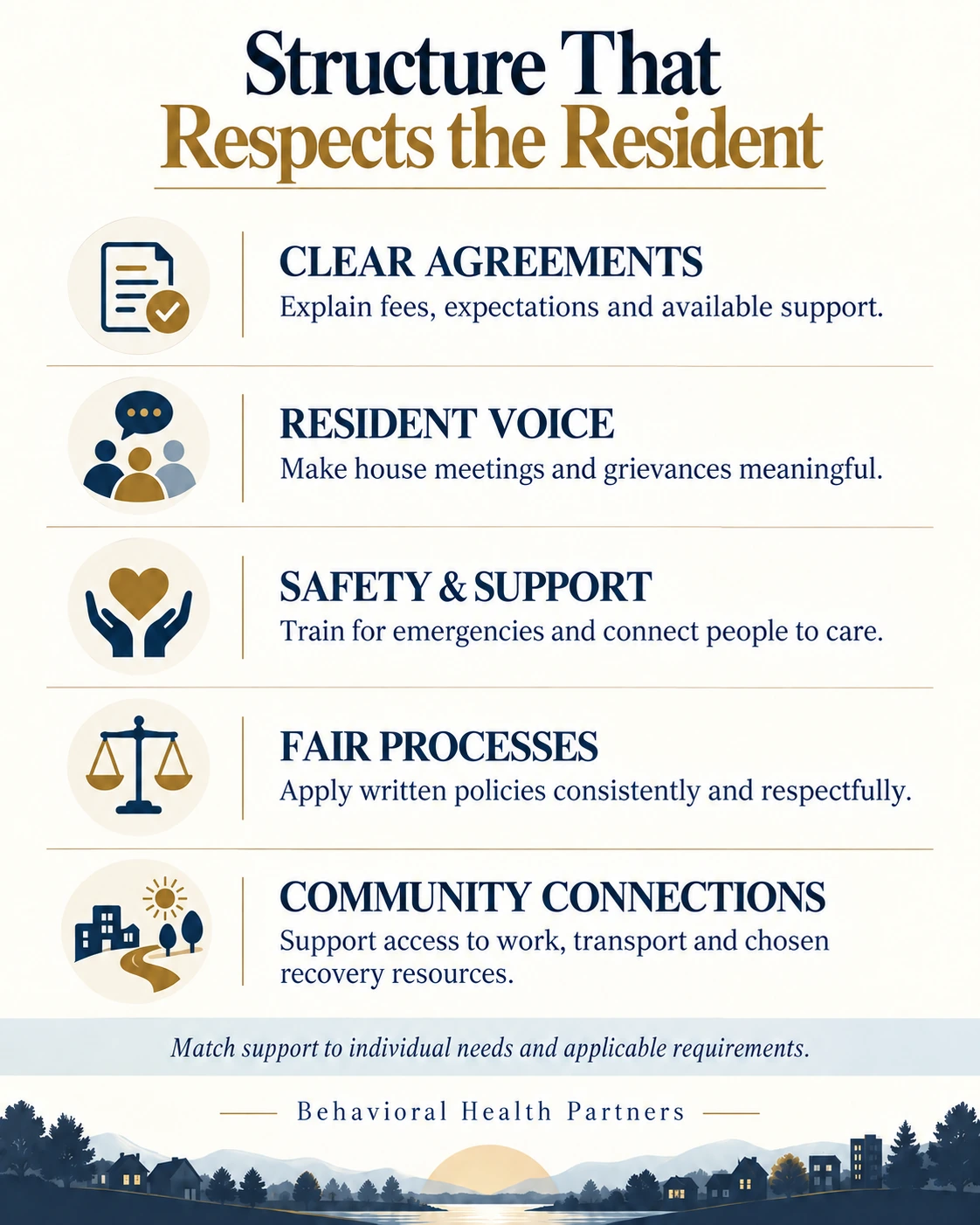
House rules are the operating system of a sober living house. Cover sobriety expectations, curfews, guests, chores, house meeting attendance, employment or program requirements, and fees. Resident agreements should outline zero-tolerance substance policies and fee schedules in writing, signed before move-in.
Good house rules maintain accountability without becoming punitive. The goal is a home, not an institution: structure that residents defend because it protects the sobriety they are building.
The rules that matter most in practice: curfews that respect work schedules, meeting or program requirements with a weekly minimum, guest policies with zero overnight exceptions early in residency, medication storage and disclosure, and consequences everyone can recite.
Create written policies for relapse response as well. What happens when someone tests positive: immediate discharge, or a structured response that connects them back to treatment? Decide before it happens, write it down, and apply it the same way every time.
Step 7: Set Drug Testing Protocols
Drug testing is essential for maintaining sobriety in the house, and your drug testing protocols need to be written before your first resident arrives. Define the cadence: scheduled testing, random drug testing, and for-cause testing when behavior changes.
Random drug testing carries the most weight because it removes predictability. Document every test and result. That compliance documentation protects residents, reassures families, and becomes the evidence referral sources ask for when they evaluate your home.
Consistency matters more than intensity. A sober living home that tests fairly and responds predictably keeps its culture; a house that tests selectively loses it.
Step 8: Hire a House Manager
Nearly every sober living home requires a house manager: the person who enforces house rules, runs drug testing, manages conflict, and sets the tone. Many operators start as their own house manager; most graduate to hiring one, often a senior resident with solid recovery time.
House managers earn $2,500 to $6,000 per month depending on duties, and some live on site with reduced or free housing as part of compensation. Whatever the arrangement, put the duties in writing: a house manager with unclear authority creates the exact instability the role exists to prevent.
Train your house manager on the emergency plan, relapse response, documentation, and de-escalation. The house manager is your culture, delivered daily.
Step 9: Get Certified
Contact your NARR state affiliate and start certification, even in states where it is voluntary. Certification is practically mandatory to receive state referrals or inclusion in state directories, and it is the fastest trust signal you can buy for the cost of an application and an inspection.
Your NARR affiliate certifies recovery residences against the national standard, and certification forces operational maturity: written policies, resident rights, grievance procedures, and compliance documentation that certifiers review. Homes that certify early build systems early.
Step 10: Build Referral Relationships and Fill Beds
Beds fill through referral relationships. Introduce yourself to the treatment centers within an hour of your house: their case managers and discharge planners need quality sober housing more than you need them. Add probation officers, hospital social workers, therapists, substance abuse counselors, and recovery community organizations to the referral network.
Treatment center referrals will anchor your census, but do not stop there. The marketing section below covers how to open a sober living pipeline that does not depend on any single referral source.
Sober Living Startup Costs
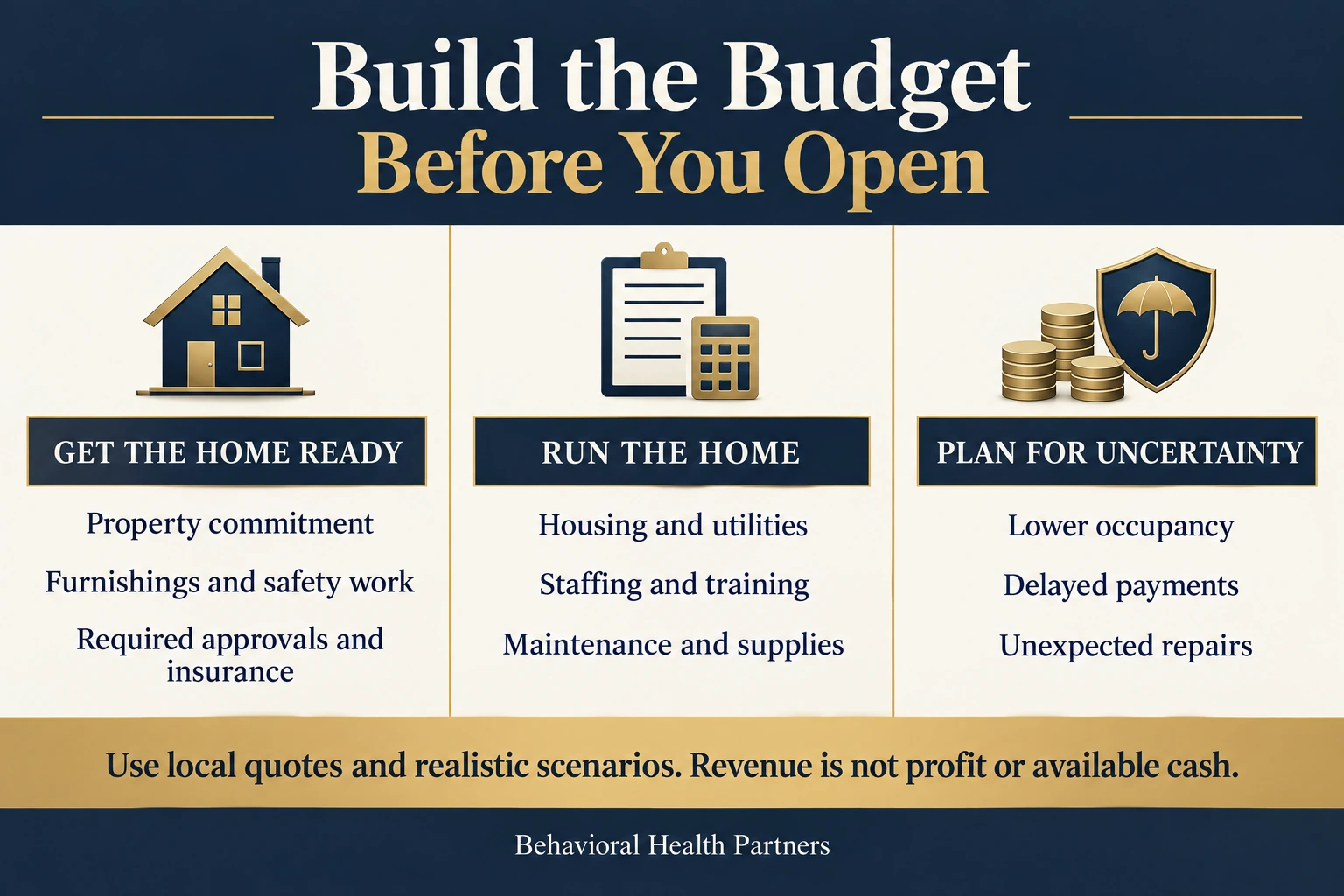
Startup costs for a sober living home range from $22,000 to $68,000 for a leased property. That covers first and last month's rent, deposits, furnishings, safety upgrades, insurance, licensing or certification fees, and two to three months of operating reserve.
Buying the property changes the math: add a down payment, but gain equity and control. Either way, the entry cost sits far below clinical care; for comparison, see how much does it cost to start a rehab center.
Underfunding is the most common business plan mistake. Beds fill over months, not days, and rent is due whether you have three residents or ten. Raise or reserve enough to operate at half occupancy for six months, and every decision gets calmer.
Revenue, Margins, and Profitability
An 8-bed sober living home can reach $10,000 to $14,000 in monthly revenue at typical market rates. Residents pay rent weekly or monthly, and in some markets county programs pay $35 to $55 per day per resident for qualifying placements.
Well-run homes achieve 20 to 35% operating margins at stabilization, and operators can expect to reach profitability within 6 to 18 months. Those margins compare favorably to almost any small business, and they compound when you add multiple properties on shared overhead.
Pricing deserves context: sober living is dramatically cheaper for residents than treatment. When families ask about the cost, walk them through how much does rehab cost by level of care; a structured sober home at $600 to $1,200 per month is the most affordable rung on the entire ladder.
For the larger economics of this industry, from housing through clinical care, our guide on how much money do rehab centers make maps revenue and margin at every level.
How Many Residents Should You Have?
How many residents makes a home work? Six is the floor where economics function; ten to twelve is where community starts straining in a single-family footprint. A sober living home typically accommodates 6 to 12 residents, and most operators land at 8.
Fill slowly and deliberately at the start; the first five residents set the culture that the next fifty inherit. And know how many residents your zoning, parking, and septic capacity actually allow before you advertise beds.
Grant Funding and Opioid Settlement Funds
You do not have to build on resident fees alone. Grant funding is available through state and federal programs, including SAMHSA recovery housing dollars that flow through states, and opioid settlement funds that states are actively directing toward recovery housing beds. Watch your state's settlement dashboards: recovery housing line items appear in budgets every cycle, and grant funding rounds reward operators who already hold certification and clean compliance documentation.
Certification is usually the gateway: registries and certified status determine who can receive this money. Federal grants and state programs rarely fund uncertified homes. Get certified, get listed, then apply.
Daily Sober Living Operations
Daily operations decide whether your sober living home is a program or just a house with rules on the wall. Establish the operational structure before residents arrive: intake procedures, orientation, chore systems, quiet hours, and the weekly rhythm.
Strong sober living operations run on rhythm. Morning accountability, work or program during the day, meetings at night, house meetings weekly. Recovery programming does not require clinical services; it requires consistency and community members who show up for each other.
Keep the paperwork honest: intake records, resident agreements, incident reports, testing logs. Operators who document well sleep well.
Set a sustainable presence for yourself too. Owners who live at the house around the clock burn out, and owners who never visit lose the culture. A predictable weekly rhythm, plus a strong house manager, is the durable middle.
House Meetings and Accountability
House meetings are the heartbeat of recovery support inside the home. Weekly meetings handle logistics, surface conflicts early, and give every resident a voice in the community they are protecting.
Accountability structures work best when residents own them: senior residents mentoring new arrivals, shared chores, and peer honesty about warning signs. The house manager referees; the house governs.
Relapse Response and Emergency Plans
Relapse will happen. Policies should include procedures for relapse response and drug testing outcomes: how a positive test is confirmed, how discharge is handled safely, and how the person is connected back to treatment rather than dropped to the street.
A humane, predictable relapse response protects the whole house. Residents trust rules that protect their recovery, and referral sources trust homes that handle the hardest moments with dignity.
Marketing Your Sober Living Home
Building community relations is crucial for successful operation, and it starts before you open. Meet the neighbors, introduce yourself to local officials, and be the operator who answers the phone. Invite the community members nearest you to see the house before residents arrive: neighbors who have met you call you, not the city council. A successful sober living home is a good neighbor first and a business second.
Then build the online presence, because families and potential residents search before they call. Your website should show the real house, the real structure, and real pricing; our guide to rehab website design best practices applies directly to sober living. Claim and optimize your listing using google business profile optimization, and build local seo for rehab centers style visibility in your city.
One more piece: brand. What your home stands for should be visible in every photo and sentence; our breakdown of branding for treatment centers shows how positioning fills beds before ads do.
And remember who actually chooses. Half of placements are driven by a parent or spouse doing research at midnight. Write the website for the mother comparing three homes, answer the phone like her son's next step depends on it, and your close rate changes.
Referral Sources That Fill Beds
Rank your referral sources and work them weekly. Treatment providers and discharge planners come first, then courts and probation officers, then therapists, hospitals, and the local recovery community itself: alumni, sponsors, and meeting networks.
Track every referral in a system, not a notebook. A simple behavioral health crm shows you which relationships fill beds and which need a visit, and it keeps follow-up from slipping when the house gets busy.
Directories, Local SEO, and Your Website
The digital referral path compounds while you sleep. State registries and certified directories send steady placements, and organic search sends families. The operators who own their city's search results own their census.
Word of mouth alone is not a growth plan. Treat digital visibility as infrastructure, the same as beds and smoke alarms.
The Growth Strategy: Sober Living to Behavioral Health Continuum
Here is the part most guides never tell you: sober living is a phenomenal business, and it is an even better foundation. Once your first home stabilizes, three growth paths open.
The first is horizontal: multiple properties. Your systems, house rules, staffing playbook, and referral network transfer to a second home at a fraction of the original effort. Many operators scale to five or more homes on this model.
Second homes also de-risk the first: shared house manager coverage, one vendor list, and a waitlist that moves between properties instead of walking away.
The second is vertical, and it is where the economics change: add services up the continuum of care.
Add an IOP: The Natural Next Step
Residents of a sober living home already leave every day for outpatient treatment somewhere else. An intensive outpatient program brings that treatment in-house, under your own license, and turns a housing margin into a healthcare margin.
The sequence works because the census already exists: stable sober living operations feed an IOP from day one, and telehealth mental health services extend the same clinical model to alumni and remote clients. An IOP is licensed treatment for substance use disorders, so the requirements jump: state licensure, accreditation (start with what is the joint commission), clinical staffing, an addiction treatment emr, and behavioral health billing that turns sessions into revenue. Layering clinical recovery support services on top of housing is how a housing company becomes a healthcare company.
That jump is exactly what our consulting work exists for. The program itself comes first: our guide on how to start a behavioral health program covers building the clinical model, the daily schedule, and the philosophy your marketing will eventually promise.
From Recovery Housing to Treatment Center
The full continuum ends where this guide began: sober living as the final step of care, now inside your own ecosystem. Operators who complete the build run detox or residential treatment, step clients down to their own IOP, and discharge them into their own recovery housing. Every level feeds the next, and no one leaves the continuum to a stranger.
If that is the ambition, start with our complete guide on how to open a rehab center. The licensing, facility, and clinical requirements are a different scale, but the demand math is the same one that filled your first sober living house.
Recovery housing operators who think in continuums build the most durable companies in this field, and the ones we partner with build them faster.
How much does it cost to open a sober living home?
Startup costs typically range from $22,000 to $68,000 for a leased property, covering deposits, furnishings, safety upgrades, insurance, certification fees, and operating reserve. Purchasing the property adds a down payment on top. Budget enough reserve to operate at half occupancy for six months, because beds fill gradually and rent does not wait.
Do you need a license to start a sober living house?
In most states, no license is required to open a sober living house that offers housing and peer support without clinical services. A growing minority, including Arizona, New Jersey, and Utah, require a state license for recovery residences, and Ohio requires certification. Adding treatment services triggers healthcare licensure everywhere, so verify your state's rules before opening.
How many residents should a sober living home have?
Most sober living homes accommodate 6 to 12 residents, and 6 to 10 beds is the range operators find most profitable. Below six, the economics rarely cover a house manager and reserves; above twelve in a single-family property, community and compliance both strain. Eight beds is the most common sweet spot for a first home.
How much do sober living homes make per month?
An 8-bed sober living home at market rates can generate $10,000 to $14,000 in monthly revenue, and well-run homes reach 20 to 35% operating margins at stabilization. Profitability typically arrives within 6 to 18 months, driven by occupancy, and county placement programs paying $35 to $55 per day can accelerate the ramp.
What is the difference between a sober living home and a halfway house?
A sober living home is usually private, voluntary, and funded by resident fees, with open-ended stays governed by house rules. Halfway houses are typically government-funded or court-mandated, with time-limited stays and formal program requirements. Both provide substance-free housing; the difference is who pays, who places residents, and how long they stay.
Adam Vibe GuntonFounder and Managing Partner, Behavioral Health Partners
Adam Vibe Gunton is an addiction recovery expert, entrepreneur, marketer, brand strategist, and speaker dedicated to advancing the behavioral health industry. As Founder and Managing Partner of Behavioral Health Partners, he has worked across treatment-center development, operations, branding, PR, SEO, advertising, and growth strategy. Combining professional experience with his own lived experience in recovery, Adam brings a unique perspective on how treatment organizations can build trusted brands, reach more people, and create a greater impact.
Thirty minutes on video with Adam directly, camera on, screen-sharing your own online presence and your top three local competitors. If we are not the right partner, we will tell you that too.