How to Start a Behavioral Health Program: Build It Before You Market It
The program is the product, and most guides skip it. We cover the needs assessment that comes first, starting from your treatment philosophy rather than your business plan, and designing the clinical model. We cover building the daily schedule, staffing your clinical team, the regulatory requirements a program must meet, writing a business plan that holds up, and choosing between practice and program structures.
Most guides tell you to form an LLC and pick a name. Almost none tell you the truth: the program is the product. What happens inside your walls between 7 a.m. and lights out fills your schedule, earns referrals, and gives your marketing something real to say. Our behavioral health consulting practice builds this with operators every week; this guide walks you through the process.
We wrote it for two readers: the mental health professional starting a private practice, and the operator building a clinical offering inside a treatment center. Both need a treatment philosophy translated into a daily structure, then put online with one congruent message.
Behavioral Health Program Development Starts With a Needs Assessment
Before you write a single policy, determine what your community actually lacks. A needs assessment is the first step of behavioral health program development, and the step most people skip.
Conduct a feasibility assessment of local service gaps: which specific mental health services are missing, where are mental health services thin, where do the underserved areas sit?
Then identify your target populations: adolescents with anxiety, adults with co-occurring disorders, working professionals who need evening hours. Tailoring services to a defined group beats serving everyone and tells you which services to create first.
Start With Your Treatment Philosophy, Not Your Business Plan
Every strong mental health practice is built on a conviction about how people heal. Write yours down before anything else. Developed fully, it becomes your mission statement, your clinical model, and eventually your marketing.
Ask the hard questions. Group-driven or individual counseling first? Where does medication management fit? What does high quality care look like on a Tuesday afternoon?
Your answers shape the treatment plans you write, the staff you hire, and the way clients experience your services. A clear philosophy attracts clients who fit it; no philosophy attracts whoever calls, then loses them.
Design the Clinical Model
A clear clinical model outlines patient care pathways and treatment strategies from first call to discharge: who assesses each person, what services they receive, and how you determine readiness to step down.
Map the pathway in writing: intake and assessment, level of care decision, active treatment with defined services (individual counseling, group work, psychiatry, case management), then step-down and alumni support.
Decide your care model now: licensed therapists carrying caseloads alone, or social workers and case managers wrapped around each client? Integrated, team-based mental health care is more consistent, and it markets itself.
Build the Daily Schedule
Here is where philosophy becomes real: the daily schedule is your treatment philosophy translated into hours, and the most overlooked part of the build.
A structured outpatient day:
Time
Block
What It Expresses
8:30 a.m.
Community check-in
Connection before content
9:00 a.m.
Group counseling
Peers as the agent of change
10:30 a.m.
Skills session
Tools clients use between visits
12:00 p.m.
Individual therapy blocks
Depth work, one on one
2:00 p.m.
Case management hour
Life logistics are treatment too
5:30 p.m.
Evening track
Access for working clients
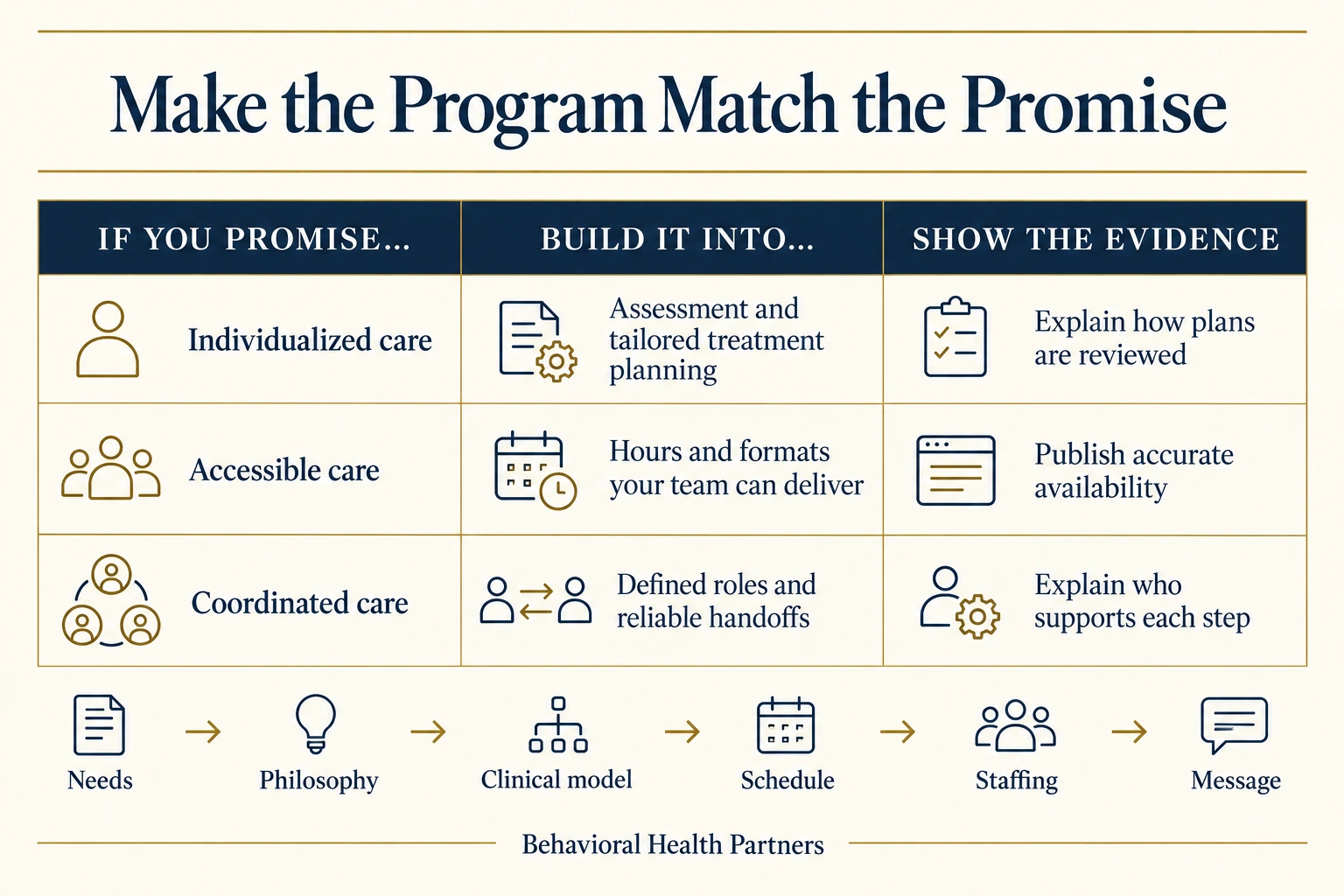
Every block traces back to a belief. Claim community heals? Build the day around groups. Claim individualized care? The schedule needs real one-on-one depth, not a token session. Congruence starts here.
Offer flexible access points: evening tracks, telehealth services, walk-in hours. Flexible access improves engagement, reduces no-shows, and answers the specific needs working clients name.
Then create the schedule as an operating document. Staff should manage the day without you in the building.
Staffing: Mental Health Professionals and Your Clinical Team
Recruit qualified staff around the model, not the other way around: licensed therapists, a clinical director who owns it, and support roles that match your pathway.
Know the credentialing path. Licensed mental health professionals typically need a graduate degree from an accredited counseling or social work track, supervised hours, and a passing score on an exam like the National Counselor Examination.
Then train staff on your model. Workforce training turns a group of clinicians into one team delivering one philosophy, managing one day. Protect their well being too: sustainable caseloads keep good people.
Behavioral Health Program Requirements
Establish a clear regulatory pathway before your first client: the requirements fall into clinician licenses and organizational licenses.
Licensing Requirements for Clinicians and Counselors
Each state sets its own licensing requirements for mental health professionals. Titles, supervision hours, exams, and state regulations all vary.
In Texas, clinician licenses are verified through the Texas Behavioral Health Executive Council, which regulates the state's counselors, psychologists, and social workers.
Verify every hire's license with the state board; it protects your clients and your insurance policies.
State Laws and Regulatory Compliance
Organizational requirements depend on what you deliver: an outpatient therapy practice faces lighter regulations than a facility offering substance use treatment.
A Texas facility treating substance use disorders needs a Chemical Dependency Treatment Facility license from the Texas Health and Human Services Commission, with its own application process and required documentation.
Beyond state laws, plan for regulatory compliance across the board: HIPAA privacy regulations, progress notes standards, infection control, and clinical safety. Create the policies before your first audit, in writing.
Regulatory requirements are not the fun part, but they are not optional, and the process moves faster when you manage compliance as a design input.
Write a Solid Business Plan
Now the business plan. A solid business plan guides creation and expansion, supports growth, and helps you make critical decisions aligned with your personal and professional goals. It forces honesty: startup costs, a sustainable revenue model, a realistic timeline to a full client base.
Cover the operating stack. Behavioral health billing is where most new practices bleed: payer credentialing, clean claims billing, and the knowledge to manage denials decide whether you get paid for the services you deliver.
Choose your tools deliberately. Practice management software and an electronic health record designed for behavioral health improve the client experience and keep documentation compliant; start with our breakdown of the best behavioral health EMR options. Good practice management frees clinical hours. Add behavioral health analytics so outcomes become data payers can see.
Data matters more every year: payers are moving toward value based contracting, where reimbursement follows measured results, and practices that tracked outcomes from day one negotiate billing rates from strength.
Choose a Business Entity
You must register your business entity with the state and your practice name with the state business registry. Common structures include a sole proprietorship, LLC, partnership, or corporation, and many clinicians choose a PLLC for added malpractice protection.
Consult an accountant; the right structure depends on revenue model, risk, and partners. Then obtain an Employer Identification Number for tax and payroll.
No drama required: careful planning, a clean billing setup, and about two weeks of paperwork.
Private Practice, Group Practice, or a Program Inside a Treatment Center?
Being a great clinician and being a business owner are different jobs. Decide which model fits your career before you commit capital.
A solo private practice offers autonomy and low overhead; a group practice adds leverage and shared coverage. Building the clinical offering inside a licensed treatment center offers the deepest impact and most complexity. Some search how to start a mental health program, others how to launch a solo caseload; the build underneath is the same.
The distinction we draw for partners: this guide covers what happens inside the walls. If you are creating the walls themselves, licensing a facility, financing a building, staffing a full continuum, start with our guide on how to open a rehab center. Different intent, different playbook; the two work together.
A private practice is your own business; run it with eyes open. Protect your work life balance from the start: burnout kills more new practices than competition.
Why Therapists Starting Their Own Practices Stall
Most therapists starting their own practices stall in two places: they underestimate the business aspects and clinical aspects of scaling, and assume clients will arrive.
Word-of-mouth referrals are not enough to attract new clients, and waiting for the phone to ring is not an action plan. The clinicians who create a sustainable career in the mental health field treat marketing as part of running the practice from month one.
Marketing Strategy: One Congruent Message
The payoff for building the day first: your marketing strategy writes itself, because you describe something real that clients can verify.
Everything potential clients see online must match what happens inside your walls. Your professional website shows your actual schedule, groups, and people; our guide to mental health website design covers the structure. Your social media presence shows the philosophy in action. Every channel stays congruent because it has one source: the model you built.
That congruence is brand positioning in its purest form, and why we put the brand at the center of the build; our breakdown of branding for treatment centers develops this further.
Investing in online marketing is what fills a practice. Define your target audience from your needs assessment, raise awareness where they already search, and make the next step obvious for clients. A behavioral health SEO company can carry the search side while you deliver the clinical side. The benefits compound because the content is true; the benefits grow with your proof.
Referral Networks and Community
Marketing is not only digital. Establish community referral networks with other healthcare providers: primary care physicians, hospital discharge planners, school counselors, and clergy. Clients referred this way arrive pre-sold on your services.
Referrals from professionals who trust your model become your most reliable referral sources; mentors bring marketing strategies you cannot buy. Serve every community referral so well the next one is automatic.
Measure Outcomes, Improve the Day
The build never ends. Measure clinical outcomes and client satisfaction, and let the data drive treatment improvements; quality improvement systems exist for this. Which groups do clients rate highest? What resources does the community keep asking for?
Let the answers reshape the schedule, the services, and the message. A mental health practice that improves in public earns trust advertising cannot buy; your growing client base is the proof, and the well being of the people you serve stops competing with the health of your business.
What is the difference between starting a behavioral health practice and opening a rehab center?
Starting a behavioral health practice means building the clinical offering: philosophy, daily schedule, clinicians, message. Opening a rehab center means creating the licensed facility around it: real estate, state facility licensure, accreditation, financing. The first is the product; the second is the container. Serious operators plan both.
Do you need a business plan to start a private practice?
Yes. A business plan supports growth, visualizes your path, and helps you make critical decisions aligned with your goals. For a private practice it should cover startup costs, a revenue model with realistic math, billing and credentialing timelines, your entity choice, and the marketing budget most new owners forget.
What licenses do you need to start a mental health practice?
Two layers. Clinicians need individual licenses, issued under each state's rules for education, supervised hours, and exams; compliance with state laws is essential for mental health practices. Your organization may need a facility license depending on services: outpatient counseling often requires none, substance use treatment usually does. Confirm both layers before seeing clients.
Adam Vibe GuntonFounder and Managing Partner, Behavioral Health Partners
Adam Vibe Gunton is an addiction recovery expert, entrepreneur, marketer, brand strategist, and speaker dedicated to advancing the behavioral health industry. As Founder and Managing Partner of Behavioral Health Partners, he has worked across treatment-center development, operations, branding, PR, SEO, advertising, and growth strategy. Combining professional experience with his own lived experience in recovery, Adam brings a unique perspective on how treatment organizations can build trusted brands, reach more people, and create a greater impact.
Thirty minutes on video with Adam directly, camera on, screen-sharing your own online presence and your top three local competitors. If we are not the right partner, we will tell you that too.