How to Start a Sober Living Home in Ohio: The 2026 Guide
Ohio rewrote its recovery housing rules on January 1, 2025, and most guides online are still wrong. We cover exactly what changed, how Ohio now defines recovery housing, and the four layers of requirements you have to satisfy. We cover the eight steps to opening a house in Ohio, startup costs and financial management, the funding sources available, and the path from sober living to an IOP.
Ohio rewrote the rules. For years this was one of the easiest states to open recovery housing in, with no license and no certification required. That era ended January 1, 2025, and most guides online have not caught up.
This guide has. Our behavioral health consulting practice helps operators launch nationwide, and Ohio is now a certification-first state. Here is what changed, what it costs, and the path to start a sober living home in Ohio the right way.
Key Takeaways
Certification is mandatory: as of January 2025, Ohio requires ORH certification for recovery housing residences to advertise, receive referrals, or access state funding.
The economics work: $500 to $1,200 monthly revenue per bed is typical, with profitability inside 6 to 12 months for most.
Ohio Recovery Housing Rules: What Changed in 2025
Ohio's Section 340.034 was updated in 2017 to remove licensing requirements, and for years the state ran on voluntary standards. Non-clinical sober living homes still need no treatment license today.
What changed is certification. Starting January 2025, mandatory certification is required for recovery housing to receive state funding or referrals, and Ohio's law limits advertising for recovery housing that has not met the registration and certification requirements.
In practice, an uncertified sober living house in Ohio cannot legally market itself as recovery housing or take referrals from licensed treatment centers, and Ohio now tracks recovery housing residences on a public registry. Certification went from nice-to-have to the whole game.
Ohio Recovery Housing, the state's NARR affiliate, handles certification for recovery residences; Oxford House charters count as an equivalent pathway.
How Ohio Defines Recovery Housing
Ohio law specifies recovery housing as housing designed to support individuals recovering from drug addiction or alcohol use, with a substance-free environment, peer support, and connections to recovery services.
Two boundaries matter. First, recovery housing is distinct from residential treatment facilities in Ohio: providing clinical treatment services on-site shifts a recovery home into a licensed medical treatment category. Second, recovery housing residences cannot impose arbitrary time limits on residents' stays, and residents must have freedom of choice in selecting treatment providers.
Keep the model clean: housing, structure, and peer support in the home; treatment happens elsewhere. Our pillar guide on how to open a sober living home covers the national model, and the benefits of sober living chapter covers what residents gain.
Ohio's Three Categories of Sober Living Homes
Ohio classifies sober living homes into three distinct categories, which map closely to the national framework.
Peer-run homes operate without paid staff: residents hold each other accountable and manage the home democratically. Monitored homes add a senior resident or manager overseeing daily operations. Supervised homes carry organizational structure, paid staff, and formal recovery programming, often connected to a clinical organization.
The National Alliance for Recovery Residences gives the industry its shared language, and NARR's four-level model categorizes recovery residences from peer-run to clinically integrated.
Level I and Level II homes require the least capital and staffing: Level I is peer-run, Level II adds a house manager. Level III homes layer in staffing and structured programming, and often require additional licensing and credentialing.
Most first-time owners start at Level II. It balances startup cost against the structure referring providers want to see, and it matches how most Ohio recovery homes actually run.
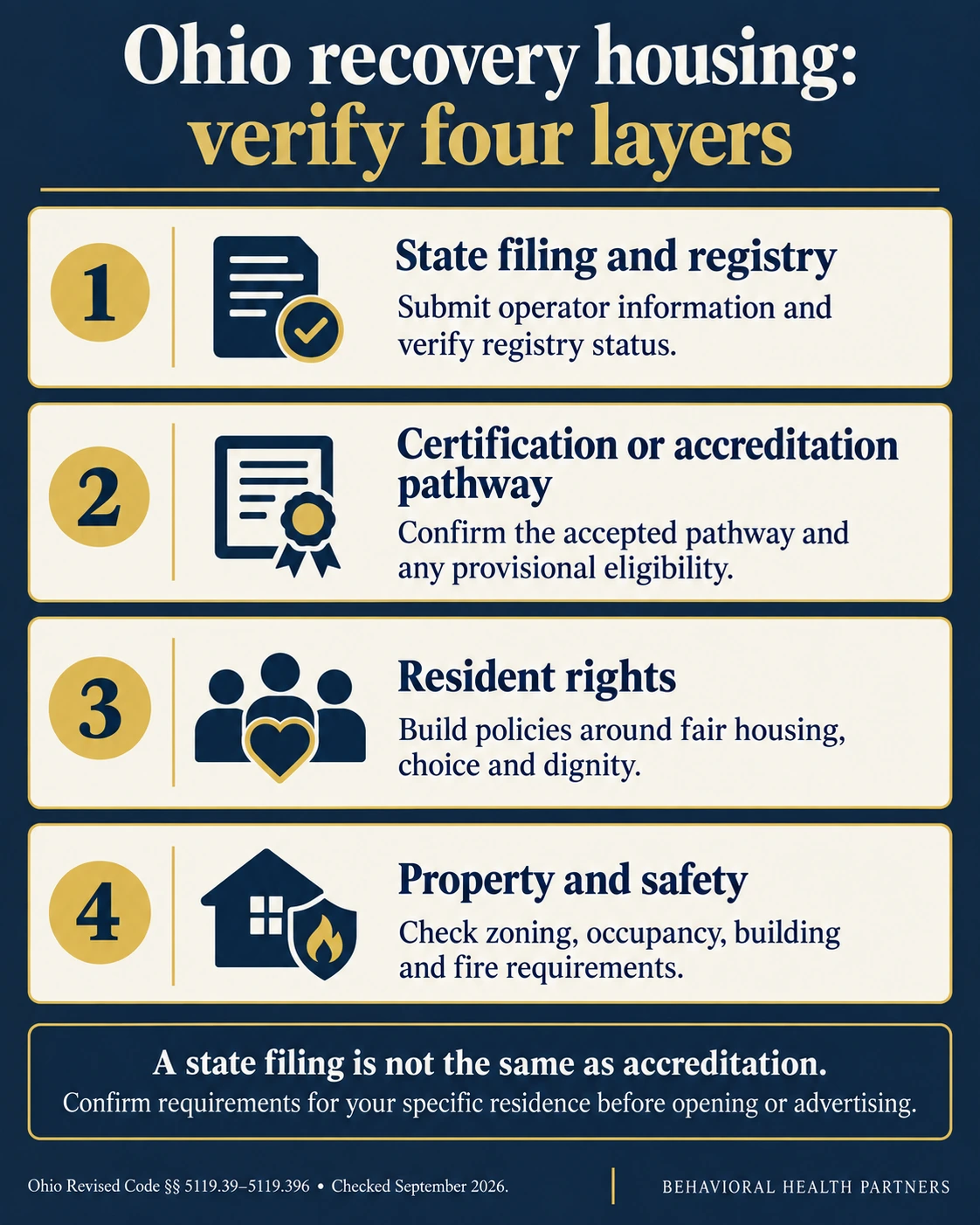
Sober Living Home Requirements: Ohio's Four Layers
Requirements stack in four layers: state registration, ORH certification, federal law, and local codes. Miss any layer and the others cannot protect you.
Register With the Ohio Department of Behavioral Health
All recovery housing residences must be registered with the Ohio Department of Behavioral Health, the agency that oversees recovery housing compliance in Ohio. New homes get a short window after the first resident arrives, so registration belongs on the pre-opening checklist.
Registration puts your home on the statewide registry referring providers and state agencies check before placing anyone.
Ohio Sober Living Certification Through ORH
Ohio sober living certification runs through Ohio Recovery Housing, which certifies homes against the National Alliance for Recovery Residences quality standard. The certification process for recovery housing residences covers written policies, resident rights, property standards, and an inspection.
Certified homes in Ohio must accommodate individuals using Medication-Assisted Treatment; medication management policies that respect MAT are a certification expectation, not an option. NARR certification is increasingly expected by funders, oversight agencies, and referral sources, and in Ohio it is the price of admission.
ORH publishes operator resources for recovery residence operators: recorded webinars, a training library covering the application, and compliance insights for certified homes.
Fair Housing Protections in Ohio
Sober living homes in Ohio must comply with Fair Housing Act protections, and the protections run in your favor. The Federal Fair Housing Act protects individuals in recovery from discriminatory zoning treatment, because people recovering from substance use disorders qualify as individuals with a disability.
A city cannot zone recovery housing out of residential neighborhoods simply because of who lives there, and operators can request reasonable accommodations when a local rule blocks an otherwise compliant home. If a municipality digs in anyway, a fair housing attorney is the right call before a fight, not after.
Zoning, Building, and Fire Codes
Ohio requires recovery housing residences to comply with local and state building and fire codes, and local zoning ordinances can still impact where you open. Zoning compliance is crucial before signing a lease: confirm occupancy limits and local rules first; our post on zoning for rehab facilities shows how operators evaluate a property's position.
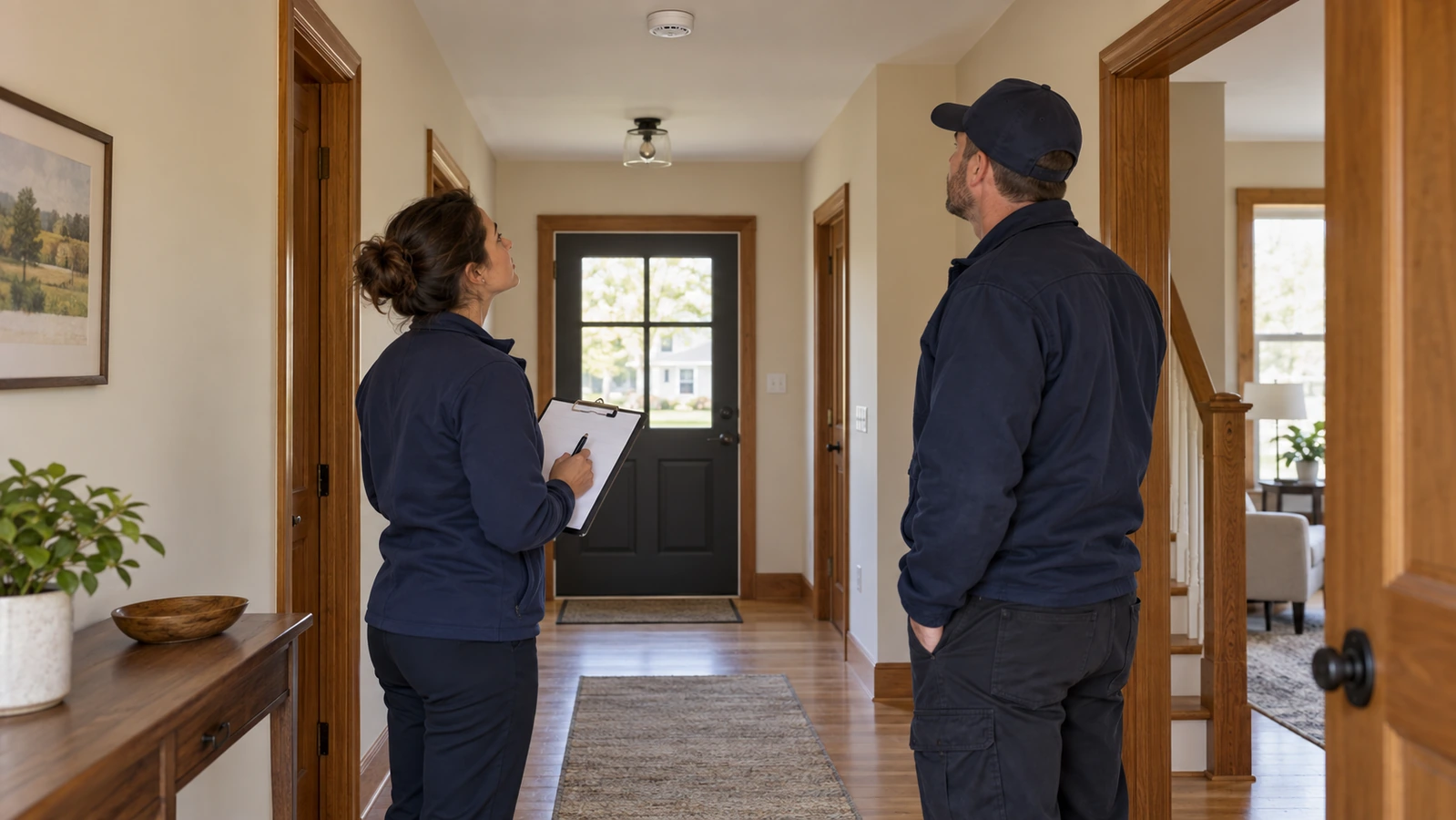
Recovery homes in Ohio must meet safety codes including smoke detectors, fire extinguishers, and clear egress. Plan for safety inspections before residents move in, not after a violation.
How to Open a Sober Living House in Ohio in 8 Steps
Starting a sober living home in Ohio follows the same eight steps. Here is how we walk operators through it, and where people who start a sober living house unprepared stall.
Step 1: Write the Business Plan
Develop a business plan including market analysis and budget. Define your target market: men, women, justice involved individuals, or professionals, and study where beds are scarce in your county.
Startup costs vary based on property type and location, so budget around your actual market. A leased four-bedroom launches for a fraction of what buying demands.
Step 2: Choose a Legal Structure
The operating structure of a sober living home can be for-profit or nonprofit in Ohio, and the legal structure you pick shapes taxes, funding eligibility, and liability protection.
Form the entity, obtain an Employer Identification Number, and open a dedicated business bank account so personal and house finances never mix. Nonprofits unlock certain grants; for-profits move faster. Talk to an accountant before you commit an organizational structure to paper.
Then insure it properly: sober living homes in Ohio must obtain liability and property insurance tailored for recovery residences. Standard homeowners policies do not cover this use, so pair general liability with additional coverage written for recovery housing operators.
Step 3: Find and Prepare the Property
Most sober living homes operate with 6 to 16 beds, and the sweet spot for a first house is 8 to 10. Look for residential properties near public transportation, jobs, and meetings, with a real dining area and common space where community can form, and outdoor space if you can get it.
Zoning and building regulations must be assessed before acquiring a property, so run the checks from Step 4 of the requirements section before money moves.
Step 4: Set House Rules and Policies
Developing comprehensive written policies is essential, and certification will require them anyway. Operational policies must include house rules and emergency protocols, plus drug testing procedures, relapse response, sobriety requirements, guest policies, and fee schedules.
Write the resident intake process too: application, screening, agreement signing, and orientation. Predictable policies protect residents and operators alike.
Step 5: Hire the House Manager and Run House Meetings
Nearly every home needs a house manager, ideally someone with lived recovery experience who sets the tone daily. Peer-run homes distribute that role; monitored and supervised homes hire for it.
Weekly house meetings are the operating rhythm: logistics, conflict resolution, accountability, and community. Homes that keep the meeting keep the culture.
Step 6: Get Registered and Certified
Register with the state, then start the ORH certification process immediately; approval takes time and your marketing legally waits on it. Keep digital records rather than paper files, because certification reviews and renewals go faster when documentation is organized.
The certification standard rewards homes that built their policies in Step 4 properly. Operators who prepare well pass on the first inspection.
Step 7: Build Referrals and Community Relations
With certification in hand, build the referral network: treatment centers, hospital discharge planners, probation officers, and county boards. Your certified home appears in the state registry referring partners check first: that is the advantage of doing this right.
Community relations matter just as much. Community partnerships with neighbors, churches, and local officials turn a new sober living house from a controversy into an asset, and community connections often become referrals themselves.
Step 8: Open, Operate, and Fill Beds
Open with your policies live, your manager trained, and your first residents screened. Drug testing runs on schedule from day one, house meetings happen weekly, and documentation stays current.
Beds fill through referrals first and search second, and the operators who treat both as systems fill fastest.
Startup Costs and Financial Management
Startup costs for sober living homes vary widely based on location and property type. A leased home needs deposits, furnishings, safety upgrades, insurance, and certification fees; buying pushes the total well into six figures.
Financial management is where new operators sink or swim. Track monthly operating expenses per bed, keep house funds separate, and review the numbers monthly, not annually.
Operating Reserves and Revenue
Ohio sober living homes can expect monthly revenue per bed of $500 to $1,200, and most Ohio operators reach profitability within 6 to 12 months.
The discipline that gets you there is operating reserves: enough cash to cover the house at half occupancy for six months. Operators start strong when the reserve exists and scramble when it does not. Operating costs stay boring when the reserve is real.
Ohio offers more funding opportunities for recovery housing than most states. Federal grants include SAMHSA Block Grants and the HUD Recovery Housing Program, both flowing through state channels, and Ohio invests heavily as overdose deaths and drug addiction keep recovery housing atop the priority list. The state wants more sober living homes and is paying for them.
Certification is the key that unlocks it: only certified recovery housing residences access grant funding and state referrals. Get certified first, then pursue grant funding through your county board and state programs.
From Sober Living in Ohio to an IOP
Here is the growth path Ohio rewards. A certified sober living house with full beds is a census waiting for treatment: add an intensive outpatient program and the residents who leave your house for treatment elsewhere can receive it inside your continuum, including through a virtual iop model.
An IOP is licensed clinical care, so the requirements jump: state licensure, accreditation (start with what is the joint commission), clinical staffing, and billing. It is a different build, the one that turns housing margins into healthcare margins.
Do you need a license to open a sober living home in Ohio?
Not a treatment license, as long as the home stays non-clinical. But to start a sober living home in Ohio since January 2025 means certification through Ohio Recovery Housing or an Oxford House charter, plus registration with the Ohio Department of Behavioral Health. Without certification, a home cannot advertise as recovery housing, receive referrals from licensed providers, or access state funding.
How much does it cost to start a sober living home in Ohio?
It depends on the property and location. A leased home covers deposits, furnishings, safety upgrades, insurance, and certification fees, while purchasing pushes totals well into six figures. Revenue runs $500 to $1,200 per bed monthly, most operators reach profitability within 6 to 12 months, and a healthy reserve makes the ramp survivable.
How many residents can a sober living home have in Ohio?
Most sober living homes operate with 6 to 16 beds, with local occupancy and building codes setting the real ceiling. Eight to ten beds is the practical sweet spot for a first house: large enough for the economics to work, small enough for genuine community and manageable supervision.
Adam Vibe GuntonFounder and Managing Partner, Behavioral Health Partners
Adam Vibe Gunton is an addiction recovery expert, entrepreneur, marketer, brand strategist, and speaker dedicated to advancing the behavioral health industry. As Founder and Managing Partner of Behavioral Health Partners, he has worked across treatment-center development, operations, branding, PR, SEO, advertising, and growth strategy. Combining professional experience with his own lived experience in recovery, Adam brings a unique perspective on how treatment organizations can build trusted brands, reach more people, and create a greater impact.
Thirty minutes on video with Adam directly, camera on, screen-sharing your own online presence and your top three local competitors. If we are not the right partner, we will tell you that too.