How to Start a Halfway House: The Complete 2026 Guide
Most halfway houses fail because the founder fell in love with the mission and skipped the business. We cover what a halfway house is and how it differs from sober living, and whether it is genuinely profitable. We cover the ten steps to opening one, the services that turn housing into recovery, the certification that opens doors, the mistakes that sink new operators, and the growth path beyond.
Most halfway houses fail for the same reason most treatment centers fail: the founder fell in love with the mission and skipped the business. We see it every week. All we do is behavioral health, from how to open a rehab center through filling its beds, and the operators who win are the ones who treat a halfway house like a real company that happens to save lives. This guide walks you through opening a halfway house the right way: the legal groundwork, the money, the property, the people, and the referral networks that keep a halfway house full. It is written for the operator who wants to open up a halfway house with integrity and still make it sustainable, because a sustainable business makes more impact.
One note before we start. A halfway house is not the same thing as a sober living home, and the differences change your licensing, your funding, and your model. We cover that below, and if the sober living model fits you better, our complete guide on how to start a sober living home goes just as deep on that path.
What Is a Halfway House?
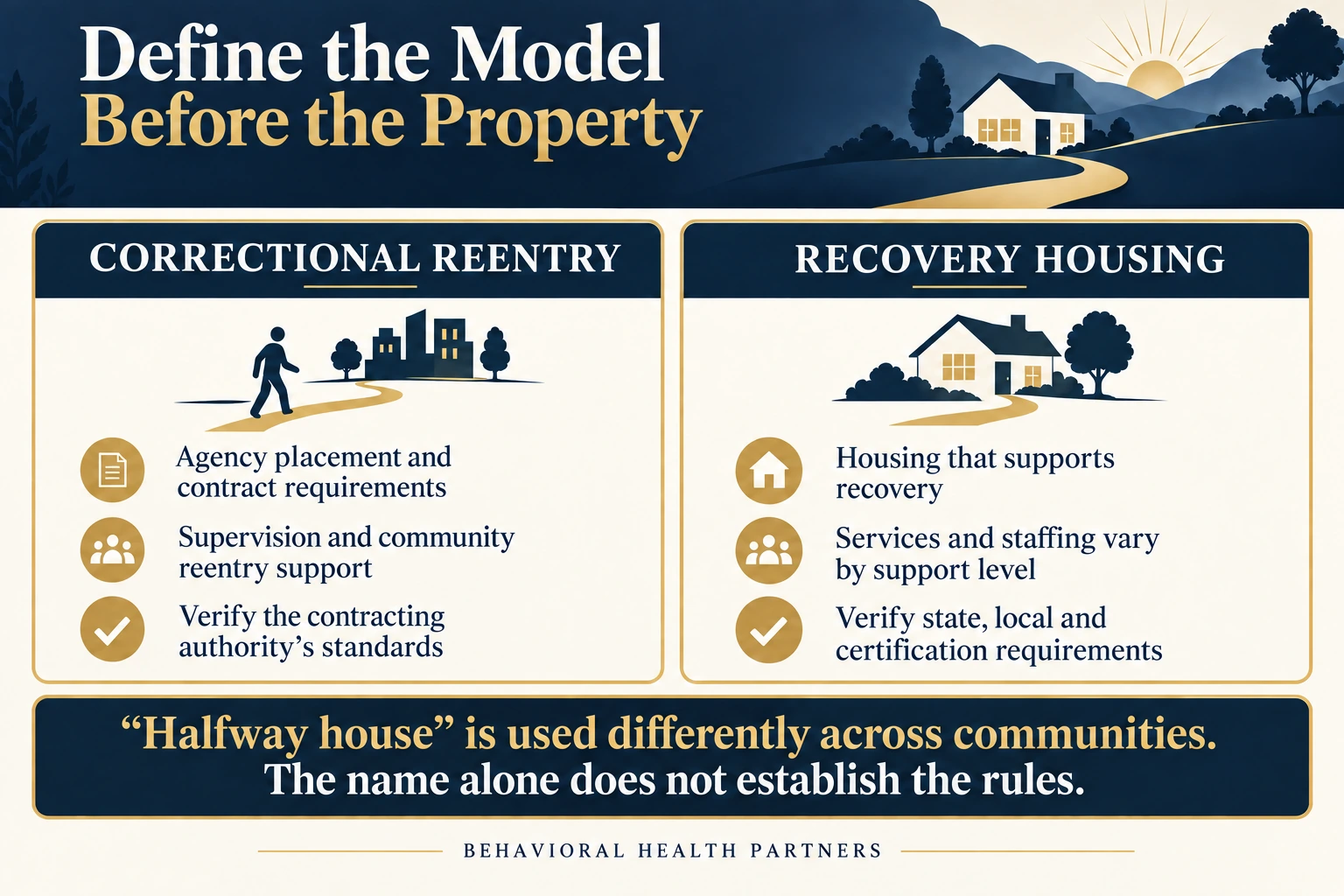
A halfway house is transitional housing with structure. Residents live together in a substance-free, supportive environment while they rebuild employment, relationships, and routines. The term gets used two different ways, and you need to know which halfway house you are building, because the two models live under completely different rules.
The first meaning is the corrections model. Federal and state agencies contract with operators to house people leaving incarceration. The Federal Bureau of Prisons calls these residential reentry centers, and they provide a safe, structured, supervised environment plus employment counseling and job placement while residents rebuild ties to the community. Funding comes from government contracts, populations are referred by the system, and oversight is contractual and strict.
The second meaning is the addiction recovery model, and it is where most new operators land. Here, a halfway house serves people leaving inpatient treatment who are not ready for fully independent living. It sits inside the broader recovery housing industry alongside sober living homes and other recovery residences. Residents typically pay program fees, follow house rules, submit to drug testing, and get support finding stable employment while they stabilize in early recovery. The halfway house becomes the bridge between treatment and independent living, and everything about the recovery process there is built to support that crossing.
Most halfway houses in the private market follow the addiction recovery model, and that is the model the rest of this guide assumes. Decide which halfway house model you are building first. Everything else about opening a halfway house flows from that choice.
Halfway House vs Sober Living Home: Know the Difference
People use the terms interchangeably. Operators cannot afford to, and honestly, the difference is the first thing we clarify on every consulting call about recovery housing.
Factor
Halfway House
Sober Living Home
Typical resident
Leaving incarceration or court-ordered, or stepping down from treatment
Voluntarily continuing addiction recovery after treatment
Structure
Higher supervision, often staffed shifts, stricter curfews
Peer-driven accountability with a house manager
Funding
Government contracts, grants, resident fees
Resident fees, private pay
Time limits
Often capped by contract or program
Usually open-ended
Regulation
Contract and licensing oversight, state rules
Certification, local zoning laws, fewer licenses
Where the Models Overlap and Where They Split
A sober living home usually runs on the social model: residents hold each other accountable, a house manager keeps order, and the sober living home stays intentionally home-like. Sober living is voluntary by design, and that changes the culture of the house. A halfway house usually carries more structure, more staff members, and more rules, because its residents are earlier in the recovery process or answering to a court. If the peer-driven model of a sober living home fits your vision better, read our guide on the benefits of sober living and build that instead. Many successful operators start with sober living operations, learn the day to day operations of one home, then open up a halfway house program once they understand the population. Others run a halfway house and a sober living home side by side, with the halfway house handling structure and the sober living home handling step-down independence.
Here is the honest answer: yes, when it is run like a business, and no, when it is run like a hobby. The same is true when someone asks is a sober living home profitable, and it decides whether opening a halfway house is worth your next two years. Both models work because demand for recovery housing outruns supply in almost every local market in the country, and a well-run halfway house earns its keep while it serves addiction recovery.
The Startup Costs and Margins Operators Report
The numbers most operators report look like this. Startup costs typically range from $50,000 to $150,000 depending on whether you lease or buy, how much renovation the property needs, and how many beds you open. Monthly per-bed revenue typically runs from $500 to over $2,000 depending on your market and your model. A well-run 10-bed halfway house can generate $180,000 to $420,000 annually at healthy occupancy. Well-managed homes commonly reach operating margins of 20 to 35 percent, and most halfway houses that survive their first year reach profitability within 6 to 18 months. Treat these as industry-reported ranges, not promises; your proforma has to be built on your local market, your rents, and your real occupancy assumptions.
If you are weighing recovery housing against the larger facility play, read how much money do rehab centers make next; the economics of licensed treatment dwarf a halfway house, and opening a halfway house is often the first rung on that ladder.
Where the Revenue Comes From
Revenue can come from more than one place, and the stable homes build multiple revenue streams: program fees, county and state contracts, and grants. Some operators receive government funding through reentry contracts or opioid settlement dollars. Government agencies move slowly, but their contracts anchor occupancy in ways private pay never will.
How to Open a Halfway House in 10 Steps
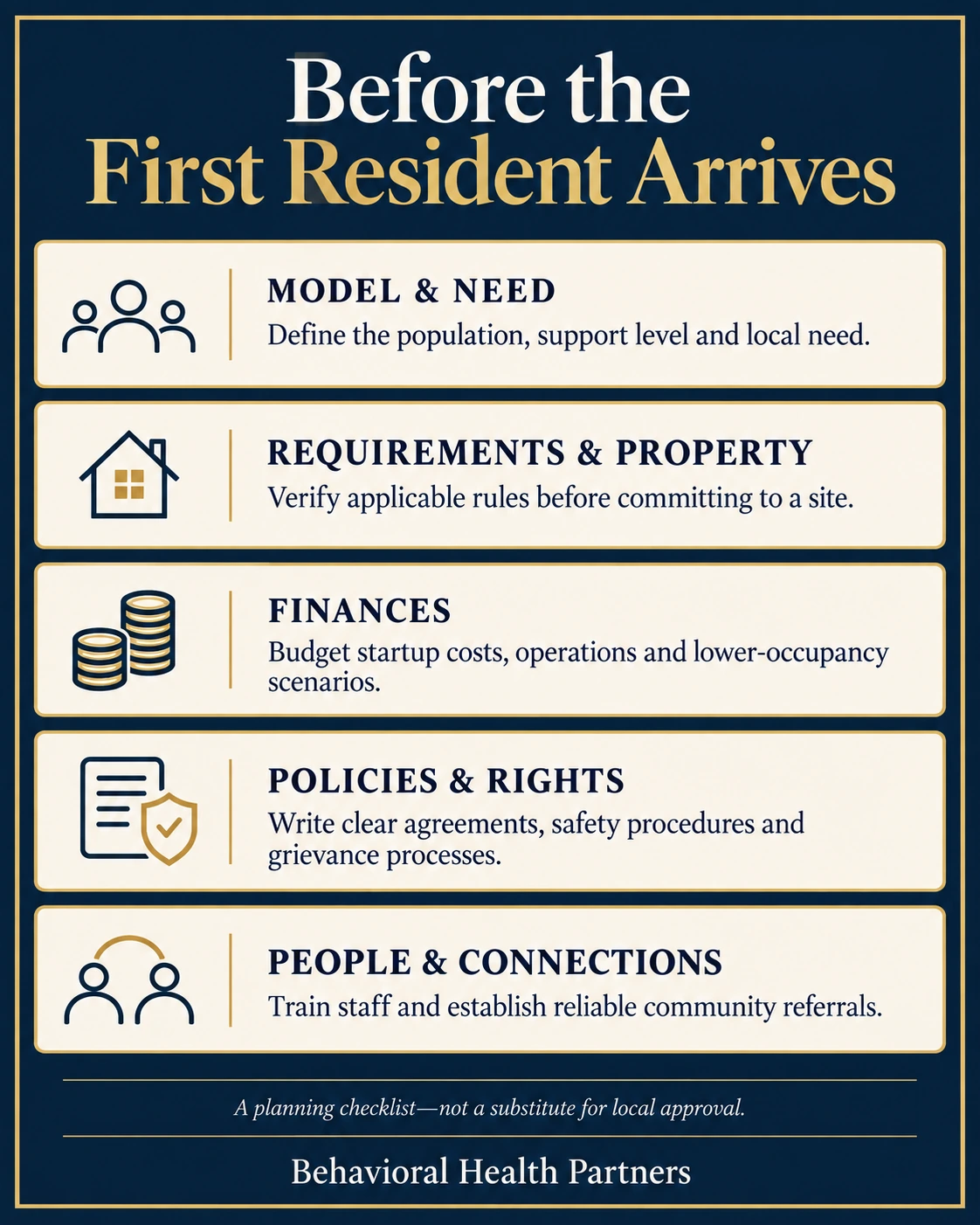
Opening a halfway house requires the same discipline as any treatment startup, compressed into a residential scale. Here is the sequence we walk founders through when they want to open up a halfway house that lasts.
Step 1: Choose Your Model and Your Population
Decide who your halfway house serves before you look at a single property. People leaving incarceration through agency contracts? Adults stepping down from residential treatment who need structure in their addiction recovery? Men, women, or a specialty population like veterans? Your population determines your structure, your referral sources, and your rules, and it decides whether your halfway house leans toward supervision or toward independent living.
This is also where you pick your level of support. The National Alliance for Recovery Residences, through its published NARR 3.0 standard, organizes recovery residences into four levels, from peer-run homes at Level 1 to service-provider residences at Level 4 that deliver clinical services with credentialed staff. Most halfway houses operate around Level 2 or Level 3: structured and supervised, with life skills training and support services but no clinical treatment. Decide your level early and write your policy on medication assisted treatment at the same time; turning away people on prescribed MAT is both bad practice and, in a growing number of states, illegal.
Step 2: Learn the Local Regulations and State Rules Before You Sign Anything
There is no single national license for a halfway house. What a halfway house requires legally depends on your state and on what you offer. The pattern looks like this: if you provide clinical services, you need a behavioral health facility license everywhere. If you provide housing and structure only, some states require licensure or certification of recovery residences, some run voluntary certification programs, and some have almost no rules at all. Local regulations layer on top of state rules, so you are checking two levels of government, not one.
Florida is a useful example of where recovery housing regulation is heading. Under Florida Statute 397.487, recovery residences are certified through an approved credentialing entity, must employ a certified administrator, pass annual inspections, and since 2025 cannot deny residents solely because they are on MAT. Misrepresenting an uncertified halfway house as certified is a criminal offense. Other states keep tightening in the same direction, so build to certification standards from day one, and check your state's current rules the week you start planning, not the week you open.
This is exactly the work our licensing team does for treatment center founders every day; our team has secured over 100 licenses with a 100% success rate after application, and the lesson from that track record is simple: the operators who research local regulations before they commit to a property never end up trapped by them. Our rehab center licensing video explains how state approval processes actually move.
Step 3: Understand Zoning and the Fair Housing Act
Zoning is where most new operators panic, and most of the panic is unnecessary. Under the federal Fair Housing Act, people recovering from substance use disorder are protected as persons with disabilities, and the Department of Justice is explicit that municipalities cannot use zoning laws to exclude group homes for people with disabilities from a residential neighborhood. Current illegal drug use is not protected, but people in addiction recovery are, and courts have upheld that protection for recovery housing again and again.
That does not mean you ignore city hall. Local zoning laws still govern occupancy counts, parking, and safety inspections, and cities can enforce neutral rules that apply to everyone. The winning posture when opening a halfway house is quiet compliance plus good neighbor behavior: meet the codes, keep the property immaculate, and introduce yourself to the neighbors before rumors do it for you. Operators who fight their community lose even when they win; operators who join it fill their halfway house through goodwill.
Step 4: Write Your Halfway House Business Plan
Nobody funds a feeling. A halfway house business plan follows the same structure the Small Business Administration recommends for any company: executive summary, company description, market analysis, organization and management, services, marketing, funding request, and financial projections. Lenders will expect the full business plan; a lean one-page version is fine for your own clarity but not for the bank.
The market analysis matters more than founders think. How many local treatment centers discharge people in your county each month? How many halfway house beds already exist? What do they charge? Your business plan should prove you understand your local market better than anyone operating in it. If you want professional help pressure-testing the plan, our consulting team builds behavioral health business plans for founders who need bank-ready documents.
Step 5: Build Your Financial Projections and Run the Numbers
Your financial plan needs three honest documents: a startup budget, a 12-month operating budget, and financial projections for years one through three. Budget the startup costs we covered above, then model operating costs line by line: mortgage or lease, insurance, utilities, staffing, drug testing supplies, food if you provide it, software, and maintenance. Then stress-test the whole financial plan. What happens at 60 percent occupancy? What happens when two residents leave the halfway house in the same week?
If you cannot make the model work on paper, do not try to make it work in real life. A professional financial proforma forces the discipline, and our guide to how much it costs to open a rehab center shows how these budgets scale when you eventually step up to licensed treatment.
Step 6: Secure Funding, From Personal Savings to Government Funding
Most first-time operators secure funding from three places: personal savings, a small business loan, and partners. Personal investment signals commitment to every other funder, so expect to have skin in the game; most lenders want to see personal savings in the deal before they add a dollar. Beyond your own initial investment, look at SBA-backed loans for the property and buildout, community development financial institutions that fund recovery housing, private investors who want a mission asset with yield, and funding opportunities from state opioid settlement funds and reentry programs.
Grant money exists, but treat it as a bonus, never the base. Grants from government agencies and foundations are competitive, slow, and usually reimbursement-based, and the operators who receive government funding almost always earned it after the halfway house was operating, not before. Build a model that can secure funding through fees and contracts first; then layer grant funding opportunities on top. However you secure funding, keep the mission and the math in the same conversation.
Step 7: Find the Right Property
The property makes or breaks the entire operation. You are looking for a house that works as a home, not an institution: enough bedrooms to reach at least eight to ten beds, bathrooms at a ratio residents can live with, common space where community actually happens, and a kitchen that can feed the whole halfway house. Look for proximity to public transportation, grocery stores, recovery meetings, and employment opportunities, because residents without cars still need to build a life.
Lease with a landlord who knows exactly what you are running, or buy if you can; ownership converts your biggest expense into your biggest asset. Our breakdown of buying property for a rehab center covers site selection, zoning diligence, and lease-versus-buy math in depth.
Step 8: Write the House Rules, Drug Testing Policy, and Resident Agreement
Structure is the product. Residents choose a halfway house because the accountability is real, so write it down before your first intake. Your core documents: house rules covering curfew, chores, meetings, visitors, and conduct; a resident agreement that spells out fees, expectations, and what triggers discharge; resident intake procedures including screening criteria and orientation; and drug testing requirements that state frequency, method, and consequences. Random drug testing plus for-cause testing is the standard, and consistent enforcement is what keeps the halfway house a genuinely supportive environment instead of a rooming house with a sign.
Two more policies deserve real thought. First, relapse response: a policy that is all punishment drives people to hide, and a policy with no teeth endangers the whole house; most experienced operators pair immediate removal from the halfway house with a warm handoff back to treatment providers. Second, ethics: SAMHSA's best practices for recovery housing warn bluntly about patient brokering, the illegal practice of trading residents to treatment centers for kickbacks. It ruins lives and it ends operations. Never sell your residents. Have every policy reviewed by an attorney who knows recovery housing, then train your staff members to enforce all of it the same way for every resident.
Step 9: Hire a House Manager Worth Trusting
Your house manager runs the culture. In most halfway houses this is the single most important hire you will make: the house manager enforces house rules, runs the drug testing, de-escalates conflict, and sets the emotional temperature of the home. The best house managers usually have lived experience plus real time in long term recovery, because you cannot stop people in recovery from helping people in recovery. You just cannot.
Depending on your level and your state, you may add staff members for overnight shifts, case management, or programming. Background-check every hire, train your staff members on your policies and on crisis response, and pay your house manager enough to keep them; turnover in that seat destabilizes the entire halfway house. As you grow beyond housing into programming, our guide on how to start a behavioral health program shows what the staffing ladder looks like at the next level.
Step 10: Build Referral Networks With Local Organizations and Fill Your Beds
Beds do not fill themselves. The strongest referral networks are built relationship by relationship with local organizations: local treatment centers discharging people who need structured housing, hospital social workers, probation and parole officers, drug courts, social service agencies, local organizations in the recovery community, and the families searching on their own. Show up in person and build relationships face to face. Give discharge planners a one-page sheet with your rules, your fees, and your open beds, then make yourself the easiest call they make all week. Ask how you can help them first; operators who build relationships before they need them never open empty, and the community partners you earn this way keep referring for years.
Then build the channel you own: a real website with your program, your house rules, your photos, and your story. Families search hard before they trust a halfway house with someone they love, and a professional online presence wins those searches. Our guide to rehab lead generation breaks down how treatment programs turn visibility into admissions, and the same playbook fills a halfway house. Local businesses can become both donors and employers once they know you, and community service projects turn skeptical neighbors into advocates. Build relationships everywhere your residents will eventually need a door opened.
The Services That Turn Housing Into Recovery
A bed keeps someone housed. Support services keep someone sober. The homes with the best resident success build a weekly rhythm around a few essential services, and none of them require a clinical license.
Life Skills Training and Employment Support
Life skills training is the backbone: budgeting, cooking, job applications, conflict resolution, the unglamorous skills that make independent living stick. Employment support comes next, because steady work is the strongest predictor that a resident thrives after the program ends; partner with staffing agencies and local businesses that create employment opportunities for your residents.
Structure That Supports Recovery Every Day
Add structure for the recovery journey itself: house meetings, transportation to twelve-step or other recovery meetings, and peer accountability that supports recovery every single day. Connect residents to outside mental health services, community college courses, and educational programs rather than trying to provide everything in-house, and keep a current referral list of support services so help is one phone call away. Encourage residents to lead where they can; a resident who chairs the house meeting or leads one of your educational programs is rehearsing the independent living they are about to step into.
That service layer, not the building, is what carries the recovery journey and makes a halfway house a bridge back to life, and it is what referral sources talk about when they recommend you. Housing services fill a need. A supportive environment changes the whole trajectory of addiction recovery.
Get Certified: The Credential That Opens Doors
If you are serious about opening a halfway house that referral sources trust, get certified. Certification is voluntary in many states and worth it in all of them. NARR-affiliate certification tells every referral source that your halfway house meets national standards for safety, ethics, and operations, and SAMHSA points to those standards as the benchmark for quality across the recovery housing industry. In a growing number of states, certification is also the gate to government contracts and provider referrals, which makes it one of the cheapest growth levers in recovery housing.
What Certification Takes
The process is straightforward for a well-run halfway house: document your policies, pass a site inspection, train your staff, and recertify annually. Certification also plugs you into a community of recovery housing operators who share what works, and in a field this young, that network is worth as much as the certificate. Most sober living operators who go through certification say the same thing afterward: the paperwork forced them to become the operator they claimed to be. The same holds for anyone opening a halfway house; the standard makes you better before it makes you certified.
The Mistakes That Sink New Operators
We have watched strong missions die from weak execution. The repeat offenders: buying property before understanding local regulations; underpricing fees to be kind, then running out of money and helping no one; inconsistent enforcement of house rules, which residents read as permission; skipping insurance built for recovery housing; opening a second halfway house before the first one runs without the founder; and ignoring the neighbors until the city council meeting. Every one of these is avoidable with planning, and most of them appear in our video on the five mistakes founders make in treatment startups.
The deeper mistake is strategic: treating the halfway house as the end game instead of the entry point to addiction recovery infrastructure. The operators who build lasting impact treat recovery housing as the first floor of a continuum that carries people from detox to long term recovery.
From Halfway House to Treatment Center: The Growth Path
Here is what most guides will not tell you: a halfway house is a phenomenal first business in this industry, and it is also the smallest one. Once you can run a full halfway house with clean operations, steady referral networks, and a waiting list, you have proven the exact skills a licensed program demands: compliance, staffing, referral relationships, and census management.
Your Halfway House as the First Floor of a Continuum
The natural next step is an intensive outpatient program or a full treatment center, where your halfway house becomes the housing arm of a continuum of care. Your residents get clinical care from a team that already knows them, your beds fill from your own program, and your revenue stops depending on one model. Every resident who moves through that continuum gets a smoother recovery journey, and every stage of the recovery process stays under one roof you control. When you are ready to explore that step, a feasibility study is where we start every founder, because the data decides the market before the market decides for you.
We build, launch, and scale addiction treatment centers. That is all we do. If your five-year picture includes more than housing, talk to our consulting team about opening a treatment program; we will tell you honestly whether the numbers support it, because we do not sell what we cannot service.
Frequently Asked Questions
How profitable is a halfway house?
Well-run homes typically report operating margins of 20 to 35 percent once occupancy stabilizes. A 10-bed halfway house charging market-rate resident fees can generate $180,000 to $420,000 in annual revenue depending on the market it serves. Profitability usually arrives within 6 to 18 months. The variables that decide it are occupancy, rent, and whether you win contracts from government agencies.
How much does it cost to open up a halfway house?
Most operators spend between $50,000 and $150,000 opening a halfway house. Leasing an existing home with minor renovation sits at the low end; purchasing and converting a larger property sits at the high end. The budget covers the property, furnishings, insurance, certification, and enough operating reserve to survive the months before full occupancy.
Do you need a license to open a halfway house?
It depends on your state and your services. A halfway house offering only housing and peer structure needs no license in many states, though several now require certification or registration of recovery residences, the same rules that govern a sober living home. Any home providing clinical treatment needs a facility license everywhere. Check your state's current rules first; they are tightening every year.
How do halfway houses get paid?
Most combine resident fees paid weekly or monthly with outside dollars: county and state reentry contracts, opioid settlement funds, and grants. Corrections-model houses run primarily on government contracts, while recovery-model houses run primarily on what residents pay and on whatever they secure funding for through grants.
Can you open up a halfway house in a residential neighborhood?
Generally yes. The Fair Housing Act protects people in recovery as persons with disabilities, and municipalities cannot zone group homes for people with disabilities out of a residential neighborhood. You must still meet neutral local requirements like occupancy limits and safety codes, so verify local zoning laws before you commit to any property.
What do you need to open up a halfway house?
At minimum: a supportive environment built on a compliant property, written house rules and a resident agreement, drug testing protocols, insurance, a trained house manager, and referral networks that keep beds full. Add state certification where available. The operators who last also open with a real halfway house business plan, a 12-month budget, and enough reserve to survive slow early months.
Ready to build something bigger than a house? We help founders open, grow, and scale treatment programs across the United States and Canada. Schedule a free discovery call about opening your program. One conversation, honest answers, and a clear picture of whether your market can support what you want to build. That is how every one of our partnerships starts.
Adam Vibe GuntonFounder and Managing Partner, Behavioral Health Partners
Adam Vibe Gunton is an addiction recovery expert, entrepreneur, marketer, brand strategist, and speaker dedicated to advancing the behavioral health industry. As Founder and Managing Partner of Behavioral Health Partners, he has worked across treatment-center development, operations, branding, PR, SEO, advertising, and growth strategy. Combining professional experience with his own lived experience in recovery, Adam brings a unique perspective on how treatment organizations can build trusted brands, reach more people, and create a greater impact.
Thirty minutes on video with Adam directly, camera on, screen-sharing your own online presence and your top three local competitors. If we are not the right partner, we will tell you that too.