Telehealth Mental Health Services: Adding Virtual Care to Your Practice
Telehealth is now a permanent part of behavioral health rather than a temporary fix. We cover what telehealth services actually include, the evidence on why virtual care works, and who benefits most from it. We cover telehealth in addiction treatment specifically, the insurance, coverage and compliance picture you have to navigate, and a practical route to adding virtual care to your practice.
Telehealth has become a permanent part of behavioral health, not a temporary fix. For a treatment center or private practice, adding telehealth services is one of the clearest ways to increase access, reach patients where they are, support more people, and grow without adding a single exam room. This chapter explains what these services cover, why they work, and how to add virtual care to your practice the right way.
These services deliver behavioral health care over secure video and, where allowed, audio-only technology, and a growing number of providers now build them into everyday care. In practice, most of what a program offers in person can be offered virtually.
Online therapy is the foundation. Individual therapy, couples work, and group therapy all translate well to video, and many patients settle in faster from the safety of their own home. Whether a patient wants weekly talk therapy or a standing appointment with the same therapist, online therapy keeps care consistent. Telepsychiatry and psychiatry visits let a psychiatrist evaluate a patient, make a diagnosis, and handle medication management remotely, and a patient can meet that provider online without ever leaving home. A structured mental health assessment can be completed by video, and follow-up telehealth appointments keep care consistent week to week. From a first diagnosis to ongoing care, virtual appointments let a therapist track progress and adjust medications for a range of disorders. Higher levels of care work too: a virtual IOP delivers the same evidence based curriculum as an in-person intensive outpatient program, with group and individual sessions on a set schedule.
The point is not that virtual treatment replaces every service. It is that a well-designed telehealth program lets a provider meet more patients, more often, without geography getting in the way.
Why Telehealth Works
The case for telehealth comes down to access and outcomes. Virtual care reaches people in remote areas, patients with busy schedules, parents who cannot leave the house, and anyone for whom a weekly drive to an office is the reason care never starts. It reaches people struggling with anxiety, depression, trauma, or the daily stress of life who simply need care to fit their week. It lowers the friction that keeps people out of treatment, and it can quietly reduce the stigma some feel about walking into a clinic.
Access would not matter if the care were weaker, but the evidence is reassuring. A systematic review of telemedicine for mental disorders found substantial evidence that virtual care improves symptoms and quality of life across a broad range of patients, with strong acceptance by the people using it. For many conditions, from anxiety and depression to trauma, telehealth appointments deliver high quality care that holds up well against in person care.
None of this removes the clinician from the center of care. A therapist still builds the relationship, reads the room over video, and decides when a patient needs to be seen in person. Telehealth extends the reach of good clinicians; it does not replace their judgment.
Who Benefits Most
Telehealth is not right for every moment of care, but it is a strong fit for many people. It helps patients in remote areas, adults juggling work and family, and parents managing a household who cannot add a commute to their week. Children and teens, who often feel more comfortable on a screen, frequently open up faster in virtual sessions, and a parent can be looped in when it helps. People who feel uncomfortable walking into a clinic, or who carry stress and negative thoughts about being seen there, sometimes find it easier to talk to a therapist from a safe space at home.
Telehealth also fills the gaps between visits. Between weekly sessions, a quick check-in with a therapist or a message to a provider can keep someone steady, support healing, and catch a problem early. For patients who rely on medications to manage symptoms, virtual visits make it easier to keep those medications adjusted and refilled without a trip to the office. The benefit is not only convenience; it is continuity of care and real support when life's challenges hit hardest. In study after study, patients felt as connected to their mental health provider over video as in the room, and mental health professionals report that many people open up sooner.
Telehealth also widens choice. A patient is no longer limited to the therapists within driving distance; virtual care can match someone with a specialist in trauma, PTSD, or another specific area anywhere in their state. Appointments flex around real life, including evenings and weekends, and a patient can join from a smartphone, computer, or tablet, or connect by secure messaging when video is not an option.
Telehealth for Addiction Treatment
Virtual care is not only for anxiety and depression. Telehealth addiction treatment has become a serious tool for substance use disorders, and a virtual IOP is often the level of care that makes recovery possible for someone who cannot step away from work or family for residential treatment.
Medication management matters here too. Under current federal telemedicine rules, a provider can start buprenorphine for opioid use disorder through a telehealth visit, a change the DEA describes in its telemedicine rules, with an in-person visit required for continued prescriptions. That flexibility has expanded access to life-saving treatment for people who live far from a provider. For many substance use disorders, a provider can prescribe and adjust the medications that support recovery through telehealth. Group therapy, individual sessions, recovery support, and coping strategies all translate to virtual settings, giving programs a way to support more patients struggling with a substance use disorder.
Insurance, Coverage, and Compliance
For providers, coverage is often the first question, and the news is good. Medicare covers telehealth for behavioral and mental health on a permanent basis, and for behavioral health it allows audio-only visits when a patient cannot manage video, as CMS explains in its Medicare mental health coverage guidance. Many commercial plans followed suit, though every insurance provider sets its own rules. Check each patient's insurance before you bill, confirm that both therapy sessions and medications are covered, and remember that telehealth insurance policies keep changing. Clear insurance policies for your mental health services protect both revenue and access. Getting telehealth behavioral health billing right protects your revenue and your patients.
Compliance is the other half. Telehealth must protect patient privacy the same way in-person care does. Use a secure, private, HIPAA-compliant platform, verify licensure for every state where your patients are located, and document consent. Security is not an afterthought in virtual treatment; it is the foundation of trust.
How to Add Telehealth to Your Practice
Adding telehealth is less about technology than about design. A patient needs only a computer or phone and an internet connection. Your program needs a clear plan.
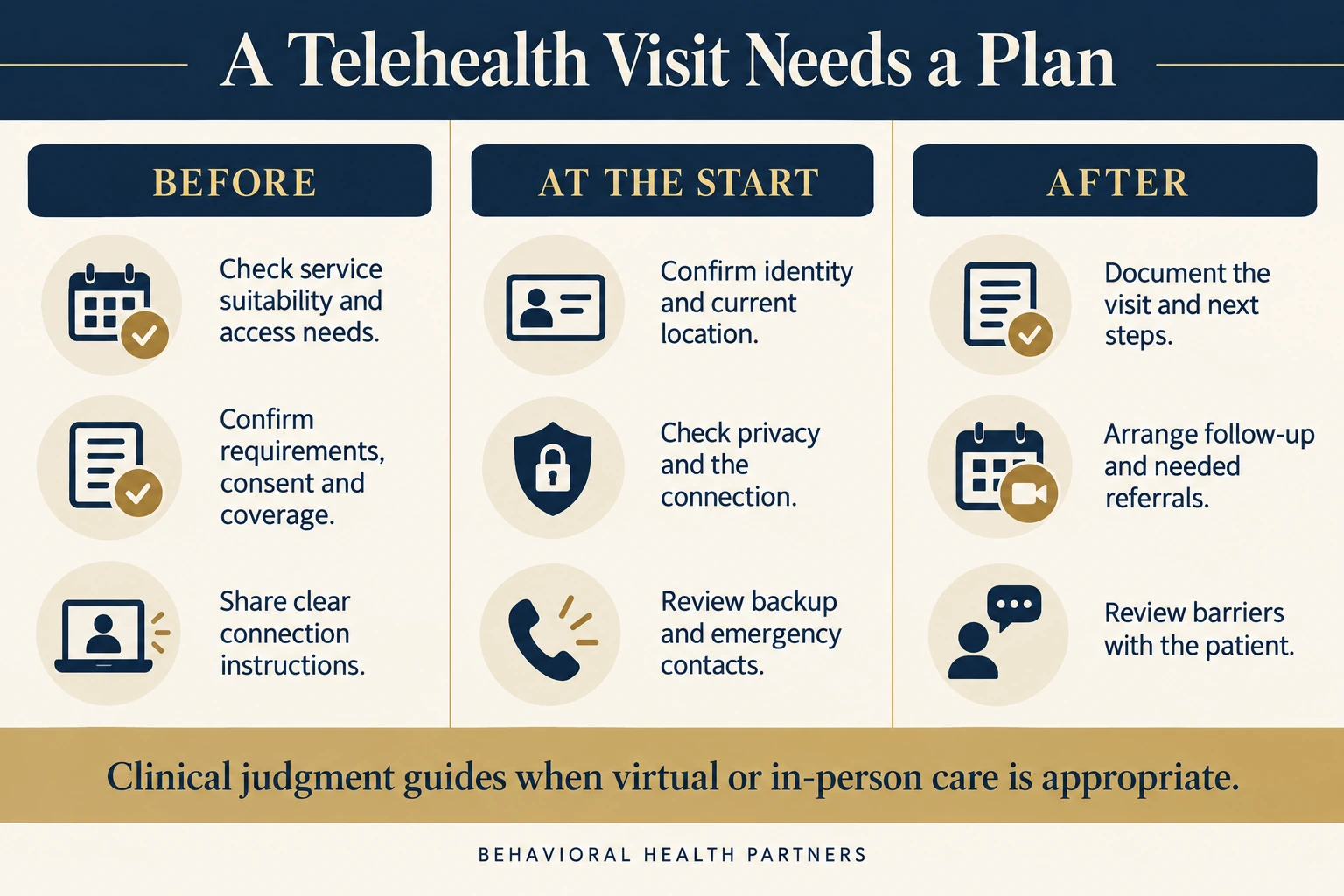
Start with the services you will offer virtually, whether that is individual therapy, group therapy, telepsychiatry, or a full virtual IOP. Choose a secure platform your clinicians and patients will actually use. Confirm licensing and payer coverage for every state you serve. Train your team on virtual clinical workflows, from intake to crisis protocols, because a good in-person clinician is not automatically ready for video. Then build the intake, scheduling, and follow-up systems that keep telehealth appointments running smoothly. A patient who is unable to travel needs only a computer or phone and a stable internet connection to join, and your team can create a simple checklist so every therapist knows how to start, secure, and document each appointment.
This is the operational work we do with programs every day, and it connects directly to building a behavioral health program that can scale. Done well, telehealth is not a side offering. It is a durable way to expand access and grow.
Frequently Asked Questions
Can telehealth be used for mental health services?
Yes. Telehealth is a proven channel for mental health care, from online therapy and group therapy to telepsychiatry and medication management. Research supports its effectiveness for anxiety, depression, trauma, and many other conditions, and most services a program offers in person can be delivered virtually.
Is virtual IOP effective?
Virtual IOP delivers the same evidence based curriculum, group therapy, and individual sessions as an in-person intensive outpatient program, on a similar schedule. For patients who cannot attend in person because of work, family, or distance, a virtual IOP makes structured treatment possible, and outcomes are strong when the program is well run.
Can telehealth prescribe mental health medications?
In many cases, yes. A psychiatrist or qualified provider can evaluate a patient and handle medication management by video. Under current federal telemedicine rules, providers can even start buprenorphine for opioid use disorder through telehealth, with an in-person visit required for continued prescriptions. Specific rules vary by medication and state.
Is telehealth for mental health ending?
No. Medicare made telehealth coverage for behavioral and mental health permanent, and virtual care is now a standard part of the field. Some rules continue to evolve, so any provider offering telehealth should track policy changes, but the core of telehealth mental health care is here to stay.
Bring Virtual Care to Your Program
Telehealth is one of the highest-leverage moves a behavioral health program can make. It increases access, reaches patients who would otherwise go without care, and lets good clinicians help more people. For patients, the benefit is steady support, easier access to a therapist or psychiatrist, and treatment that fits a real life, with appointments and support that work around it, all of which protects their well-being and keeps healing on track. The programs that treat virtual care as core infrastructure, with the right platform, licensing, and workflows, are the ones that will keep growing.
If you want a partner to help you add telehealth the right way, reach out to work with us and we will help you build virtual services that expand access and hold up over time.
Adam Vibe GuntonFounder and Managing Partner, Behavioral Health Partners
Adam Vibe Gunton is an addiction recovery expert, entrepreneur, marketer, brand strategist, and speaker dedicated to advancing the behavioral health industry. As Founder and Managing Partner of Behavioral Health Partners, he has worked across treatment-center development, operations, branding, PR, SEO, advertising, and growth strategy. Combining professional experience with his own lived experience in recovery, Adam brings a unique perspective on how treatment organizations can build trusted brands, reach more people, and create a greater impact.
Published April 11, 2025 · Updated September 28, 2026
One Conversation. No Pitch.
Schedule Your Free Discovery Call
Thirty minutes on video with Adam directly, camera on, screen-sharing your own online presence and your top three local competitors. If we are not the right partner, we will tell you that too.