Behavioral Health CRM: Why Your Treatment Center Needs One Built for Recovery
Most centers lose admissions they already paid for, and the cause is usually the system, not the care. We cover what a behavioral health CRM is, why generic sales CRMs fail treatment centers, and the features this work genuinely requires. We cover coordinating care across your team, the custom versus off-the-shelf decision, and how to build a CRM around the program you actually run.
By Adam Vibe Gunton·December 30, 2024·Updated September 28, 2026·12 min read
Most treatment centers lose admissions they already paid to attract, not because their care is weak, but because their systems are. Inquiries slip through the cracks, follow up is inconsistent, and no one can see the full picture. A behavioral health CRM fixes that. It is the system that captures every inquiry, guides each prospective client from first contact through admission and beyond, and keeps your whole team working from one source of truth. This guide explains what a behavioral health CRM is, why generic tools fail substance abuse treatment centers, and what to look for, and if you want a CRM built and customized for your program, our addiction treatment marketing team builds them for treatment centers every day. Our video on the CRM strategy every treatment center needs is a great companion.
A CRM is not a luxury for large organizations. For any addiction treatment center or mental health program that markets for admissions, it is the difference between growth and guesswork. Substance abuse treatment is one of the most competitive spaces in healthcare, and a CRM built for substance abuse and addiction treatment is how a treatment center keeps up. Below, we break down exactly what a CRM does and why a system built for behavioral health, and for behavioral health providers specifically, not a generic sales tool, is what your treatment center actually needs.
What Is a Behavioral Health CRM?
CRM stands for customer relationship management. A behavioral health CRM is customer relationship management software designed specifically for behavioral health providers, treatment centers, and mental health providers, rather than for selling products. Where a general CRM tracks sales deals, a CRM tracks people, guiding each prospective patient through the full patient journey from initial inquiry to admission, treatment, and alumni life.
Think of a behavioral health CRM as the operational backbone of your admissions and marketing. It holds every lead, every conversation, and every follow up in one system, so your admissions team, your clinical staff, and your marketing team all see the same information. A good CRM system captures patient data securely, automates the reminders and follow ups that keep patients engaged, tracks compliance, and turns raw activity into actionable insights. For substance abuse treatment centers and mental health treatment programs alike, it is the tool that connects marketing spend to real admissions and keeps care coordinated across the full continuum. Whether your focus is substance abuse treatment, mental health treatment, or both, the CRM keeps every substance abuse treatment and mental health inquiry organized in one place.
Why Generic CRMs Fail Treatment Centers
Here is the core problem: most generic CRMs were built to close sales, not to guide a person through addiction treatment at addiction treatment centers. A general CRM can store contacts and send emails, but it does not understand the realities of behavioral health, the compliance rules, the clinical workflows, or the sensitivity of the patient information it holds.
Generic CRMs fail treatment centers in specific ways. They rarely handle the strict compliance that behavioral health facilities require, leaving patient data exposed. They are not built for the admissions process a treatment center actually runs, from initial inquiry through insurance verification to admission. They do not track the clinical and compliance details that matter in substance abuse treatment. And they treat a person in crisis like a sales lead, which is both ineffective and wrong. A CRM built for behavioral health, by contrast, is designed around the real patient journey and the real rules that govern addiction treatment centers. That difference is why a purpose-built system consistently outperforms a repurposed general CRM.
The stakes are higher in behavioral health than in almost any other field. In substance abuse treatment, the person on the other end of an inquiry is often in crisis, and the window to reach them is short. A generic sales CRM was never designed for that reality. It does not understand the difference between a curious researcher and a family ready to admit a loved one, it cannot flag the urgency that addiction treatment demands, and it has no concept of the clinical records, treatment plans, clinical data, and progress notes that a real treatment center depends on, all tied to individual treatment plans. For substance abuse treatment centers and mental health treatment programs, those gaps in substance abuse care are not minor inconveniences; they are lost admissions and worse patient care.
Key Features a Behavioral Health CRM Needs
Not every CRM is the same. When evaluating a system, or building a custom one, these are the key benefits and features that matter most for treatment centers.
Lead Management: Turning Inquiries Into Admissions
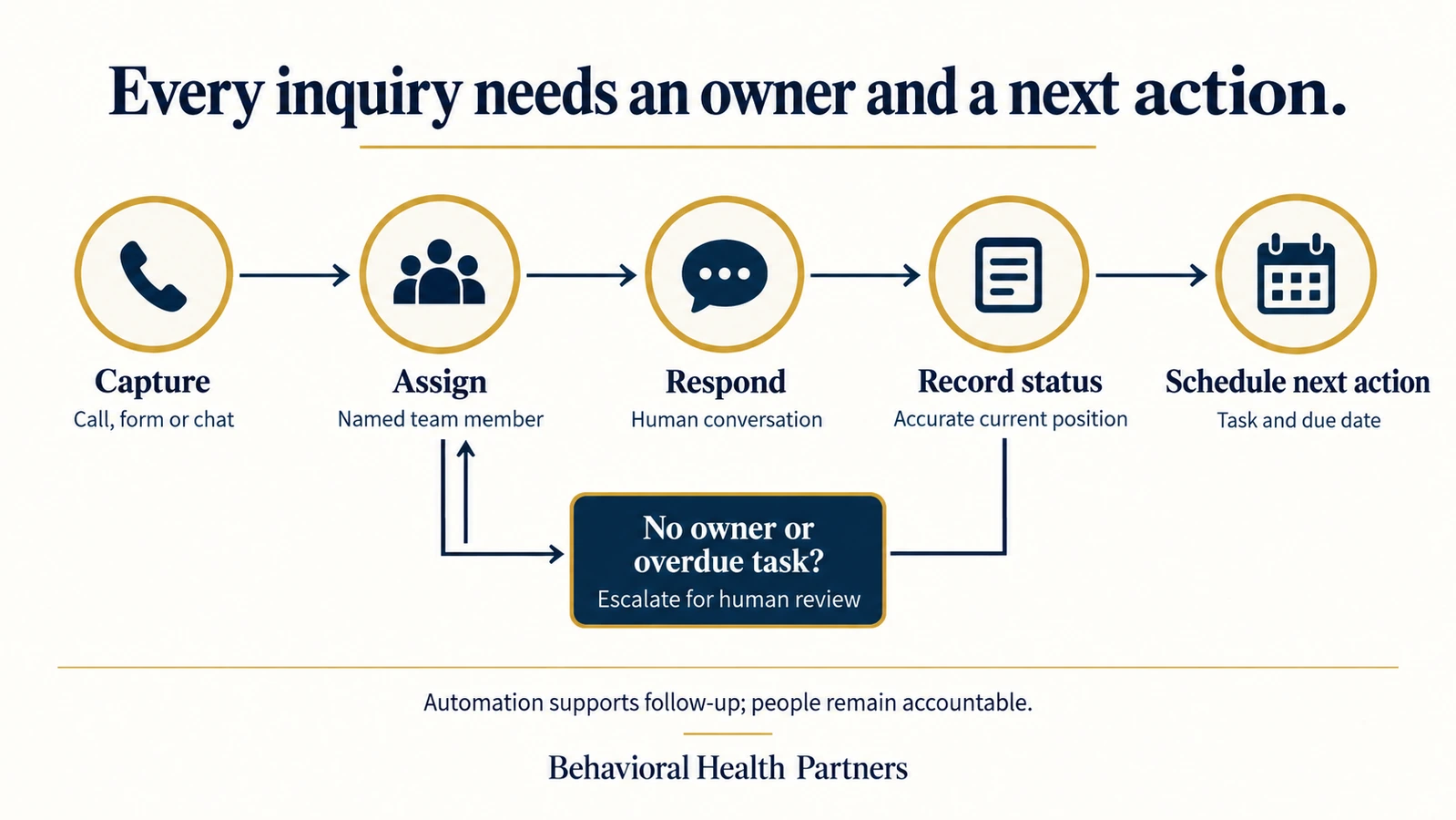
The first job of a CRM is lead management: capturing every inquiry from every source and making sure none is lost. When a prospective client or family reaches out by call, form, or chat, the CRM logs it instantly, assigns it to your admissions team, and tracks it through the admissions workflow. Strong lead management ties directly to your rehab lead generation and your admissions funnel, so no prospective patient falls through the cracks and every initial inquiry gets a fast, human response. By organizing insurance verification, follow ups, and status in one place, a good CRM lifts your conversion rates and turns more inquiries into admissions. For busy substance abuse treatment centers, this lead management discipline is often the single biggest driver of growth.
Patient Engagement and Alumni Follow Up
A behavioral health CRM keeps patients engaged well beyond admission. Automated reminders and appointment reminders reduce no-shows, secure messaging keeps communication compliant and lifts patient engagement, and personalized care touches keep engaged patients invested in their own recovery. The best systems support email nurture, alumni engagement, and alumni follow up, so your relationship with a person does not end at discharge. Staying connected with alumni through the CRM supports long-term recovery, encourages referrals, and keeps your community strong. Patient engagement is not a nice extra; it is central to both outcomes and growth, and for addiction treatment centers, engaged patients relapse less, improve outcomes, and refer more.
Compliance Tracking and Data Security
Because a behavioral health CRM holds sensitive patient information, compliance is non-negotiable. Any CRM your treatment center uses must protect clinical data, clinical records, and patient data to the standards that govern behavioral health. That means HIPAA compliance and, for substance use records, the stricter confidentiality of 42 CFR Part 2. It also means the vendor itself is accountable: according to HHS, any software provider that handles protected health information is a business associate, and your center must have a business associate agreement in place before sharing patient information with it. Under the HIPAA Security Rule, a compliant CRM needs administrative, physical, and technical safeguards, including user access controls that limit access to ePHI to the right people and audit controls that record activity. A strong CRM builds compliance tracking and these compliance tasks into daily workflows, so protecting data is automatic rather than an afterthought.
Reporting and Analytics: Data-Driven Insights
You cannot improve what you cannot see. A CRM with built in analytics turns every inquiry, admission, and campaign into data driven insights. CRM analytics show which marketing efforts actually produce admissions, so you can prove and improve marketing ROI, while marketing reports connect spend to results. Beyond marketing, the right reporting and built in analytics track patient progress and patient outcomes, helping your team improve outcomes and deliver more personalized care. These actionable insights, drawn together with your analytics for behavioral healthcare, let you make decisions from evidence rather than guesswork. With built in analytics, you can watch conversion rates by source, spot where inquiries stall, and see which programs fill fastest. Over time, that same data helps you improve outcomes and improve efficiency, because you are managing addiction treatment programs and mental health services from real numbers, not hunches. A system that can integrate seamlessly with your other tools makes those numbers complete, pulling marketing, admissions, and clinical activity into one clear view.
Automation: Reducing Administrative Burdens
Your team should spend its time on people, not paperwork. A CRM automates the repetitive tasks that eat up hours: automated follow ups, reminders, data entry, and routine administrative tasks. By streamlining workflows and reducing administrative burdens, automation frees your admissions and clinical staff and helps streamline operations, so they can to focus on care, not clerical work. Well-designed automation does not replace the human touch; it removes the busywork that gets in the way of it, helping your treatment center improve efficiency and streamline operations across the board. Good CRM software turns a chaotic, manual operation into a calm, repeatable one.
Integration: One System, Not Silos
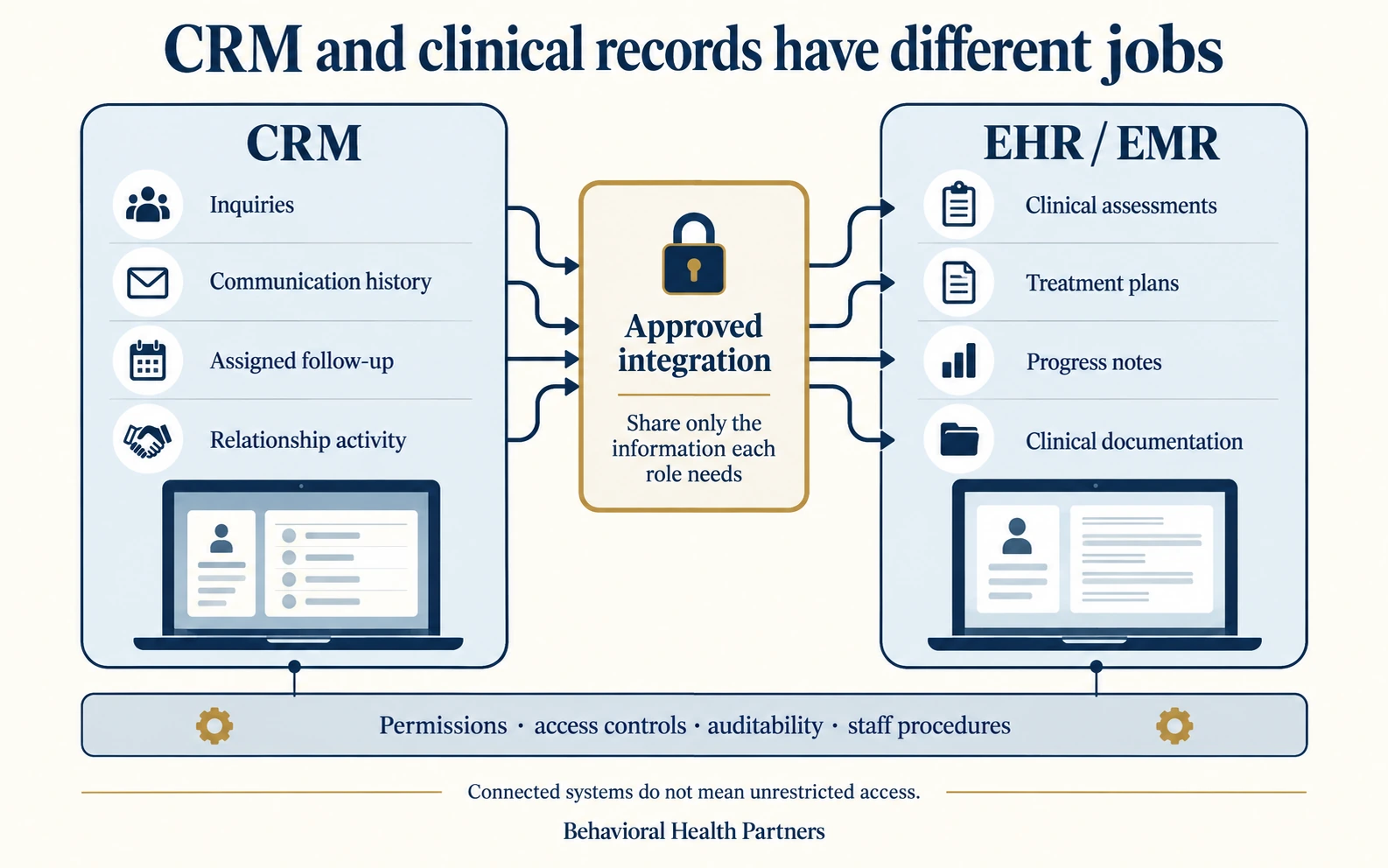
Treatment centers run on data from multiple sources, and a CRM should pull it together rather than add another silo. The best CRM systems integrate seamlessly, connecting and integrating seamlessly with the tools you already use, including your electronic medical records and, where relevant, revenue cycle management and claims submission. When your CRM and your clinical documentation talk to each other, your team works from one system instead of juggling half a dozen. That connection keeps patient care coordinated across the full continuum and gives leadership a single, complete view of the operation.
Deep integration also connects the front office to the back office. When your CRM can integrate seamlessly with your electronic medical records and, where relevant, your revenue cycle management and claims submission, the same patient information and patient care history flow from admission to billing without re-entry or error. Clinical documentation, clinical records, and treatment plans stay connected to the marketing and admissions data that brought the person in, so leadership finally sees the whole picture in one system. That end-to-end view is nearly impossible to build from a general CRM bolted onto separate tools.
Coordinating Care Across Your Team
A purpose-built CRM is not only a marketing and admissions tool; it also strengthens care coordination. When your admissions team, clinicians, and alumni coordinators all work from one system, everyone sees the same history, and no one has to chase information across inboxes and spreadsheets. That coordination improves patient care, because the people serving a client, whether in addiction treatment or mental health treatment, share a single, current view of that person.
While a CRM is not a clinical charting system, it complements your clinical records by keeping the operational and relationship data, communications, follow ups, referrals, and alumni engagement, connected to each patient. Paired with your electronic medical records, where progress notes and treatment plans live, the CRM gives your team the full context around every person. The result is smoother patient intake, tighter care coordination, and fewer things falling through the cracks as a client moves through the intake process and into treatment.
Custom-Built vs. Off-the-Shelf: Why Customization Wins
Off-the-shelf CRMs force your treatment center to fit their workflow. A custom or customized CRM does the opposite: it fits your program. Because no two treatment centers run their admissions, clinical documentation, and follow up exactly alike, a CRM configured around your actual workflow will always outperform a generic tool you have to work around.
This is where partnering matters. Rather than buying a rigid platform and forcing your team to adapt, a customized CRM is shaped to your admissions process, your levels of care, your compliance needs, and your reporting priorities. It captures the specific patient data you rely on, automates the exact follow ups your program uses, and produces the reports your leadership actually wants. The result is a system your team adopts because it matches how they already work, not one they resent because it fights them. A CRM built and customized for behavioral health, with ongoing support to evolve as you grow, is a far stronger investment than a one-size-fits-all product.
A CRM Is a Strategic Investment
It helps to reframe how you think about a CRM. It is not just software; it is a strategic investment in growth and quality of care. A well-implemented CRM captures more of the admissions you already pay to generate, keeps patients engaged and connected to their recovery, protects sensitive data, and gives leadership the data driven insights to run a better organization. Every inquiry that no longer slips away, every no-show that a reminder prevents, and every marketing dollar you can finally trace to an admission adds up quickly.
For a treatment center serious about growth, the question is not whether you can afford a CRM, but whether you can afford to keep operating without one. Generic tools and disconnected spreadsheets quietly cost you admissions every month. A purpose-built system, matched to how your program actually runs, turns those losses into growth.
Build a CRM Around Your Program
A CRM is the system that ties your marketing, your admissions, your clinical team, and your alumni together in one place. It captures every lead, keeps patients engaged, protects patient data, automates the busywork, and shows you exactly what is working. Built for behavioral health rather than borrowed from a sales team, and customized to your workflow, it becomes the operational engine behind sustainable growth.
If you want a CRM designed and customized for your treatment center, request a strategy conversation with our rehab marketing team. We build CRM systems around how your program actually works, so you capture more admissions, stay compliant, and keep patients engaged from the first inquiry through lifelong recovery.
Frequently Asked Questions
What is a behavioral health CRM?
A behavioral health CRM is customer relationship management software built specifically for treatment centers, behavioral health providers, and mental health providers. Instead of tracking sales deals like a general CRM, it tracks people, guiding each prospective patient through the full patient journey from initial inquiry to admission, treatment, and alumni follow up. A CRM captures leads, keeps patients engaged, protects patient data, tracks compliance, and turns activity into actionable insights, all in one system built for the realities of addiction treatment and mental health care.
What does CRM mean in healthcare?
CRM stands for customer relationship management. In healthcare, and specifically in behavioral health, a CRM is the system that manages relationships with prospective patients, current patients, and alumni across their entire journey. A CRM organizes inquiries, automates follow ups and appointment reminders, coordinates communication among teams, and reports on both marketing and patient outcomes. Unlike a general CRM built for sales, a CRM is designed around patient care, the admissions process, and the compliance requirements that govern treatment centers.
Do treatment centers really need a CRM?
Yes, if they market for admissions. Without a CRM, treatment centers lose inquiries they already paid to attract, follow up inconsistently, and cannot connect marketing spend to admissions. A CRM captures every lead, ensures fast follow up, keeps patients engaged, and gives leadership clear reporting. It pays for itself by recovering admissions that otherwise slip away and by making your whole operation more efficient. For any treatment center serious about growth and quality of care, a CRM is a core system, not an optional extra.
Are CRMs HIPAA compliant?
They must be, but not every CRM is, which is why the choice matters. Because a CRM holds protected health information, it must meet HIPAA and, for substance use records, the stricter confidentiality of 42 CFR Part 2. The CRM provider is a HIPAA business associate, so your center needs a business associate agreement with it, and the system needs administrative, physical, and technical safeguards, including user access controls and audit trails. A generic CRM often lacks these protections, while a CRM builds compliance and data security in from the start.
Is a custom CRM better than an off-the-shelf one for a treatment center?
Usually, yes. Off-the-shelf CRMs force your treatment center to adapt to their workflow, while a custom or customized CRM is shaped around how your program actually runs, your admissions process, your levels of care, your compliance needs, and your reporting. That fit means higher adoption by your team and better results, because the system matches your real workflow instead of fighting it. Paired with ongoing support to evolve as you grow, a customized CRM is typically a stronger long-term investment than a rigid, generic platform.
Share this guideLink copied
Adam Vibe GuntonFounder and Managing Partner, Behavioral Health Partners
Adam Vibe Gunton is an addiction recovery expert, entrepreneur, marketer, brand strategist, and speaker dedicated to advancing the behavioral health industry. As Founder and Managing Partner of Behavioral Health Partners, he has worked across treatment-center development, operations, branding, PR, SEO, advertising, and growth strategy. Combining professional experience with his own lived experience in recovery, Adam brings a unique perspective on how treatment organizations can build trusted brands, reach more people, and create a greater impact.
Thirty minutes on video with Adam directly, camera on, screen-sharing your own online presence and your top three local competitors. If we are not the right partner, we will tell you that too.