Rehab Lead Generation: The Complete Guide to Drug Rehab Leads That Convert
Turning people actively seeking treatment into inquiries your admissions team can convert. We cover what rehab lead generation is and why quality beats volume, with a real case study behind that claim. We cover the lead generation funnel, how it differs across programs and levels of care, which channels actually produce leads, how your website and landing pages do the converting, and call tracking and measurement.
Rehab lead generation is the process of attracting people who are actively seeking treatment and turning them into qualified inquiries your admissions team can convert into admissions. For a drug rehab, it is the difference between a full census and empty beds. But not all drug rehab leads are equal, and the biggest mistake in drug rehab lead generation for addiction treatment centers is chasing volume instead of quality. This guide covers everything a drug rehab needs to build a drug rehab lead generation system that produces high quality leads, the channels that drive drug rehab lead generation, how to measure them, and how to stay compliant. If you want a partner to run it, our addiction treatment marketing team builds drug rehab lead generation systems for drug rehabs and addiction treatment centers every day, and our video on the lead generation strategy that works shows the approach in action.
Lead generation for a rehab center is not one tactic. Treatment center lead generation is a system that spans your marketing efforts, your website, and your admissions process, and it only works when every piece is aligned. Below, we break down how drug rehab lead generation actually works, from the first search to the call that becomes an admission.
What Is Rehab Lead Generation?
Rehab lead generation is the practice of generating leads, meaning inquiries from potential clients, patients, and their family members who are looking for addiction treatment. For a drug rehab, a rehab lead is any person who reaches out: a phone call, a form submission, a chat, or an insurance verification request. Drug rehab lead generation is the full set of marketing efforts that produce those inquiries and route them to your admissions team.
It helps to separate three different things that treatment centers often confuse. Any inquiry is a rehab lead. A qualified lead is an inquiry from someone who is a genuine fit for your addiction treatment services, in your area, with a real need and, often, insurance coverage. An admission is a qualified lead who actually enters treatment. Good rehab lead generation is not measured by raw lead volume; it is measured by qualified leads and admissions. A treatment center drowning in unqualified inquiries is worse off than one with fewer, higher quality leads, because every unqualified inquiry costs your admissions team time it does not have.
Quality Over Quantity: Why High Quality Leads Matter
The single most important idea in drug rehab lead generation is that lead quality beats lead volume every time. High quality leads connect you with individuals seeking treatment who are ready to act, a real fit for your program, and reachable. Low quality leads, tire-kickers, people outside your service area, or inquiries with no genuine intent, waste your marketing dollars and exhaust your admissions team.
Many treatment centers fall into the volume trap, celebrating a flood of leads that never convert. But more leads are not better leads. A drug rehab that generates one hundred qualified leads will fill more beds than one that generates a thousand unqualified inquiries, and it will field fewer calls that go nowhere while spending less doing it. Focusing your rehab lead generation on high quality leads, the potential clients and potential patients who match your ideal target audience, is what turns marketing spend into admissions. This is why the smartest drug rehab marketing for a drug rehab starts by defining exactly who a qualified lead is, then builds every channel to attract that person and screen out the rest.
A Real Case Study: Quality Over Volume
The power of this approach is best shown by a real client. An out-of-network outpatient treatment center came to us with a familiar problem: plenty of website traffic, but not enough admissions. Instead of chasing more leads, we rebuilt their rehab lead generation around quality. We tightened their targeting, sharpened their messaging to attract genuine prospective clients, and optimized their site to screen for intent.
The counterintuitive result: their raw website conversions and total leads coming in actually dropped, because we deliberately filtered out the low quality leads that never converted. But the leads that did come through were dramatically better. According to the center's own leadership, the facility grew from three active clients to thirty in five months, a roughly nine hundred percent increase in admissions, driven not by more leads but by better ones. Fewer, higher quality leads produced far more admissions and far more revenue. That is the entire philosophy of good drug rehab lead generation in one story: quality is what fills beds.
The Rehab Lead Generation Funnel
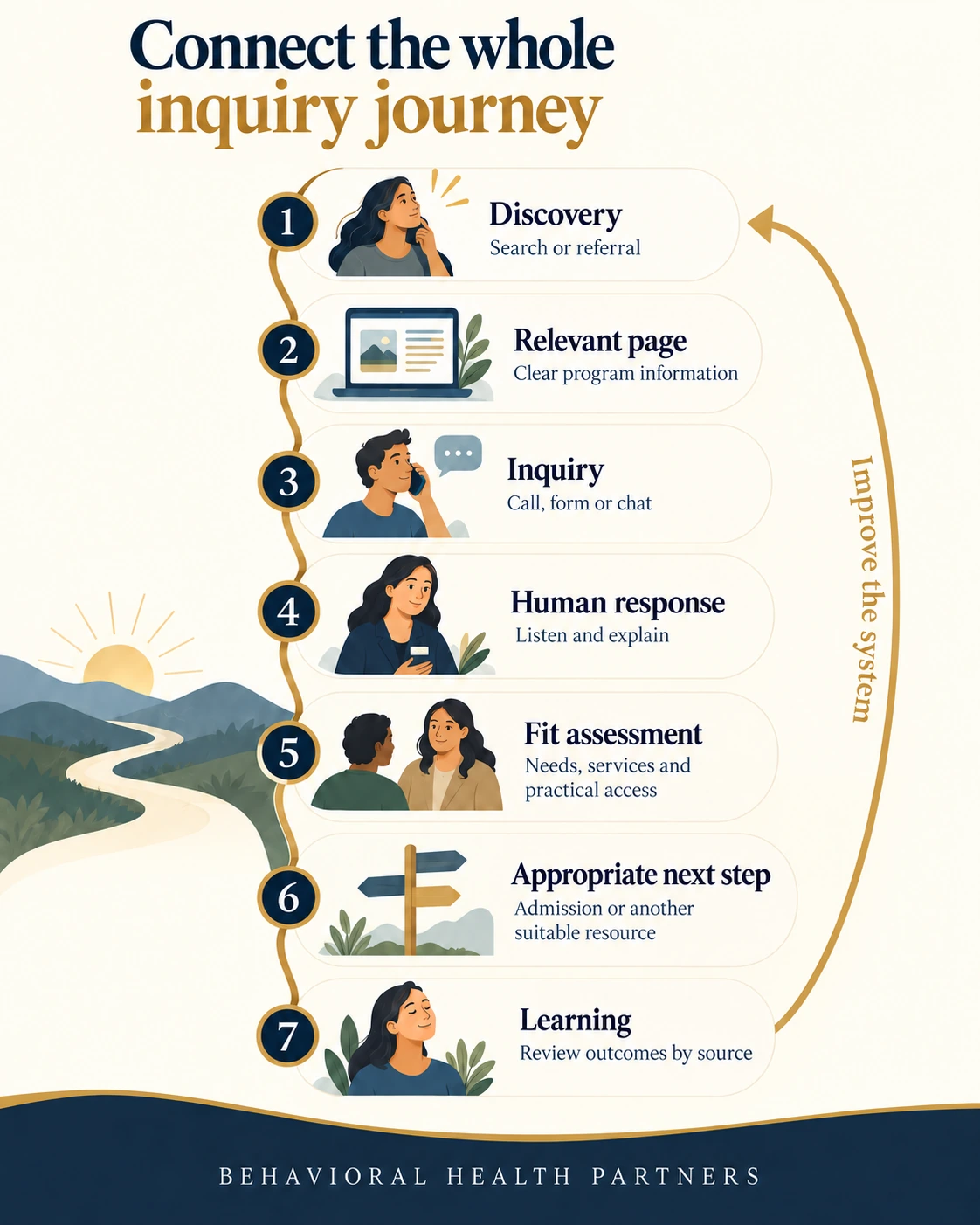
Rehab lead generation works as a funnel, and a leak at any stage costs you admissions. Understanding the funnel is how you find and fix those leaks.
First, a person searches for help or receives a referral. Second, they reach a page on your site that matches their intent, ideally a focused landing page, not a generic homepage. Third, they take an action: a phone call, a form submission, a chat, or an insurance verification request. Fourth, your admissions team responds, and how fast and how well they respond decides everything. Fifth, the inquiry is qualified, meaning your team confirms fit, level of care, and insurance coverage. Sixth, the qualified lead completes the next step and becomes an admission. Seventh, the outcome flows back to marketing, so you learn which channels and campaigns actually produce admissions.
Most treatment centers obsess over the top of the funnel, generating more leads, while ignoring the bottom, where admissions are actually won or lost. Our chapter on the rehab admissions funnel covers what happens once someone calls or submits a form, including the admissions response, the phone call, and the follow up that turns each lead into an admission. Rehab lead generation does not end when the lead comes in; it ends when the person starts treatment.
Rehab Lead Generation Across Programs and Levels of Care
Not every drug rehab generates leads the same way, because the target audience differs by program. An alcohol rehab, a drug rehab detox program, and an outpatient treatment center each attract different potential clients and prospective clients searching different terms, so your rehab lead generation has to match your treatment options. A rehabilitation center that offers multiple levels of care should build pages and campaigns for each, because a family searching for an outpatient program has a different decision process than one searching for residential care.
The same is true across behavioral health and addiction treatment. Addiction treatment centers, mental health programs, and dual-diagnosis rehabilitation center services across behavioral health, all draw distinct potential patients and potential customers, and lumping them together dilutes your message. The most effective addiction treatment centers segment their drug rehab marketing and lead generation by program, so a person seeking alcohol rehab lands on an alcohol rehab page and a person seeking substance abuse treatment finds substance abuse content that speaks to them. Matching your rehabilitation center's treatment options to what each potential client is actually searching for is one of the quickest ways to lift lead quality and get more qualified leads coming in.
Which Channels Generate Rehab Leads?
A strong drug rehab lead generation strategy uses several channels, each producing a different kind of lead. The right mix depends on your market, your budget, and your target audience.
Search Engine Optimization
Search engine optimization is the foundation of sustainable rehab lead generation. When you rank for the terms people search when they need help, you generate high quality leads with strong intent, and unlike paid search, those leads keep coming without paying per click. SEO can take twelve to eighteen months to build fully, but it produces some of the highest quality, lowest cost leads over time. Our guide on behavioral health SEO covers how to rank for the searches that matter, and strong local SEO and your Google Business Profile, with accurate business hours and strong online reviews, capture people searching for treatment nearby and lift you in local search results.
Paid Search and Google Ads
Paid search puts your drug rehab at the top of the results the moment someone searches, which makes Google Ads the fastest way to generate rehab leads. The catch is cost and control: addiction treatment keywords are among the most expensive anywhere, so your PPC campaigns must be tightly managed. Well-run PPC campaigns use negative keywords and negative keyword lists to filter out unqualified inquiries, so your PPC traffic and ad spend produce qualified leads rather than wasted clicks. Our guide on SEO versus PPC for treatment centers explains how paid search and organic work together in a rehab lead generation strategy.
Social Media and Content
Social media and content marketing build awareness and trust that feed your funnel over time. Empathetic, accurate, and where possible medically reviewed content answers the questions potential clients and family members ask, drawing organic traffic and prospective clients into your funnel, while social media keeps your rehab center visible and human. These channels rarely produce immediate admissions, but they warm up your target audience and make every other channel convert better.
Email Marketing and Nurture
Not every lead is ready today. Email marketing lets you nurture prospective clients, family members, and past inquiries until the moment they are ready to act. A simple nurture sequence keeps your treatment center top of mind, and our guide on how to build an email list shows how to build that audience. Email marketing is also one of the highest-return, lowest-cost channels in all of drug rehab marketing.
Reviews and Reputation
In addiction treatment, potential clients and families rely heavily on reviews, so reputation management is a real lead generation channel. Encourage satisfied clients and families to leave honest online reviews, respond to every one, and showcase video testimonials, shared with consent, because an honest video testimonial builds credibility no ad can. A strong reputation lifts both your search visibility and your conversion rate.
Referrals and Community
Professional and community referrals are the gold standard of rehab leads, because they arrive pre-trusted. Relationships with therapists, hospitals, community centers, sober support groups, alumni, and former patients produce high quality leads that convert at high rates. These referral relationships take time to build, but they generate leads no ad can match.
Your Website and Landing Pages Do the Converting
Every channel above sends people to your website, and if your site does not convert, all that traffic is wasted. Your landing pages are where a visitor becomes a lead, so they deserve real attention. A strong landing page loads fast, works on mobile, states who you help and where, and makes the next step obvious with clear calls to action like Call Now and Verify Insurance. Add mobile click-to-call so calling is one tap away, and offer live chat, because chat leads engage visitors who are not ready to pick up the phone yet.
Mobile optimization is not optional, because most individuals seeking treatment search on a phone. Prominent insurance verification and a simple form submission process turn more site visitors into qualified inquiries. Our guide on why your treatment center website is not converting and our conversion rate optimization service both focus on exactly this: turning traffic into leads. In rehab lead generation, better landing pages often produce more admissions than more traffic ever could.
Call Tracking, Lead Scoring, and Measurement
You cannot improve rehab lead generation you do not measure. Two tools make measurement possible: call tracking and lead scoring.
Call tracking assigns the source of every phone call, so you know which channel produced each lead and each admission. Without call tracking, you are guessing which marketing dollars actually work. Scoring your leads ranks them by quality signals, so your intake staff call the most promising leads first and does not waste time on unqualified inquiries.
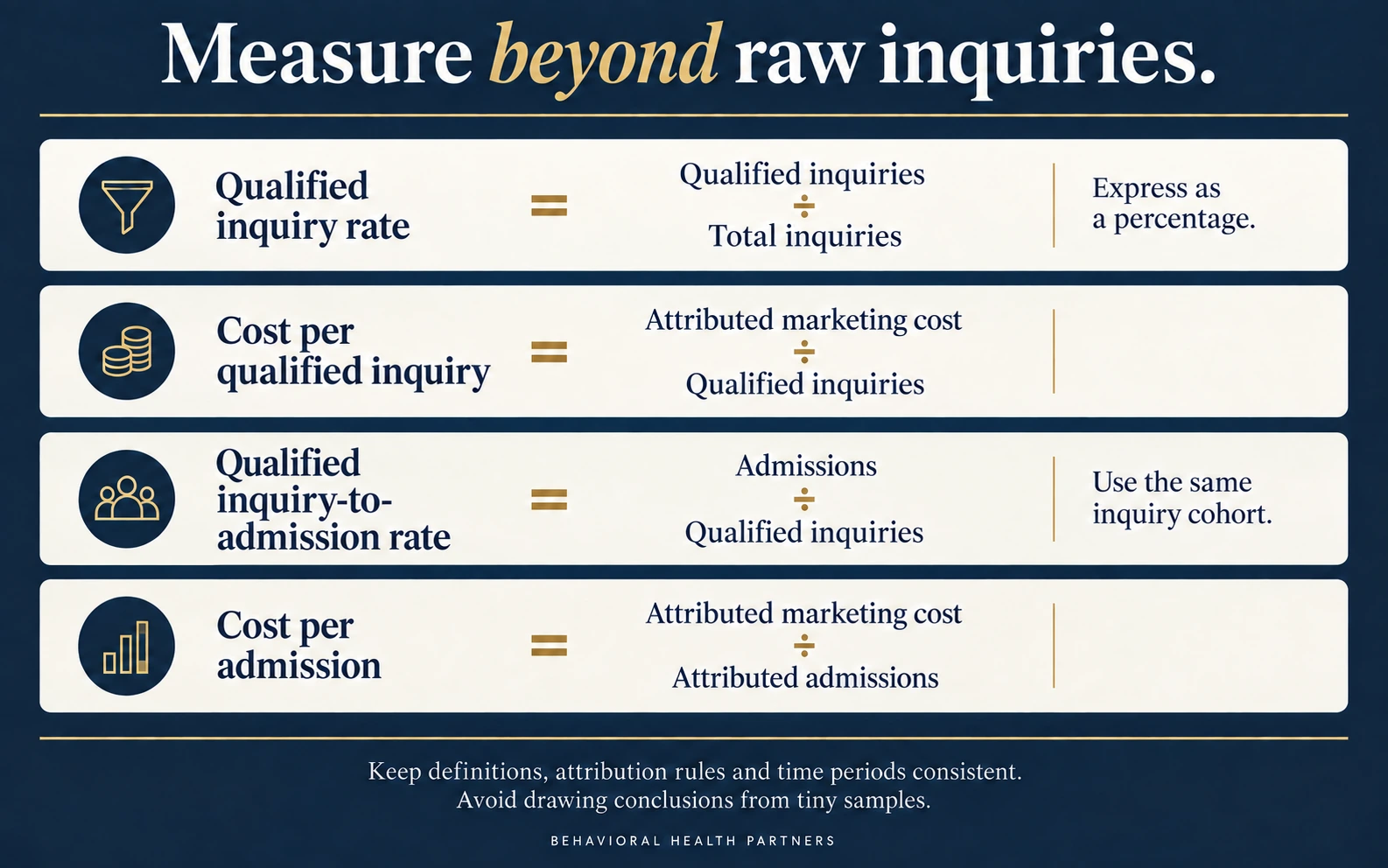
Beyond those tools, measure the metrics that matter: qualified lead rate, cost per qualified lead, qualified lead-to-admission rate, cost per admission, and the lifetime value and long-term lifetime value each admission represents, and the collected revenue each channel produces for your drug rehab. These numbers, tracked through your analytics for behavioral healthcare, tell you where to put your marketing budget. A rehab center that measures cost per admission by channel, rather than cost per lead, makes far smarter decisions about its marketing dollars.
Admissions Response Is Part of Lead Generation
Here is what most treatment centers miss: the person who answers your admissions phone is part of your lead generation. You can generate the best drug rehab leads in the world and still lose them if the follow up is slow or the phone call goes to voicemail. Speed to lead matters enormously; a lead contacted within minutes converts far better than one called back hours later.
Every inquiry needs an immediate, human response and a real follow up process. Marketing automation can help route and nurture leads, but nothing replaces a trained, compassionate person answering the phone to address concerns when a family in crisis calls. Because this is so important, we devote an entire chapter to it. Our guide on the rehab admissions funnel covers the admissions response, a call answering script, and how to talk to a lead on the phone, because the best addiction treatment marketing and lead generation fails without an admissions team that converts.
Should You Buy Rehab Leads?
Many treatment centers ask whether to buy leads. Bought leads and pay-per-call lead vendors can deliver volume fast, but they come with real risks: buying leads often means low quality leads, shared leads sold to several centers at once, higher costs over time, and serious compliance exposure. Bought drug rehab leads are fast and expensive, and they rarely match the quality of leads you generate yourself.
Generating your own leads through SEO, paid search, content, and referrals costs more effort up front but produces higher quality leads you control, at a lower long-term cost. For most treatment centers, the right answer is to build your own rehab lead generation engine and use purchased leads, if at all, only as a carefully vetted supplement. And before you buy any leads, understand the compliance rules below, because in addiction treatment, buying and selling leads is legally fraught.
Compliance and Ethics in Rehab Lead Generation
Rehab lead generation carries legal obligations that most industries never face, and compliance cannot be added later. It has to be built in from the start.
The biggest issue is paying for referrals. Under the federal Anti-Kickback Statute, according to HHS OIG, "in the Federal health care programs, paying for referrals is a crime." More specific to addiction treatment, the Eliminating Kickbacks in Recovery Act, 18 U.S.C. 220, prohibits knowingly paying or receiving "any remuneration (including any kickback, bribe, or rebate)" in exchange for referring a patient to a recovery home, clinical treatment facility, or laboratory, with penalties up to two hundred thousand dollars and ten years in prison per violation. This is why paying per admission for leads, or accepting payment to refer patients, is so dangerous in this space. Structure your lead generation so you are paying for marketing services, not for patient referrals.
Protecting protected health information is the other pillar. Any lead handling that touches health details must respect HIPAA, so, as in all behavioral health, use compliant call tracking, forms, and systems, and never expose a person's information. Running addiction treatment ads on Google and Meta also requires LegitScript certification. Get written consent before marketing to any past client, and never aggressively remarket to people in distress. And in all of your drug rehab marketing and lead generation, never make misleading claims about outcomes, success rates, or amenities. Ethical drug rehab marketing and rehab lead generation is not just the law; it is what protects the vulnerable people your marketing reaches.
Common Myths About Rehab Lead Generation
A few myths trip up treatment centers again and again. The first is that more leads always mean better business; in reality, quality beats quantity, and a flood of unqualified inquiries costs more than it earns. The second is that any traffic is good traffic; traffic that does not match your target audience never converts. The third is that digital ads are the only way to generate leads; referrals, SEO, and community relationships often produce your highest quality leads. The fourth is that lead generation is set-it-and-forget-it; it requires constant testing and optimization. And the fifth is that lead generation is only about online efforts; your admissions team and your follow up are just as much a part of it as any campaign.
Build a Rehab Lead Generation System That Fills Beds
Rehab lead generation is not a single campaign; it is a system that connects your marketing, your website, your measurement, and your admissions team around one goal: qualified leads that become admissions. Focus on quality over volume, use the channels that fit your target audience, convert traffic with strong landing pages, measure cost per admission by channel, respond to every inquiry fast, and build compliance in from the start. Do that, and your treatment center stops chasing leads and starts filling beds predictably.
If you want a partner to build and run a rehab lead generation system that produces high quality leads and admissions, request a strategy conversation with our rehab marketing team. We help drug rehabs generate better leads, convert more of them, and grow, ethically and predictably.
Frequently Asked Questions
What is the best way to generate high quality leads for a drug rehab center?
The best way to generate high quality leads is to combine channels that attract high-intent people, primarily search engine optimization and well-managed paid search, with a website built to convert and screen for intent. Define exactly who a qualified lead is for your program, target that person across SEO, Google Ads, content, and referrals, and use call tracking and lead scoring to focus your admissions team on the best leads. Quality beats volume every time, so a rehab lead generation strategy built around qualified leads will always outperform one chasing raw numbers.
What is the difference between a rehab lead and an admission?
A rehab lead is any inquiry, a phone call, form submission, chat, or insurance verification request from someone interested in treatment. A qualified lead is an inquiry from someone who genuinely fits your program, in your area, with a real need. An admission is a qualified lead who actually enters treatment. Measuring rehab lead generation by qualified leads and admissions, rather than raw lead volume, is what separates treatment centers that fill beds from those that waste marketing dollars on leads that never convert.
Should treatment centers buy drug rehab leads?
Usually not as a primary strategy. Purchased leads can add volume quickly, but bought drug rehab leads are often low quality, frequently shared with several centers at once, expensive over time, and legally risky under laws like EKRA and the Anti-Kickback Statute. Generating your own leads through SEO, paid search, content, and referrals produces higher quality leads you control at a lower long-term cost. If you use purchased leads at all, vet them carefully and make sure your arrangement pays for marketing services, not patient referrals.
How do you measure rehab lead generation?
Measure the metrics that connect marketing to admissions: qualified lead rate, cost per qualified lead, qualified lead-to-admission rate, and above all cost per admission by channel. Use call tracking to attribute every phone call to its source and a lead scoring model to rank lead quality. Tracking cost per admission and the collected revenue each channel produces, rather than just cost per lead, tells you exactly where to invest your marketing budget for the most admissions.
Is rehab lead generation legal, and what are the compliance rules?
Rehab lead generation is legal, but it is heavily regulated. The Anti-Kickback Statute and the Eliminating Kickbacks in Recovery Act prohibit paying or receiving remuneration for patient referrals, so you must structure lead arrangements to pay for marketing services rather than referrals. You must protect protected health information under HIPAA, use LegitScript certification to run addiction treatment ads on Google and Meta, and avoid misleading claims about outcomes. Building compliance in from the start protects both your treatment center and the vulnerable people your marketing reaches.
Adam Vibe GuntonFounder and Managing Partner, Behavioral Health Partners
Adam Vibe Gunton is an addiction recovery expert, entrepreneur, marketer, brand strategist, and speaker dedicated to advancing the behavioral health industry. As Founder and Managing Partner of Behavioral Health Partners, he has worked across treatment-center development, operations, branding, PR, SEO, advertising, and growth strategy. Combining professional experience with his own lived experience in recovery, Adam brings a unique perspective on how treatment organizations can build trusted brands, reach more people, and create a greater impact.
Thirty minutes on video with Adam directly, camera on, screen-sharing your own online presence and your top three local competitors. If we are not the right partner, we will tell you that too.