How to Build an Email List for Your Treatment Center
Email is one of the few audiences a treatment center truly owns. We cover why the list matters, and the compliance ground rules under HIPAA and CAN-SPAM before you send anything. Then the build, step by step: choosing a provider, landing pages that convert, lead magnets people actually want, where to place opt-in forms, and how to test pop-ups without wrecking the experience.
For addiction treatment centers, email is one of the few channels you truly own. When you learn how to build an email list, you stop renting your audience from social media platforms and start owning a direct line to the people who matter most: prospective clients, alumni, families, and referral partners. This guide walks through email list building for treatment centers step by step, from your first opt in form to a healthy email list, built with the right sign up forms, that fills your calendar. If you want a partner to run it for you, our content and email marketing team builds these systems for rehabs every day, and our companion video on five underrated ways to grow a treatment center email list is worth a watch before you start.
Knowing how to build an email list is not complicated, but it does reward doing the fundamentals well. Below, you will learn exactly how to build an email list from scratch, which tools, sign up forms, and opt in forms actually convert website visitors, how to stay compliant in a regulated industry, and how to turn a growing email list into more admissions.
What Is Email List Building?
Email list building is the ongoing process of collecting email addresses from people who have given you permission to contact them. Every signup form, lead magnet, and pop up you place is there to collect email addresses for your email list from genuinely interested people and add them to your email list. The goal is not raw size. The goal is an email list of engaged subscribers who want to hear from you, because a smaller email list of engaged subscribers will always outperform a huge email list of inactive subscribers.
For a treatment center, list building means capturing the contact details of families researching care, alumni who want to stay connected, professionals who refer clients, and website visitors who are not ready to call yet but want to learn more. Each of those email sign ups gives you direct access to a potential client at the exact moment they are weighing their options, and email marketing lets you nurture that relationship with potential customers over weeks or months rather than losing them after a single visit.
Why an Email List Is a Treatment Center's Most Valuable Asset
Before we get into how to build an email list, it helps to understand why the effort is worth it. A social following can vanish overnight when an algorithm changes or an account is suspended. Your email list is different. You own it. No platform can take your subscriber list away, throttle your reach, or charge you more to talk to the audience you already built.
Email also gives you direct access to interested prospects without a middleman. When you send email, it lands in the inbox of people who asked to hear from you, which is why email marketing consistently delivers one of the highest returns on investment of any channel in digital marketing for most marketers. For treatment centers, that direct line matters even more, because the decision to seek help is personal and often slow. A steady stream of relevant, helpful email messages keeps your center top of mind until a family is ready to act.
There is a compounding effect, too. Every new subscriber you add today becomes someone you can reach for every future campaign at no additional cost. Over time, a growing email list becomes the engine behind your admissions, your alumni engagement, and your referral relationships. That is why learning how to grow an email list is the kind of email list building that becomes one of the highest-leverage things a treatment center can do.
Compliance First: HIPAA and CAN-SPAM for Treatment Centers
Because you operate in healthcare, email marketing for healthcare comes with rules that most industries never think about. Getting compliance right protects your clients and your license, so build it into your email list building from day one.
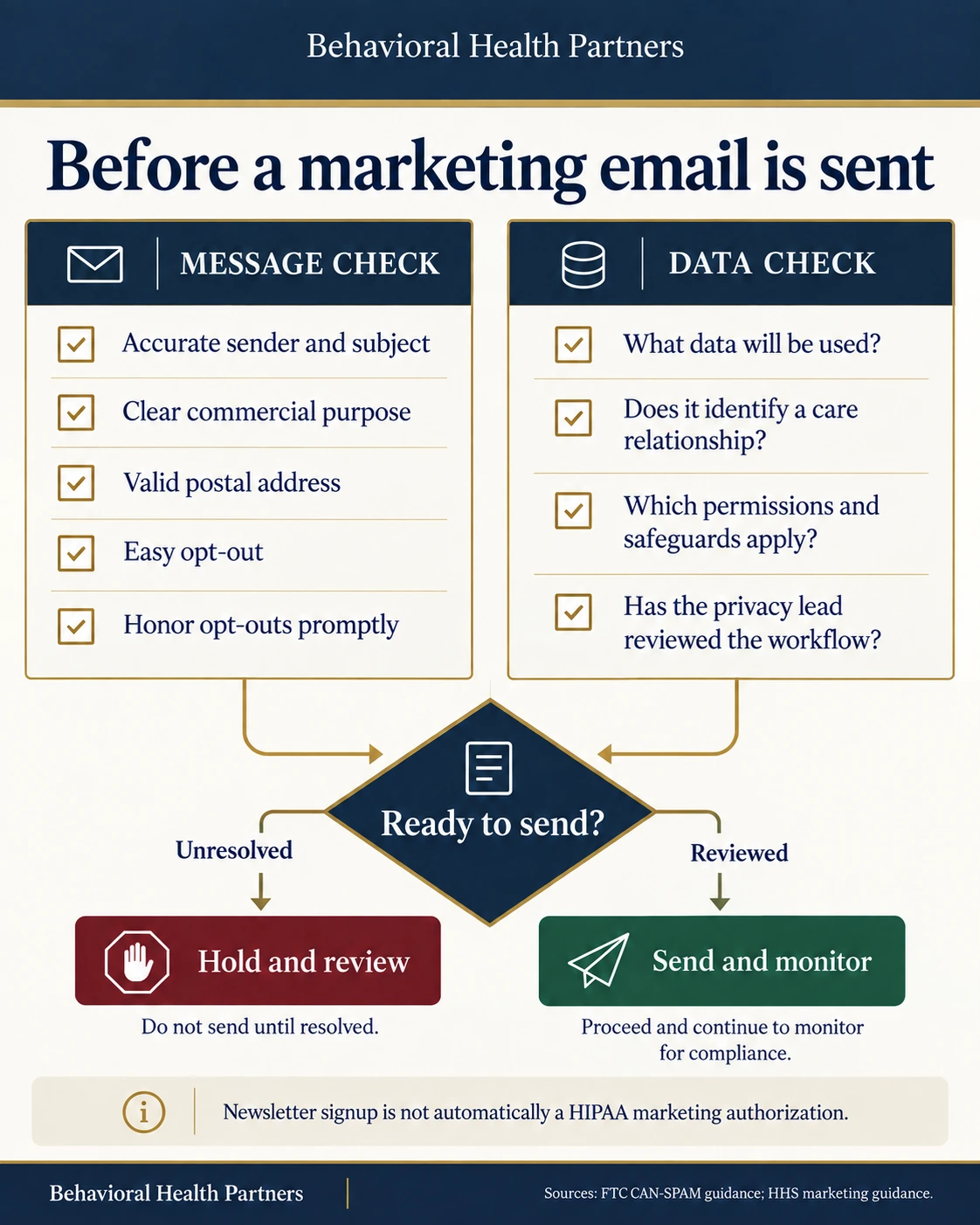
Start with the CAN-SPAM Act, which governs commercial email in the United States. According to the Federal Trade Commission, every marketing email you send must use accurate header and "From" information, carry a truthful subject line, clearly identify the message as an ad, include your valid physical postal address, and give recipients "a clear and conspicuous explanation of how the recipient can opt out." You must honor an opt out request within 10 business days, and keep that opt out mechanism working for at least 30 days. The FTC notes each separate email that violates the law can carry penalties of up to $53,088, so this is not optional. Getting these basics right protects your email list, keeps your email recipients trusting you, and keeps your future campaigns out of the spam folder.
HIPAA is the second layer. A common question is whether emailing a patient is a HIPAA violation. According to HHS guidance, the Privacy Rule does permit providers to email patients, as long as they apply "reasonable safeguards," such as "checking the e-mail address for accuracy before sending" and warning the person about the risks of unencrypted email. The practical takeaway for list building is simple: keep your marketing list separate from protected health information, never reveal that someone is a client in a promotional message, and use a HIPAA-compliant email marketing platform when any message could touch clinical details. When in doubt, keep marketing emails educational and general, and route anything clinical to a secure channel.
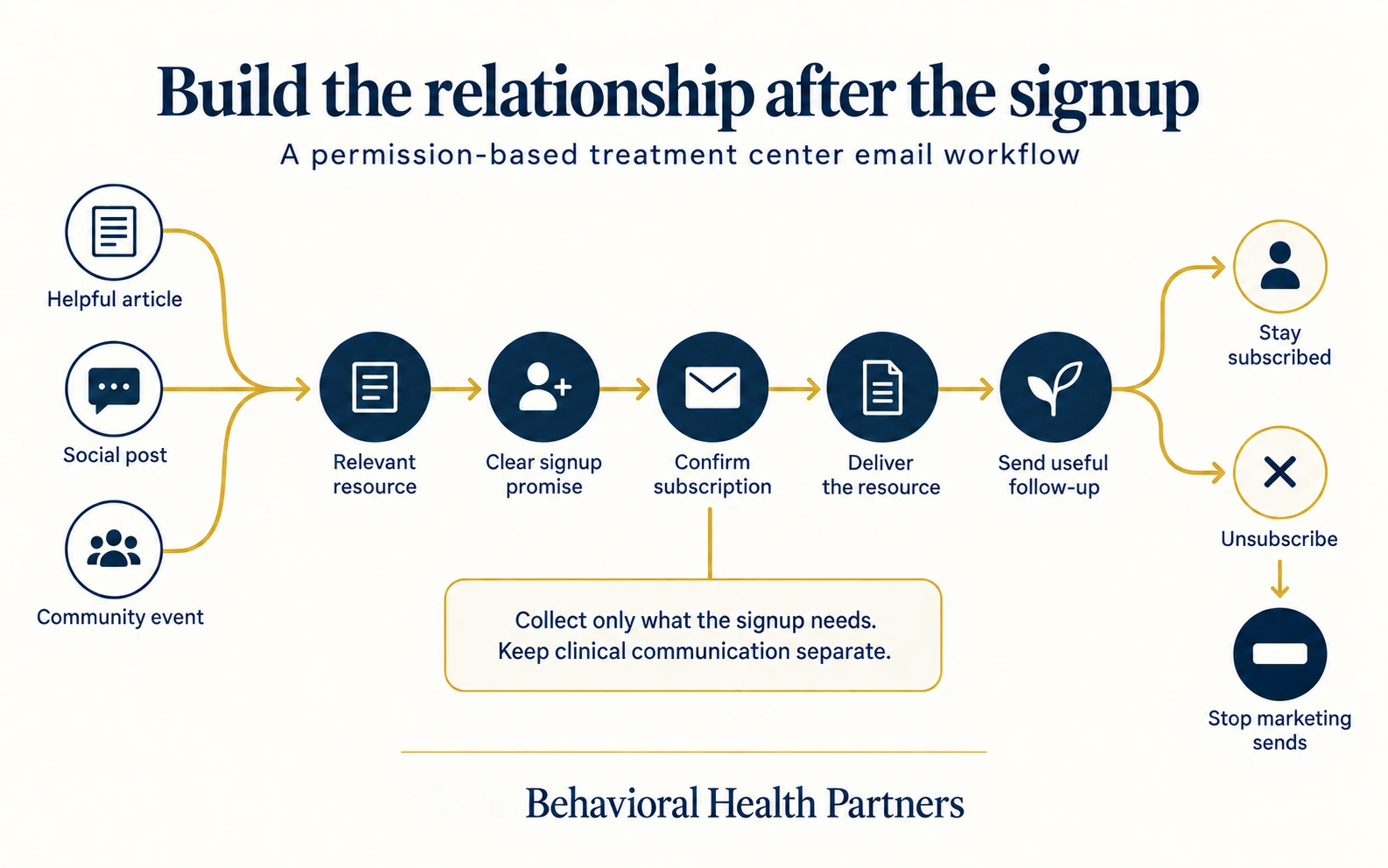
Ethical email sign ups matter as much as legal ones. Use a double opt in where possible, so every subscriber confirms they want your emails, which improves the quality of your email list from the start. Set clear expectations at signup about what you will send and how often, because subscribers who know what is coming stay engaged longer. And never buy or rent an email list. Purchased email lists tank your sender reputation, generate spam complaints, and put compliant campaigns at risk.
Step One: Choose the Right Email Service Provider
Every email list needs a home. Your email service provider, sometimes called an email marketing platform, is the software that stores your email list, hosts your signup forms, sends your email campaigns, measures your email campaigns, and reports on email campaign performance across your whole email list. Choosing the right tools early saves you painful migrations later.
For a treatment center, look for an email service provider that offers HIPAA-compliant handling if you need it, easy-to-build email opt in forms and landing pages, automation for welcome emails and sequences, list segmentation, and clear analytics on open and click through rate. The right email marketing software should make it simple to build an email list without a developer, so your team can launch a new opt in form or pop up in minutes.
Do not over-invest in features you will not use. Most treatment centers start with a straightforward platform that handles email capture, signup forms, and basic automation, then add sophistication as the email list grows and your email list of potential customers expands. Everything should feed one clean email list. What matters most is that your email marketing platform makes email list building repeatable, keeps your data clean, and protects your sender reputation with strong deliverability.
Step Two: Create Landing Pages That Convert
A high-converting landing page is one of the most effective ways to build an email list, because it removes distractions and focuses the visitor on a single action: handing over their email address, one of the most valuable email addresses you can collect. Unlike a busy homepage, a focused landing page has one job, so it almost always converts better for email signups.
A strong landing page for email capture keeps the form short, asks only for the contact details you truly need, and pairs a clear headline with a single, obvious call to action cta. Explain exactly what the subscriber gets and when, reassure them about privacy, and remove every link that could pull them away from the email sign up form. The fewer required fields on your opt in form, the more website visitors will complete it. As a rule, ask for just an email address, or at most two to three fields, since every extra field lowers conversion. It also helps to validate email addresses at signup, so a simple typo does not leave you with a dead address on your email list.
Because these pages carry so much of the load in list building, they deserve real investment. Our conversion rate optimization team tests headlines, form length, layout, and different call to action cta copy so more of your traffic turns into email subscribers rather than bouncing. Even small improvements to a landing page compound across every campaign that sends traffic to it.
Step Three: Offer Lead Magnets People Actually Want
Most website visitors will not join your email list just to "get updates." They opt in when you offer something valuable in return. That something is a lead magnet: a free download, a free ebook, a checklist, a free e-book, a discount code on a paid service, or a short email course that solves a real problem for your audience.
For treatment centers, effective lead magnets speak directly to the people you serve. A family guide to choosing a rehab, a free ebook on what to expect in the first week of treatment, a checklist for supporting a loved one, or a guide to insurance and admissions all make excellent lead magnets, because they deliver exclusive content a worried family, your core target audience, genuinely wants. Offer that free download in exchange for an email address, and your email sign ups will climb.
The key is relevance. A lead magnet aligned with your audience attracts the families who are likely to become clients, while a generic freebie attracts subscribers who never engage. A well-timed offer, even something as simple as exclusive discounts or a members-only offer with exclusive discounts, can generate interest and pull new subscribers onto your email list. Match each lead magnet to a specific stage of the decision, promote it with a clear call to action cta, and deliver it instantly through a welcome email so the subscriber's first experience with your list is a good one.
Step Four: Place Opt-In Forms and Sign Up Forms Everywhere
Once you have a compelling offer, give people every chance to take it. The more opportunities website visitors have to opt in, the faster your email list grows, so place email opt in forms and sign up forms across your website rather than hiding a single form in the footer.
Put an email signup form on your high-traffic blog articles, in your sidebar, on your about page, and on service pages where a family is already learning about your program. Add an inline sign up form partway through long articles, where an engaged reader is most likely to opt in. Make sure every signup form is simple, mobile-friendly, and consistent with the offer that brought the visitor there. Well-placed opt in forms turn ordinary website traffic into a steady flow of email signups without any extra ad spend, and every one of those email signups is yours to keep.
Consistency helps here. When your signup forms share a clear promise and a single call to action cta, visitors know exactly what they are getting, which lifts conversions across every form on your site. A great website turns list building into a background process that runs on every page, and our website design team builds treatment center sites with email capture designed in from the start.
Step Five: Test Pop-Ups and Exit-Intent Offers
Pop ups have a reputation for being annoying, but done well they are one of the most reliable list building tools available. The trick is timing and value. Instead of hitting a visitor with a pop up the second they arrive, trigger it based on behavior: an exit-intent pop up that appears as someone moves to leave, a timed pop up after a visitor has read for a while, or a scroll-based pop up that waits until an engaged reader is halfway down the page.
Pair every pop up with a genuine offer, such as your best lead magnet or a piece of exclusive content, so the interruption feels worth it. Keep the pop up form short, ask only for an email address, and make it easy to dismiss. When you test pop ups against each other and refine the offer, headline, and timing, they can meaningfully increase your email signups without hurting the visitor experience. Interactive content works well here too: a short self-assessment or a "which level of care is right for us" quiz can engage a visitor and earn an email address in exchange for the results. A well-run giveaway or awareness campaign can work too, such as offering a bundle of free recovery resources to everyone who signs up, as long as the incentive attracts the families you actually want to reach rather than freebie-seekers. The more compelling and relevant the offer, the higher your sign-up rate climbs.
Treat pop ups as one tool among many, not the whole strategy. Combined with inline signup forms, other signup forms, and a landing page, well-timed pop ups round out a system that captures interested prospects at every stage of their visit.
Step Six: Turn Blog Content Into List-Building Machines
Your blog is an email list building asset, not just an SEO play. Every visitor who finds a blog post through search is a potential subscriber, and the right offer turns that reader into one of your new subscribers before they leave.
The single most effective blog tactic is the content upgrade: a bonus resource tied directly to a specific article, offered in exchange for an email address. A reader finishing an article on paying for treatment might opt in for a downloadable insurance checklist, while a reader on a family-support article might want a printable conversation guide. Because the offer matches the article's topic, content upgrades convert far better than a generic newsletter signup form.
Strong organic traffic makes every one of these offers more valuable, which is why list building and search work hand in hand. A solid behavioral health SEO foundation sends more qualified website visitors to your blog posts, and every additional visitor is another chance to drive email signups. Add a clear call to action cta and an inline email signup form to every popular post, and your blog quietly builds your email list around the clock.
Step Seven: Convert Social Media Followers Into Subscribers
Your social media followers already like your center. The problem is that you do not own that audience, so the smartest move is to convert your followers into email subscribers you can reach anytime. Learning how to move people from social platforms to your list protects you from ever losing that audience to a platform change.
Devote regular social media posts to your best lead magnet, and add a link to your email sign up form in every social media bio and profile. Use a simple link tool in your social media accounts so followers can reach your landing page in one tap. Run occasional social media campaigns built entirely around an email signup, promoting a free ebook or exclusive content that lives behind an email list opt in. Because these followers already trust you, they convert well once you give them a clear reason and an easy path to join your list.
If you want help turning your channels into a list building engine, our social media marketing team runs campaigns across social media platforms that consistently drive email sign ups, not just likes. The goal is always the same: move fans from rented social media channels onto an email list you own and control.
Step Eight: Use Paid Ads to Accelerate List Growth
Organic list building compounds over time, but paid ads can accelerate it when you need subscribers faster, and it is a proven part of email list building. Instead of pointing ad spend only at admissions, run campaigns that send clicks to a landing page offering a lead magnet, turning cold traffic into email subscribers you can nurture toward a call.
This approach often costs less per lead than direct admissions campaigns, because a family is far more willing to trade their email addresses for a helpful guide than to pick up the phone on a first visit. Once they are on your list, a welcome sequence and ongoing email does the slower work of building trust until they are ready. Paid ads that feed your email list turn one-time visitors into a long-term audience, and they let you retarget the people who did not opt in the first time.
Because rehab keywords are expensive, efficient targeting matters. Our paid ads team builds campaigns that grow your email list at a sustainable cost per subscriber, so every dollar of ad spend keeps working long after the click.
Step Nine: Launch a Referral Program
Your existing subscribers can grow your list for you. A referral program invites your existing customers and most engaged subscribers to share your content and lead magnets with friends, families, and colleagues who could use your help. A treatment center referral program works because the recommendation comes from someone they trust, referred contacts tend to become engaged subscribers themselves.
Keep it simple. Add a forward-to-a-friend link and a clear share prompt to your best marketing emails, and encourage existing subscribers to pass along a genuinely useful free download. For alumni and referral partners, a light referral program that rewards sharing among existing subscribers with more exclusive content can steadily bring in new customers without any ad spend. Your most active subscribers are often happy to help when the content is worth sharing. Partnerships work the same way: co-marketing with aligned organizations, such as interventionists, alumni networks, or community health providers, lets each partner promote the other to a warm audience, which can accelerate email list growth for everyone involved.
Step Ten: Capture Emails Offline and In Your Signature
List building does not stop at your website. Treatment centers attend conferences, host alumni events, run community workshops, and meet referral partners in person, and every one of those moments is a chance to collect emails from genuinely interested people.
At in-person events, use a tablet with a simple email sign up form or a QR code that opens your landing page, so attendees can opt in and share their email addresses on the spot. Unlike a brick and mortar store that captures walk-ins at a counter, your team can collect email addresses at events and meetings, so make it effortless and explain exactly what the subscriber will receive.
One of the easiest wins is your email signature. Every staff member sends dozens of emails a day, so add a short line and a link to your email signup form in each email signature across your team. It costs nothing, runs automatically, and turns routine correspondence into a quiet, steady source of new subscribers. A single email signature link, multiplied across your whole team, adds up over a year.
Step Eleven: Protect Deliverability and Sender Reputation
Building an email list is only half the job. If your emails land in spam, none of it matters, so protect your sender reputation from the start. Your sender reputation is how inbox providers decide whether to deliver your email messages, and it is shaped by how recipients respond to what you send.
Keep your list clean by regularly removing inactive subscribers and dead email addresses, because sending to dead addresses drags down deliverability. Honor every opt out immediately, both to comply with the CAN-SPAM Act and to avoid spam complaints that damage your reputation. Use a double opt in so only truly interested prospects join, send relevant messages that people actually want, and watch your engagement metrics for early warning signs. A healthy list of engaged subscribers protects your sender reputation, which protects the deliverability of every future campaign.
Segmentation helps, too. When you send relevant content to the right people, such as separate messages for families, alumni, and referral partners, your open and click through rate climb, spam complaints fall, and inbox providers keep delivering your promotional messages to the inbox.
Step Twelve: Nurture Subscribers With Welcome Emails and Valuable Content
Collecting an email address is the beginning, not the end. What you send next determines whether a new subscriber becomes a client or an unsubscribe. Start every relationship with a welcome email, or a short series of welcome emails, that delivers the promised lead magnet, sets expectations, and introduces your center in a warm, human way.
From there, keep the value flowing. Send valuable content that helps your audience, mixes education with the occasional offer, and respects the inbox. A useful rule of thumb many marketers follow is to keep most emails helpful and only a small share directly promotional, so your subscribers keep opening. When your marketing emails consistently deliver relevant, helpful content, your most engaged subscribers stay engaged, your unsubscribes stay low, and your list keeps working.
Personalization lifts everything. A clear subject line, a relevant offer, and content matched to where someone is in their journey turn ordinary email into messages people look forward to. That is the difference between a list that drives admissions and one that quietly decays.
Measure What Matters
You cannot improve what you do not track, so watch the metrics that reveal the health of your list. Monitor list growth over time, open rates, click through rate, unsubscribes, and spam complaints, and tie those numbers back to admissions wherever you can. Email campaign performance tells you which lead magnets, signup forms, and messages actually work, so you can do more of what drives new subscribers and admissions.
Connect your email data to the rest of your marketing so you can see the full picture. Our guide on analytics for behavioral healthcare shows how to track email alongside your website and campaigns, so you know exactly how your email list contributes to admissions rather than guessing.
Put It All Together: An All-In-One List Building Strategy
Your email list is the payoff of all this work, and the treatment centers that win at email do not rely on a single tactic. They combine the right email service provider, a dedicated landing page, compelling lead magnets, signup forms and pop ups across the website, blog content upgrades, social media promotion, paid ads, referral programs, and offline email capture into one system. Each channel feeds the others, and the whole thing compounds. The same email list powers your welcome emails, your nurture email campaigns, and your future campaigns, so every new subscriber you add makes the next email campaigns more valuable. Sign up forms on every page, a referral program, and steady email signups keep new subscribers flowing while you sleep. Website visitors become email subscribers, subscribers become clients, and clients become the alumni and referral partners who bring in new customers.
When list building runs as an integrated strategy rather than a scattered set of forms, your email list becomes a predictable engine for admissions, and a bigger email list means more admissions. Every blog post, every social media post, every event, and every ad quietly adds to an audience you own outright, and every email you send builds customer loyalty and keeps your center top of mind.
Knowing how to build an email list, and how to build an email list the right way, is one of the smartest long-term investments a treatment center can make, because it turns an audience you rent into an email list you own. If you want a partner to build and run the whole system for you, request a strategy conversation with our rehab marketing team. We build compliant, high-converting email list building programs for treatment centers every day.
Frequently Asked Questions
What is the best way to build an email list for a treatment center?
The best way to build an email list is to give people a genuine reason to opt in and make signing up effortless. Offer a valuable lead magnet, such as a family guide or a free ebook, then place clear signup forms on a dedicated landing page, across your blog posts, and inside pop ups timed to engaged website visitors. Promote the offer through social media, email signatures, paid ads, and events. There is no single trick, but a combination of relevant offers and well-placed opt in forms reliably grows a quality email list over time.
Is emailing a patient a HIPAA violation?
No, emailing a patient is not automatically a HIPAA violation. HHS guidance confirms that providers may use email to communicate with patients as long as they apply reasonable safeguards, such as confirming the email address and warning the person about the risks of unencrypted email. For list building, the safest approach is to keep your marketing list separate from protected health information, never reveal in a promotional message that someone is a client, and use a HIPAA-compliant email marketing platform for anything that could touch clinical details.
How can I build an email list for free?
You can start building an email list for free using the tools you already have. Add an email signup form to your website and blog posts, promote it in every email signature, share your best lead magnet through organic social media posts, and collect emails at events with a simple form or QR code. Many email service providers offer a free tier for smaller lists, so you can capture emails and send to your email list at no cost while you grow. Free list building is slower than paid, but it builds a genuinely engaged email list.
How much should a treatment center spend on email marketing?
It depends on your list size and goals, but email is one of the most cost-effective channels in digital marketing, so most treatment centers start small. Your main costs are an email marketing platform, which often scales with subscriber count, and the time or help needed to create lead magnets, signup forms, and campaigns. Because you own the list and can email it repeatedly at little additional cost, email marketing typically delivers a strong return relative to what you spend, especially as the list grows.
How do I keep my email list healthy and compliant?
Keep your list healthy by only adding subscribers who opt in, ideally through a double opt in, and never buying a list. Regularly remove inactive subscribers and bounced addresses to protect deliverability and your sender reputation. Honor every opt out within the timeframe the CAN-SPAM Act requires, include your physical address and a clear unsubscribe link in every email, and send relevant content that people want. A clean, permission-based email list keeps spam complaints low and your emails landing in the inbox.
Share this guideLink copied
Adam Vibe GuntonFounder and Managing Partner, Behavioral Health Partners
Adam Vibe Gunton is an addiction recovery expert, entrepreneur, marketer, brand strategist, and speaker dedicated to advancing the behavioral health industry. As Founder and Managing Partner of Behavioral Health Partners, he has worked across treatment-center development, operations, branding, PR, SEO, advertising, and growth strategy. Combining professional experience with his own lived experience in recovery, Adam brings a unique perspective on how treatment organizations can build trusted brands, reach more people, and create a greater impact.
Thirty minutes on video with Adam directly, camera on, screen-sharing your own online presence and your top three local competitors. If we are not the right partner, we will tell you that too.