Healthcare Strategy Jobs: Roles, Skills, and How to Build a Career
Someone has to help healthcare organisations decide where to go next, and that is strategy work. We cover what a healthcare strategy job involves and the common roles, the skills and qualifications employers look for, and realistic salary and career outlook. We cover how to land a role, where these jobs are advertised, how to grow the career, and what strategy looks like inside behavioral health.
Healthcare is one of the largest and fastest-changing parts of the economy, and someone has to help all of those healthcare organizations decide where to go next. That is the work of healthcare strategy. If you are drawn to solving big problems, working with data, and shaping the direction of care, healthcare strategy jobs offer a rewarding and well-paid path.
This guide breaks down what these roles are, the skills they require, what they pay, and how to land one. It draws on the same strategic thinking we bring to our behavioral health consulting work, where strategy is not a slide deck but the plan a real organization lives by. Whether you want to join a health system, a consulting firm, or a growing behavioral health company, this is your starting map.
What Is a Healthcare Strategy Job?
A healthcare strategy job is any role focused on setting the long-term direction of an organization and figuring out how to get there. These professionals study the market, analyze the numbers, evaluate opportunities, and build the plans that leaders act on. In an industry defined by shifting regulation, new technology, and constant pressure on cost and quality, that work is essential.
Healthcare strategy sits at the intersection of business and care. A strong strategy team helps an organization grow the right services and service lines, enter new markets, partner wisely, and stay financially healthy without ever losing sight of the patient. Across the healthcare industry, from hospitals to health systems to insurers, demand for this skill set keeps rising.
On any given week, the work spans a lot of ground. A strategist might size a new market, model the future of a service line, help a management team weigh an acquisition, or design a plan to expand access to patient care. Healthcare leaders across health systems lean on these professionals to focus limited resources, develop and create new services, and present solutions the whole organization can rally behind. It is a position with real responsibility: it shapes where an organization invests, how it supports its employees, and how it can contribute to better care. Those efforts, and the knowledge and innovation behind them, are what make strategy and management central to a modern healthcare organization.
Common Healthcare Strategy Roles
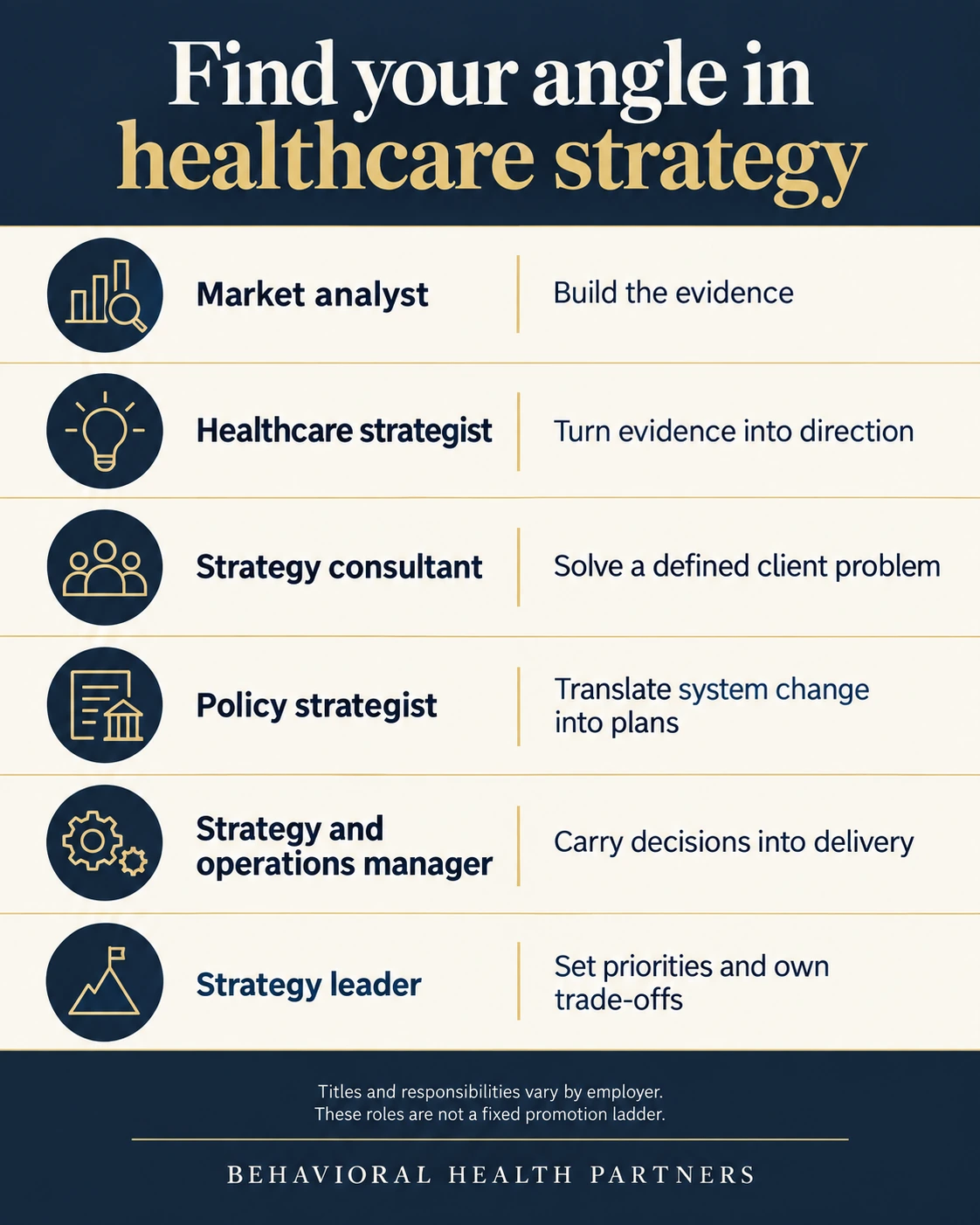
This field is not one job; it is a family of roles at every level. The angle you choose shapes the skills you build and the path you take. Here are the most common positions, each of which can grow into a career of its own.
Healthcare Strategist
The core role. A healthcare strategist researches the market, tracks competitors and trends, and turns that analysis into recommendations leaders can act on. Healthcare strategists often sit inside a hospital or health system strategy department, supporting decisions on growth, service lines, and partnerships. It is a role built on curiosity, analysis, and clear communication.
Healthcare Strategy Consultant
A healthcare strategy consultant does similar work from the outside, advising multiple clients rather than one employer. Working at a consulting firm, a strategy consultant is brought in to solve a specific problem, size a market, or design a plan, then move to the next engagement. Consulting is fast-paced and varied, and it is one of the best ways to build broad expertise quickly.
Health Strategist and Health Policy Strategist
A health strategist often works at the intersection of care, population health, and policy. These professionals help organizations respond to regulation, payment reform, and public health priorities, translating complex policy into a practical plan. It is a strong fit for people who care about systems-level change.
Healthcare Market Analyst
A more analytics-focused role, the market analyst gathers and interprets data on markets, competitors, and demand. Strong with numbers and research, analysts give the strategy team the evidence its recommendations stand on, and the role is a common entry point into the field.
Strategy and Operations Manager
This role connects planning to execution. A strategy and operations manager makes sure the plan actually happens, coordinating project management, timelines, and the teams responsible for implementing change. It rewards people who like to develop ideas and then deliver them.
Director, Vice President, and C-Suite Strategy Roles
As you advance, these roles move from analysis to leadership. A director or vice president of strategy owns the direction of a whole organization, and at the top, C-suite healthcare executives set the vision the rest of the strategy team builds around. These are the senior positions the field points toward.
Across every role, the mission is the same: help the organization develop the right services, use its resources wisely, support its people, and improve access to patient care. These teams collaborate to weigh critical trade-offs, present clear plans, and create the innovation and best practices that shape the future. Healthcare executives count on that work, and a solid healthcare education, whether formal or earned on the job, plus a clear job description and healthy work life balance, helps professionals at all skill levels contribute through steady thought leadership and sharp insights. Great strategy teams and management teams share one habit: they support one another, keep sharpening their skills, and plan for the future of the organization, whether it is a hospital, an insurance company, or a growing practice.
Skills and Qualifications
The role rewards a specific mix of skills. On the technical side, you need strong analytical ability, comfort with data analytics, and financial literacy. Strategic planning, market research, and the ability to turn complex information into a clear plan are the daily work, and strong strategic planning is what separates a good analyst from a great one. Just as important are the human skills: communication, collaboration, and the judgment to know which idea is worth pursuing.
Most of these roles start with at least a bachelor's degree in business, healthcare administration, public health, or a related field, and many senior roles favor a master's such as an MBA or MHA. A deep understanding of the healthcare industry, how care is delivered, paid for, and regulated, is what separates a strong strategist from a generic one. That knowledge and expertise can be built through hands on experience, and it compounds over an entire career.
The field attracts professionals at all skill levels, from analysts building their first models to seasoned leaders. The strongest professionals pair technical skills, financial modeling and market research, with the soft skills to present a clear recommendation to a room of executives. Day to day, the work blends research and analysis to surface insights, collaboration with colleagues across the organization, and the focus to turn a pile of information into a few practical solutions. Great strategists create clarity, contribute to the decisions that matter, and develop best practices the whole team can rely on. It is critical, high-impact work that rewards people who keep learning and support the professionals around them.
This work is open to people of every background, regardless of gender identity, sexual orientation, or national origin. What matters most is the ability to think clearly, work with people, and help an organization move forward.
Salary and Career Outlook
These jobs pay well, and demand is strong. The exact figure depends on the role, the employer, and your experience, but the trend is clearly up.
Medical and health services managers, the category that captures many healthcare management and leadership positions, earned a median of 117,960 dollars a year in 2024, and the Bureau of Labor Statistics projects 23 percent job growth from 2024 to 2034, far faster than average. Management analysts, the category that includes strategy consultants, earned a median of 101,190 dollars in 2024, with 9 percent projected growth. At the top, chief executives earned a median of 206,420 dollars in May 2024. This is a field in high demand, with a clear ladder from analyst to executive.
How to Land a Healthcare Strategy Job
Breaking into the field takes preparation, not luck. A few steps make the difference.
Tailor your resume and cover letter to each role, using the language of strategy and the specific healthcare organization you are applying to. Generic applications get lost; a focused one that shows you understand the employer's market stands out in any application process.
Build relevant experience wherever you can. Analyst roles, internships, consulting projects, and even strategy work inside a clinical or operations job all count. Hands on experience with real healthcare problems and real decisions is what hiring managers look for.
Grow your healthcare network. Many roles are filled through relationships, so attend networking events, connect with people already in the field, and stay visible. Then prepare for the interview by learning the organization's strategy, its market, and the challenges it faces, so you can speak to them directly.
Where to Find Healthcare Strategy Jobs
These roles are hiring across the whole industry. Knowing where to look focuses your search.
Major health systems and hospitals employ large internal strategy teams and are among the biggest employers of healthcare strategists. Their strategy and management departments hire steadily.
Health insurance companies are among the largest employers of strategy professionals. Payers hire strategists to shape insurance products, provider networks, pricing, and value-based programs, and to plan how the company competes as insurance markets shift. Because so much of healthcare is paid for through insurance, insurance knowledge is prized across every role: a professional who understands how insurance reimbursement, insurance networks, and insurance regulation work brings insight others lack. Even outside an insurance company, strategy and management teams spend much of their time on questions that trace back to insurance and coverage. If you can learn the insurance side of healthcare, you make yourself valuable to almost any employer.
Consulting firms, from global names to boutique healthcare specialists, hire consultants at every level, and management consulting is a classic launchpad. Health technology companies and insurance-focused firms need professionals who understand care, software, and the way insurance shapes healthcare services and their employees. And growing behavioral health organizations, like the ones we help build, increasingly need strategy and management talent of their own.
Use general online job platforms alongside healthcare-specific job boards, and do not overlook the strategy department pages of organizations you admire. The right role is often posted where the most motivated candidates are already looking.
Growing Your Healthcare Strategy Career
Landing the first role is the start, not the finish. The strongest careers are built on continuous learning. Stay on top of industry trends, including the shifts we track in our guide to mental health industry trends, and keep building the skills that matter, from analysis to the value-based contracting models reshaping how care is paid for.
The best professionals never stop building skills. They deepen technical skills and people skills alike, take on more responsibility, and look for a position with room to grow. Employers reward that: strong management and strategy teams promote from within, and the professionals who develop new services, support their colleagues, and shape the future of the organization are the ones who rise. Whether your focus is a health system, an insurance company, a consulting firm, or a health technology employer, the habits that carry a career are the same.
Invest in professional development and professional growth deliberately, and treat professional development as a lifelong habit. Pursue certifications, expand your professional network, and look for chances to lead. Building a reputation through thought leadership, whether by speaking, writing, or simply being the person who sees around corners, opens doors that job boards never will. Over time, that steady investment is what carries a strategist from a first analyst role to the executive suite.
Healthcare Strategy in Behavioral Health
Behavioral health is one of the most dynamic corners of the healthcare industry, and it needs strategy talent as much as any hospital system. Programs are growing, payment is shifting toward value, and technology is changing how care is delivered. The organizations that win are the ones that plan ahead, which is exactly the work our team does when we help operators open and scale a treatment center.
A healthcare strategist researches the market, analyzes data, and builds the plans that guide a healthcare organization's growth and direction. The work includes tracking competitors and trends, evaluating opportunities like new service lines or partnerships, and turning that analysis into clear recommendations for leaders. Strategists sit at the crossroads of business and care.
How much do healthcare strategists get paid?
Pay varies by role and experience, but healthcare management and strategy are well compensated. Medical and health services managers earned a median of about 117,960 dollars in 2024, strategy consultants (management analysts) about 101,190 dollars, and chief executives about 206,420 dollars. Salaries rise steadily as you move from analyst to manager to executive.
What does a healthcare strategy consultant do?
A healthcare strategy consultant advises healthcare organizations from the outside, usually through a consulting firm. Consultants are brought in to solve a defined problem, size a market, or design a growth plan, then move to the next engagement. It is a fast-paced role that builds broad expertise across many clients and healthcare settings quickly.
How do you become a healthcare strategist?
Most healthcare strategists start with a bachelor's degree in business, healthcare administration, or public health, and many add a master's like an MBA or MHA. From there, build relevant experience in analyst, consulting, or operations roles, develop strong data and communication skills, grow your network, and deepen your understanding of the healthcare industry. Continuous learning does the rest.
Build Your Future in Healthcare Strategy
Healthcare strategy jobs sit at the center of one of the most important industries there is, with strong pay, real growth, and the chance to shape how care is delivered. Whether you start as an analyst or step in as a consultant, the field rewards curiosity, analytical skill, and a genuine understanding of healthcare.
If you lead a behavioral health organization and need strategy expertise to plan your next move, reach out to work with us and we will help you turn strategy into results.
Adam Vibe GuntonFounder and Managing Partner, Behavioral Health Partners
Adam Vibe Gunton is an addiction recovery expert, entrepreneur, marketer, brand strategist, and speaker dedicated to advancing the behavioral health industry. As Founder and Managing Partner of Behavioral Health Partners, he has worked across treatment-center development, operations, branding, PR, SEO, advertising, and growth strategy. Combining professional experience with his own lived experience in recovery, Adam brings a unique perspective on how treatment organizations can build trusted brands, reach more people, and create a greater impact.
Thirty minutes on video with Adam directly, camera on, screen-sharing your own online presence and your top three local competitors. If we are not the right partner, we will tell you that too.