
Patient Brokering: What It Is, Why It Is Illegal, and How to Keep Your Center Clean

Patient brokering is the buying and selling of people who are seeking addiction treatment. A broker finds someone with an insurance card, delivers that person to a treatment facility, and collects a referral fee for the head. It is a federal crime, a felony in Florida and a growing list of other states, and the single most corrosive practice in the substance use disorder treatment industry. In South Florida and Southern California it is better known as body brokering, and the name fits.
Behavioral Health Partners builds, launches, and scales addiction treatment centers, and we will not touch a brokered patient. Not one. The only addiction treatment marketing we run is the kind that makes a frightened family call you directly, because they found you, trusted you, and chose you. This guide explains how patient brokering schemes work, what the law does to the people who run them, the warning signs families should watch for, and how a treatment center keeps its admissions pipeline clean from day one. For the legitimate version of filling beds, watch How to Generate Drug Rehab Leads: 9 Marketing Channels Every Treatment Center Needs.
What Is Patient Brokering?
Patient brokering is any arrangement where someone offers, pays, solicits, or receives anything of value in exchange for referring a patient to a substance use treatment program, a sober living home, or a laboratory. The payment can be cash, a plane ticket, free rent, waived copays, gift cards, or drugs. The form does not matter. What matters is that a person's clinical needs were never the reason for the referral. The insurance payout was.
Legitimate referrals exist everywhere in healthcare. A primary care doctor sends a patient to a cardiologist. An emergency room refers someone to a detox. Nobody writes a check for the referral, and the patient goes where the clinical assessment says they should go. Patient brokering replaces that clinical judgment with a financial incentive, and vulnerable patients become inventory.
What Is Body Brokering, and What Is a Body Broker?
Body brokering is the same illegal practice under a blunter name. The term "body broker" came out of South Florida and Southern California, where recruiters hung around 12-step meetings, detox parking lots, coffee shop patios, and sober homes looking for people with good health insurance. A body broker is the recruiter: sometimes an independent operator, sometimes a marketer on a drug treatment center's payroll, and sometimes a sober home owner who steers residents to the facility that pays him. In the research literature and in court documents the two terms are used interchangeably, and in this post we use them the same way.
Patient Brokering vs. a Legitimate Referral
The cleanest test is to ask one question: would this referral happen if no money changed hands? A warm handoff between a detox and the inpatient program down the road, built on outcomes and trust, passes. A $3,000 "placement fee" per admission does not. Real rehab lead generation earns the call with search visibility, reputation, and content, and your admissions funnel then qualifies the caller against your levels of care. A broker skips all of that and sells the person to whichever program bids highest. Referring patients to the right level of care is a clinical decision. Selling them to the highest bidder is a crime.
How Patient Brokering Schemes Work
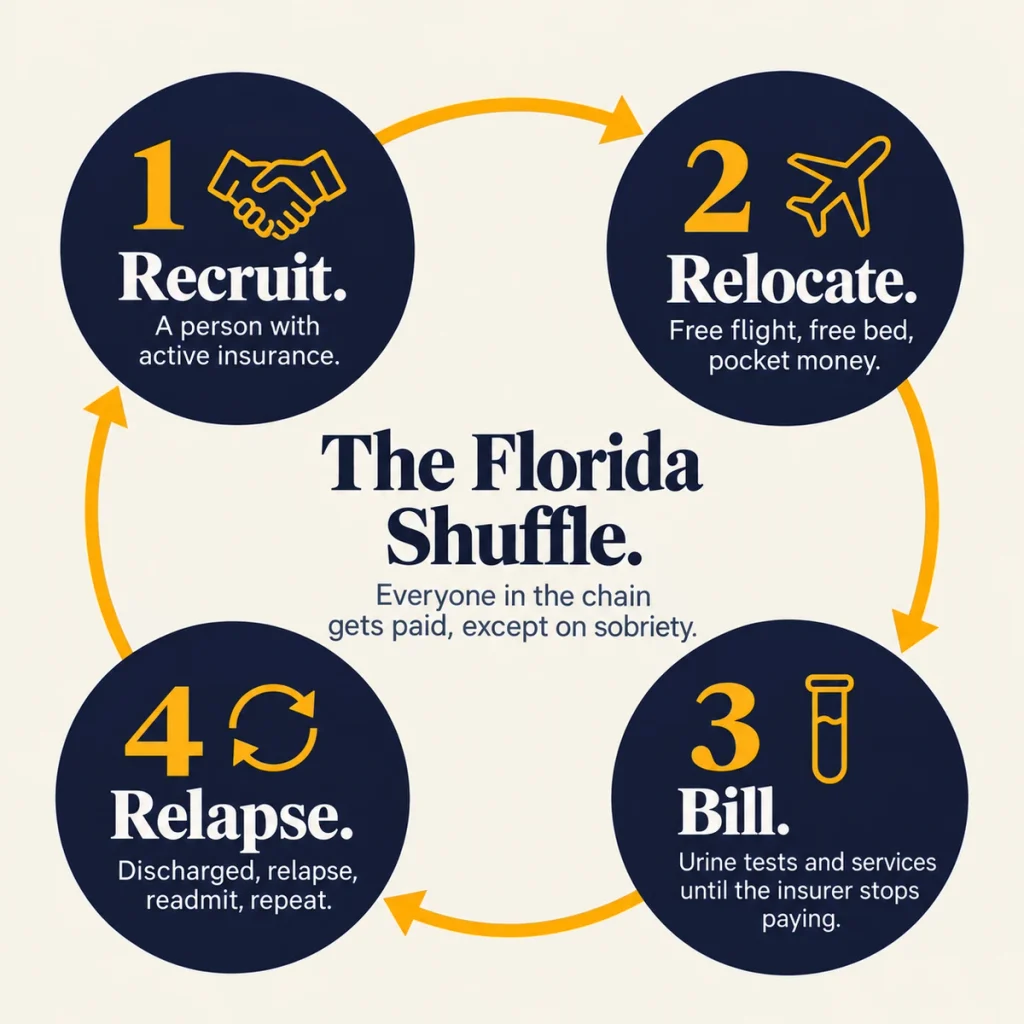
Every body brokering scheme runs on the same engine: a vulnerable person, an active insurance policy, and a chain of providers who each take a cut. Here is the cycle prosecutors in Palm Beach County named "the Florida shuffle" when they testified before Congress in 2017.
Step 1: Recruit Vulnerable People With Good Insurance
Brokers target vulnerable individuals with high-end commercial insurance, often young adults still covered under a parent's plan under the Affordable Care Act rule that keeps children on a parent's policy until age 26. They recruit individuals struggling with substance use at meetings, outside other programs, on social media, and through "free treatment" call centers. Some brokers even buy the insurance policy for the person first, because the premium is small next to the insurance claims the policy will generate.
Step 2: Free Flights, Cash Kickbacks, and a Free Bed
In the body brokering economy the pitch is sunshine and a fresh start: a free plane ticket to Florida or California, a free bed in a sober home, pocket money, cigarettes, movie tickets, and no copay. In the peer-reviewed study of for-profit substance use disorder treatment published in BMC Health Services Research in 2023, 7 of 10 out-of-state participants had their flights paid for or booked by a treatment center or broker, and one participant reported being offered $4,000 to attend treatment for 20 days.
Step 3: Bill the Insurance Company Until It Stops Paying
Once the person is admitted, the fraudulent billing starts: daily urine drug tests billed at thousands of dollars each, duplicate services, treatment services that were never delivered. The sober home collects illegal kickbacks from the outpatient program, the outpatient program gets a kickback from the lab, and the broker gets paid at every handoff. When the insurance company stops paying, the person is discharged, frequently onto the street in a state where they know no one.
Step 4: The Relapse Loop, Where Drug Use Restarts the Billing
Here is the part that kills people. A broker is paid once for a person who gets well and paid again every time that person relapses and re-enters treatment. So brokers encourage drug use before admission to meet an insurance company's medical necessity rules, and some supply the drugs themselves. Treatment centers that run on brokered admissions may overlook relapses because a relapse restarts the billing cycle. State Attorney Dave Aronberg put it plainly in the congressional hearing: everyone in the chain makes money except on sobriety, which makes it a relapse model, not a recovery model.
Here is who gets paid in a body brokering operation, and who pays for it:
| Who gets paid | For what | Who pays |
|---|---|---|
| Body broker | Delivering a person with active insurance coverage | The treatment facility |
| Sober home operator | Steering residents into a specific outpatient program | The treatment program |
| Treatment facility | Admissions, often with excessive drug testing and unnecessary services | The health insurance plan |
| Laboratory | Urine drug tests billed at thousands of dollars per test | The health insurance plan |
| The person seeking treatment | A free flight, free rent, cash, or drugs. Not genuine recovery. | Their own health, and sometimes their life |
Why Body Brokering Is So Dangerous
Substandard Care, and Treatment for Survival Instead of Recovery
When the admission is the product, effective treatment is optional. Unethical treatment facilities that depend on brokered admissions get paid the same whether or not anyone recovers. The BMC study found that financial incentives compromise the integrity of the treatment process, that brokered programs deliver lower quality care, and that some participants attended treatment for money and housing rather than to stop using. People who were offered cash to attend treatment described taking it because they were unhoused and broke. That is not a choice. That is exploitation of vulnerable populations dressed up as patient care, and the vulnerable patients inside those programs often did not know a legitimate alternative existed.
Overdose Risk After Periods of Abstinence
The study's professionals and participants linked body brokering directly to overdose deaths. A person who has been abstinent in treatment loses tolerance. A broker who pulls that person out, puts them in a motel, and hands them opioids so they will test positive for a new admission has created the exact conditions for a fatal overdose. Several participants described peers who died this way. The Massachusetts Attorney General's office told Congress about young people lured out of state by paid recruiters who found no real treatment on arrival, and some of them died of overdoses far from home.
Co-Occurring Mental Health Needs Go Untreated
Many people who enter addiction treatment also need mental health care, and a legitimate clinical assessment screens for it before the first group session. Brokered programs rarely bother. The billing engine runs on urine tests, not psychiatry, so a person who needs trauma therapy or medication assisted treatment for a substance use disorder gets a cup and a group schedule instead. Participants in the BMC study described programs that offered housing and testing and little else. When the mental health piece is ignored, the relapse that follows is not a failure of the model. It is the model.
What It Does to the Treatment Industry
Body brokering distorts medical ethics, undermines the trust between a patient and provider, and erodes public trust in every rehab center and mental health program that does the work right. Every link in the chain is prioritizing profit over people, and the insurance profits on a single admission are large enough to fund the next recruiter. It raises healthcare costs for everyone through unnecessary and ineffective medical treatment. It violates patient autonomy and informed consent, because a person who thinks they are calling a helpline is actually being auctioned to the highest bidder by a telemarketer paid on commission. And it makes it harder for people seeking addiction treatment to find the long term recovery they came for, because the first three results they call may all route to the same call center.
Patient Brokering Laws: What Federal Law Says
Patient brokering in substance use disorder treatment is considered health care fraud under federal law, and there are two statutes that reach it directly, plus a third enforcement lane that has produced the biggest convictions.
The Anti-Kickback Statute
The federal Anti-Kickback Statute makes it a crime to knowingly and willfully offer, pay, solicit, or receive remuneration to induce patient referrals for anything paid by a federal health care program such as Medicare or Medicaid. It covers both sides of the illegal kickbacks, the payer and the payee, and the government does not need to prove the patient was harmed. Its limit, for years, was that it only reached federal programs. The Florida shuffle ran mostly on private health insurance, which is exactly the gap Palm Beach prosecutors asked Congress to close in 2017.
EKRA: The Eliminating Kickbacks in Recovery Act of 2018
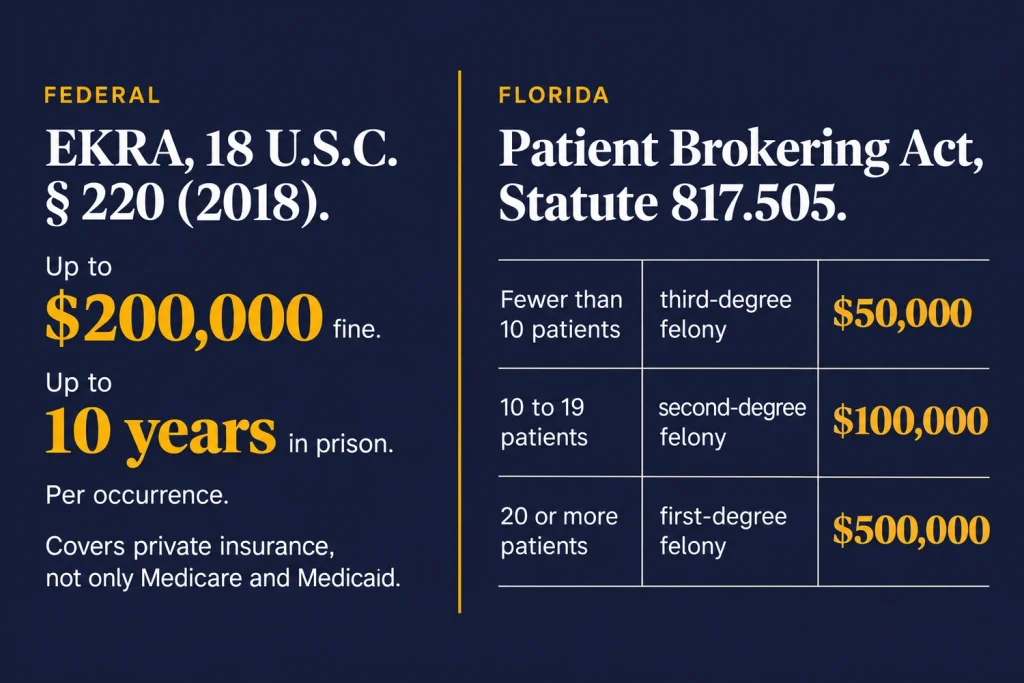
Congress closed that gap with the Eliminating Kickbacks in Recovery Act, enacted in October 2018 and codified at 18 U.S.C. § 220. EKRA covers services paid by any health care benefit program, private insurance included, and it names the three businesses at the center of body brokering: recovery homes, clinical treatment facilities, and laboratories. Each violation carries a fine of up to $200,000, up to 10 years in prison, or both, per occurrence.
EKRA also answers the question every treatment center owner should be asking about their own marketing team. The statute exempts bona fide employees and contractors only when their pay does not vary with the number of individuals referred, the number of tests performed, or the amount billed. Pay a marketer a salary for marketing work and you are inside the exception. Pay a marketer per head and you are not, no matter what the job title says.
Health Care Fraud Enforcement: The Sober Homes Initiative
The Department of Justice's 2020 national health care fraud takedown charged 345 defendants with more than $6 billion in alleged losses, including more than $845 million connected to substance abuse treatment facilities and sober homes. That same month the Department launched the Sober Homes Initiative, the first coordinated federal enforcement effort aimed at the treatment industry. By January 2023 it had produced charges or convictions against 28 defendants tied to over $1 billion in alleged false billings, including a Palm Beach County physician sentenced to 20 years after serving as medical director for more than 50 sober homes, treatment facilities, and labs that billed health care benefit programs over $746 million for medically unnecessary urine tests and addiction treatments.
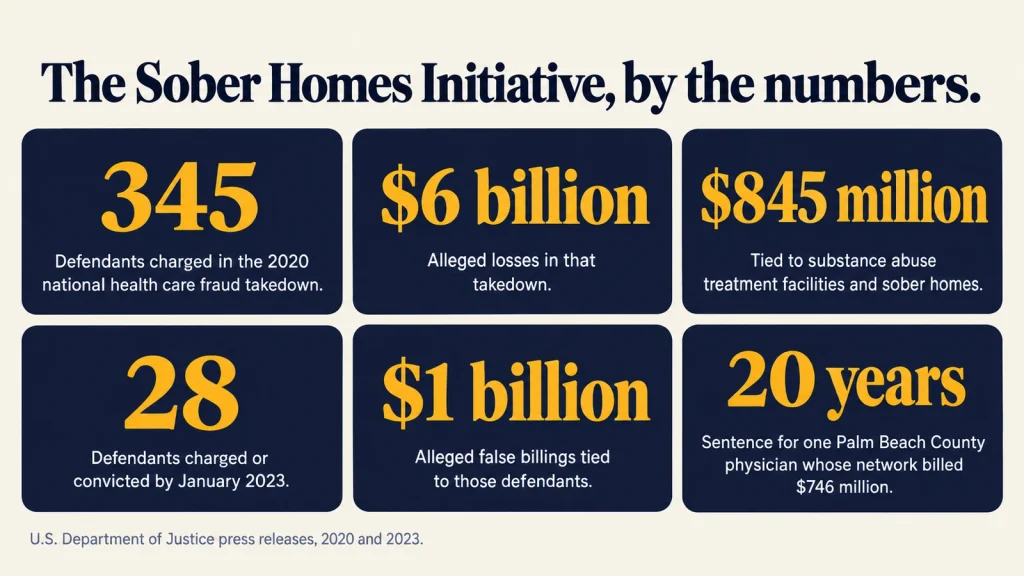
Those are not hundreds of thousands. Those are hundreds of millions, and the cases against treatment centers keep coming.
The Florida Patient Brokering Act and Other State Laws
Florida wrote the model statute because Florida had the model problem. The state's warm climate and decades-old drug treatment economy made it a destination, and by 2017 prosecutors estimated that 75 percent of private-pay rehab patients in Florida came from out of state.
What the Florida Patient Brokering Act Prohibits
The Florida Patient Brokering Act, Florida Statute 817.505, makes it unlawful for any person, including any health care provider or facility, to offer or pay any commission, bonus, rebate, kickback, or bribe, in cash or in kind, to induce a patient referral, or to solicit or receive one in return for a referral. It also criminalizes aiding, abetting, or advising the conduct, and, after the 2017 reforms, paying or receiving anything of value in return for a patient accepting or acknowledging treatment. Penalties scale with the number of patients involved:
| Patients involved | Felony degree | Mandatory fine |
|---|---|---|
| Fewer than 10 | Third degree | $50,000 |
| 10 to 19 | Second degree | $100,000 |
| 20 or more | First degree | $500,000 |
The Attorney General or a state attorney can also seek injunctions, and penalties can be imposed on both the business entity and the individual.
Florida's Deceptive Marketing Law
Florida paired the brokering statute with Florida Statute 397.55, which prohibits a provider, a recovery residence operator, or any third-party marketer from making false or misleading statements, from planting deceptive links or code on a website, and from contracting with a call center or web-based lead generator unless the prospective patient is told which licensed providers pay that marketer. The law exists because so much brokering happens at the first phone call, when potential clients believe they are talking to a clinician and are actually talking to a marketer paid on commission.
Other States With Patient Brokering Laws
Florida is not alone. New York made it illegal to profit from referring patients to addiction treatment in 2018 and runs a state hotline for reporting brokers. North Carolina made patient brokering a felony in 2023. West Virginia passed its own Patient Brokering Act in 2024. Other states cover the same conduct through all-payer anti kickback laws that apply to commercial insurance, not only to Medicaid. Body brokering followed the insurance money across state lines, and the laws followed it. If you operate in more than one state, assume the strictest state law applies to every referral relationship you have.
Warning Signs of Patient Brokering
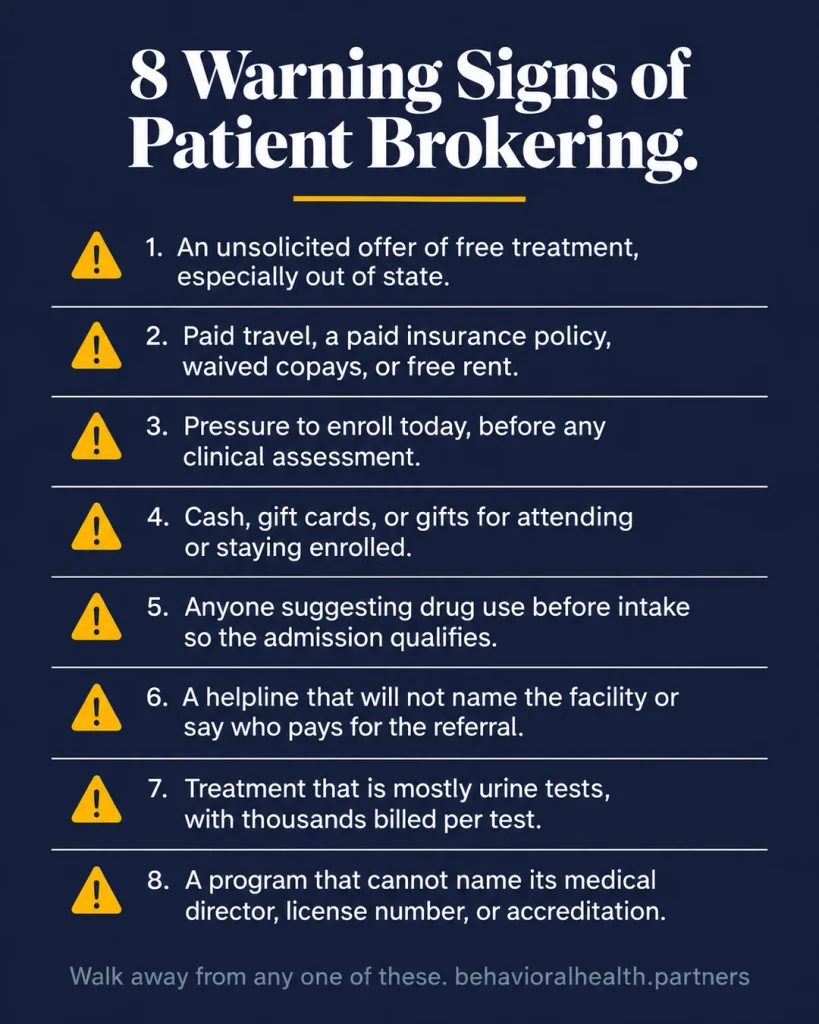
Body brokering has a recognizable pitch. Families and people seeking addiction treatment should walk away from any of the following:
- An unsolicited call, text, or social media message, or a stranger at a coffee shop or a meeting, offering free treatment, especially out of state.
- A recruiter who offers to pay for travel, pay for an insurance policy, waive every copay, or cover rent at a sober home.
- Pressure to enroll today, before any clinical assessment and before anyone has asked what level of care the person needs.
- Cash, gift cards, or other gifts offered for attending treatment or for staying enrolled.
- Anyone who suggests using drugs before intake so the admission "qualifies."
- A "helpline" that will not tell you the name of the treatment facility you are being sent to, or whether it is paid for the referral.
- Treatment that consists mostly of urine tests, with explanation of benefits statements showing thousands of dollars billed for tests nobody discussed.
- A rehab center that cannot name its medical director, its state license number, or its accreditation.
One more sign a family member can miss: the person struggling with substance use may not see themselves as a victim. The free flight, the free rent, and the friends in the sober home feel like help. A parent of a young adult who struggled socially before treatment may hear, "Why would I leave? I have everything I need here." That sentence is the scheme working as designed.
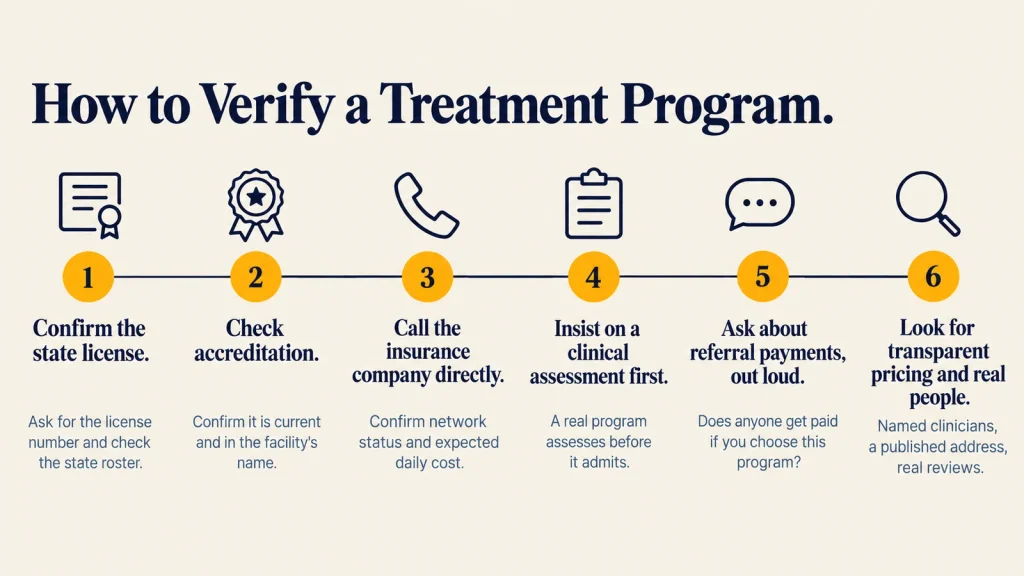
How to Verify a Treatment Program: License, Accreditation, and Clinical Assessment
Legitimate drug treatment looks like healthcare. Verify it the way you would verify a surgeon for a family member.
- Confirm the state license. Every clinical treatment facility is licensed by a state agency, and state licensing boards publish their rosters. Our state licensing team has walked centers through that process in more than 20 states, and a rehab center that cannot produce a license number is not a rehab center.
- Check accreditation. Accreditation is a floor, not a ceiling, but it is a real floor. Learn what the Joint Commission actually reviews at addiction treatment programs, and confirm the accreditation is current and in the facility's name.
- Call the insurance company directly. Confirm in-network status, ask what a day of treatment at that facility is expected to cost, and ask whether the plan has flagged the provider.
- Insist on a clinical assessment first. A real program assesses before it admits, and it tells you plainly if a different level of care, or a different program, is the better fit.
- Ask about referral relationships, out loud. "Does anyone receive payment if I choose your program?" An ethical admissions team will answer in one sentence.
- Look for transparent pricing and real people. Named clinicians, a published address, clear program descriptions, and reviews that read like families wrote them. Thread counts, yoga, and "scholarships" are not treatment options.
How Addiction Treatment Centers Keep the Admissions Pipeline Clean
Most owners who end up in a body brokering scheme did not set out to break the law. They hired a marketer who "had relationships," paid per admission because it felt like a safe way to control cost, and never asked where the calls came from. Here is how we keep our partners out of that trap.
Pay for Work, Never for Heads
Pay salaries and flat fees. Never pay a bonus or a commission tied to admissions, census, or billed revenue, whether the person is a W-2 employee, a contractor, an outreach rep, or a sober home operator. This is the single clearest line in EKRA and in state law, and it is the first thing a prosecutor will pull from your payroll records.
Build a Compliance Program and Use It
A proactive compliance program is the strongest defense available. Document every referral source. Review contracts with any marketing vendor for per-lead or per-admission pricing. Train your admissions team to ask every caller how they found you and to refuse any caller who was promised money or travel. Audit your drug testing frequency against medical necessity. Keep a written anti-kickback policy that your medical director, your marketer, and your sober living partners all sign. The National Association of Addiction Treatment Providers prohibits payment for referrals in its Code of Ethics, and it names call aggregation and lead sales as the forms body brokering takes online. NAATP members are required to adhere to the code's ethical practices as a condition of membership.
Own Your Demand Instead of Renting It
Addiction treatment centers that own their demand never need a broker. Organic search is where families start, and drug rehab SEO builds the topical authority and local signals that put your program in front of them first, on your own domain, under your own name. Families now also ask ChatGPT, Claude, Gemini, Perplexity, and Google AI Overviews which center to call, and generative engine optimization is how a legitimate center shows up in those answers. Both compound. A purchased lead is gone the moment it is used.
Your website has to close what search opens. Rehab website design that answers a family's two questions in the first screen, do you have what I need and can I trust you, converts the calls you earned. If traffic arrives and the phone stays quiet, the fix is conversion rate optimization, not a broker. And the trust signals that beat a recruiter's sales pitch are the ones you can only earn: named clinicians, a real addiction treatment branding system, and client testimonials for drug treatment recorded with consent, long after discharge.
Follow Google's Rule for Rehab Ads
Google restricted addiction treatment advertising in 2018 and requires United States advertisers to hold LegitScript certification before running ads. Lead generators, referral agencies, and sober homes are not eligible, which removed the broker's favorite storefront overnight. If you want paid search to bridge the gap while organic grows, drug rehab PPC starts with your own certification, in your own account, with your own phone number on the ad. Our guide on how to get LegitScript certified walks through the application.
Track Every Call to Its Source
If you cannot say where an admission came from, you cannot prove it was clean. Call tracking and a behavioral health CRM attribute every call, form, and text to the page, campaign, or referral partner that produced it. That record protects you in an audit, and it shows you which channels bring the right people for your levels of care. The affordable rehab marketing shortcuts that look cheapest, bought leads and shared call centers among them, are the ones that cost centers their license.
Start Compliant if You Are Still Building
If you are learning how to open a rehab center, the referral policy belongs in your business plan next to the proforma, not in a memo you write after the first subpoena. Our addiction treatment consulting team builds licensing, accreditation, and admissions policy together, so the center opens with a website already producing calls and no reason to buy a single one.
Where Behavioral Health Partners Stands on Insurance Fraud and Brokering
We say our refusals out loud. We refuse to work with anyone whose model involves insurance fraud, body brokering, or deceptive marketing. We refuse to sell what we cannot service, and we refuse to market something a center is not. We built treatment centers of our own and have helped dozens across the country open, grow, and scale, and every call those centers receive is a call a family placed on purpose. Ethical care starts before admission, with how the person found you.
That matters because the person on the other end of the line is the reason this company exists. Adam Vibe Gunton, our founder and Managing Partner, was once the person calling every treatment center he could find and getting turned away. He built Behavioral Health Partners so the next person who calls gets real treatment, not a finder's fee. Body brokering is the opposite of that, and no census number is worth it. If you are opening or growing a center and want a partner with skin in the game, see how we partner with treatment centers.
How to Report Patient Brokering
If you suspect body brokering, report it. Federal health care fraud can be reported to the Department of Health and Human Services Office of Inspector General and the FBI. In Florida, the Palm Beach County State Attorney's Sober Homes Task Force takes tips, and the state Department of Children and Families licenses substance use providers. New York runs a Stop Treatment Fraud hotline through its Office of Addiction Services and Supports. Your state's licensing agency and your insurance company's fraud unit will both take a complaint. Addiction treatment professionals can also file an ethics complaint with NAATP against a member program. The BMC study's authors concluded that normalizing the reporting of unethical practices is one of the most effective ways to curb patient brokering, and that only happens if people who see it say something.
Frequently Asked Questions About Patient Brokering
Which activity is specifically prohibited under patient brokering laws?
Patient brokering laws prohibit offering, paying, soliciting, or receiving anything of value, including cash kickbacks, commissions, split fees, free housing, or travel, in exchange for referring a patient to a treatment provider, a sober living home, or a laboratory. Florida's statute also prohibits paying a patient to accept treatment and prohibits aiding or advising the scheme, and EKRA reaches referrals paid by private insurance as well as federal programs.
What does brokering mean in addiction treatment?
Brokering, or body brokering, means acting as a paid middleman between a person seeking addiction treatment and the treatment facility that admits them. The broker is compensated per referral rather than for any clinical or marketing work, which creates a direct conflict between the broker's income and the patient's clinical needs. Ethical referrals are based on an assessment and are never paid for.
Is patient brokering a federal crime?
Yes. Since October 2018 the Eliminating Kickbacks in Recovery Act has made patient brokering a federal felony, punishable by up to 10 years in prison and a $200,000 fine for each occurrence, for referrals to recovery homes, clinical treatment facilities, and labs paid by any health care benefit program. Kickbacks involving Medicare or Medicaid were already illegal under the federal Anti-Kickback Statute, and prosecutors also charge healthcare fraud and wire fraud when the billing behind the scheme is false.
What is the Florida Patient Brokering Act?
The Florida Patient Brokering Act, Florida Statute 817.505, is the state law that criminalizes paying or receiving commissions, bonuses, rebates, or kickbacks for patient referrals to or from a health care provider or facility. Violations are third-degree felonies with a $50,000 fine, rising to a first-degree felony with a $500,000 fine when 20 or more patients are involved. Florida strengthened the law in 2017 after a Palm Beach County grand jury investigation.
What is the Body Brokers movie about?
Body Brokers is a 2021 crime drama written and directed by John Swab that dramatizes the body brokering scheme described in this post: a young man is recruited into treatment in Southern California and discovers the people who helped him are paid per admission and profit from relapse. The film is fiction based on real cases, and the practices it portrays match what prosecutors, researchers, and families have documented.
Why is it so hard to get into a legitimate rehab center when brokers make it look easy?
Legitimate drug treatment centers verify insurance coverage, run a clinical assessment, and admit only to a level of care the person actually needs, which takes time and sometimes ends in a referral elsewhere. Brokers skip every one of those steps because the admission, not the outcome, is what they are paid for. The friction is the sign that a program is real.
Fill Beds the Way Families Deserve
Body brokering is a business model built on relapse. The centers that outlast it are the ones families can find, trust, and call directly, and those are the only centers we will help build. Thirty minutes with Adam, a live look at your current online presence and your top three local competitors, and a plain answer about whether we are the right partner.

Adam Vibe Gunton is an addiction recovery expert, entrepreneur, marketer, brand strategist, and speaker dedicated to advancing the behavioral health industry. As Founder and Managing Partner of Behavioral Health Partners, he has worked across treatment-center development, operations, branding, PR, SEO, advertising, and growth strategy. Combining professional experience with his own lived experience in recovery, Adam brings a unique perspective on how treatment organizations can build trusted brands, reach more people, and create a greater impact.
More about Adam

One Conversation. No Pitch.
Schedule Your Free Discovery Call
Thirty minutes on video with Adam directly, camera on, screen-sharing your own online presence and your top three local competitors. If we are not the right partner, we will tell you that too.
Schedule Your Free Initial ConsultWe take one client per level of care, per market. We confirm your market is open before partnering with you.