Written from running a nonprofit that reached as many as 50 million people in a single month, without a national ad budget. We cover what nonprofit marketing is and how it differs from for-profit work, and exactly how that reach happened. We cover building the plan first, nine strategies that move the needle, the analytics that matter, low-budget approaches, and when to hire an agency.
Our nonprofit has reached as many as 50 million people in a single month. Not with a national ad budget: with stories, search, and a marketing plan we ran ourselves. We are Behavioral Health Partners, the team behind addiction treatment marketing for treatment centers across the country, and Recovered On Purpose is the nonprofit our founder built to help people in recovery share their stories. This is the complete nonprofit marketing guide we wish someone had handed us at the start: every strategy laid out so you can do it yourself, with honest notes on where an agency actually helps.
One belief drives this whole guide: your mission deserves marketing strategies as good as any for profit company buys, and most of them cost you time, not money.
Key Takeaways: Nonprofit Marketing That Works
The key takeaways nonprofit marketing teams need before we go deep: your marketing plan matters more than any single tactic; storytelling is your unfair advantage; the Google Ad Grant gives you $10,000 in free search ads every month; email is the channel you own; and everything gets measured, because donors trust what you can prove. Nonprofit marketing is not for profit marketing with a smaller budget. It is a different discipline with different rules, and this complete guide covers the marketing strategies, the plan, and the measurement that make a nonprofit marketing strategy actually produce.
What Is Nonprofit Marketing, and How Is It Different From For Profit Marketing?
Nonprofit marketing is how an organization promotes its mission, attracts donors and volunteers, and moves people to act. A for profit company markets to convert buyers; a nonprofit markets to convert believers. That difference changes everything downstream: your target audience includes donors, volunteers, board members, program participants, and community partners all at once, and each group needs its own message.
The other difference is trust. People buy products on impulse; nobody gives to a cause on impulse twice. Successful nonprofit marketing builds proof of impact into every channel, because your supporters are not buying a thing, they are buying an outcome for someone else. Show the outcome and potential supporters lean in; hide it, even accidentally, and your marketing efforts stall no matter how loud they get. Donor relationships are built on demonstrated impact, and every piece of this guide serves that.
Nonprofit organizations also carry an advantage most companies would kill for: a mission people actually want to talk about. An environmental organization cleaning rivers, a food bank feeding families, a recovery nonprofit helping people rebuild their lives: these stories spread on their own when marketing gives them a push. Your job is the push: awareness campaigns that raise awareness and attract donors at the same time, without diluting the organization's mission.
How We Reached 50 Million People in One Month
Recovered On Purpose exists to help people in recovery share their stories and live with purpose. It was founded by Adam Vibe Gunton, a bestselling author, TEDx Speaker, and international recovery advocate featured on NBC News Daily, CBS News, and ABC News. Its marketing campaigns run on the same engine this guide teaches. In its biggest months, Recovered On Purpose has reached as many as 50 million people in a single month, and the playbook was nothing exotic: real stories from real people, published consistently, optimized for search and social, and amplified by the community they were written for.
We are telling you this for one reason: the strategies in this guide are the exact strategies we use, both for the nonprofit and for the treatment centers we market. They work with a marketing budget of almost nothing. They work better with discipline than with dollars. And every one of them is something your team can start this month.
Build Your Nonprofit Marketing Plan First
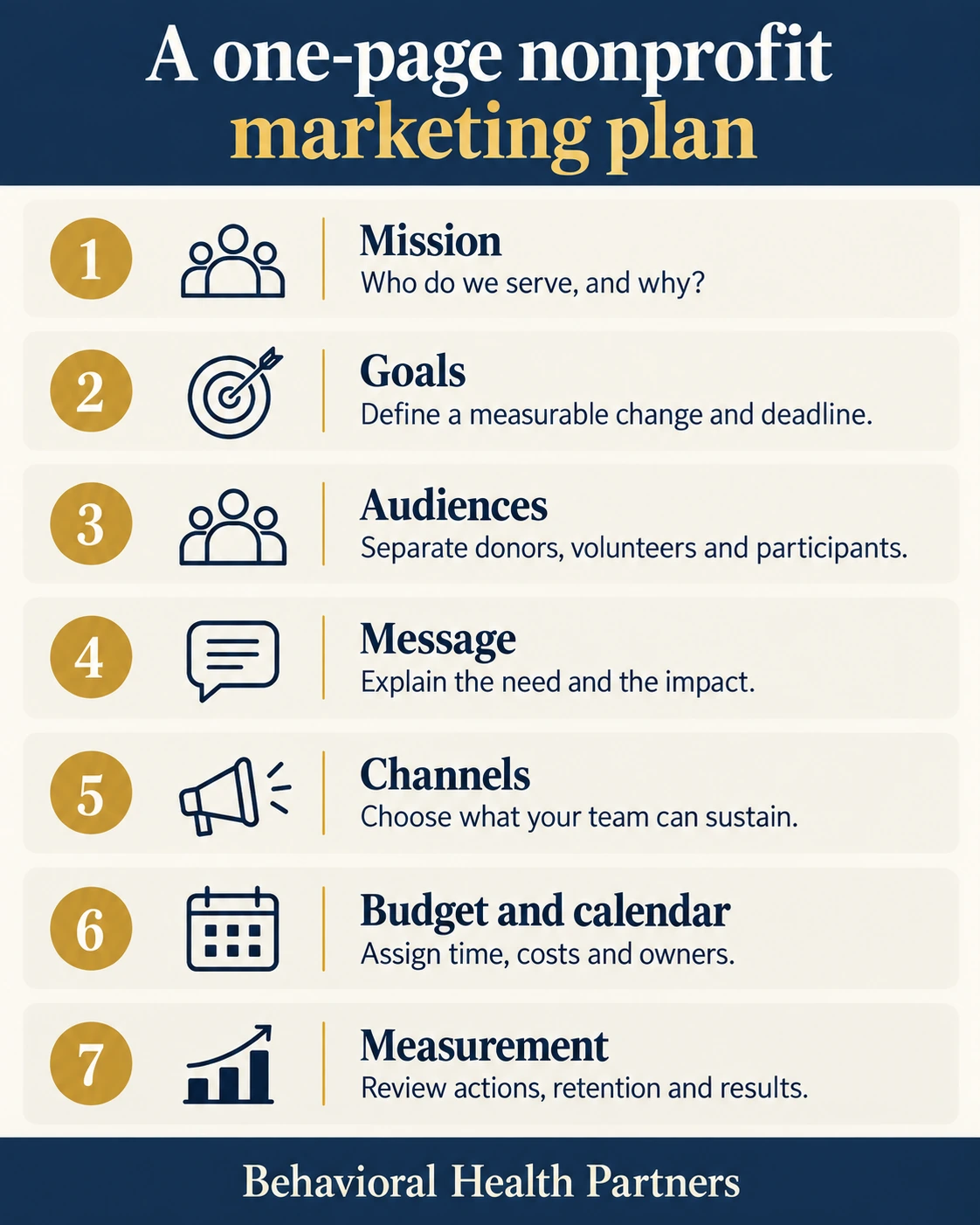
Tactics without a marketing plan burn volunteers and money, and no nonprofit marketing strategy survives without one. A strong nonprofit marketing plan fits on one page, and we built a free fillable One-Page Nonprofit Marketing Plan you can download with this guide to work through as you read. Here is what goes in it.
Step 1: Start With the Mission and Your Marketing Goals
Write your nonprofit's mission at the top of the page, in the exact words you want the public to repeat. Every campaign gets tested against it. Then set marketing goals the SMART way: specific, measurable, achievable, relevant, and time-bound. "Raise awareness" is a wish; "grow our email list from 800 to 2,000 subscribers by June" is one of your nonprofit marketing goals. Most organizations need one goal in each of three buckets: awareness, raising funds, and volunteer support, because a nonprofit's success is measured across all three.
Step 2: Define Your Target Audience and Segments
You cannot message everyone the same way, and segmenting your audience is the single fastest upgrade to any nonprofit marketing strategy. At minimum, separate donors from volunteers from program participants, then split donors again: new donors, existing donors giving monthly, major donors, and lapsed supporters you want back. Each segment gets messaging built around that audience's interests, not your org chart, and every segment holds potential supporters at different stages of trust. When a message matches the reader, response rates climb; nonprofit platforms consistently report double-digit lifts in donor engagement from personalization alone, with some studies showing retention gains around 20 percent.
Step 3: Craft the Core Message
One sentence: who you serve, what changes because of you, and why it matters now. This is the sentence your board members repeat at dinner parties and your volunteers put in their bios. Write it once, use it everywhere, and let every campaign carry a version of it. Consistency is what turns marketing materials into a brand identity, and it is how potential donors learn to recognize the organization's work at a glance.
Step 4: Choose Your Marketing Channels
Pick three marketing channels you can run well before adding a fourth; scattered marketing efforts across every channel is the most common mistake in the nonprofit sector after having no plan at all. For almost every nonprofit the first three are the website, email, and one social platform where your target audience already spends time. Direct mail, events, PR, and digital advertising come next. Multiple channels matter eventually; mastered marketing channels matter first.
Step 5: Set the Marketing Budget and the Calendar
Even a volunteer-run organization needs a real marketing budget line, if only for tools and boosted posts on social media platforms. Map the year: giving season, awareness months tied to your cause, fundraising events, and program milestones. A simple content calendar keeps your marketing efforts steady when the team gets busy, and steady beats brilliant in this work.
Step 6: Measure With Key Performance Indicators
Decide upfront how you will know it worked. Website traffic, email open and click rates, donation conversion rate, volunteer sign-ups, and donor retention are the core key performance indicators. Track them monthly, compare against your marketing goals, and feed what you learn into future campaigns. The plan is a living document; review it quarterly and rewrite it annually.
The 9 Nonprofit Marketing Strategies That Move the Needle
These are the nonprofit marketing strategies we run ourselves, ordered roughly by return on effort, from storytelling through digital marketing strategies to partnerships. None of them require an agency. All of them reward doing the work properly.
1. Storytelling: Your Unfair Advantage
Stanford research from professor Jennifer Aaker found that stories are remembered up to 22 times more than facts alone. For a nonprofit, that is not a marketing tip; that is the whole game. Statistics inform, stories convert. The strongest nonprofit marketing campaigns pair one human story with one hard number: the person AND the proof. That pairing is what turns engaging content into commitment.
Recovered On Purpose is built entirely on this: people in recovery telling the truth about where they were and where they are now. Collect stories systematically from the people you serve, with written permission and real dignity, and pair each one with outcome data that shows the organization's work landing. This data-driven storytelling is also mission work in itself; our post on breaking the stigma of addiction shows how honest stories change public perception while they raise money, and our video on ending the mental health stigma makes the same case on camera. If your stories work on camera, our guide to video content ideas maps out every format worth filming, and our content strategy video shows how trust-first content outperforms clever content.
2. SEO: Own the Searches Your Mission Deserves
Search engine optimization is the most undervalued channel in the nonprofit sector, and it is our home turf: it is the same discipline behind drug rehab SEO for treatment centers. People search for exactly what nonprofits offer: help, resources, answers, local services. Rank for those searches and your nonprofit's online presence works every hour of every day at no cost per click.
Start simple. Write website content that answers the real questions your community types into Google; that is content marketing in its purest form. Build one great page per program. Keep titles clear, load speed fast, and every page pointed at one topic so you rise in the search engine results pages. Publish consistently and the compounding starts; that is how our biggest months happened. For the full method, our guide to behavioral health SEO walks through the exact process, and most of it applies to any cause.
3. The Google Ad Grant: $10,000 a Month, Free
Google gives eligible nonprofits $10,000 per month in free search ads through the Google Ad Grant. Most eligible organizations either do not know it exists or let it sit unused. Those search ads put your programs, donation pages, and volunteer applications in front of people actively searching, and the only cost is setup and upkeep.
The catch: the grant rewards well-run accounts. Keep campaigns tightly themed, point every ad at a specific page, and hold the account to Google's minimum performance standards or the online advertising credit gets throttled. If you already run paid media, the same discipline behind addiction treatment PPC applies here: search ads win on relevance, not budget.
4. Email Marketing: The Channel You Own
Your email list is the most valuable asset in nonprofit marketing, full stop. Social platforms change their algorithms; your list is yours. Email marketing turns one-time donors into monthly givers, fills fundraising events, and mobilizes volunteers in hours; a monthly giving program built through email is the steadiest funding base a nonprofit can own. Personalization does heavy lifting here too; campaigns with personalized content consistently outperform batch-and-blast, with reported open rate lifts near 29 percent.
Build the list at every touchpoint: website popups with a real reason to subscribe, event sign-ins, program enrollments. Send a consistent rhythm, monthly at minimum, mixing impact stories, needs, and wins. Ask clearly with one call to action per message, because a reader who never sees an ask never becomes one of your new donors, and existing donors want to see the mission moving too. Our full walkthrough on how to build an email list applies to nonprofits nearly verbatim, and this email list video covers the five tactics we see work fastest.
5. Social Media: Community First, Broadcasting Second
Social media works for nonprofit organizations when it builds community and fails when it only broadcasts. Pick the social media platforms where your people already are: Facebook for older donors and local community, Instagram for stories and volunteers, LinkedIn for corporate partnerships and major donors, TikTok or YouTube if video is your strength. One platform run well beats four run thin.
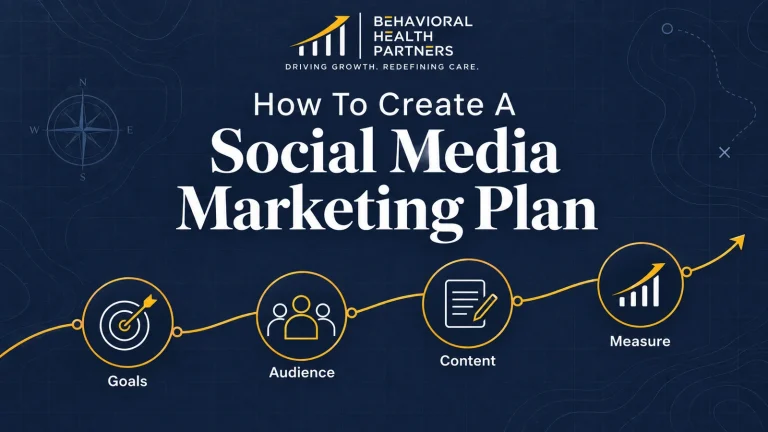
Post the faces and the moments, not just the marketing materials. A behind-the-scenes social media post outperforms a polished graphic almost every time, and short-form video is the biggest reach lever available right now; it is exactly how a recovery nonprofit reaches tens of millions, and professional video production pays for itself once your stories start converting. Let supporters carry the message: every share is an endorsement. Our guide to creating a social media marketing plan goes deeper on cadence and content mix, and if you want the paid and organic sides handled together, that is what our social media marketing team does all day. Keep your social media presence consistent, then measure which social media channels actually drive donations, not just likes.
6. Direct Mail: The Comeback Channel
Direct mail sounds dated until you see the numbers: physical mail gets seen, with reported open rates as high as 90 percent, and 69 percent of marketers say direct mail improves donor response. USPS neuromarketing research found physical mail creates stronger memories and stronger emotional response than digital ads. Inboxes are crowded; mailboxes are not. For donor acquisition and year-end fundraising campaigns, direct mail campaigns still out-earn almost everything for organizations with older donor bases.
Make it personal, make it about one story, and make the ask specific: "your $50 feeds a family for a week" beats "please support our work" every time. Pair each mailing with a matching landing page and email follow-up so multiple channels reinforce one appeal. Test small before you print big, the way you would test any of your marketing campaigns.
7. Peer to Peer Fundraising and Ambassadors
Your supporters have audiences you will never reach. Peer to peer fundraising hands them the tools: personal fundraising pages, birthday campaigns, race-day challenges. Their friends give because of the relationship, then stay because of the mission; peer to peer campaigns engage supporters as marketers and recruit the target audience you could not buy. The same logic powers ambassador programs: equip your most vocal volunteers and board members with stories, graphics, and talking points, and let them market for you. Recruiting volunteers gets easier too, because visible supporters recruit their own replacements. People trust people. Marketing campaigns run through supporters, from birthday fundraisers to team challenges, routinely bring in new donors no ad could touch, and they raise money while raising awareness at the same time.
8. Partnerships: Borrow Trust, Share Reach
Community partnerships multiply small teams. Local businesses will sponsor events, match employee gifts, and host donation drives, because your credibility helps their brand identity too. Other organizations serving the same population will co-host events and cross-promote to their lists; you are not competitors, you are a coalition. Court local leaders and micro-influencers whose endorsement means something in your community; influencer marketing for nonprofits is less about follower counts and more about genuine alignment. Corporate partnerships bring money and visibility; grassroots ones bring volunteers and word of mouth. A nonprofit that partners well shows up everywhere without paying for anywhere.
9. Your Website and Google Business Profile: The Trust Layer
Every strategy above sends people to one place. If the website is slow, confusing, or silent about impact, everything upstream leaks. The essentials of good website design: a clear statement of your nonprofit's mission above the fold, one-click donate, program pages that answer real questions, proof everywhere (outcomes, financials, testimonials), and mobile speed. Add a complete Google Business Profile so local searches find you; our Google Business Profile optimization guide takes an afternoon to apply and pays for years. This is your digital front door; treat it like the lobby of your organization.
Want the shortcut? If you would rather have this whole engine built for you, we do this for a living. Schedule Your Free Discovery Call and we will look at your organization's marketing together, no pitch on the first call.
Measure What Matters: Analytics for Nonprofit Marketers
Vanity metrics kill nonprofit marketing. Follower counts and impressions feel good and fund nothing, and transparent communication about real results builds more donor confidence than any inflated number ever will. The numbers that matter map to your marketing goals: donation conversion rate, email list growth, donor retention, volunteer applications, and cost per acquired supporter. Donor relationships show up in these numbers before they show up anywhere else, and the organizations that maintain relationships deliberately watch retention like a hawk.
Google Analytics tracks your website traffic and shows which channels actually produce donors, not just visitors. Your email platform tracks opens and clicks per segment. A CRM ties it together: organizations that track supporters in a real CRM report donor engagement lifts around 30 percent, because nobody falls through the cracks. Industry sources like the annual M+R Benchmarks study publish what good looks like across the nonprofit sector, so you can compare your numbers against organizations your size instead of guessing. Review your marketing efforts monthly. Cut what fails. Double what works. That discipline, more than any tactic, is what separates the organizations that grow from the ones that plateau.
Low-Budget Nonprofit Marketing That Still Wins
No money is not no marketing. The free stack: the Google Ad Grant for search ads, organic social, email through a free-tier platform, SEO done in-house, PR pitches to local media hungry for good news, and marketing software discounts through TechSoup-style programs for nonprofit marketing tools. Add volunteer skills: every community has a photographer, a writer, and a video editor who will donate a Saturday to a mission they love.
Two rules keep a small marketing budget honest. First, concentrate: one great channel beats five neglected ones. Second, recycle: one strong story becomes a blog post, three social media posts, an email feature, and a direct mail insert. That is a month of marketing materials from one interview, and the same marketing strategies keep working at every size. Effective marketing strategies at this level are about leverage, not spend, and a successful marketing strategy on a shoestring is usually just consistency maintained for a year. The best marketing strategies were never expensive; they were repeated.
When to Hire a Nonprofit Marketing Agency, and When Not To
Honest answer: most small nonprofits should not hire an agency yet. If your email list is under a thousand people and your website gets a trickle of traffic, spend the money on programs and run the free stack above; you are not ready to get full value from professional help, and a good agency will tell you so.
Hire help when the math flips and your nonprofit marketing strategy is bigger than your team's hours: when unclaimed opportunities (an unused Ad Grant, a stalled capital campaign, search rankings your cause deserves) are worth more than the fee, or when your team's time is now the bottleneck. Choose a partner who shows real results in your vertical, explains everything in plain language, and never locks you into contracts you cannot leave. We are that partner for behavioral health and recovery organizations: we run nonprofit marketing for our own cause and treatment marketing for clients nationwide, and we will be straight with you about whether you need us at all. Schedule Your Free Discovery Call if that conversation would help.
Nonprofit Marketing FAQs
What is the 33% rule for nonprofits?
The 33% rule refers to the IRS public support test. To keep public charity status, an organization generally must receive at least one-third (33.3 percent) of its support from the general public, per the IRS guidance on public support and Schedule A. It shapes marketing indirectly: a broad donor base is not just healthy fundraising, it protects your tax status.
What is the 80/20 rule for nonprofits?
The 80/20 rule observes that roughly 80 percent of results come from 20 percent of effort: most donation revenue comes from a small share of major donors, and most engagement comes from a small share of content. Use it to prioritize. Identify the donors, channels, and stories doing the heavy lifting, and invest there before spreading thinner.
How do I market my nonprofit organization with no budget?
Start with what is free: claim the Google Ad Grant, build an email list, post consistently on one social platform, optimize your website for search, and ask supporters to share your story. Concentrate on one channel until it produces, recycle every story across formats, and recruit volunteer skills for design and video. Consistency, not spend, is what compounds.
How do you get your nonprofit noticed?
Lead with stories, not statistics. Pitch local media with a human angle, show up in community partnerships, publish answers to the questions your community already searches for, and equip your most passionate supporters to speak for you. Visibility follows generosity: organizations that help loudly, thank potential supporters publicly, and celebrate wins get talked about, and word of mouth remains the best awareness engine a mission can have.
What are the 5 P's of a nonprofit marketing plan?
The classic five are product, price, place, promotion, and people, translated into nonprofit marketing strategies for mission work: your programs (product), the ask (price), the channels where supporters find you (place), your campaigns (promotion), and the humans, from staff to board members to volunteers, who carry the message (people). Some nonprofit marketers add a sixth P, proof, because demonstrated impact is what converts attention into trust.
What should a one-page nonprofit marketing plan include?
Seven boxes: mission statement, three SMART marketing goals, audience segments, core message, chosen channels, monthly budget and calendar, and the key performance indicators you will review monthly. That is the entire skeleton of a strong nonprofit marketing plan, and it is exactly what our free fillable One-Page Nonprofit Marketing Plan walks you through; download it, fill it in, and put it where the whole team can see it.
Your mission deserves to be found. Whether you run this playbook yourself or want a partner who lives it daily, the families, donors, and volunteers you are meant to reach are already searching. Go meet them.
Adam Vibe GuntonFounder and Managing Partner, Behavioral Health Partners
Adam Vibe Gunton is an addiction recovery expert, entrepreneur, marketer, brand strategist, and speaker dedicated to advancing the behavioral health industry. As Founder and Managing Partner of Behavioral Health Partners, he has worked across treatment-center development, operations, branding, PR, SEO, advertising, and growth strategy. Combining professional experience with his own lived experience in recovery, Adam brings a unique perspective on how treatment organizations can build trusted brands, reach more people, and create a greater impact.
Thirty minutes on video with Adam directly, camera on, screen-sharing your own online presence and your top three local competitors. If we are not the right partner, we will tell you that too.