How Much Do Google Ads Cost for Drug Rehab Centers?
Addiction treatment is one of the most expensive corners of paid search, so the numbers matter. We cover how Google Ads pricing works and what clicks genuinely cost for drug rehabs. We cover cost per acquisition as the figure that actually matters, branded versus non-branded costs, budgets by level of care, the hidden costs owners should plan for, how to reduce spend, and whether it is worth it.
Google Ads can fill beds fast, but addiction treatment is one of the most expensive corners of paid search, so the first question every operator asks is simple: how much do Google Ads cost for a drug rehab center? The honest answer is that Google Ads cost depends on your keywords, your competition, your location, and how well your campaigns are managed, and in rehab those costs run high. This chapter breaks down real Google Ads pricing for treatment centers, what drives your cost per click CPC, how to budget by level of care, and how to lower your Google Ads cost without losing admissions. If you want experts to manage it for you, our drug rehab PPC digital marketing team runs these campaigns every day. This page is part of our larger guide on SEO vs PPC for addiction treatment.
Before we get to the dollar figures, it helps to understand how Google Ads pricing actually works, because the amount you pay is not a fixed price. It is the result of an auction, and understanding that auction is the key to controlling your Google Ads cost.
How Google Ads Pricing Works
Google Ads is a pay per click model, which means you are charged only when someone clicks your ad, not when it shows. There is no flat fee and no minimum spend. You set a budget, you bid on keywords, and the Google Ads auction system decides whether your ad appears and what you actually pay for each click. Understanding how much Google Ads cost and how Google Ads works is the first step, and knowing how Google Ads work here matters, to understanding Google advertising costs and what Google Ads truly cost.
Google Ads shows your ads in several places. Google search ads appear on the search network at the top of results when someone searches your keywords, while the Google Display Network places ads across millions of websites, and video ads run on YouTube, each with its own ad formats. For a treatment center, search ads on the search network usually deliver the highest intent and the best return, which is where most of your Google Ads budget should go, ahead of other Google Ads formats. Display ads typically carry a lower cost per click than search ads, but they also reach lower-intent users, so cheaper clicks do not always mean cheaper admissions. Different ad formats carry different typical Google Ads costs, and different bidding strategies change them further, but the core of the pricing model is the same across all of them: the auction system sets your cost.
A few factors drive higher costs and higher CPCs in Google Ads. Highly competitive keywords with high search volume cost more because more advertisers bid on them. Poor ad quality raises your cost per click, while high quality ads lower it. Weak targeting wastes ad spend on the wrong people, whereas tightly targeted ads that match search intent convert at a lower cost. Your ad campaigns, your ad budget, and your bidding strategies all interact, so what you pay for Google Ads depends on how well the whole account is built. Treat Google Ads as one part of a broader digital marketing plan, since digital marketing and treatment center marketing work best when paid and organic reinforce each other, not a standalone lever, and your advertising efforts across paid search and organic will reinforce each other.
The Google Ads Auction and Ad Rank
Every time someone searches, Google Ads runs an auction to decide which ads show and in what order. Your position and your cost per click are set by your Ad Rank, not your bid alone. According to Google Ads, Ad Rank is calculated from your bid, the quality of your ad and landing page, the Ad Rank thresholds, the context of the search, and the expected impact of your assets. The critical point is that higher quality ads can lower your cost per click. As Google puts it, you can pay less per click when your ads are higher quality. In simple terms, Ad Rank blends your bid with your Quality Score, so a strong Quality Score can outrank a competitor who bids more. You also rarely pay your maximum bid; you typically pay only just enough to beat the advertiser ranked below you, so your actual cost per click is usually less than your bid cap. That is why two rehab centers bidding on the same keywords can pay very different prices.
Quality Score: How to Pay Less Per Click
Quality Score is Google's rating, on a scale of 1 to 10, of how relevant and useful your ad, keywords, and landing page are to a searcher. It is built from your expected click through rate, your ad relevance, and your landing page experience. Improving it can enhance your ad position without raising your bids at all. A high Quality Score improves your Ad Rank and lowers your average CPC, while a low Quality Score forces you to bid more just to appear. For a treatment center, improving Quality Score is often the single fastest way to reduce your Google Ads cost, because a strong Quality Score means better ad position and better ad placement and ad position at a lower price.
Google Ads Budgets and Spending Limits
You control your Google Ads spending with an average daily budget for each campaign. According to Google Ads, your actual spend can vary day to day, but you will not pay more than your daily spending limit on any single day or more than your monthly spending limit, which is your average daily budget multiplied by 30.4, in any month. That means a treatment center always has a hard ceiling on Google Ads spending, even when daily costs fluctuate with demand. Setting the right average daily budget and ad budget, and adjusting it as data comes in, is the foundation of managing your Google Ads cost and your wider Google advertising.
What Do Google Ads Cost Per Click for Drug Rehabs?
Here is where addiction treatment stands apart, much like legal services. Across most industries, the average cost per click on Google Ads sits in the low single digits, but rehab is not most industries. Treatment centers commonly see a cost per click between $25 and $150 for high-intent addiction keywords, which makes drug rehab one of the most expensive verticals in all of Google advertising and paid search, on par with legal services, insurance, and other high-cost, highly competitive industries.
Why so high? Demand for a limited number of clicks is intense, every admission is worth a great deal, and hundreds of treatment centers bid on the same keywords. Location matters too. Highly competitive states like California, Florida, and Texas, where addiction treatment centers cluster, drive up Google Ads costs, while less saturated markets often show lower costs and avoid the higher costs of big metros. Highly competitive keywords like drug detox program push toward the top of that range, while more specific searches can cost less. The takeaway is simple: a typical Google Ads click for a rehab center costs many times what it costs most local businesses in other fields.
How Addiction Compares to Other Competitive Industries
It helps to see where addiction treatment sits. Across all advertisers, the average cost per click on the search network is only a few dollars, and for many local businesses the average Google Ads click stays low, and that average Google Ads figure is far below rehab. But a handful of competitive industries pay far more. Legal services, insurance, and addiction treatment consistently rank among the higher costs and highest cost per click categories in Google Ads, because each new client is worth so much. Where ecommerce businesses might happily pay a few dollars per click, in average CPC terms a rehab center routinely pays twenty-five times that, and sometimes more. So when you compare your average CPC to a generic average cost per click figure online, remember that those averages blend cheap industries with expensive ones. Your real benchmark is other treatment centers, not the overall average CPC and average cost across every business.
Cost Per Acquisition: The Number That Actually Matters
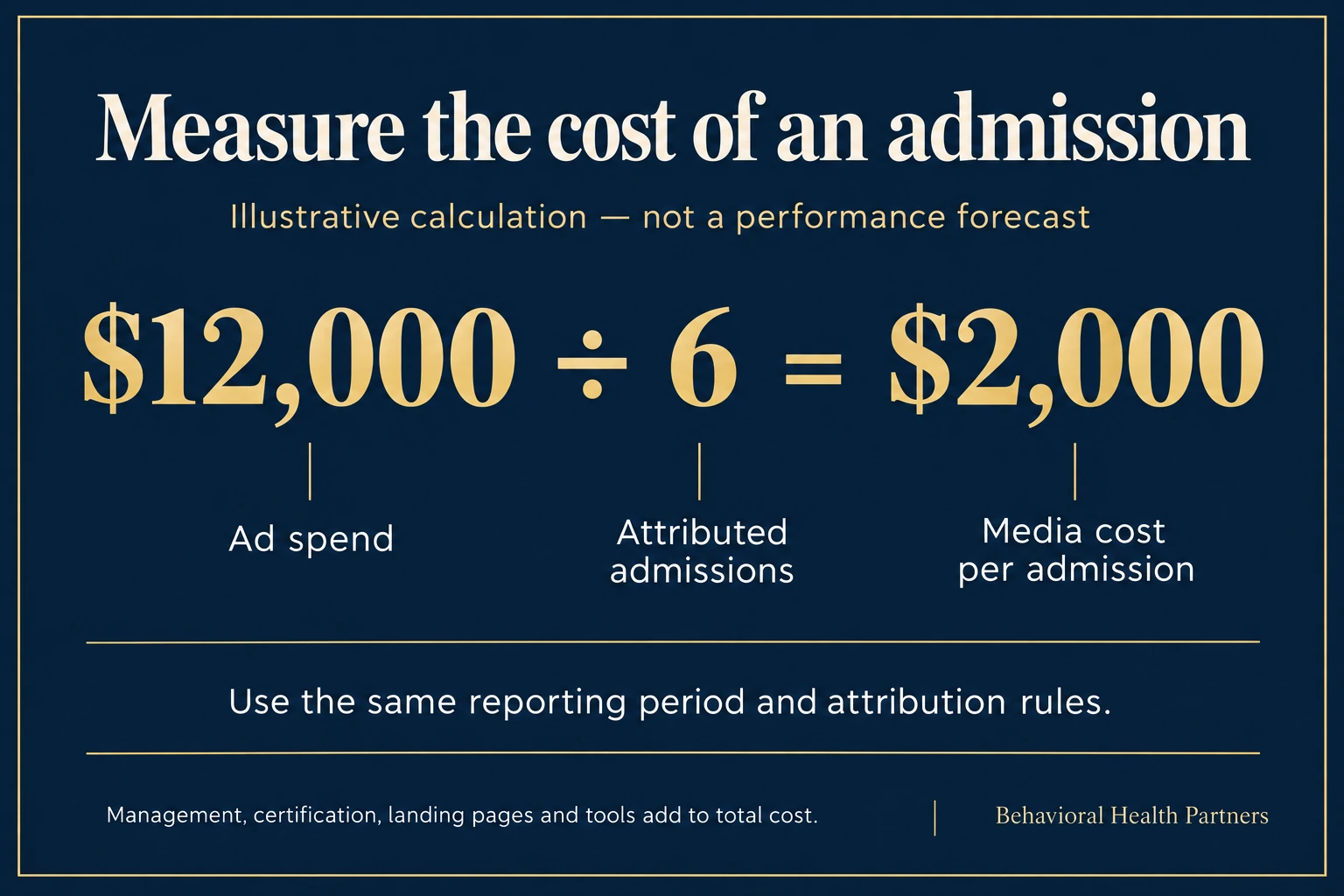
Cost per click, the headline CPC, is only the beginning. Your cost per click CPC is just the entry price to the auction. What truly matters is cost per acquisition, or what you pay to turn clicks into an actual admission. For addiction treatment, cost per acquisition commonly runs between $1,500 and $15,000 per admit, a wide range that depends on your ad campaigns and paid advertising campaigns, your ad campaigns' landing page quality, your level of care, and how well your funnel converts.
A high cost per click is not a problem if your conversion rate is strong and your cost per admission is sustainable for your program. A cheaper PPC ad click that never converts is far more expensive in the end. This is why smart treatment centers judge Google Ads on cost per acquisition and return, not on the price of a single click. Conversion tracking, connected to your analytics for behavioral healthcare, is what lets you see the real cost of an admission rather than guessing.
Branded Versus Non-Branded Google Ads Costs
Not all clicks cost the same. Branded campaigns, which target searches for your own facility name, are cheap, often just $3 to $10 per click, because you face little competition on your own brand. Non-branded campaigns, which target high-intent terms like a drug detox program near a city, are where costs climb, commonly $50 to $150 per click in these PPC campaigns, because every treatment center is competing for those same keywords.
A balanced Google Ads strategy runs both. Branded search campaigns protect your name and capture people who already know you at a low cost, while non-branded search ads connect with new potential clients who have not heard of you yet. The mix shifts your overall Google Ads cost, so a good PPC plan is deliberate about how much budget goes to each.
Google Ads Budget by Level of Care
How much should a rehab center spend on Google Ads? It depends heavily on your level of care and your market. Based on what treatment centers commonly invest, outpatient and intensive outpatient programs often allocate roughly $30,000 to $50,000 per month for a steady flow of qualified leads in a competitive market. Detox and residential facilities, where each bed is worth far more and competition is fiercer, frequently budget on a per-bed basis, often in the range of $5,000 to $10,000 per bed per month.
These are starting points, not rules. A local, single-market campaign needs a smaller budget than a national one, so a single-location outpatient clinic in a smaller market may spend far less, while a multi-state provider spends much more. Seasonality matters too: search volume for treatment often rises after the holidays and at the new year, so plan to increase budget for those peaks and ease off in slower months. The right Google Ads budget is the one that produces admissions at a cost per acquisition your program can sustain, which is why budgets should be set from your own numbers and adjusted as the data comes in rather than copied from a competitor.
Once you set the number, managing it well is what protects your return. Split your ad budget across each Google Ads campaign by goal, level of care, and location, then watch the data and shift ad spend toward the ad campaigns that convert. Set daily and monthly limits so no single Google Ads campaign runs away with your budget, and review your cost per click CPC and your cost per admission weekly. The right bidding strategies matter here too: a bidding strategy tuned to conversions keeps your ad spend efficient, and a strong Quality Score keeps your costs down, and a rising Quality Score keeps pulling your cost per click down over time. Disciplined budget management, more than any single trick, is what keeps Google Ads costs predictable for a treatment center. A well-run account treats every dollar of ad spend as an investment measured against admissions, not a fixed cost.
Hidden Costs Rehab Owners Should Plan For
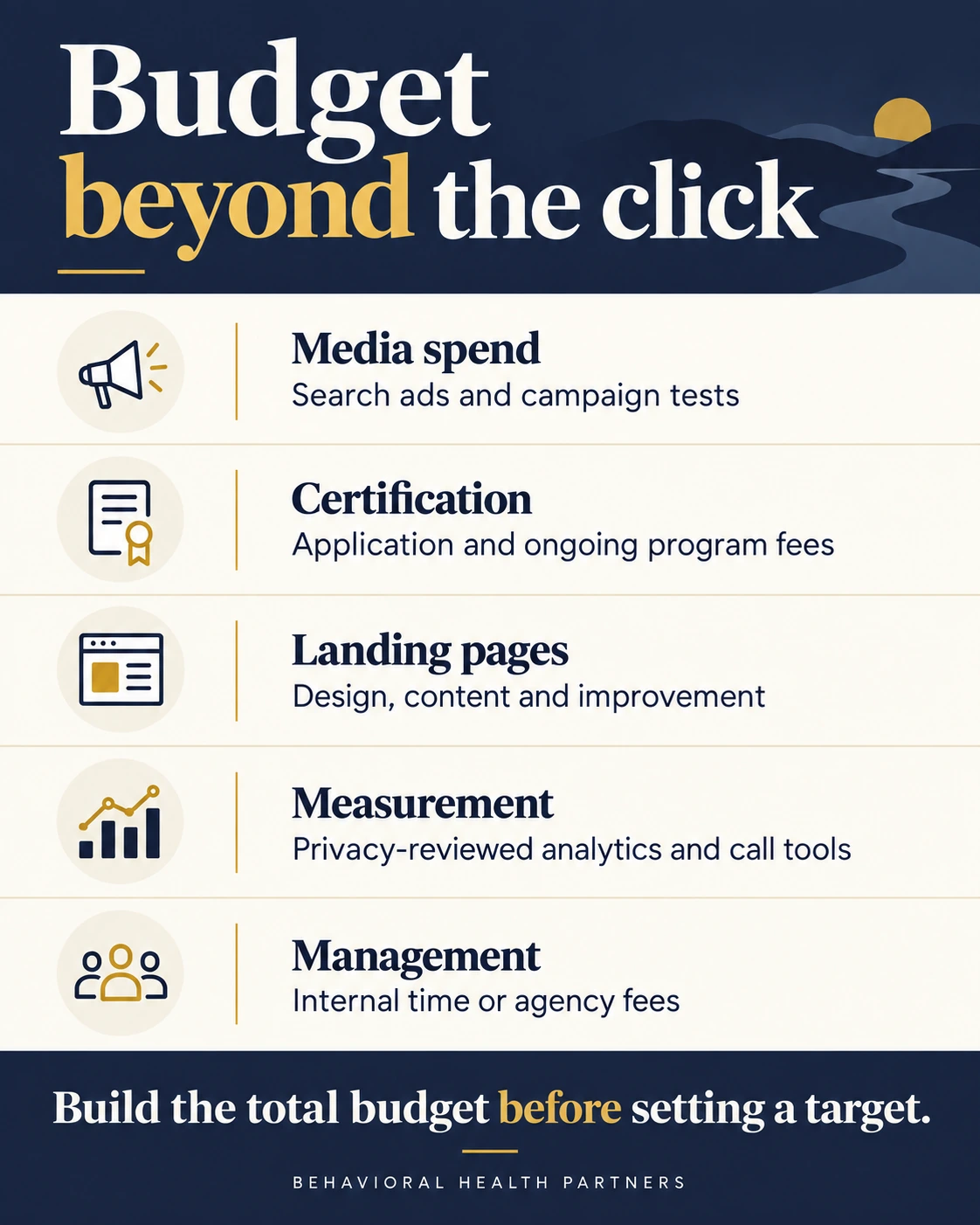
The click price is not the whole bill. Several other costs shape what Google Ads truly costs a treatment center.
First is compliance. Before you can run addiction treatment ads at all, you must be LegitScript certified, and that certification carries an application fee and ongoing monitoring costs. Our guide on how to get LegitScript certified walks through the process and the fees. Second is landing pages. Sending expensive clicks to a weak page wastes ad spend, so investment in conversion rate optimization and fast, trustworthy landing pages is really part of your Google Ads cost. Third is call tracking, which typically runs a modest monthly fee but is essential, since most rehab conversions happen on the phone. Finally, there is management. Whether you hire a specialist or build an in-house team, managing Google Ads well takes real time and expertise. Agencies usually charge either a flat monthly fee or a percentage of ad spend, commonly in the range of ten to thirty percent of ad spend, and our chapter on what a PPC agency does explains what that fee actually buys.
How to Reduce Your Google Ads Cost
You cannot change that rehab keywords are expensive, but you can control how efficiently you spend. Here is how treatment centers lower their Google Ads cost.
Start with Quality Score, because a higher Quality Score directly lowers your average cost per click and lifts your ad position. Stronger ad placement follows better relevance, so tighten ad relevance until your ad copy matches the keyword and the landing page, lifting your click through rate, and Google will reward you with better ad placement at a lower price. Use negative keywords aggressively to reduce wasted ad spend, filtering out searches like free rehab or celebrity rehab gossip that will never convert. Lean into long tail keywords, since long tail keywords face less competition and often carry lower costs and higher intent. Use local geo-targeting, ad scheduling, and day-part ad scheduling to focus spend on the locations and times that actually convert, and use conversion tracking to move budget toward the campaigns that produce admissions. Finally, retarget the visitors who did not convert, since retargeting ads cost far less than acquiring a brand-new click and reach people who already know you.
Managed well, these tactics compound. A treatment center that improves Quality Score, cuts wasted spend, and focuses on high-intent long tail keywords can meaningfully lower its overall Google Ads cost while increasing admissions.
Bidding Strategies and Tools That Control Cost
Your bidding strategies also shape what you pay. Manual bidding gives you direct control over your maximum cost per click, while automated bidding lets Google optimize toward conversions, and the right choice depends on your data and goals. Either way, good bidding keeps your ad campaigns efficient and protects the ad budget and daily ad budget behind those ad campaigns. Use the Google Keyword Planner to research keywords, search volume, and estimated costs before you launch, use the Performance Planner to forecast budgets, and connect Google Analytics and conversion tracking so every Google Ads campaign is measured against real admissions. Build in a testing and learning phase when you start, because early data is what tells you where to move budget. Your conversion rate also drives everything downstream: it determines how many clicks you need to hit an admissions goal, which is why lifting conversion is often cheaper than buying more clicks. A skilled Google Ads expert lives in these tools daily, adjusting bids by device, location, and time so your spend on Google Ads always chases the searches that convert. This is where a specialist earns their fee, because small, constant adjustments to bidding and targeting steadily lower your cost per admission over time.
Google Ads is not the only option, either. Bing Ads reaches a smaller but often less expensive audience, and some treatment centers add it to widen their reach at a lower blended cost. Still, for most rehab centers the majority of qualified traffic and admissions comes from Google search ads, so that is where the core budget belongs.
Is Google Ads Worth It for Rehab Centers?
Given the costs, is paid search worth it? For most treatment centers, yes, as long as it is managed well and measured on cost per acquisition rather than cost per click. Google Ads reaches people at the exact moment they are searching for help, which no other advertising channel does as immediately, and a well-run campaign turns that intent into admissions quickly.
The smartest approach pairs paid search with organic growth. Google Ads delivers immediate admissions while a strong behavioral health SEO foundation lowers your reliance on paid clicks over time. Our pillar guide on SEO vs PPC explains how to balance the two. Run alone and unmanaged, Google Ads can become a money pit; run well, alongside SEO and with a disciplined focus on cost per admission, it is one of the highest-return investments a treatment center can make.
Get Google Ads Costs Under Control
Google Ads cost for drug rehab centers is high, but it is far from random. It is driven by the auction, your Quality Score, your keywords, your location, and how well your campaigns and landing pages are built. Control those, measure everything against cost per acquisition, and Google Ads becomes a predictable engine for admissions rather than a gamble.
If you want a partner who knows exactly what drives Google Ads cost in addiction treatment, request a strategy conversation through our rehab marketing team. We build compliant, cost-efficient Google Ads campaigns for treatment centers every day.
Frequently Asked Questions
How much do Google Ads cost per click for a drug rehab center?
For addiction treatment, the cost per click on Google Ads commonly runs between $25 and $150 for high-intent keywords, making rehab one of the most expensive industries in paid search. Branded searches for your own facility name are far cheaper, often $3 to $10 per click, while competitive non-branded terms sit at the top of the range. Your exact cost per click depends on your keywords, location, competition, and your ad's Quality Score.
How much should a rehab center budget for Google Ads?
It depends on your level of care and market. Outpatient and intensive outpatient programs commonly allocate roughly $30,000 to $50,000 per month, while detox and residential facilities often budget $5,000 to $10,000 per bed per month because each admission is worth more and competition is higher. The right budget is the one that produces admissions at a cost per acquisition your program can sustain, so start from your own numbers and adjust as data comes in.
Is a small daily budget enough for Google Ads in addiction treatment?
Probably not for competitive non-branded rehab keywords. Because a single click can cost $25 to $150, a very small daily budget may buy only a handful of clicks, which is rarely enough to gather meaningful data or drive admissions. A small budget can work for low-cost branded campaigns or a tightly geo-targeted test, but scaling admissions in addiction treatment usually requires a budget matched to the high cost per click in this space.
What is a good cost per click on Google Ads for rehab?
There is no single good number, because rehab cost per click is naturally high. A better question is whether your cost per acquisition is sustainable. A $100 click that converts into an admission at a profitable cost per acquisition is excellent, while a $5 click that never converts is expensive. Judge your Google Ads by cost per admission and return, and use Quality Score improvements and negative keywords to keep your cost per click, or CPC, as efficient as possible.
Are Google Ads worth the cost for a treatment center?
For most treatment centers, yes, when campaigns are managed well and measured on cost per acquisition. Google Ads meets people at the moment they are searching for help and can drive admissions within days, which is unmatched for speed. The key is disciplined management, LegitScript compliance, strong landing pages, and pairing paid search with SEO so you are not renting all of your visibility forever. Run that way, Google Ads is well worth the cost for a rehab center.
Adam Vibe GuntonFounder and Managing Partner, Behavioral Health Partners
Adam Vibe Gunton is an addiction recovery expert, entrepreneur, marketer, brand strategist, and speaker dedicated to advancing the behavioral health industry. As Founder and Managing Partner of Behavioral Health Partners, he has worked across treatment-center development, operations, branding, PR, SEO, advertising, and growth strategy. Combining professional experience with his own lived experience in recovery, Adam brings a unique perspective on how treatment organizations can build trusted brands, reach more people, and create a greater impact.
Thirty minutes on video with Adam directly, camera on, screen-sharing your own online presence and your top three local competitors. If we are not the right partner, we will tell you that too.