The Rehab Admissions Funnel: How to Turn a Phone Call Into an Admission
The most expensive lead in addiction treatment is the one that reaches out and never gets a call back. We cover what the admissions process is and why the person answering your phone decides everything, then the process step by step. We cover a call answering script for your team, speed and follow-up so calls are never missed, and holding compassion and compliance together.
In addiction treatment, the single most expensive lead is the one that reaches out and never gets a call back. You can spend a fortune generating inquiries, but if your rehab admissions process fumbles the moment someone calls or submits a form, that marketing is wasted. This guide covers the full rehab admissions process, what happens from the first contact to the day someone begins their treatment and recovery, and it harps on the one thing most treatment centers underinvest in: the person who answers your admissions phone. If you want help building this system, our addiction treatment marketing team wires your admissions process to your marketing, and this chapter is part of our larger guide on rehab lead generation.
Lead generation gets someone to raise their hand. The admissions process is what turns that raised hand into an admission. Below, we walk through every step, give you a call answering script, and show why your admissions staff are the most important people in your entire funnel.
What Is the Rehab Admissions Process?
The rehab admissions process is the series of steps a person moves through from their first contact with your treatment center to the moment they begin treatment. Think of it as a funnel: many people reach out, fewer complete and finish a pre-screening, fewer still verify insurance coverage and set a start date, and a subset actually arrive and start the program. Every step is a place where a person in crisis can slip away, and every step is a place your team can either build trust or lose it.
The idea of a conversion funnel comes from sales and higher-education enrollment, where prospects move through stages, from awareness and inquiry to applicant, admit, and finally enrolled, and conversion rates measure how many move from one stage to the next. A treatment center funnel works the same way: awareness, inquiry, pre-screening, insurance verification, and enrollment into your program. As in a college enrollment funnel, some people drop off at each stage, some skip stages entirely, and the whole point of managing the funnel is to move the right people smoothly toward starting treatment. The difference is urgency: a rehab center cannot wait for a semester to begin, because a person ready to start treatment today may not be ready tomorrow.
Unlike a university or college enrollment process that moves students through a university on a fixed calendar, rehab admissions run in real time, often in a moment of crisis. The person calling may have decided to get help only minutes ago, and that window can close fast. That is why speed, compassion, and a clear process matter so much. A smooth intake is not just good operations; it is part of care, because it removes the friction between a person who needs help and the addiction treatment that can save their life and start their recovery.
Why the Person Answering Your Admissions Phone Is Everything
Here is the truth most treatment centers miss: your admissions staff are your most important marketers. You can run flawless campaigns and still lose the admission if the phone call goes to voicemail or the person who answers sounds rushed, cold, or unsure. When a family member, a loved one, or a person struggling with substance use finally reaches out, the human on the other end of that phone call decides whether they feel safe enough to take the next step.
A great director of admissions builds a team that answers every call live, with warmth and competence. Research on lead response makes the case plainly. According to Harvard Business Review, most companies respond to inbound inquiries far too slowly, and the odds of ever connecting with someone seeking addiction help drop sharply as the minutes pass. In addiction treatment, where the person seeking help may be ambivalent and in pain, a fast, compassionate response is the difference between an admission and a missed chance. Your admissions team is not overhead; it is the highest-leverage investment in your entire admissions process.
Hire for empathy, train relentlessly, and staff your admissions line so that no call, no form submission, and no message ever goes unanswered. Compassionate team members who know how to speak to someone in crisis will convert more inquiries than any amount of extra ad spend.
The Rehab Admissions Process, Step by Step
A clear, repeatable path gives your team a way to guide each person through. Here is what a strong rehab admissions process looks like from start to finish.
Step 1: The First Contact
Everything begins when a person, or a loved one calling for them, reaches out, by phone call, form submission, or chat. This first conversation is the most fragile moment in the funnel. Answer live whenever possible, listen more than you talk, and lead with empathy rather than paperwork. The goal of that first call is not to collect basic information as fast as possible; the first call exists to make a frightened person feel heard and understood. Once they feel safe, the rest of the intake flows. Remember what the person and their loved one are feeling: fear, shame, and often unresolved trauma, along with real hope that they can finally begin to heal. Millions of Americans live with a substance use disorder, and when someone who has struggled with addiction takes the brave step to seek help, they need to feel that your team expects them, will walk each step with them, complete the intake alongside them, and know what to expect, and will not judge them for the substance use or trauma that brought them here.
Step 2: The Pre-Screening Assessment
Addiction rarely travels alone. Many people who seek treatment for substance use disorders also live with mental health conditions, trauma, unresolved trauma, or a co-occurring mental health disorder, so a good pre-screening asks about mental health care needs as well as substance use. Understanding whether a person needs dual-diagnosis care for co-occurring substance use disorders and a mental health disorder shapes everything that follows, from the program and facility that fit them to the medications and the clinical services, support services, and wraparound services their recovery will require.
Once trust is established, your intake counselors gather basic information and complete a pre-screening. This is a brief, compassionate assessment of the person’s substance use and any substance use disorder, mental health, drug and alcohol history, and specific needs, enough for a healthcare professional to understand whether your program is the right fit and what level of care they need. A good pre-screening feels like a caring conversation, not an interrogation. It also surfaces any urgent medical or safety concerns that need immediate attention.
Step 3: Insurance Verification and Payment Options
Cost is the single biggest barrier people cite, so handle it early and clearly. Run an insurance verification quickly, explain what their health insurance covers in plain language, and walk through payment options and any mental health benefits for anything not covered. Removing the fear of an unknown bill keeps people in the funnel. A fast, transparent insurance verification, paired with honest guidance on payment options, prevents the anxiety that causes many people to give up before they ever begin treatment.
Step 4: The Personalized Treatment Plan
With the pre-screening and insurance coverage confirmed, your clinical team develops, builds, and helps develop and explain an individualized treatment plan, or at least a personalized treatment recommendation for the appropriate level of care. Explaining this plan to the person and their family, what treatment options fit their specific needs and why, builds confidence and commitment. People are far more likely to begin and follow through when they understand the individualized treatment path ahead of them and can see how it addresses their situation.
Step 5: Preparing for Admission
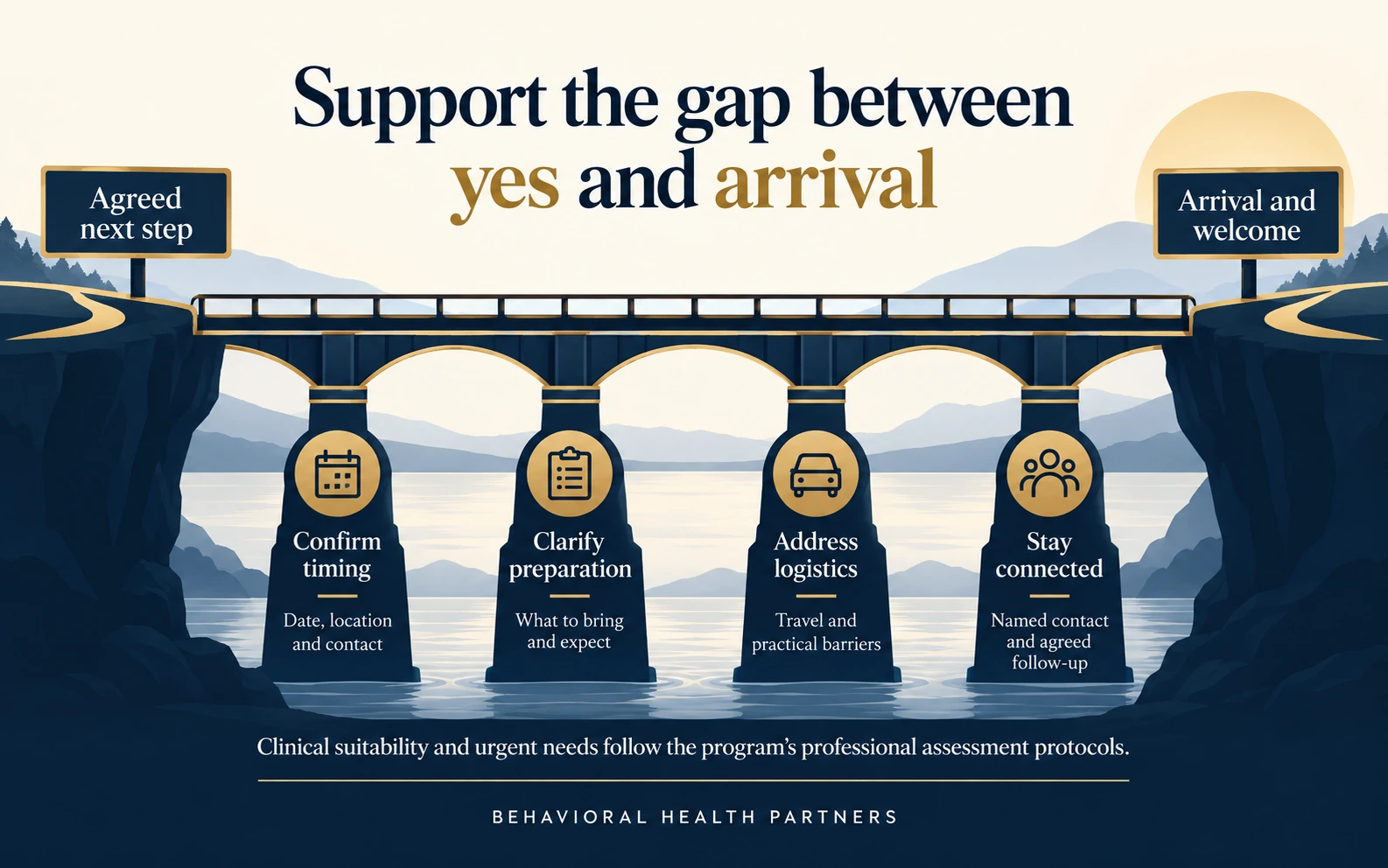
Once a person commits, help them actually get there. Set an admission date, coordinate their travel schedule if they are coming from out of town, and give them a simple packing list so they know what to bring. Offer virtual tours of the facility so they know exactly what to expect at your facility on arrival. This is also where many admissions quietly fall apart, in the gap between yes and arrival at the facility, so stay in close touch, answer questions, and keep the person supported right up to their admission day.
Step 6: Arrival and Final Medical Screening
On arrival at your rehab center, the person completes intake paperwork, completes a brief orientation, and a final medical screening with a healthcare professional to confirm the treatment plan, review current medications, and address any immediate medical services, assistance, or medications they need. A warm, organized arrival matters: the first hours at a rehab facility set the tone for the entire recovery process. Greeting someone by name, walking them through what happens next, and introducing their assigned case manager, who becomes their case manager throughout, turns a scary first day at the facility into the real first step, the most important first step, of their recovery.
Step 7: The Full Continuum of Care and Aftercare
Admission is the beginning, not the end. The strongest treatment centers guide each person through the full continuum of care, from detox or residential care through outpatient programs, and plan for aftercare and relapse prevention before discharge. Connecting the person to ongoing support, a strong support system, alumni programs, and additional resources gives them the best chance at long term recovery and lasting recovery from addiction. An admissions process that thinks past the admission, all the way to sustained recovery, is what separates centers that fill beds from centers that change lives. Aftercare, alumni programs, family education, ongoing education, and relapse prevention planning turn a completed program into lasting recovery, and they give each person and their family the tools and support to protect that recovery from substance use once they leave the facility. The recovery journey does not end at discharge; the best treatment centers keep offering support, and they offer support and rehab resources long after, because sustained recovery from a substance use disorder from addiction is built over months and years, not weeks.
Throughout every step, involve the family. A loved one is often the one who first reached out, and a scared loved one needs reassurance too, and keeping the family and each loved one informed and supported and supported, within the bounds of the person’s privacy, strengthens the whole recovery journey for the person and their family.
A Call Answering Script for Your Admissions Team
A script is not about sounding robotic. It is a framework that helps your admissions staff stay warm, consistent, and effective under pressure. Here is a simple structure your team can adapt.
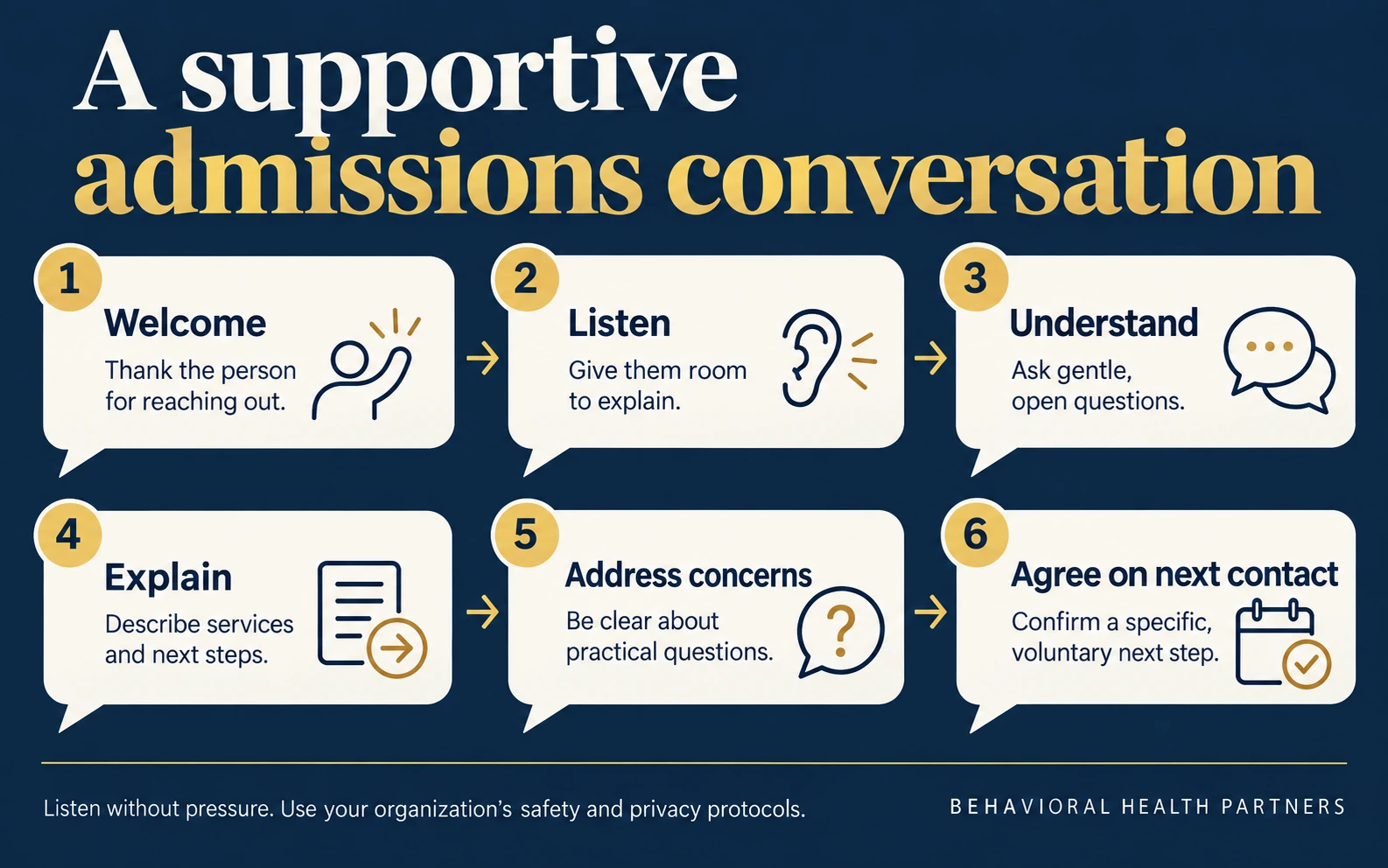
Open with warmth and reassurance: thank the person for calling, tell them they did the right thing by reaching out, and let them know you are here to help. Then listen, and let them tell their story before you ask for anything. Next, ask gentle, open questions to understand their situation and specific needs, rather than firing off a checklist. When the moment is right, explain the next steps simply, offering to verify insurance and walk them through the admissions process. Address concerns directly and honestly, especially about cost, time away from work or school and family, and what to expect. Finally, guide them to a concrete next step, ideally setting a start date or scheduling a follow up, so the call ends with momentum rather than a vague maybe.
The best admissions staff never pressure and never judge. They speak to the person, not the diagnosis, and they treat addiction as the treatable disease it is, whether the struggle is with alcohol, another drug, or alcohol and drugs together, or a co-occurring mental health condition. A script keeps the conversation on track, but empathy is what closes the gap between a phone call and an admission.
Speed, Follow Up, and Never Missing a Call
Even a perfect script fails if no one picks up. Missed calls are missed admissions, so staff your rehab center admissions line for real coverage, including evenings and weekends when many people, after leaving work or school, finally decide to get help. Make sure your website captures every inquiry cleanly, then respond to every form submission within minutes, not hours, because the person's willingness to begin treatment can fade quickly.
Not everyone is ready on the first contact, so build a real follow up process. Many people call two, three, or more times before they commit, and a compassionate follow up, without pressure, keeps the door open. A simple system that tracks every inquiry and prompts timely follow up ensures no one falls through the cracks. Connecting your admissions process to a CRM built for treatment, like the one covered in our guide on CRM in substance abuse treatment, makes this follow up reliable instead of accidental.
Compassion and Compliance Together
Everything in the admissions process must protect the vulnerable person on the other end. Speak with genuine compassion, never use fear or pressure, and be scrupulously honest about what your program offers. Protect every person's privacy and health information, and follow the rules that govern addiction treatment marketing and intake. Ethical admissions are not a constraint on conversion; they are the foundation of the trust that makes people say yes and stay.
If someone who contacts you is not the right fit for your program, help them anyway. Point them toward the free, confidential SAMHSA National Helpline, a 24/7 treatment referral and information service, or other additional resources. Offering support and pointing them to substance use treatment elsewhere, even when it does not become an admission builds the reputation and referral relationships that fill beds over time.
Build an Admissions Process That Converts
Your admissions process is where marketing turns into admissions, and it deserves the same investment as any campaign. Answer every call live and fast, lead with empathy, guide each person smoothly from first contact through pre-screening, insurance verification, a personalized treatment plan, preparation, arrival, and the full continuum of care. Above all, invest in the people who answer your phone, because they are the ones who turn a frightened phone call into someone beginning treatment.
If you want a partner to connect your marketing to an admissions process that actually converts, request a strategy conversation with our rehab marketing team. We help treatment centers stop losing hard-won leads at the admissions stage and start turning more inquiries into admissions.
Frequently Asked Questions
What is the rehab admissions process, and how does it work?
The rehab admissions process is the path a person follows from their first call to a treatment center to the day they begin their program. It usually includes the first contact, a pre-screening assessment, insurance verification and payment options, a personalized treatment plan, preparation for admission, arrival and a final medical screening, and entry into the program. It is called a funnel because people drop off at each step, so the goal of a strong admissions process is to reduce that friction and guide as many people as possible, with compassion, all the way to beginning treatment.
What does a director of admissions do at a treatment center?
A director of admissions leads the team and the process that turns inquiries into admissions. They hire and train admissions staff, build the call answering and follow up systems, oversee pre-screening and insurance verification, and make sure every person who reaches out is answered quickly and treated with compassion. A great director of admissions understands that the admissions team is really the front line of both care and marketing, and they build a process that never lets a person in crisis slip through the cracks.
How quickly can someone be admitted to rehab?
It varies by program and level of care, but many drug and alcohol treatment centers can move a person from first call to admission within a day or two, and sometimes the same day for urgent cases. Speed matters, because the window when someone is ready to seek treatment can be short. A well-run admissions process completes the pre-screening, insurance verification, and preparation quickly and compassionately, so the person can begin entering treatment, actually entering treatment while their motivation is strong rather than waiting days and losing the moment.
Why is the person who answers the admissions phone so important?
Because that person is often the deciding factor in whether an inquiry becomes an admission. When someone struggling with substance use or a worried family member finally reaches out, the warmth, speed, and competence of the admissions counselor answering determines whether they feel safe enough to continue. A rushed, cold, or missed call can undo an entire marketing campaign and lose a person who was ready to receive treatment, while a compassionate, well-trained admissions team converts far more inquiries. Investing in the people who answer your admissions phone is one of the highest-return decisions treatment centers can make.
How can a treatment center improve its admissions conversion rate?
Answer every call live and respond to every form submission within minutes, train your admissions staff in empathy and a consistent call framework, handle insurance verification and payment options early and transparently, and build a reliable follow up process for people who are not ready the first time they call. Connecting your admissions process to a CRM ensures no inquiry is missed. Most of all, invest in compassionate, well-trained people on the phone, because the admissions team, more than any single tactic, is what turns leads into admissions.
Adam Vibe GuntonFounder and Managing Partner, Behavioral Health Partners
Adam Vibe Gunton is an addiction recovery expert, entrepreneur, marketer, brand strategist, and speaker dedicated to advancing the behavioral health industry. As Founder and Managing Partner of Behavioral Health Partners, he has worked across treatment-center development, operations, branding, PR, SEO, advertising, and growth strategy. Combining professional experience with his own lived experience in recovery, Adam brings a unique perspective on how treatment organizations can build trusted brands, reach more people, and create a greater impact.
Published August 20, 2026 · Updated September 28, 2026
One Conversation. No Pitch.
Schedule Your Free Discovery Call
Thirty minutes on video with Adam directly, camera on, screen-sharing your own online presence and your top three local competitors. If we are not the right partner, we will tell you that too.