Social Media and Mental Health: What the Research Actually Shows
What the research actually shows, in both directions. We cover how social media affects mental health, the statistics worth knowing, and what the Surgeon General's advisory says. We cover the documented negative effects, why teenagers are hit hardest, the design choices that make platforms hard to put down, when use becomes addiction, and the genuine benefits that honest coverage should not leave out.
Social media was built to connect human beings, and for billions of us it does. The honest answer researchers keep arriving at: social media and mental health are linked in both directions. The same platforms that help people find support and like minded individuals can also fuel anxiety, feed low self esteem, and steal sleep, with the heaviest risks landing on young people. Our mental health marketing team lives inside this search data every day, and the questions families type into Google at 2 a.m. tell the story. This chapter of our digital addiction guide breaks down the research and what to do about it.
How Does Social Media Affect Mental Health?
How social media affects mental health depends less on the app and more on the pattern. Active social media use, meaning messaging friends, joining supportive communities, and creating rather than consuming, is associated with better well being. Passive scrolling, comparing, and lurking is consistently associated with worse. The digital world rewards the second pattern, because every social media app is engineered to keep you consuming.
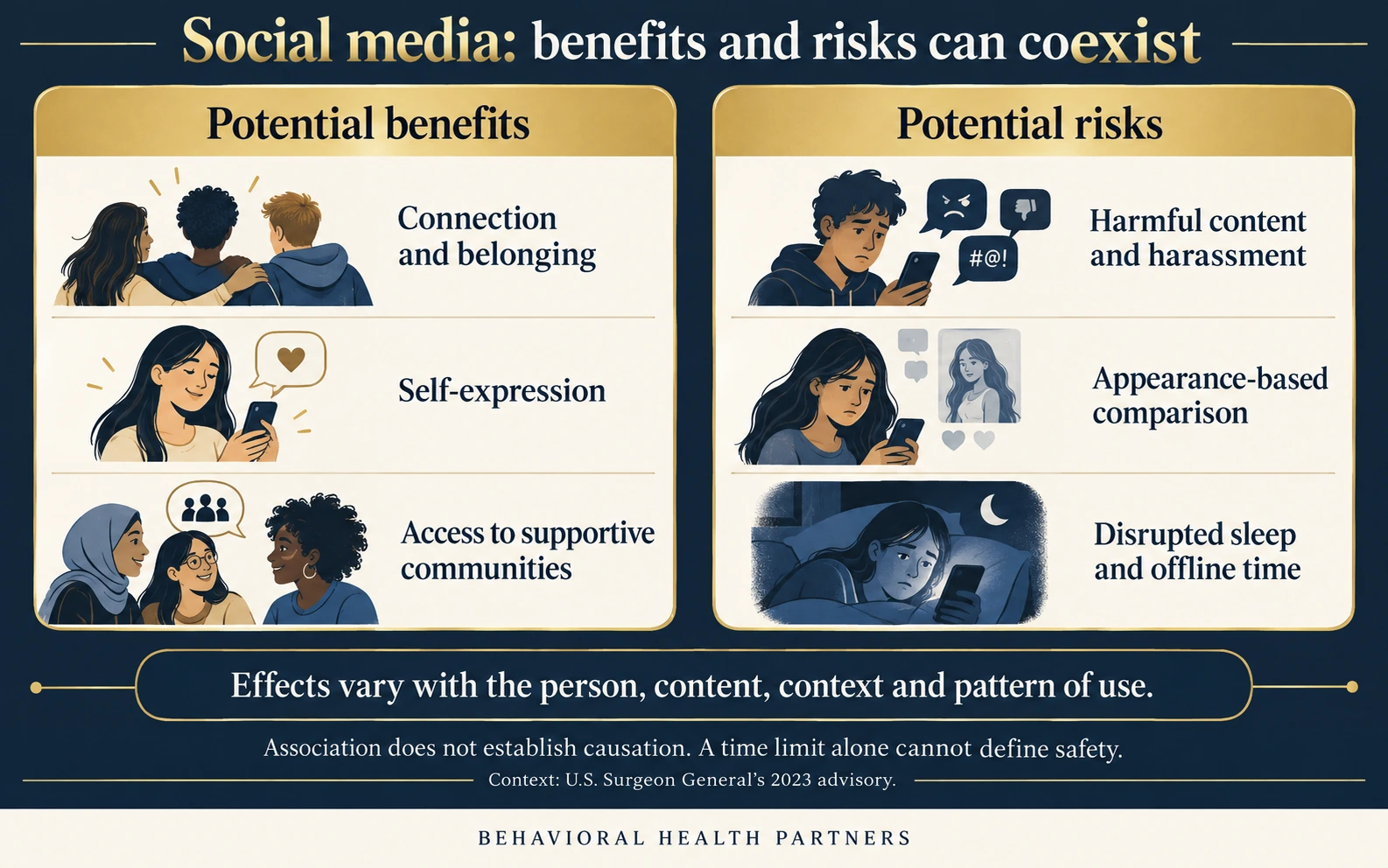
That is why the research keeps landing on one conclusion: social media can both support well being and contribute to real psychological distress. It connects people across long distances and puts mental health information in front of teens who would never pick up a pamphlet. It also amplifies social comparison, online abuse, and the pressure to perform a curated version of your own life. Which side you land on depends on how you use it, how much, and who you are when you log on.
Social Media Mental Health Statistics Worth Knowing
The numbers below come from the U.S. Surgeon General, Pew, and peer-reviewed research.
Statistic
What it tells us
Up to 95% of youth ages 13 to 17 use social media
Widespread use is the baseline; opting out is rare
Teens average 3.5 hours per day on social media
More than 53 full days a year
46% of adolescents say social media makes them feel worse about their body image
Nearly half feel worse, not better, after scrolling
3+ hours a day doubles the risk of poor mental health outcomes
The dose matters
22% of teens name social media as the main factor hurting teen mental health
Teens rank it the top culprit themselves
55% of parents are extremely or very concerned about teen mental health today
Parents feel the shift at home
34% of teens get mental health information on social media; 63% of those call it an important source
The platforms causing harm are also where teens look for help
45% of teens say social media platforms hurt their sleep; 40% say they hurt productivity
Teens report the costs unprompted
According to the Pew Research Center, teens are not naive about any of this. They see the negative impact in their own lives and keep scrolling anyway. This is not a willpower problem. It is a design problem.
What the Surgeon General's Advisory Says
In 2023, the U.S. Department of Health and Human Services released the Surgeon General's advisory on social media and youth mental health, a formal warning reserved for serious public health threats. It concluded that adolescents with more than three hours of daily social media use face double the risk of poor mental health outcomes, including symptoms of depression and anxiety.
Read that again: double the risk, below the current teen average.
The surgeon general did not claim social media is all bad. The advisory acknowledges real benefits for connection and belonging. What it demands is that we stop treating an unregulated experiment on adolescent well being as a normal childhood.
The Negative Effects of Social Media on Mental Health
The negative effects of social media are not one thing. They are several distinct mechanisms, and they compound each other. Multiple studies keep pointing at the same four.
Social Comparison, Self Esteem, and Body Image
Social media is a comparison machine. You measure your unfiltered life against everyone else's highlight reel, and the math never favors you. That gap feeds low self esteem, and the strong link to body image problems is well documented: 46% of adolescents say scrolling leaves them more insecure about their bodies.
Social media turns ordinary social pressures into a 24-hour broadcast. People feel pressure to post, to respond instantly, and to constantly check social media so they never miss anything. That fear of missing out is a documented driver of social anxiety, and notifications exist to exploit it.
For people already prone to social anxiety, the apps offer a tempting trade: connection without face-to-face risk. The trade backfires. Online-only interaction becomes avoidance, and avoidance is the fuel social anxiety runs on. What looks like a coping tool ends up fueling anxiety instead.
Cyberbullying: Negative Experiences That Leave Lasting Scars
Bullying used to end at the front door. Now it follows a kid's phone into their bedroom. Cyberbullying, which the federal government defines as sending, posting, or sharing harmful or false content about someone, includes harassment, exclusion, and spreading hurtful rumors that reach an entire school in an hour. These negative experiences can leave lasting emotional scars because they are public, permanent, and inescapable. Victims of online abuse carry an increased risk of anxiety, depressive symptoms, and school avoidance.
Screen Time, Sleep Problems, and What the Scroll Displaces
Every hour of social media screen time used to belong to something else: sleep, exercise, offline activities, face-to-face friendship. Sleep is the most consistent casualty. Late-night social media use delays bedtime, and the light and stimulation disrupt sleep quality even after the phone use stops. Sleep problems then feed irritability, poor concentration, and depression, which makes the next day's scrolling feel like relief. Teens who protect sports, hobbies, and in-person time alongside their app usage fare far better than those whose leisure hours migrate online.
Depressive Symptoms and Suicide Related Outcomes
The most sobering research tracks what happened after smartphones became universal. Work published in the journal Clinical Psychological Science found that depressive symptoms and suicide related outcomes among U.S. teens rose sharply after 2010, the same window in which social media adoption spread, and suicide rates among young people climbed in the same period. Correlation is not proof of cause, and researchers still debate how much weight social media carries in these mental health problems. But the pattern is consistent enough that no serious clinician dismisses it.
It matters to say this plainly: if you or someone in your family is struggling, help exists and it works. We cover where to find it below.
Social Media and Teen Mental Health: Why Young People Are Hit Hardest
Adolescence is the window when identity, belonging, and peer approval matter most, and social media monetizes all three. Teen social media use collides with a brain whose impulse control is still under construction, which is why adolescent mental health absorbs damage adult users shrug off. The frontal cortex that says "put it down, it is 1 a.m." is not finished until the mid-twenties, so young adults are not fully in the clear either. That developmental collision is why youth mental health sits at the center of this entire debate.
There is a hopeful wrinkle in the teen data. Remember that 34% of teens get mental health information on social media. Teens in distress reach for a search bar before they reach for a parent, and credible blogs about mental health and honest creators reach kids traditional outreach misses. The platform is not the enemy. The unmanaged, algorithm-steered version of it is.
Why Social Media Sites Are So Hard to Put Down
None of this is accidental. Social media sites run on the same variable-reward mechanics as slot machines. Every pull-to-refresh is a lever: sometimes a like, sometimes nothing, and the unpredictability keeps the loop spinning. Infinite scroll and autoplay removed the stopping points, and streaks punish you for leaving. Different platforms tune the machine differently, Facebook use among older adults, TikTok among teens, but the goal is identical: maximize screen time. People who say quitting feels harder than it should are not weak. They are outmatched by very good engineers.
When Use Becomes Social Media Addiction
Most people who scroll heavily are not addicted. But for some, social media use crosses into compulsion: reaching for the phone without deciding to, failed attempts to cut back, restlessness when offline, lying about time spent, and continued heavy social media use despite obvious damage to sleep, school, work, or relationships.
Social media addiction sits inside a larger picture of compulsive technology use, and we wrote a complete guide to digital addiction covering causes, warning signs, and how treatment works. If this sounds like you or your kid, start there. Mental health issues rarely improve while the compulsion driving them goes unaddressed.
The Positive Aspects: When Social Media Platforms Help
Honesty cuts both ways: social media platforms genuinely help some people.
The benefits are real: connection with family members across long distances, and communities for people whose struggles are rare or stigmatized. Online communities reduce isolation in ways nothing else does; a person in recovery in a rural town can find a hundred people who understand them tonight. People in recovery sharing their stories openly is one of the most powerful forces breaking the stigma of addiction and mental illness. Our video on how leaders can help end the mental health stigma makes the same case.
The difference between help and harm comes down to three things: active use instead of passive scrolling, communities built on support instead of comparison, and a hard limit on the dose.
How to Build Healthy Social Media Use
Healthy social media use is not about deleting every account and moving to a cabin. It is about making the dose and the diet deliberate.
Then fix the diet, and re examine who you follow. Unfollow accounts that reliably make you feel worse and add ones that teach you something or make your day more fun. Turn off nonessential notifications so you decide when to check, not the app. Create phone-free spaces, especially meals and the hour before bed, and protect offline activities like appointments. Small structural changes beat willpower; your overall wellbeing will tell you within two weeks.
Healthy pattern
Harmful pattern
Logging on to message specific people
Opening the app by reflex, no purpose
Time-boxed sessions with notifications off
Constant checking across the whole day
Following accounts that inform or encourage
Following accounts you compare yourself to
Phone out of the bedroom at night
Scrolling as the last act before sleep
Sharing honestly with people you trust
Performing a curated self for strangers
For Parents: Protecting Young People Without Losing Them
Delay is the most protective move available: every year a child does not have an algorithmic feed is a year of development that happens offline. When social media use does begin, parental control apps and time limits on your child's phone are reasonable tools, not spying, especially for younger teens. Pair them with the conversation that matters: what they see, who they talk to, and what they share online, discussed with curiosity instead of interrogation.
Model it too. A parent who scrolls through dinner has no standing to lecture, and kids know it. Family norms, devices docked overnight and screen-free meals, protect the whole household's well being, including yours.
When to Reach Out to Mental Health Professionals
Self-help has limits. If low mood, anxiety, or compulsive checking persists for weeks despite real changes, if grades, work, or relationships are sliding, or if social media has become a window into self-harm content, it is time to bring in mental health professionals. For teens, an evaluation is urgent any time you see hopelessness, giving away belongings, or withdrawal from everything they used to love.
Mental health problems respond to treatment. The people who get better are not the ones who struggled least; they are the ones who asked soonest.
What This Means for Behavioral Health Providers
If you run a treatment program, everything above is your intake pipeline talking. Youth mental health needs are rising, families search online before they ever call a facility, and social media use now comes up in nearly every clinical conversation with teens and young adults. The broader shifts are mapped in our breakdown of mental health industry trends.
Programs are responding on two fronts. Clinically, more centers screen for problematic social media usage at intake; if you are designing services around this need, our guide on how to build a behavioral health program walks through the process from concept to census, and our behavioral health consulting team builds these programs with operators every week. Operationally, your center has to show up where these families search. That is the discipline of behavioral health marketing: meeting a frightened parent mid-search with credible answers instead of ads. Your own channels can be part of the solution too, and our playbook on social media marketing for addiction treatment centers treats dignity as a requirement, not a constraint.
FAQ: Social Media and Mental Health
How many hours of social media per day is too much?
Roughly three hours a day is the danger line for adolescents. The Surgeon General's advisory reports that teens above that line face double the risk of poor mental health outcomes, and the average teen already spends 3.5 hours. For adults, experiments capping social media use near 30 minutes show measurable mood benefits.
Does quitting social media improve mental health?
Reducing it clearly does. A University of Pennsylvania study found that limiting social media use to about 30 minutes a day reduced loneliness and depression within three weeks, and a 2024 study found a one-week break helped young women feel better about their appearance. Quitting entirely is not required; capping the dose and curating the feed captures most of the benefit.
Does social media have a negative impact on all teens?
No. Many teens use social media without measurable harm, and some, especially isolated or marginalized kids, benefit from online community. Risk concentrates among heavy users, kids with existing mental health issues, girls facing appearance-based comparison, and anyone experiencing cyberbullying. The real question is what it is doing to your kid.
What are the signs social media is hurting your mental health?
Watch for feeling worse after scrolling, checking apps compulsively without enjoying them, losing sleep to late-night use, and withdrawing from offline activities and friendships. In teens, add slipping grades, secrecy about their phone, and mood crashes tied to what happens online. If several of these sound familiar, cap the dose for two weeks and see what changes.
Why does social media cause social anxiety?
It combines permanent public performance with instant, countable judgment. Every post asks "how will this be received," and likes answer with a number. That trains the brain to over-monitor social evaluation, which is the core of social anxiety. Choosing online interaction over in-person contact then removes the practice that builds real-world confidence, so the anxiety grows.
The Takeaway
Social media is not leaving. The honest summary: the dose makes the poison, the design makes the dose hard to control, and the youngest users carry the most risk. Cap the time, curate the feed, protect sleep and well being, and take warning signs seriously, because behind every statistic in this guide is a kid lying awake at 1 a.m. comparing their real life to somebody's highlight reel. They deserve adults, and providers, who understand the machine they are up against and help them build better lives on the other side of the screen.
If you run a behavioral health organization and want your center to be the credible answer families find when they search, we should talk.
Adam Vibe GuntonFounder and Managing Partner, Behavioral Health Partners
Adam Vibe Gunton is an addiction recovery expert, entrepreneur, marketer, brand strategist, and speaker dedicated to advancing the behavioral health industry. As Founder and Managing Partner of Behavioral Health Partners, he has worked across treatment-center development, operations, branding, PR, SEO, advertising, and growth strategy. Combining professional experience with his own lived experience in recovery, Adam brings a unique perspective on how treatment organizations can build trusted brands, reach more people, and create a greater impact.
Published August 20, 2026 · Updated September 28, 2026
One Conversation. No Pitch.
Schedule Your Free Discovery Call
Thirty minutes on video with Adam directly, camera on, screen-sharing your own online presence and your top three local competitors. If we are not the right partner, we will tell you that too.