How to Get Facebook Followers for Drug Rehab Centers
A follower is someone who chose to keep hearing from you, and that outlasts any ad budget. We cover why Facebook followers matter for a treatment center, and optimising your page before you chase growth. We cover posting consistently with a content calendar, content that actually earns follows, engaging to grow, building a strong local presence, cross-promotion, and using paid social to accelerate.
Building a Facebook following is one of the most durable ways an addiction treatment center can stay visible to the families who need it, long after an ad budget runs out. A follower is someone who chose your page, sees your posts, and remembers your name when a loved one is ready for help. That is why organic growth belongs at the center of any real social media marketing for treatment centers plan, working alongside the paid social media campaigns our team runs for clients. This chapter walks through the organic tactics that actually move follower counts for rehab centers, without gimmicks and without putting your license at risk. If you prefer to watch first, our short video on growing a rehab center's Facebook audience covers the same growth secret that addiction treatment centers use.
Facebook still has the reach to justify the effort. According to DataReportal, Facebook had about 198 million users in the United States in late 2025, roughly 71 percent of adults, which keeps it among the most widely used social media platforms. For a treatment center, that means the parents, spouses, and adult children who make most admission decisions are already on the platform every day. Your job in social media marketing is to become a page they choose to follow, then to keep earning that follow with content worth their time.
Why Facebook Followers Matter for Addiction Treatment Centers
Followers are not a vanity number. For addiction treatment centers, each follower expands the audience that sees your social media content organically, which lowers what you eventually spend on paid advertising to reach those same people. A person who follows your page has raised a quiet hand and said they want to hear from you, whether they are researching treatment options for themselves or for someone they love. That is the difference between social media marketing that builds an asset and advertising that only rents attention, and it is why follower growth sits at the core of digital marketing for rehab centers.
Facebook is also where local trust gets built for addiction treatment centers. Recovery is deeply personal, and families choose a center they feel they already know. The Pew Research Center has found that Facebook use is especially strong among women, at roughly 76 percent compared with 59 percent of men, and mothers and wives are very often the ones searching first for a rehab. Followers also compound: a person who follows your page today may not need help for a year, but when the moment comes, your center is the one already in their feed, sharing addiction recovery content that kept you familiar. That is the advantage organic social media gives a treatment center that paid ads alone cannot buy.
Complete and Optimize Your Facebook Page First
Before you chase new followers, make sure the page they land on earns the follow. Many rehab centers lose potential clients to a half finished profile that fails to build credibility in the first three seconds.
Fill in every field. Your page name should be your center's real name, your category should reflect behavioral health or addiction treatment, and your About section should state clearly which treatment services you offer and where. Add your service area, your hours, and links to the key pages and landing pages on your website so an interested visitor can explore your services and go deeper in one click. Use a recognizable profile photo, usually your logo, and a cover image that shows your space or your team rather than a generic stock scene. Every one of these details signals to potential clients that a real, established center stands behind the page.
Turn on a clear call to action button. A Send Message or Learn More button gives a ready family an obvious next step, so make sure its destination loads fast and answers the questions a worried parent will have. In behavioral health, the gap between a page that looks abandoned and one that looks trusted is often the gap between a scroll and a follow.
Post Consistently With a Content Calendar
Consistency is the single biggest driver of organic follower growth, and it is where most addiction treatment centers fall short. Facebook rewards pages that show up regularly, and audiences follow accounts they can count on to appear in their feed.
You do not need to post every day. A sustainable rhythm of a few quality posts each week, planned in advance, beats a burst of daily activity followed by weeks of silence. Build a simple content calendar so your team always knows what you will create and when. Our chapter on how to schedule social media posts walks through the best tools for planning a steady stream across social media platforms, so a small team can stay consistent without living inside the app.
Consistency also protects quality and compliance. When you plan ahead, you can review every post for accuracy and tone before it publishes, and you can plan content that promotes each of your treatment services in turn, rather than writing something rushed in the moment. For a full library of post ideas built for treatment centers, see our chapter on social media posts for addiction treatment centers, which gives your team a running head start on what to create each week and how to repurpose it across platforms.
Create Content That Earns Followers
People follow pages that give them something. For an addiction treatment center, the content that grows an audience educates, reassures, and humanizes your program. This is the heart of social media marketing that actually works in behavioral health.
Lead with education and recovery tips. Answer the questions families actually ask about treatment options, insurance, and what the first days of care look like. Share thought leadership from your clinical team so your page becomes a trusted source rather than a billboard. Behind the scenes looks at your community, your staff, and your space help a nervous family picture themselves walking through your doors. The strongest social media content for addiction treatment centers usually falls into a few buckets: education about treatment and recovery, real stories shared with consent, video content that humanizes your brand, community and event highlights, and clear answers about your services and insurance. Rotate across these so your page stays varied, and drug rehabs of every size will find this mix easier to sustain than chasing viral moments. This is the kind of content that people save, share, and remember.
Video content deserves special attention. Video marketing consistently earns more reach and engagement than text or images on Facebook, and short-form video in particular is favored by the algorithm, so brief clips often travel furthest of all. A clinician explaining a concept in sixty seconds, a short tour of your space, or a quick message of hope can reach far beyond your current followers. Link your longer videos rather than relying only on native uploads, and keep a steady cadence so followers know more is coming. For treatment centers, video content is often the single fastest lever for both follower growth and engagement.
Real stories are the most persuasive content you can share, and also the most sensitive. An alumni story or testimonial should never be posted without explicit written consent, and it must reflect that person's honest, actual experience. The Federal Trade Commission's endorsement guides require that testimonials reflect the honest opinions and genuine experience of the person giving them, and that any material connection be disclosed. When you honor those rules, a real recovery story becomes both compliant and deeply moving, and stories like these are what turn casual followers into advocates for your center.
Engage to Grow Your Audience
Following is a two way street. Pages that engage grow faster than pages that only broadcast, because every interaction signals to Facebook that your content deserves wider reach.
Reply to comments and messages promptly and warmly, without ever confirming that anyone is or was a client. A thoughtful public reply signals to everyone watching that a real, caring team stands behind the page. Ask questions in your posts to invite comments, and encourage your current followers to tag someone who might benefit, because every comment and every tag expands the reach of that post to a new network and puts your center in front of new potential clients. The more you engage, the more the platform rewards you.
Collaboration expands your audience too. Partner with local businesses, healthcare referral sources, alumni networks, and trusted creators in the recovery community to co-create content and reach followers you could never find alone. A single post shared by a respected local partner can introduce your center to hundreds of nearby families at once.
Facebook Groups can extend your community further. A well run group focused on family support or recovery education gives people a reason to connect around your center rather than simply consume its posts. Engagement builds the sense of community that keeps followers loyal and encourages them to bring others in. When people feel seen and supported by your page, they follow, they share, and they refer others in recovery to you.
Build a Strong Local Presence
Most of the people your center can actually help live within driving distance, so your Facebook growth should lean local. A national follower who will never enter treatment near you is worth far less than a nearby family who might. This is one place where local drug rehabs have an advantage over national brands, because your community already knows your name and your services. Local campaigns, both organic and paid, reach these families across the platforms they use every day, and behavioral healthcare thrives on that kind of nearby trust.
Post about your local community, tag local events and partners where appropriate, and use location details in your content so nearby users recognize you as their local resource. Pair your Facebook presence with an optimized Google Business Profile so nearby families find your addiction treatment center across the platforms they actually search. Encourage staff and alumni, with permission, to share your page with their own networks, which are overwhelmingly local. A strong local presence turns your page into a recognized community fixture, and community recognition is what turns viewers into followers and followers into admissions.
Invite and Cross Promote Across Every Platform
The fastest early followers are people who already know you. Invite the connections your center and its team have built. Cross promote your Facebook page everywhere your treatment center already has a presence, so your different platforms feed one another.
Add follow buttons and links to your website, your email signatures, your newsletters, and your other social media platforms. Mention your page in intake conversations and on printed materials. When you publish a helpful blog post or video, share it to your page and back to your website so traffic flows both directions. Facebook's own free business tools make much of this easy, from page invites to scheduling. A simple, tasteful giveaway or community contest, run within your ethical guidelines, can also attract genuine new followers when it fits your brand. Every touchpoint is a chance to convert someone who already trusts you into a follower who hears from you regularly.
Think of Facebook as one connected part of your center's wider marketing. The families who follow your page also see your website, your Google listing, your videos, and your ads. When all of those healthcare marketing channels carry the same voice and point back to the same services, drug rehabs and larger rehab centers alike build a presence that feels bigger than any single platform, and both your organic content and your paid campaigns get more effective.
Use Paid Social to Accelerate Follower Growth
Organic growth and paid advertising work best together. Once your page and content are strong, a modest paid budget can put your best posts in front of thousands of new local users and accelerate follower growth. Paid social does not replace organic social media marketing, it multiplies it.
Facebook is a powerful advertising platform, and it is not the only one. Many addiction treatment centers pair Facebook ads and social ads with Google ads so the same families see them whether they are scrolling or searching. Facebook ads and Google ads reach people at different moments, and running ads on both advertising platforms compounds the effect. On every advertising platform, the work is the same: identify the right people, then reach them with ads they trust. Boosted posts and page campaigns amplify your strongest video content, while lookalike audiences and specific audiences built from your existing followers help Facebook identify more people who resemble the families you already reach. You can build audience segments around location, interests, and behavior so your ads focus spend on the people most likely to enter treatment for drug or alcohol addiction.
Getting the ad creative, the ad copy, the targeting, and the landing pages right for behavioral health is specialized work that general marketers miss, and the rules for behavioral health ads change often. Meta requires LegitScript certification before a center can run addiction treatment ads at all, and every piece of ad creative must clear a strict health and wellness policy. That policy has teeth: ads must avoid before-and-after imagery, must not use fear-based messaging, and must not use personal targeting language that implies Meta knows something about the user. You also cannot build custom audiences from patient data, because doing so violates HIPAA and can trigger penalties reaching into the millions of dollars. Sloppy ads get rejected or waste budget. Strong ads, matched to strong landing pages, turn paid reach into real admissions and improve performance across your whole marketing.
This is where paid and organic hand off to each other. Our team runs compliant paid social campaigns for addiction treatment centers that feed the same audience your organic content nurtures, so if you want the bidding, the audience strategy, the ad copy, and the ad creative handled by a partner who knows recovery, that service page is where to start. Organic follower growth makes every advertising dollar work harder, because warm followers convert on paid campaigns far better than cold audiences.
Measure What Works and Improve
You cannot grow what you do not measure. Facebook's built in insights show you which posts earned the most reach, engagement, and new followers, and that data should guide the content you create next.
Use your insights to identify what works. If video content outperforms images, create more video. If a topic drives comments and shares, create a series around it. If real recovery stories move people, plan more stories with proper consent. Track follower growth month over month, and compare what your organic posts and your paid campaigns each deliver so you can improve performance and shift effort toward whatever earns real engagement and reaches new potential clients. These free analytics are among the most valuable resources a treatment center has, and using them well is how the strongest addiction treatment centers pull ahead of competing rehab centers on social media.
Keep Every Post Compliant
Growth means nothing if a single careless post exposes your center to a privacy violation. The rules that protect patients also protect your reputation and your ability to keep marketing at all.
Never confirm that anyone is or was a client, and never post protected health information, including recognizable photos, names, or care details, without documented written authorization. HIPAA requires that written authorization before any use of protected health information for marketing. Train everyone who touches the page, and when you are unsure whether something is safe to post, do not post it. Our pillar guide on building a social media marketing plan covers the full compliance framework for treatment centers across every social media platform.
Compliance is not the enemy of growth. A center that families trust to handle sensitive stories with care is exactly the kind of page they choose to follow, and that trust is the real engine behind every follower you earn.
Grow Your Facebook Audience With a Partner Who Knows Recovery
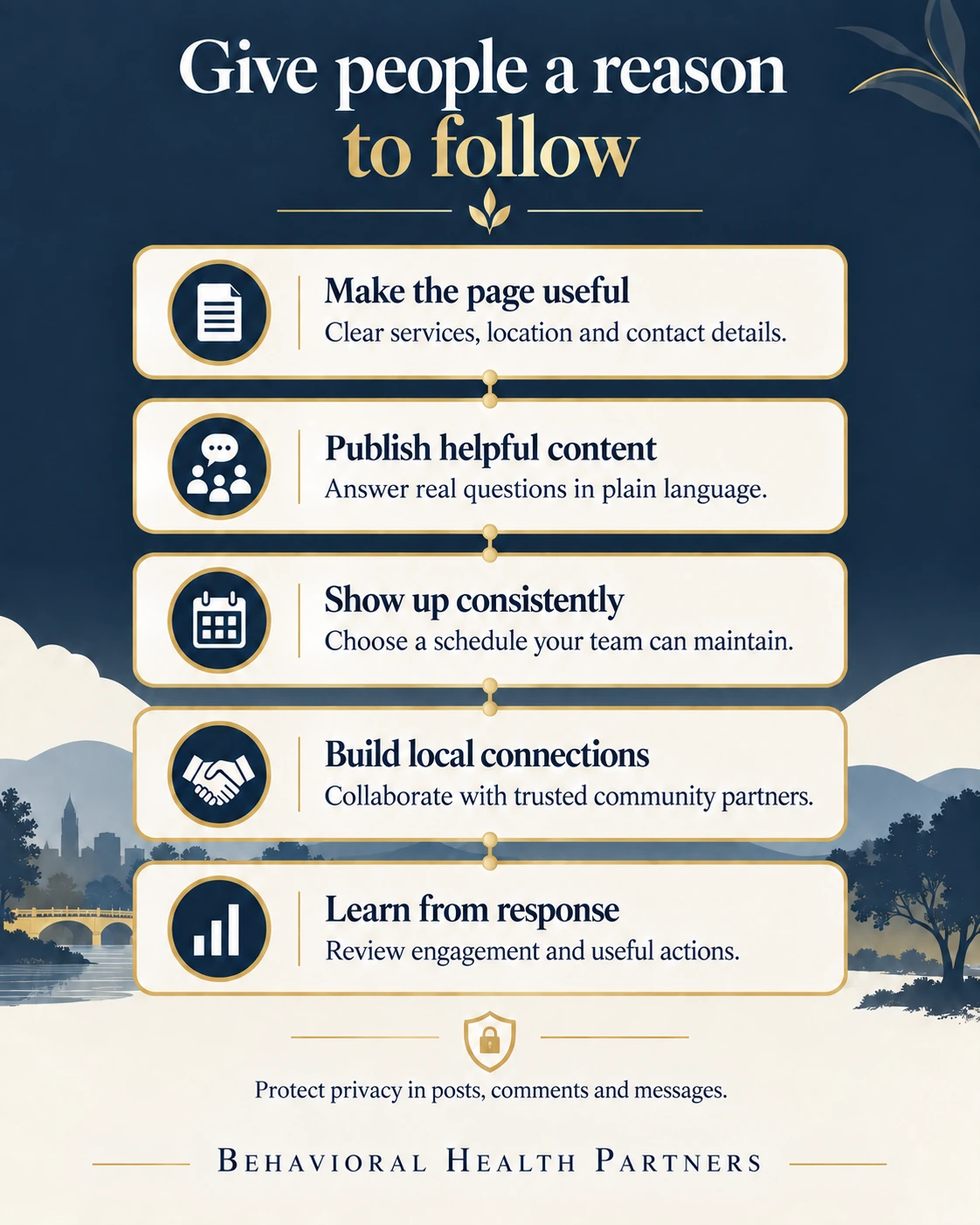
Organic follower growth is patient work that pays off for years. A complete page, consistent and human content, real engagement, a strong local presence, and steady measurement will build a Facebook audience that keeps your addiction treatment center visible to the families who need it most. Add compliant paid social on top, and you have a social media engine that grows followers and admissions at the same time.
If you want help building that audience faster, our team pairs organic social media strategy with compliant advertising and full digital marketing to grow your followers, your engagement, and your admissions together. We help treatment centers create content that connects, promote the services that fill beds, and reach new clients across every platform that matters. Request a strategy conversation through our rehab marketing team.
Frequently Asked Questions
How can I get more Facebook followers for a rehab center for free?
Focus on the fundamentals that cost only time. Complete your page fully, create a few quality pieces of content each week on a consistent schedule, use video, reply to every comment, and invite the connections your team already has. A strong local presence and genuinely helpful content grow followers steadily without any ad spend, and those followers tend to be the local families most likely to become clients. Free organic growth and paid advertising are not opposites, but the organic work should come first.
Should a treatment center buy Facebook followers?
No. Purchased followers are fake or disengaged accounts that never become clients, they damage your reach because they do not interact with your posts, and they undermine the trust your page depends on. Real, organic followers who chose your center are worth far more than a large but empty number. Invest the same effort in content and engagement instead, and let your audience grow with people who might actually enter treatment.
How often should a rehab center post on Facebook to gain followers?
Consistency matters more than volume. A sustainable rhythm of a few quality posts per week, planned in a content calendar, beats a burst of daily posts followed by silence. Choose a schedule your team can maintain, use scheduling tools to stay steady, and let your Facebook insights guide adjustments over time. Steady posting is what compounds into real follower growth for treatment centers.
Can we run Facebook ads to grow our page faster?
Yes, once your organic foundation is in place. Boosted posts and page campaigns can accelerate follower growth, but treatment centers must be LegitScript certified to run addiction treatment ads, and the ad creative behind those ads must meet Meta's health and wellness policy. Facebook ads for rehab centers perform far better when they target lookalike audiences built from real followers, and many centers run Facebook ads and Google ads together for wider reach. Because the compliance and targeting rules that govern these ads are specialized, most centers grow fastest by pairing organic content with paid social media campaigns and digital marketing managed by a partner who knows the behavioral healthcare space and its ad policies.
Adam Vibe GuntonFounder and Managing Partner, Behavioral Health Partners
Adam Vibe Gunton is an addiction recovery expert, entrepreneur, marketer, brand strategist, and speaker dedicated to advancing the behavioral health industry. As Founder and Managing Partner of Behavioral Health Partners, he has worked across treatment-center development, operations, branding, PR, SEO, advertising, and growth strategy. Combining professional experience with his own lived experience in recovery, Adam brings a unique perspective on how treatment organizations can build trusted brands, reach more people, and create a greater impact.
Thirty minutes on video with Adam directly, camera on, screen-sharing your own online presence and your top three local competitors. If we are not the right partner, we will tell you that too.