What Does a Behavioral Health Consultant Do, and Why Hire One?
What a behavioral health consultant actually does, and when hiring one pays for itself. We cover the scope of the role across licensing, accreditation, reimbursement, compliance and program design, the difference between a consulting firm and an independent consultant, and the questions that separate a genuine operator from someone selling slide decks. Written for leaders deciding whether outside help is worth the line item.
Running a behavioral health organization has never been more complex. Between licensing, accreditation, reimbursement, compliance, and program design, the operational demands can pull leaders away from the reason they started: caring for people. A behavioral health consultant exists to carry that weight, and the right one can be the difference between a struggling program and a thriving one. If you are weighing whether to bring in outside help, our behavioral health consulting services offer professional, hands-on behavioral health services built to guide organizations through exactly these challenges, and this article explains what a behavioral health consultant does and when hiring one pays off.
What Is a Behavioral Health Consultant?
A behavioral health consultant is a seasoned professional who helps behavioral health organizations and treatment programs plan, launch, operate, and improve their programs. Unlike a clinician who treats patients directly, a consultant works on behalf of the organization itself, solving the strategic, operational, financial, and clinical challenges across their behavioral health organizations that determine whether a program can deliver high quality care and stay sustainable. Their clients range from small mental health clinics and outpatient behavioral health providers to hospitals, health systems, and government agencies that support people living with mental illness, substance abuse, and co-occurring disabilities.
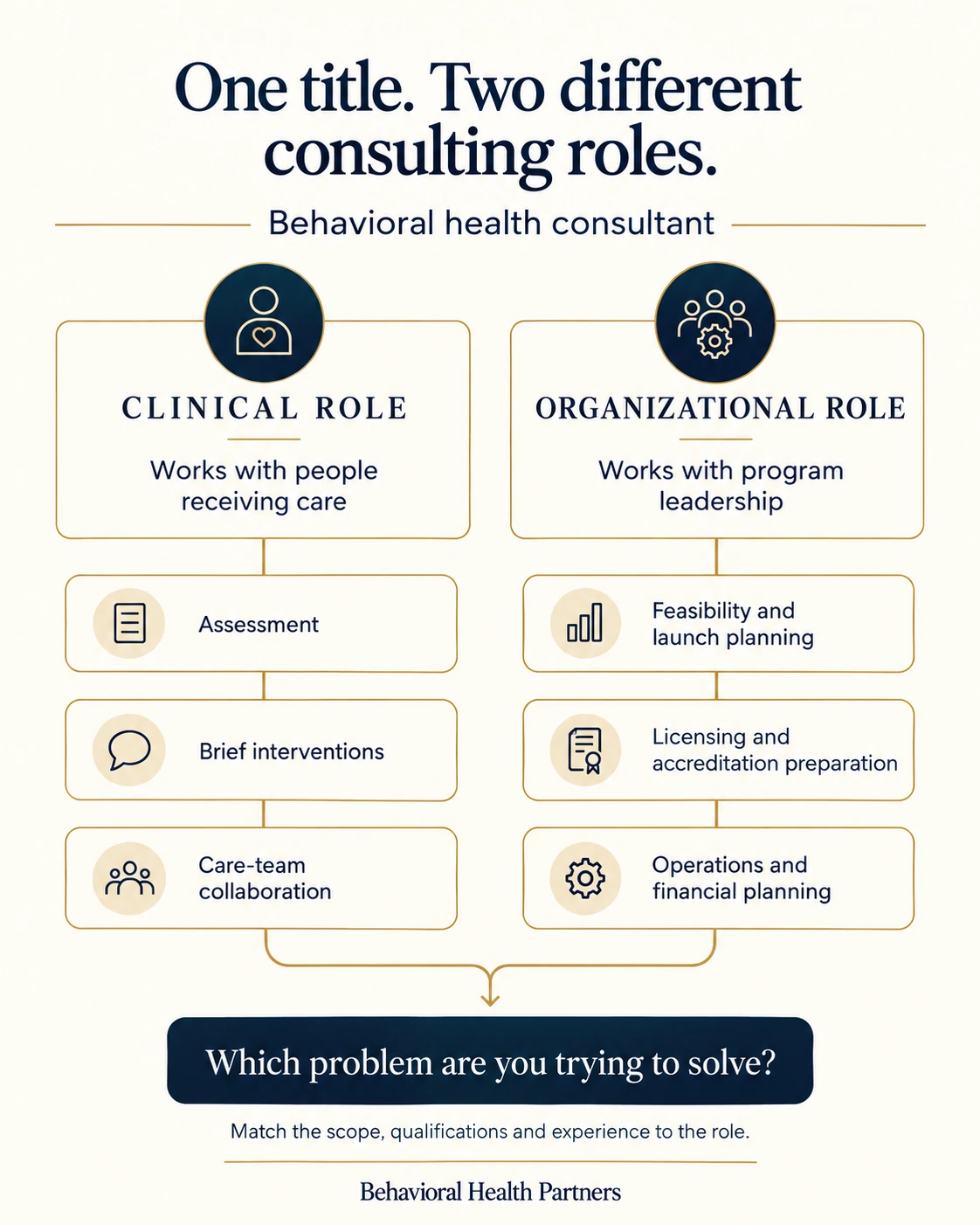
It helps to know that the title carries two meanings. In a clinical, integrated care setting, a behavioral health consultant is a licensed clinician embedded in a medical team who assesses and treats mental health issues on site. These embedded consultants deliver short, practical interventions, typically lasting 15 to 30 minutes, rather than long-term therapy. They collaborate with the medical team, connect patients to specialty mental health services when needed, educate patients on coping skills and stress management, and help reduce stigma by offering support inside a regular medical office. Because they address behavioral health factors alongside physical health, this model recognizes the link between mental and physical health and often improves medical outcomes.
The second meaning, and the focus of this article, is the organizational behavioral health consultant: an expert who advises the organization itself rather than treating patients. Good organizational consultants bring a mix of clinical understanding and business skills. They know the regulations that govern behavioral health and substance use services, the payment landscape that funds them, and the accreditation standards that legitimize them. That combined know-how is hard to build in-house, which is why so many mental health providers, hospitals, and health systems bring in outside help rather than learning every rule the hard way. The best behavioral healthcare and substance abuse consultants pair deep mental health knowledge with the business skills to turn that clinical insight into sustainable programs.
What Does a Behavioral Health Consultant Do?
The work spans the full life of a program. A behavioral health consultant typically supports an organization across several core areas, from core services and program development to compliance and financial strategy. The right professional brings solutions and support to mental health and substance use providers, treatment programs, clinics, and agencies alike.
They guide licensing and start-up. From a feasibility study that tests whether a program will work in your market to a detailed state licensing roadmap, a consultant helps you open the right way. They prepare you for accreditation, walking your team through Joint Commission accreditation so you meet the standards payers and referral sources expect. They guide the shift to value-based care, since behavioral health organizations increasingly face the challenge of transitioning to value-based payment, and a readiness assessment across core function domains shows where you stand. They build the financial foundation, developing a proforma and a full business plan that turn a vision into numbers investors and lenders trust.
Beyond launch, consultants strengthen operations and services. Their services span program design, quality improvement, compliance, staff development, and hands-on assistance, and it often includes needs assessments, program evaluation, and the data collection that shows whether a program is working. They streamline operations, improve compliance, and identify the risks that quietly undermine financial health and long-term financial sustainability. They conduct assessments, develop strategies, provide ongoing assistance, and help leaders make data-informed decisions about growth, innovation, and accountability. Whether the goal is opening a new site, fixing a struggling one, or preparing for a feasibility study before you commit capital, the consultant's job is to bring proven solutions, services, and support to problems your team is facing for the first time.
The complexity here is real. Meeting a model like SAMHSA's Certified Community Behavioral Health Clinic standard, for example, requires coordinated, comprehensive services, crisis care, a crisis lifeline, and ongoing technical assistance and resources that few organizations can assemble alone. Consultants also help programs move toward integrated care, connecting mental health and substance use care with primary care to improve patient outcomes. A good consultant makes all of that achievable.
Why Hire a Behavioral Health Consultant?
The honest answer is that expertise saves you time, money, and risk. Behavioral health is one of the most heavily regulated corners of the healthcare system, where even experienced healthcare professionals struggle, and mistakes are expensive.
Consider reimbursement. The CMS Behavioral Health Strategy shows how access, quality, and payment rules across Medicare, Medicaid, and private insurance keep shifting, and how misaligned incentives can penalize the very services you want to provide. Government funding and payment rules change often, and navigating them alone often means slower approvals, denied claims, and missed opportunities. An experienced consultant has already solved these problems for other behavioral health organizations and brings that pattern recognition to yours, along with the resources and crisis-ready solutions to respond promptly when rules change.
Hiring an expert also protects your focus. When a consultant manages the licensing timeline, the accreditation prep, and the financial modeling, your clinical leaders and their team can spend their energy on patient care, families, and the community you serve rather than on paperwork. Access to that mental health expertise is critical for programs that want to expand without sacrificing quality. And in a competitive market, moving faster and more confidently than the program down the road is a real advantage that supports future growth. The value of a consultant is not just the problems they solve, but the costly ones they help you avoid, so your organization can achieve its mission and improve patient outcomes at the same time.
Behavioral Health Consulting Firms Versus Independent Consultants
You will find both independent behavioral health consultants and larger behavioral health consulting firms and companies. Independents can offer close, personal attention and deep niche knowledge. Firms bring a broader team, more capacity, and the ability to support many workstreams and clients at once, from clinical program design and operations to financial planning and development. Larger behavioral healthcare organizations often prefer this model.
The right choice depends on the scope of your challenges. A single licensing question may need one specialist, while opening a new facility usually benefits from a team that can develop strategies and manage strategy, compliance, and finances together under one accountable partner. Either way, the goal is the same: solutions and services that fit your organization and the clients you help, now and in the future.
How to Choose the Right Behavioral Health Consultant
Look for behavioral health specialists, not generalists. The regulations, payment models, and clinical realities of this field are specific, and a consultant who has actually opened and operated behavioral health programs will serve you better than a broad management consultant. Ask about outcomes, references, and the exact services and solutions included. Make sure their expertise matches your stage, whether you are planning your first program or developing and scaling an established organization.
Above all, choose a partner who is invested in your success rather than a vendor selling hours. The best consulting relationships feel like an extension of your own team.
Work With Behavioral Health Experts Who Have Done It Before
If you are ready to plan, launch, or strengthen a behavioral health program, working with the right expert turns a daunting process into a clear path. Our team has guided behavioral health organizations and providers through licensing, accreditation, and everything in between, keeping their focus on treatment and their clients while we manage the rest. Start the conversation on our open a rehab page and put experienced behavioral health consultants to work for your organization.
Frequently Asked Questions
What does a behavioral health consultant do?
A behavioral health consultant helps organizations plan, launch, operate, and improve their programs. That includes feasibility studies, licensing, accreditation preparation, financial modeling, program design, compliance, and operational strategy. Rather than treating patients, the consultant works on behalf of the organization to solve the strategic and financial challenges that determine whether a program succeeds and stays sustainable.
Is a behavioral health consultant the same as a therapist?
No. A therapist provides clinical care to patients, while a behavioral health consultant advises the organization itself. Many consultants have clinical backgrounds, which helps them understand the work, but their role is strategic and operational, focused on how a behavioral health program is built, funded, accredited, and run rather than on direct treatment.
Why should I hire a behavioral health consultant instead of handling it in-house?
Behavioral health is heavily regulated, and the cost of licensing delays, failed accreditation, or reimbursement mistakes is high. A consultant brings expertise your team may not have, having already solved these problems for other organizations. That saves time and money, reduces risk, and lets your clinical leaders stay focused on patient care instead of navigating unfamiliar regulations alone.
What qualifications does a behavioral health consultant need?
For a licensed behavioral health consultant, a master's degree is typically required, along with an independent license and a period of supervised experience before licensure. There is no single standardized certification for the role in the United States, and some states require continuing education to maintain licensure. Clinical consultants may work in hospitals, clinics, schools, or medical offices. Organizational and management consultants, by contrast, are judged less on a specific credential and more on a track record of actually opening, operating, and improving behavioral health programs.
Share this guideLink copied
Adam Vibe GuntonFounder and Managing Partner, Behavioral Health Partners
Adam Vibe Gunton is an addiction recovery expert, entrepreneur, marketer, brand strategist, and speaker dedicated to advancing the behavioral health industry. As Founder and Managing Partner of Behavioral Health Partners, he has worked across treatment-center development, operations, branding, PR, SEO, advertising, and growth strategy. Combining professional experience with his own lived experience in recovery, Adam brings a unique perspective on how treatment organizations can build trusted brands, reach more people, and create a greater impact.
Thirty minutes on video with Adam directly, camera on, screen-sharing your own online presence and your top three local competitors. If we are not the right partner, we will tell you that too.