


Interventional Psychiatry Marketing · Behavioral Health Only
TMS Clinic Marketing
Fill the chair for 36 sessions, one patient at a time
Behavioral Health Partners works only in behavioral health. TMS clinic marketing, the way we do it, means ranking your clinic for the searches patients and referring psychiatrists make when medication has not worked, advertising it inside the platforms' healthcare policies, and turning that visibility into consultations, insurance authorizations, and completed courses. We build the clinic's pages, the Google Business Profile, clinically reviewed content, compliant Google and Meta campaigns, the referral relationships, and the tracking that shows which searches produced which consultations.
What TMS search decides
A buyer sent by a psychiatrist: most TMS patients have failed two or more antidepressants, and many arrive through a referral that checked the clinic's site before mentioning it
Insurance decides the start date: does insurance cover TMS is the search that happens right before the consultation, and the clinic that answers it books it
+86% organic clicks for a mature property, 11,500 to 21,400, holding average position 5.8 while impressions doubled
4.3 to 4.8 Google rating in 30 days for a residential facility, without asking a single client for a new review
Real client data. We show the screenshots, not stock charts.
About 41,300,000 results (0.48 seconds)

Joint Commission accredited. Insurance verified in minutes. Speak with a real admissions counselor now, 24 hours a day ...
People also ask
How do I find a drug rehab near me?
Does insurance cover alcohol detox?
How long does inpatient rehab take?
About 41,300,000 results (0.48 seconds)
SponsoredDdirectory-site.com › listings
Top 10 Rehab Centers Near You | Compare Options
Paid directory listing, updated monthly. Compare centers by location and price.
Yyourtreatmentcenter.com › admissions
Detox & Residential Treatment, Admissions Open TodayOur client
★★★★★ Rating: 4.9 · 212 reviews
Joint Commission accredited. Insurance verified in minutes. Speak with a real admissions counselor now, 24 hours a day.
AdmissionsDetoxInsuranceTake a TourPlaces near you
Your Treatment Center4.9 ★ (212) · Open 24 hours
Competitor Recovery4.3 ★ (48) · Closes 5 p.m.
Regional Behavioral Health4.1 ★ (26) · Closes 5 p.m.
Front Range Detox Center3.9 ★ (61) · Open 24 hours
Verifiable Results Only
What Is TMS Clinic Marketing?
TMS clinic marketing is the work of ranking a transcranial magnetic stimulation clinic for the searches made by the people who can become its patients: TMS therapy plus city, TMS for depression, does insurance cover TMS, TMS vs medication, and the questions a psychiatrist or primary care office asks before referring someone who has not responded to antidepressants. It is one lane inside the work of a mental health marketing company, and it is the lane with the longest commitment on the patient's side: a standard course is daily sessions over roughly six weeks, so the clinic has to earn trust before the first one.
TMS therapy marketing has its own rules. TMS is FDA-cleared for major depressive disorder and several other indications, and insurance plans generally cover it for depression after a documented history of medication trials, so the clinic's pages have to be accurate about who qualifies, what the course involves, and how authorization works. Google's healthcare and medicines policies govern the ads, Meta's health and wellness restrictions limit targeting, and HIPAA governs the tracking behind every form and call. A clinic that overstates outcomes loses its campaigns first and its referring psychiatrists second.
We built centers of our own and dozens across the country, and we know what a TMS clinic's site has to show before a patient or a referring clinician trusts it: the psychiatrist and technicians by name, the device and the protocol, who is and is not a candidate, what insurance covers and how authorization works, and a path to a consultation that answers the same day. Marketing for TMS clinics that skips any of those is selling clicks, not courses.
The searches we own for a clinic
TMS therapy, TMS treatment, and transcranial magnetic stimulation plus city or state
TMS for depression, TMS for OCD, and treatment-resistant depression searches
Does insurance cover TMS, TMS cost, and the authorization questions
TMS vs medication, TMS vs ketamine, and TMS side effects, the comparison searches made before a consultation
The referral questions psychiatrists and primary care offices search before they refer
Every search reports into the same number: scheduled consultations from search.
Real Organic Search Results, Not Stock Charts Like the Other Agencies
Most rehab SEO companies show rounded percentages and stock graphics. We show the screenshots. Every number below comes from an active Behavioral Health Partners client and a live Google Search Console account, over the dates named on each card. This is what compounding organic traffic looks like for drug rehab centers.
Google Search Console Screenshots
Client · Detox and Inpatient Center
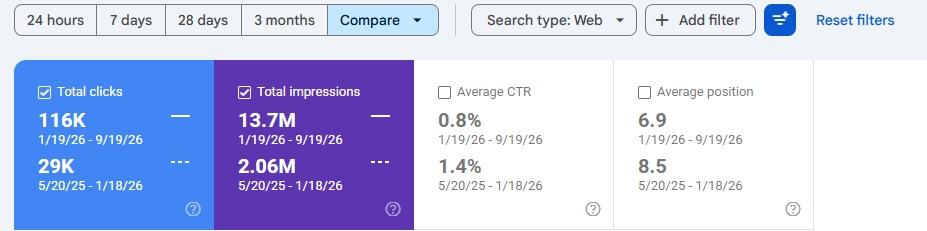
29,000 → 116,000
+300% organic clicks
Organic clicks 29,000 to 116,000 across equal 244 day periods, 87,000 more, with search impressions up 565 percent from 2.06 million to 13.7 million. All 68 detox and inpatient beds full with a waitlist by August 2026.
Live Search Console data · May 20, 2025 to January 18, 2026 against January 19 to September 19, 2026
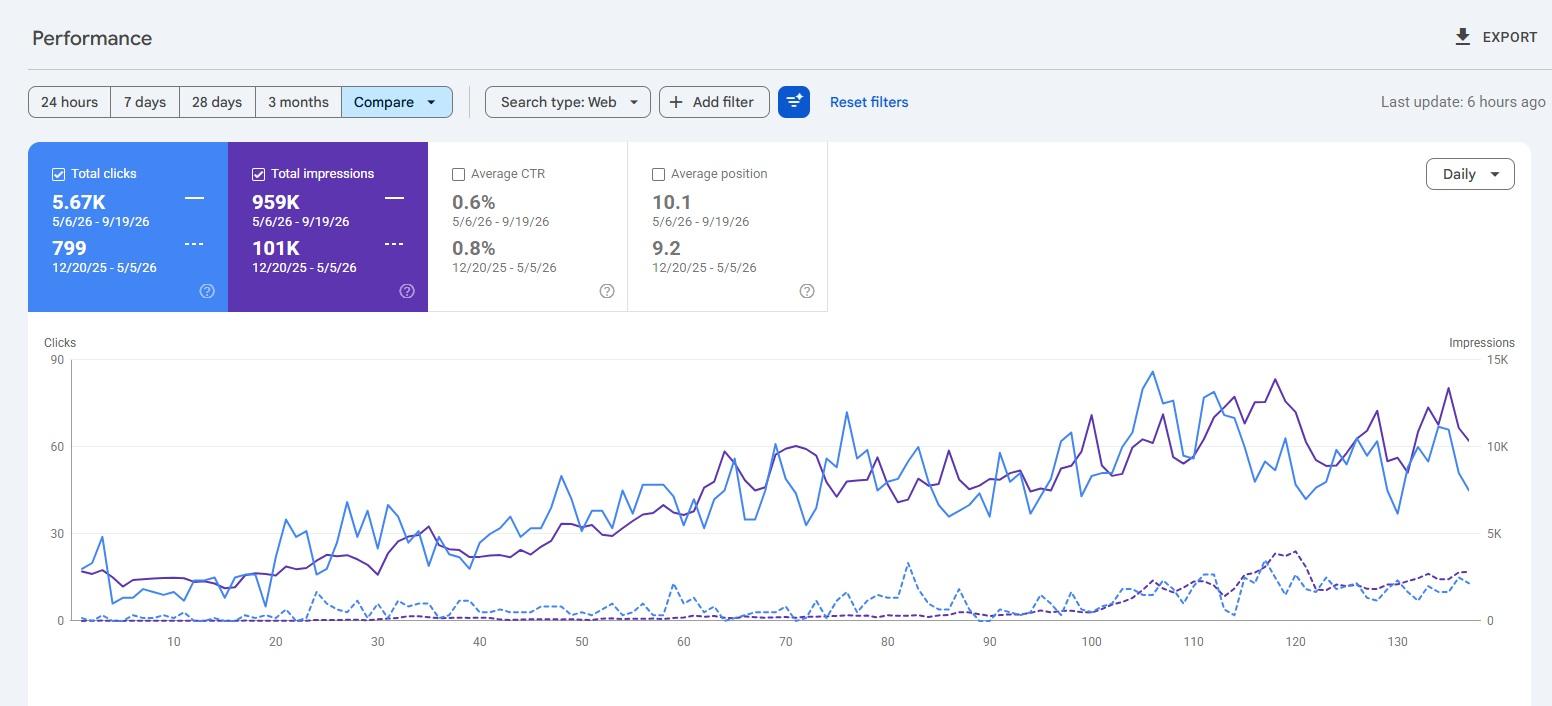
Client · Treatment Center Startup
799 → 5,670
+610% organic clicks
Organic clicks 799 to 5,670 across equal 137 day periods, with search impressions up 850 percent from 101,000 to 959,000. Website launched December 2025; licensed and operational March 2026.
Live Search Console data · December 20, 2025 to May 5, 2026 against May 6 to September 19, 2026
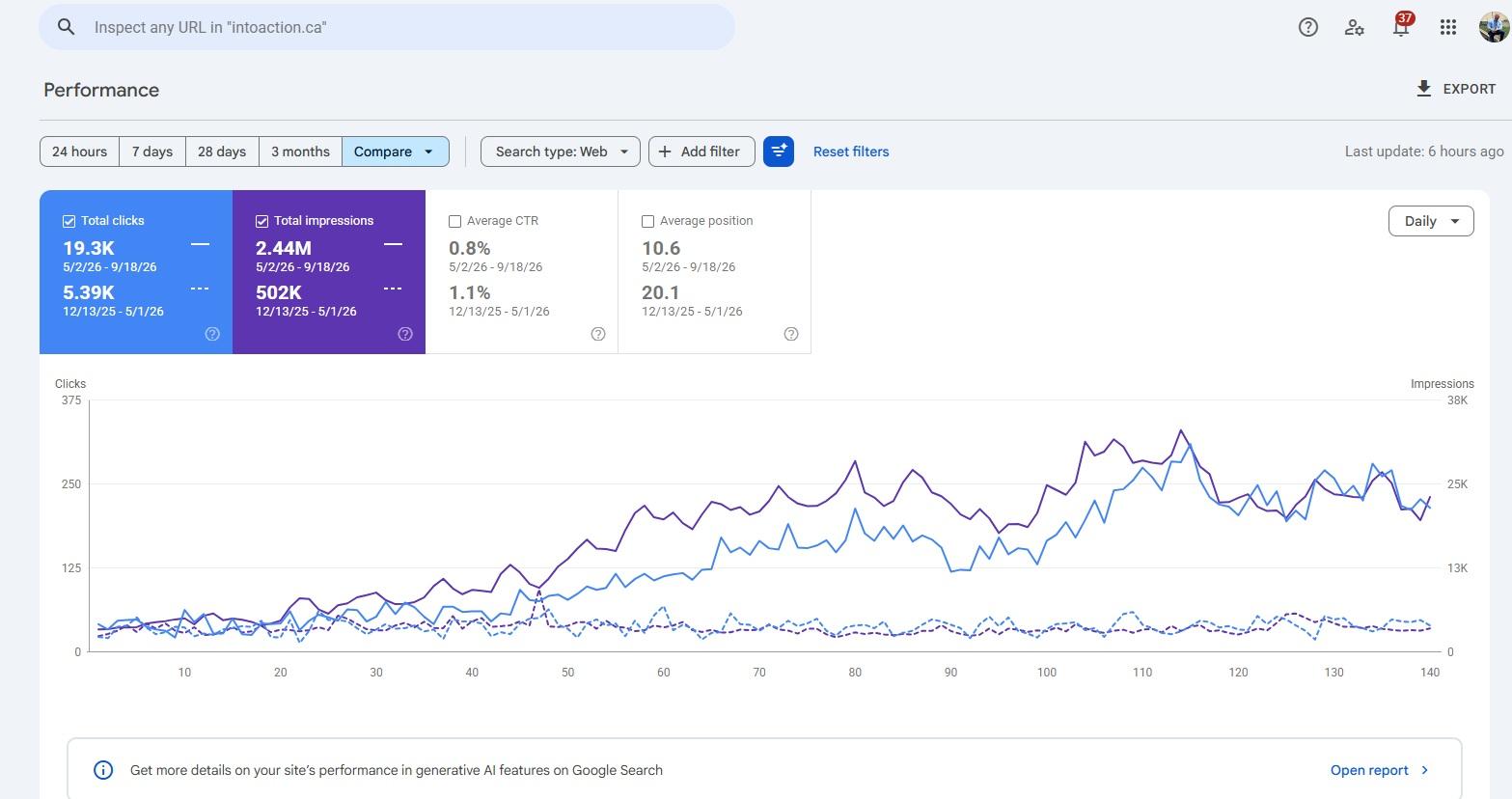
Client · Private Pay Center
5,390 → 19,300
+258% organic clicks
Organic clicks 5,390 to 19,300 across equal 140 day periods, with search impressions up 386 percent from 502,000 to 2.44 million. 78 of 107 private pay admissions in 4 months came from digital marketing, 73 percent of the total.
Live Search Console data · December 13, 2025 to May 1, 2026 against May 2 to September 18, 2026
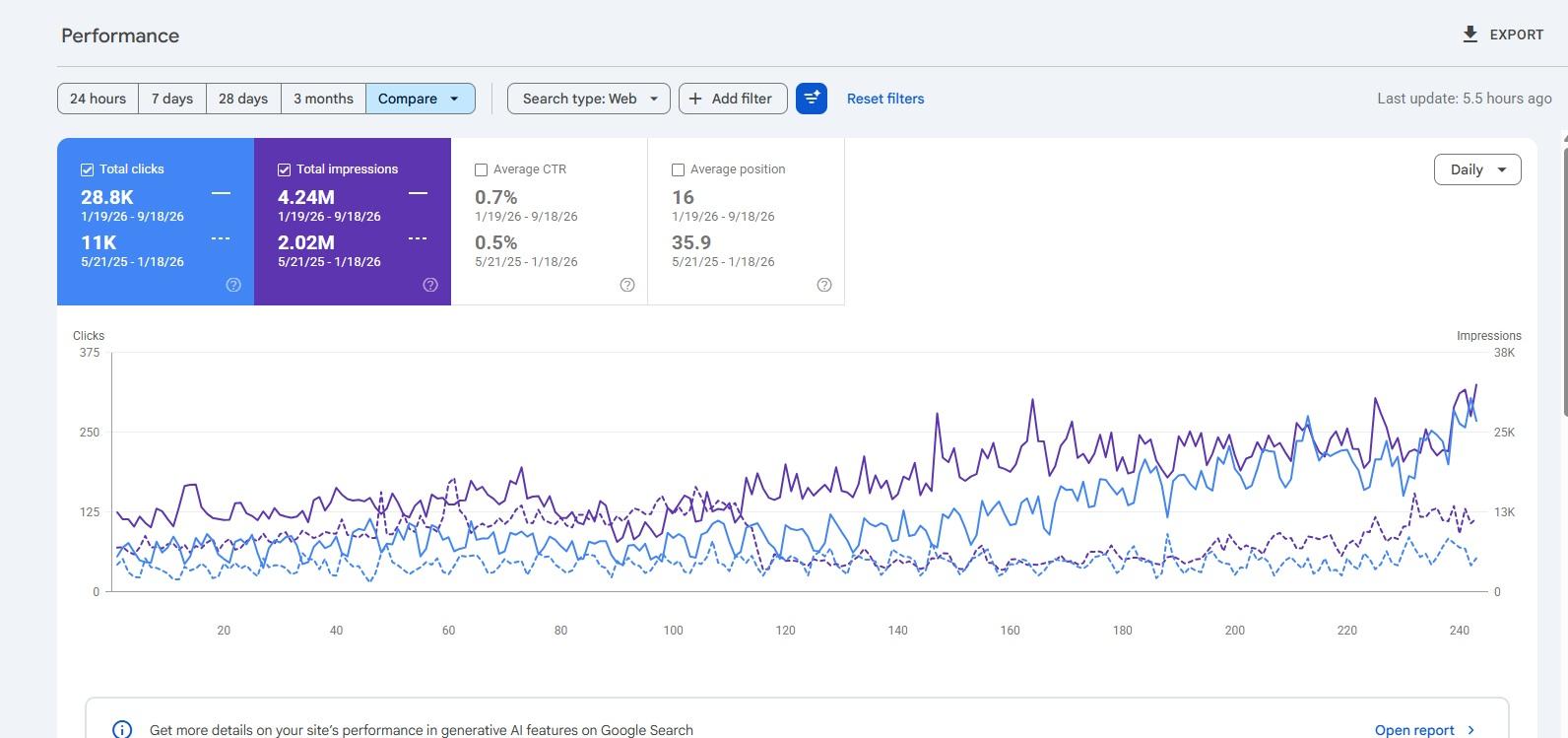
Client · Residential Center
11,000 → 28,800
+162% organic clicks
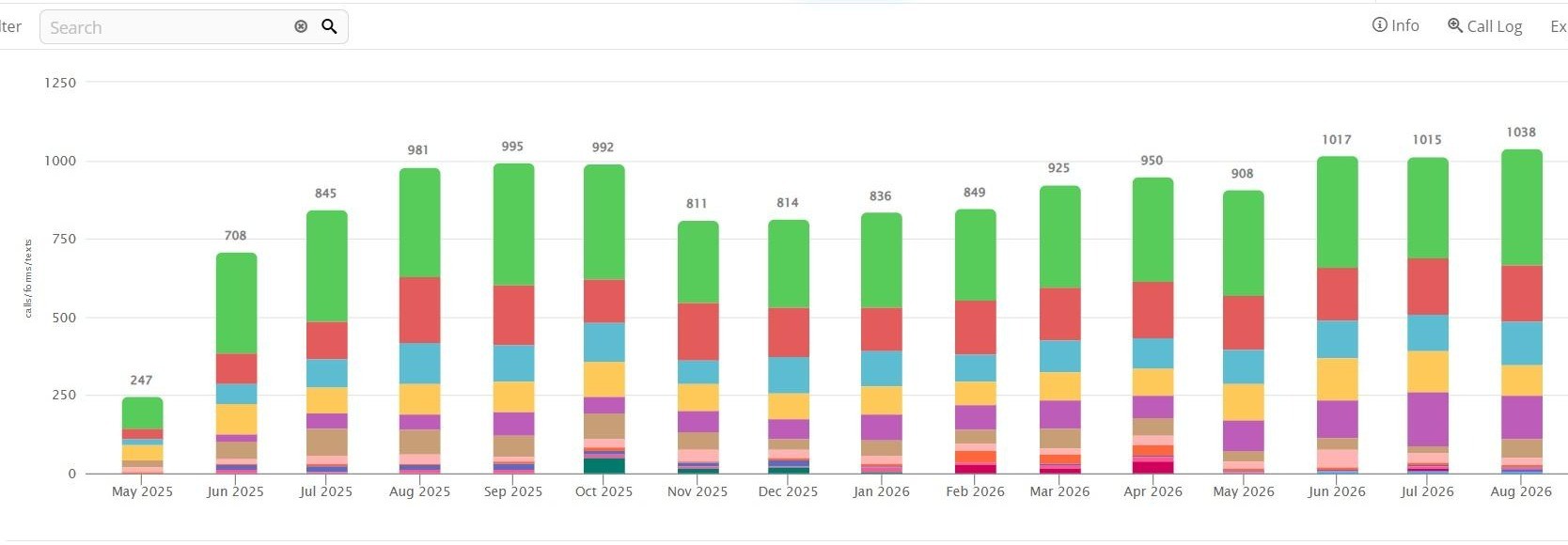
Organic clicks 11,000 to 28,800 across equal 243 day periods, 17,800 more, with average position improving from 35.9 to 16.0. Over 1,000 tracked organic calls every month from June to August 2026.
Live Search Console data · May 21, 2025 to January 18, 2026 against January 19 to September 18, 2026
Call Tracking Metric Screenshots
Clicks do not pay for a treatment center. Calls do.
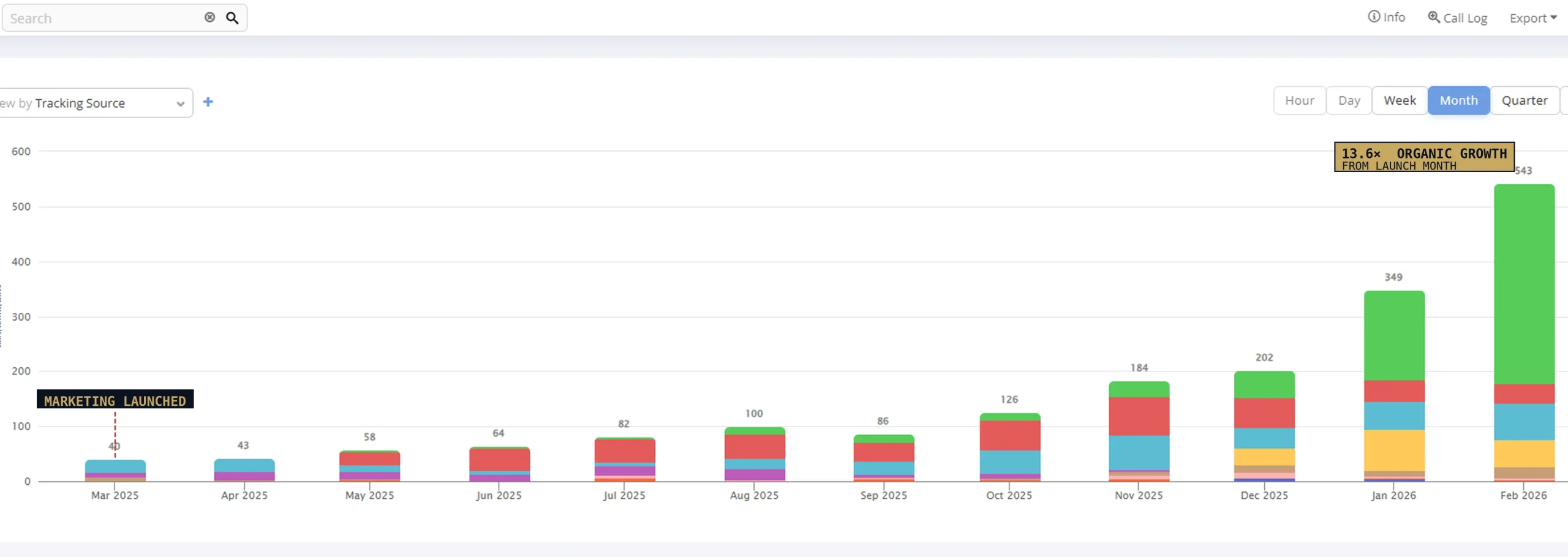
One active client, marketing launched December 2024, tracked through February 2026. Organic inbound volume only: calls, with every paid-ad-sourced call stripped out.
40
Organic calls in launch month, March 2025
543
Organic calls per month, February 2026
13.6x
Organic growth in 12 months
Residential Treatment Center With IOP
Inbound volume from CallTrackingMetrics: calls, June to August 2025 against the same three months of 2026.
+21.2%
Inbound growth, calls
3,070
Inbound organic calls, June to August 2026
1,000+
Inbound organic calls in each of those months
Private Pay Residential Inpatient Center
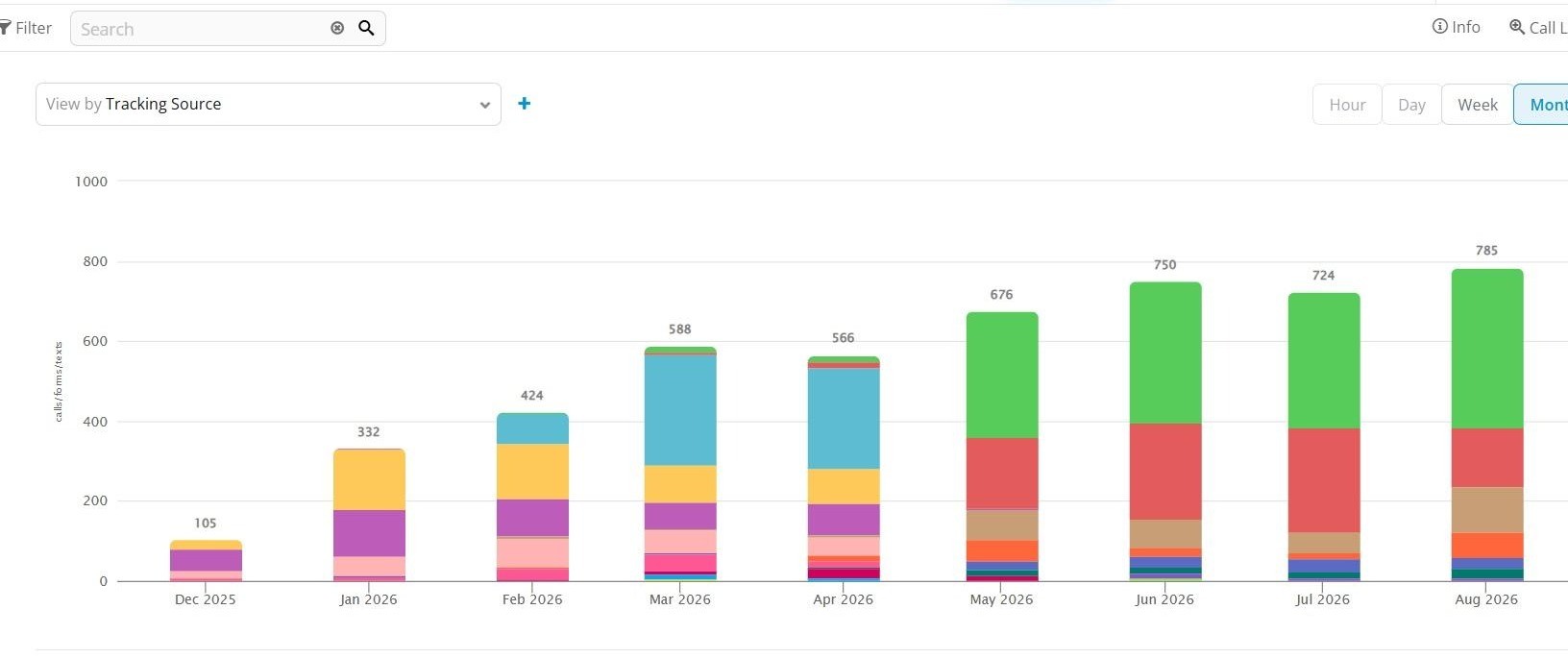
Inbound volume from CallTrackingMetrics: calls, January 2026 against August 2026.
647.6%
Inbound call growth in first 8 months
785
Inbound organic calls in August 2026
78
Private, cash-pay admissions in trailing four months
Stats From Our Entire Client Portfolio No Other Rehab SEO Agency Can Touch
724%
average organic clicks growth in first 6 months
678%
more Google search visibility in first 6 months
1,126%
median growth in Google clicks in first 6 months
874.7%
average client inbound organic call growth in first 6 months
Our guarantee
Our 30-Days-To-Value Guarantee
Your new website ready for approval.
Your profiles optimized.
Your first business listings ordered.
Your review-growth strategy delivered.
Your local commercial keyword targets selected.
Why Marketing a TMS Clinic Is Different
Three things are true of TMS search in every market we have audited, and they decide how a clinic gets marketed.
The referral is half the funnel
A large share of TMS patients arrive because a psychiatrist or primary care office suggested it after medications failed. Those clinicians check the clinic's site before they refer: who runs it, what device, what protocol, what the authorization process looks like. A referral page and a clinician to call earn those patients; a device logo does not.
Insurance decides the start date
TMS is generally covered for depression after a documented history of medication trials, and the authorization process decides whether a consultation becomes a course. Does insurance cover TMS is the search that happens right before the call, and the clinic that answers it plainly, by payer, with the authorization steps, books the consultation.
The commitment is 36 sessions
A patient is choosing a clinic they will visit daily for roughly six weeks. Location, hours, parking, the technicians they will see every day, and what a session is actually like decide the choice as much as the clinical credentials do. The pages have to show the experience, not just the outcomes language.
TMS Clinic Marketing: the Pages That Rank
TMS marketing is a page architecture problem before it is a keyword problem. Here is the architecture we build for a clinic, one page per search a patient or a referring clinician makes.
01
The TMS therapy page
The money page for TMS therapy and transcranial magnetic stimulation searches in your city: the device, the protocol, the course length, who is a candidate, what a session is like, the psychiatrist by name, and how a consultation starts. Written for the patient and the referring clinician both, reviewed by the medical director, structured for search engines and AI engines.
02
Condition pages
TMS for depression, TMS for OCD, and treatment-resistant depression are the searches with the most intent. One page per indication the clinic treats, accurate about what the clearance and the evidence support, written for the person who has already failed medication.
03
Insurance and authorization pages
Does insurance cover TMS, TMS cost, and the authorization steps by payer. A page per major payer the clinic accepts and a plain cost page for patients without coverage rank on their own and answer the question that decides the start date.
04
Comparison pages
TMS vs medication, TMS vs ketamine, TMS vs ECT, and TMS side effects are searched by nearly every patient before a consultation. Plain, clinically reviewed comparison pages catch those searches and keep the patient on the clinic's site instead of a directory's.
05
Google Business Profile and the clinic location page
A claimed profile with the right categories, real photos of the treatment room, hours that match the session schedule, and reviews handled inside privacy limits, plus a location page that mirrors it. This is what puts the clinic in the map pack for TMS therapy near me.
06
Referral pages for psychiatrists and primary care
A page that tells a referring clinician exactly how to refer, what the clinic needs, how authorization is handled, and how the patient is communicated back, with a named contact. This is what earns the referrals the device locators cannot, and what AI engines cite when a patient asks which clinic is credible.
TMS Marketing Beyond the Rankings
Rankings win the shortlist. The rest of TMS marketing turns the shortlist into a scheduled consultation and a completed course. Compliant TMS advertising comes first for clinics that need patients before the organic work matures: Google search campaigns for TMS therapy and insurance searches, built inside Google's healthcare and medicines policies, and Meta campaigns inside the health and wellness restrictions, landing on pages that answer the patient's questions above the fold. Paid search is a bridge to the organic foundation, never the foundation itself.
Reputation carries unusual weight for a TMS clinic, because the patient is committing to daily visits with people they have never met. Rating, recency, and reply cadence are managed inside privacy limits, and no review is ever incentivized. The referral network runs alongside: psychiatrists, primary care offices, and therapists check the same pages a patient does before they refer, and a clinic with a referral page and a named contact earns the referrals a device locator cannot.
Every call and form is tracked in the platform your front desk answers on, and the CRM is configured so no protected health information reaches an ad platform. TMS clinic marketing reports in scheduled consultations, authorizations, and completed courses, not impressions. That is the number on the monthly report.
The TMS clinic marketing stack
TMS, condition, insurance, and comparison page architecture
Google Business Profile and the map pack
Compliant Google and Meta advertising
Reviews and reputation inside privacy limits
Referral pages for psychiatrists and primary care
Call tracking, reported in scheduled consultations
On the call
Your free audit. No sales pitch.
We audit your clinic's online presence, including which TMS and insurance searches you rank for today and which ones the device locators and chains own, and walk you through it in a 30-minute call. Then you decide whether to book a second call about working with BHP.
How Long Does TMS Clinic Marketing Take to Work?
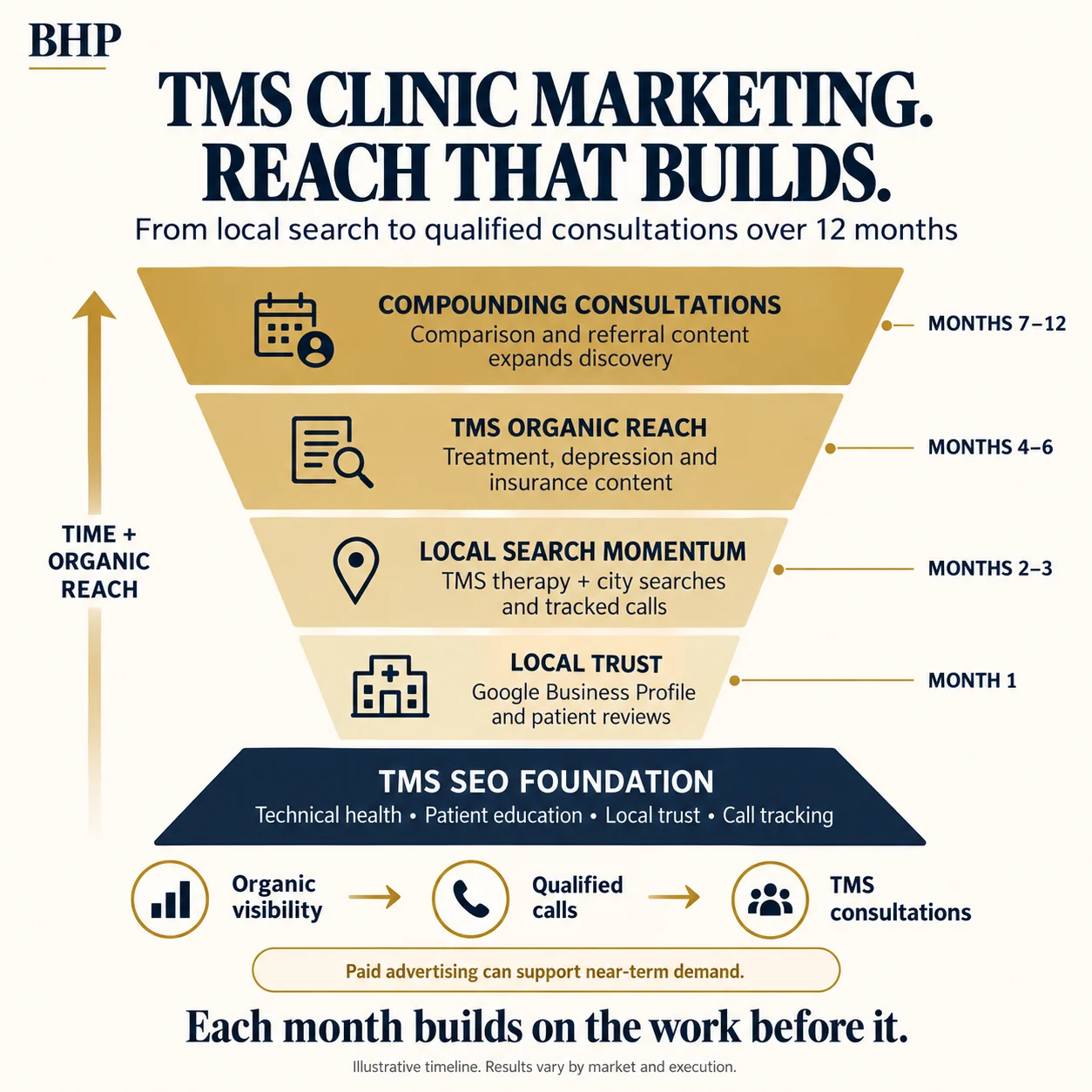
Google Business Profile and reputation work usually moves inside 30 days, and for a clinic with one location that is where the first new consultations come from. Map pack rankings for TMS therapy plus city typically begin shifting in 60 to 90 days. Competitive organic terms, TMS for depression and does insurance cover TMS in a metro, usually stabilize on page one in 4 to 6 months, and the comparison and referral content keeps compounding after that. Advertising fills the gap for clinics that need patients now. Our promise is 30 days to value: a finished deliverable in your hands inside the first month.
How Much Does TMS Clinic Marketing Cost?
It depends on how many locations the clinic runs, whether it also offers ketamine or Spravato, and how many chains and device locators are competing for the same searches in its market. Our SEO packages range in price depending on market, locations, and overall campaign scope, and advertising budgets are set separately once the organic plan is scoped. We offer 6-month and 12-month partnership terms, and pricing is quoted on the second call once it is scoped to your clinic.
How Do You Choose a TMS Marketing Company?
Ask to see live Search Console and call tracking screenshots from a current clinic client, not a stock chart. Ask whether the company works only in behavioral health, because a protocol page written by a generalist will describe treatment in ways your psychiatrist will not sign off on. Ask how advertising stays inside Google's healthcare policies, how conversion tracking is configured without protected health information, and whether the plan includes referral pages for the clinicians who send you patients. And ask whether the company will tell you when your market is a poor fit. We confirm your market is open before partnering with you, and if your market is taken, we will tell you on the first call.
Where TMS Fits in the Silo
TMS clinics sit inside interventional psychiatry, next to ketamine, and most of them need the same search and advertising foundation every mental health program does. Each page below carries the same rule this one does: rankings are the output, scheduled patients are the point.
Our guarantee
Our 30-Days-To-Value Guarantee
Within 30 days, we'll have your modern, SEO-ready website built for conversions and ready for approval, your social and Google Business profiles optimized, your first business listings ordered, and your review growth strategy delivered. Clear progress you can see. Confidence you've found your long-term agency partner.
FAQs About TMS Clinic Marketing
The questions clinic owners and medical directors ask on the audit call, answered the way we answer them there.
TMS clinic marketing is the work of ranking a transcranial magnetic stimulation clinic for the searches patients and referring psychiatrists make when medication has not worked, advertising it inside the platforms' healthcare policies, and turning that visibility into consultations, insurance authorizations, and completed treatment courses. It combines TMS, condition, insurance, and comparison pages, a Google Business Profile, referral pages, compliant campaigns, and call tracking.
Mostly people who have failed two or more antidepressants and are weighing TMS against another medication, ketamine, or ECT, plus the psychiatrists and primary care offices who refer them. Both check the psychiatrist's credentials, the device and protocol, insurance coverage, and the reviews before they contact the clinic.
Yes, inside Google's healthcare and medicines policies, which govern what a medical treatment ad can claim and which pages it can land on. Campaigns that overstate outcomes get paused. We build every campaign inside those rules and have the medical director review the landing pages.
Yes. TMS is generally covered for depression after a documented history of medication trials, and does insurance cover TMS is the search that happens right before the consultation. A page per major payer, with the authorization steps spelled out, is one of the highest-converting pages a clinic can publish.
Because a large share of TMS patients arrive through a psychiatrist or primary care office that checked the clinic's site first. A page that tells a referring clinician how to refer, what the clinic needs, how authorization is handled, and who to call earns referrals that a device locator listing never will.
A claimed Google Business Profile with the right categories, real photos of the treatment room, hours that match the session schedule, and reviews handled inside privacy limits, plus a location page that mirrors it and citations that agree with it. That is what puts the clinic in the map pack for TMS therapy near me, where most local patients start.
Google Business Profile and reputation work usually moves inside 30 days, map pack rankings typically begin shifting in 60 to 90 days, and competitive organic terms usually stabilize on page one in 4 to 6 months. Advertising fills the gap for clinics that need patients sooner. Our promise is 30 days to value.
Ask for live Search Console and call tracking screenshots from current clinic clients, whether the company works only in behavioral health, who clinically reviews the protocol and condition pages, how advertising stays inside Google's healthcare policies, how tracking is configured without protected health information, whether the plan includes referral pages, how results are reported, and what the partnership terms are.
The Psychiatrists in Your Market Are Referring Somewhere Tonight
Thirty minutes with Adam, a clear picture of which TMS and insurance searches your clinic ranks for and which ones the chains own, and a plain read on what would move first. If we are not a fit, you keep the strategy.
Behavioral health only. Verifiable results only.

Written and reviewed by Adam Vibe Gunton, Founder and Managing Partner of Behavioral Health Partners.
Adam Vibe Gunton is an addiction recovery expert, entrepreneur, marketer, brand strategist, and speaker dedicated to advancing the behavioral health industry. As Founder and Managing Partner of Behavioral Health Partners, he has worked across treatment-center development, operations, branding, PR, SEO, advertising, and growth strategy. Combining professional experience with his own lived experience in recovery, Adam brings a unique perspective on how treatment organizations can build trusted brands, reach more people, and create a greater impact.
Last updated October 8, 2026