What Is Brand Positioning? A Rehab Center's Guide to Standing Out
Positioning is the specific ground your center owns in a family's mind. We cover what brand positioning is and how it differs from branding, why it matters so much in a crowded treatment market, and the main types of positioning strategy. We cover how to build a positioning strategy step by step, the approaches that work specifically for rehabs, and the mistakes centers make most.
What Is Brand Positioning? A Rehab Center's Guide to Standing Out
With thousands of rehab centers competing for the same families, the ones that grow are not always the ones with the best clinical care. They are the ones people remember and trust. That is the work of brand positioning. So what is brand positioning, and how do you use it to make your rehab center the obvious choice? This chapter answers that in full, from the definition to a step-by-step brand positioning strategy and a positioning statement you can actually write. It is part of our larger guide on addiction treatment branding, and if you want a partner to do it with you, our addiction treatment marketing team positions rehab centers for growth every day. Our video on the rehab branding strategy that gets more admissions is a great companion.
Most rehab centers confuse branding with brand positioning, and that confusion costs them admissions. Get positioning right, and every dollar of marketing works harder, because your message lands in a mind that already understands who you are and why you matter.
What Is Brand Positioning?
Brand positioning is the distinct place your brand occupies in the mind of your target audience. In marketing, brand positioning, market positioning, and product positioning strategies all describe the same core idea, and market positioning and product positioning both aim at owning a clear space in the customer’s mind. It is how customers perceive your product or service relative to competitors, and market positioning like this applies to any product or service in any category, and it answers a simple question: when someone thinks about treatment centers like yours, what do they think of you? Strong brand positioning establishes a clear competitive advantage in the marketplace, so your rehab product or service owns a specific, valuable space in consumer perception rather than blending into a sea of similar options.
Put simply, brand positioning is not what you say about yourself. It is what your target market believes about you. Effective brand positioning shapes that belief on purpose, so prospective customers associate your brand with a specific promise, feeling, or strength. For a rehab center, that might be a particular clinical specialty, a population you serve best, or an experience of care no competitor matches. The goal of any brand positioning strategy, as part of your wider marketing strategy, is to make that value proposition and association clear, consistent, and impossible to confuse with anyone else.
Branding vs. Brand Positioning: What Is the Difference?
People use branding and brand positioning interchangeably, but they are different. Your brand identity is what you look and sound like: your name, logo, visual identity and website, brand personality, and voice. Brand positioning is the strategic decision about where you stand in the market and in the mind of your target customers. Branding is expression; positioning is strategy.
Think of it this way. Brand identity is how you dress and speak. Brand positioning is the role you have decided to play and the reputation you are building. A rehab program can have a beautiful brand identity and still have weak positioning, because it has never decided what it stands for or who it is for. Positioning comes first: once you know your position, your brand identity, your messaging strategies, and your marketing materials all have something clear to express. That is why a strong brand positioning strategy is the foundation of every other branding decision and every marketing strategy you run. Good brand positioning turns a scattered marketing strategy into a focused one and multiplies your marketing efforts.
Why Brand Positioning Is Important for Rehab Centers
Why is brand positioning important, especially in addiction treatment? Because the market is crowded and the stakes are high. Thousands of rehab centers operate across the country, and to a searching family, many of them look and sound exactly alike, with the same stock photos, the same promises, and the same generic messaging. In that competitive market, a brand that stands for something specific wins, and a brand that tries to be everything to everyone disappears.
Strong brand positioning does several things for a rehab center. It differentiates you from every other option, giving families a clear reason to choose you. It builds brand loyalty and trust, because a clear position is easier to believe and remember. It attracts the right target segments, the clients your program serves best, and it raises the return on all of your marketing efforts and marketing tactics, because well-positioned marketing campaigns and a clear marketing strategy convert far better than generic ones. Ultimately, effective brand positioning directly impacts admissions: when a family in a competitive market immediately understands why your rehab center is right for them, the decision gets easier and the phone rings more.
The Main Types of Brand Positioning Strategies
There are several types of brand positioning strategies, and the right one depends on your real strengths and your target market. Most successful brand positioning falls into one of these categories.
Value-based positioning centers on the overall value and outcomes you deliver, ideal when your greatest strength is results and experience. Quality-based positioning emphasizes superior clinical quality, credentials, and outcomes, a strong fit for centers with genuine clinical depth. Customer service positioning is built on an exceptional, compassionate experience from the first phone call through aftercare. Innovation positioning highlights distinctive programs or cutting edge technology, such as a unique therapeutic model. And niche positioning focuses on serving a specific target demographic better than anyone else, such as veterans, professionals, women, or faith-based clients.
Notice what is missing: price. Price-based positioning, competing on being the cheapest, almost never works in addiction treatment, because families are not shopping for the lowest price when a life is at stake. They are looking for the right fit and genuine trust. The strongest brand positioning strategy for a rehab is built on a real, defensible strength and, among other factors, genuine fit, not on being cheaper than the center down the road.
How to Build a Brand Positioning Strategy
A powerful brand positioning strategy, built as a successful brand positioning strategy, is built deliberately as part of your brand strategy, not by accident, and it should reflect real customer preferences. Here is how to develop one for your rehab center, step by step.
Step 1: Define Your Target Audience
Everything starts with a deep understanding of your target audience and intended audience. Define your ideal customer and your target market in detail: who they are, the substances and conditions they struggle with, their pain points, their fears, and what they need to feel safe choosing care. Build a clear buyer persona, and remember that families often make the first call, so they are part of your audience too. You cannot position for everyone, so decide exactly whose problem you solve best.
Step 2: Understand Your Competition and the Market
Next, study your competitive landscape. Conduct honest market research on how other rehab centers position themselves, what they claim, and where they all sound the same. A perceptual map, plotting competitors on the dimensions that matter to your target customers, helps you identify gaps in the market that no one else owns. Those gaps are your opportunity. The goal is to find a position that is both true to your strengths and unclaimed by competitors.
Step 3: Define Your Unique Value Proposition
Your unique value proposition is the heart of your positioning, and a clear value proposition is what a searching family remembers. Every strong positioning strategy is anchored by a strong value proposition only you can claim. A strong value proposition answers three things clearly: who you serve, what makes your rehab program different, and why a family should choose your product or service over anyone else. It should be built on genuine unique selling points, not vague claims every center makes. If your unique value could be copied and pasted onto a competitor's website, it is not unique enough. Sharpen it until it names a real, specific advantage only you can credibly claim.
Step 4: Write Your Brand Positioning Statement
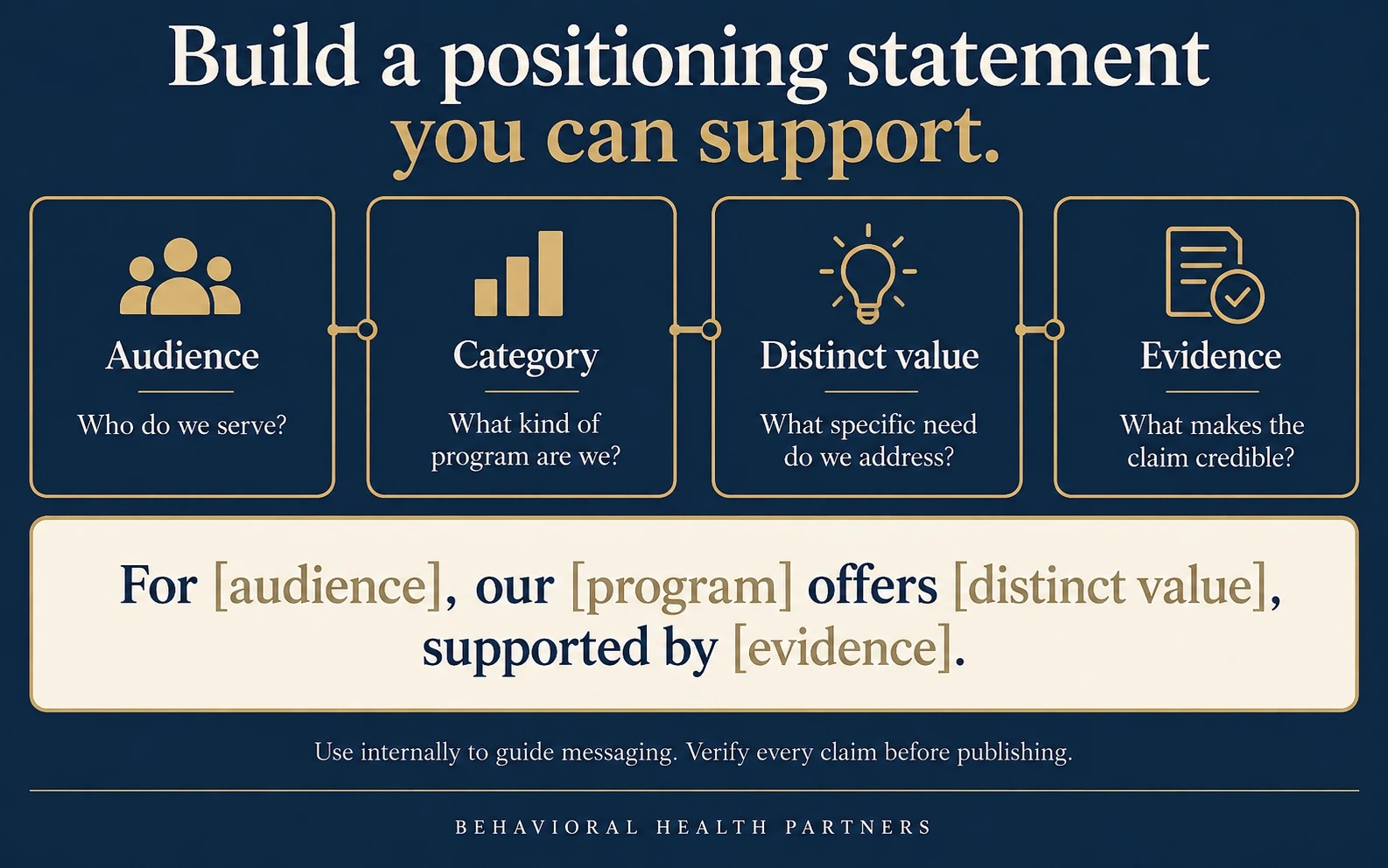
Now capture it in a brand positioning statement, the single sentence, your brand positioning statement, that defines your position. According to Harvard Business School Online, a positioning statement follows a simple formula: "For [target market], our brand is the only one among all [competitive set] that [unique value claim] because [reasons to believe]." It is not a public tagline; it is the internal North Star that guides your brand marketing, your messaging strategies, and every piece of content you create.
For a rehab center, a compelling positioning statement might read: for professionals struggling with alcohol use, our program is the only rehab center in the region that combines executive-friendly scheduling with evidence based practices, because our outcomes and confidential care are proven by the people we have helped. Notice the four parts: the target market, the market category, the unique value, and the reasons to believe. Your positioning statement should name all four.
Real world examples make this concrete. The brands you know best are the ones that positioned themselves clearly and stayed consistent: each owns a simple brand promise tied to its brand's mission, and that clarity built brand image, market share, and loyalty over decades. A brand that is successfully positioned earns a place in memory that competitors cannot buy their way into. Your rehab center will never have their budgets, but you can apply the same discipline: pick a compelling message, ground it in your value proposition and brand promise, and repeat it until potential customers associate it with you. The lesson from every strong brand is not the slogan; it is the consistency behind a clear position.
A good brand positioning statement is short, specific, and honest. Test your brand positioning statement against a simple bar: could a competitor claim the exact same thing? If so, your positioning statement is not sharp enough yet. Rewrite it until the brand positioning statement names something only you can credibly own. Keep the positioning statement internal, and let it guide, not replace, your public messaging. Many rehab centers skip the positioning statement entirely and wonder why their marketing feels scattered; the positioning statement is what gives every campaign a single, consistent direction. When your whole team can recite the brand positioning statement, your brand positioning has taken hold. A brand positioning statement is worth the effort because a written brand positioning statement keeps everyone aligned.
Step 5: Align Everything and Stay Consistent
A positioning statement only works if everything reinforces it. Align your brand identity, visual identity, brand voice, and core values with your position, and carry it consistently across every channel and all communication channels, your website, your content marketing, your social media channels, your paid ads, and your marketing tactics, and how your team speaks on the phone. Consistency is what makes a position stick. Then reinforce your brand's differentiation at every touchpoint, so your intended audience hears the same clear message everywhere they encounter you.
Step 6: Test, Measure, and Refine
Finally, test whether your positioning is landing. Gather customer feedback, watch how prospective customers respond, and measure the metrics that matter, from engagement to qualified leads to admissions. If the market does not perceive you the way you intended, refine your message. Positioning is not set once; it is reinforced and adjusted over time as you learn and as the competitive market shifts.
Rehab-Specific Positioning Strategies That Work
Beyond the fundamentals, a few brand positioning strategies are especially powerful for rehab centers.
Niching down is the fastest path to a strong position. Rather than marketing to everyone with a substance use problem, position your rehab services around specific target segments you serve exceptionally well, and build dedicated content and landing pages for each. A brand that clearly serves one audience deeply will beat a generic brand every time, and niching builds brand loyalty because those clients feel understood.
Storytelling and authenticity turn a position into an emotional connection. Real recovery stories and customer testimonials, especially authentic video testimonials shared with consent, prove your position in a way no claim can. They show, rather than tell, what makes your center different, and they make a lasting impression on families weighing their options.
Congruent message marketing ties it all together. Every ad, keyword, and landing page should match the searcher's intent and reinforce your position across social media, so a person who clicks a message about your specialty lands on a page that delivers exactly that. Broad, generic messaging wastes ad spend and blurs your position; congruent messaging sharpens it and lifts conversions.
Finally, a strong digital presence is where modern positioning is won. Your position must show up consistently across search and social media, so integrated SEO, PPC advertising, and cohesive branding across digital platforms are how you make your position dominant online. When your content marketing and paid advertising all reinforce the same clear position, your brand becomes the one families remember.
Common Brand Positioning Mistakes Rehab Centers Make
A few mistakes undo even good intentions. The first is confusing branding with positioning, polishing the logo while never deciding what the brand stands for. The second is generic messaging that tries to appeal to everyone and connects with no one. The third is positioning on claims you cannot back up; your reasons to believe must be real, and in addiction treatment, honesty is both an ethical duty and the law. Position your center on genuine strengths and proven clinical methods, the kind of proven approaches curated in SAMHSA's Evidence-Based Practices Resource Center, rather than on hype. The fourth is inconsistency, sending a different message on every channel until the position dissolves. Avoid these, and your positioning will hold.
Position Your Rehab Center to Win
Brand positioning is the strategic core of your brand. Decide who you serve best, find the gap only you can own, build a unique value proposition on real strengths, capture it in a positioning statement, and reinforce it consistently across every channel. Do that, and your treatment center stops competing on sameness and starts standing out, which is exactly what turns a searching family into an admission.
If you want a partner to define and execute a brand positioning strategy that sets your center apart, request a strategy conversation with our rehab marketing team. We help treatment centers find their position, sharpen their message, and win the families they are meant to serve.
Frequently Asked Questions
What is brand positioning in simple terms?
Brand positioning is the distinct place your brand holds in the mind of your target audience. It is how your target audience and customers perceive you compared to competitors and what they associate with your name. Positioning applies to any product or service, and rather than what you say about yourself, brand positioning is what your target market actually believes about you. A strong brand positioning strategy shapes that belief on purpose, so your target audience connects your rehab center with a specific strength, population, or promise, and choose you because that position fits exactly what they need.
What is a brand positioning statement, and how do I write one?
A brand positioning statement is an internal statement that captures your brand positioning in one clear sentence, and a strong brand positioning statement anchors your whole positioning strategy. As a positioning strategy tool, a widely used formula is: for your target market, your brand is the only one in your category that delivers your unique value, because of your reasons to believe. It is not a public tagline; it is the North Star that guides your messaging and marketing. To write a brand positioning statement, name your target audience, your market category, your unique value proposition and core value proposition, and the genuine proof behind it, then keep every piece of your positioning strategy and marketing aligned with it.
Why is brand positioning important for a treatment center?
Because thousands of rehab centers compete for the same families, and most of them sound identical. Strong brand positioning differentiates your center, builds trust and brand loyalty, attracts the clients you serve best, and makes all of your marketing more effective. When a family instantly understands why your rehab center is right for them, the decision becomes easier and admissions rise. Without clear positioning, even excellent clinical care gets lost in a crowded, competitive market.
What are the main types of brand positioning strategies?
The main brand positioning strategies are value-based positioning (built on outcomes and overall value), quality-based positioning (built on clinical quality and credentials), customer service positioning (built on an exceptional, compassionate experience), innovation positioning (built on distinctive programs or technology), and niche positioning (built on serving a specific audience better than anyone). Price-based positioning, competing on being cheapest, rarely works in addiction treatment, because families seeking care are looking for trust and the right fit, not the lowest price.
What are the most common brand positioning mistakes?
The most common mistakes are confusing branding with positioning, so you refine your logo but never decide what you stand for; using generic messaging that appeals to everyone and resonates with no one; positioning on claims you cannot prove, which is both ineffective and, for treatment providers, a legal risk; and being inconsistent across channels until your position blurs. Avoid these by choosing a clear, honest position built on real strengths and reinforcing it consistently everywhere your brand appears.
Adam Vibe GuntonFounder and Managing Partner, Behavioral Health Partners
Adam Vibe Gunton is an addiction recovery expert, entrepreneur, marketer, brand strategist, and speaker dedicated to advancing the behavioral health industry. As Founder and Managing Partner of Behavioral Health Partners, he has worked across treatment-center development, operations, branding, PR, SEO, advertising, and growth strategy. Combining professional experience with his own lived experience in recovery, Adam brings a unique perspective on how treatment organizations can build trusted brands, reach more people, and create a greater impact.
Published August 20, 2026 · Updated September 28, 2026
One Conversation. No Pitch.
Schedule Your Free Discovery Call
Thirty minutes on video with Adam directly, camera on, screen-sharing your own online presence and your top three local competitors. If we are not the right partner, we will tell you that too.