
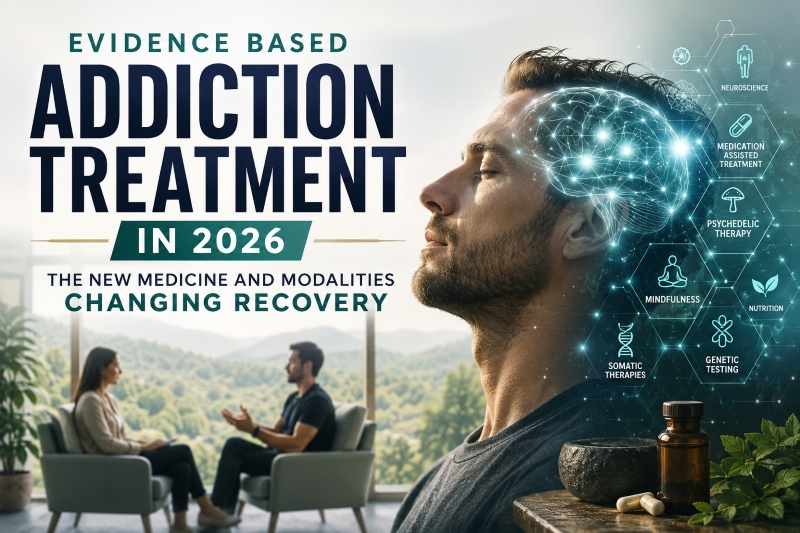
Addiction medicine is moving faster right now than it has in decades. A diabetes drug is showing real promise for alcohol cravings. The federal government is fast-tracking research into compounds that were untouchable two years ago. And treatment centers are rethinking how they handle co-occurring conditions like ADHD instead of treating addiction in a vacuum.
For families researching care and for professionals working in the field, the challenge is separating genuine clinical progress from hype. This guide walks through the most significant developments in evidence based addiction treatment in the United States, what the research actually supports today, and what is still in the investigational stage. Every claim below is linked to its primary source.
What Makes Addiction Treatment Evidence Based
Evidence based addiction treatment means care that is supported by peer-reviewed clinical research, not tradition, testimonials, or marketing. In practice, that includes FDA-approved medications for opioid and alcohol use disorders, behavioral therapies with demonstrated outcomes such as cognitive behavioral therapy and contingency management, and integrated treatment for co-occurring mental health conditions.
The standard matters because the gap between what works and what gets used remains enormous. According to the National Institute on Alcohol Abuse and Alcoholism, 27.9 million people ages 12 and older had alcohol use disorder in the past year based on 2024 National Survey on Drug Use and Health data (NIAAA). Only three medications are FDA approved to treat the condition: disulfiram, naltrexone, and acamprosate (NIAAA Medications Development Program). And of the roughly 28 million people with past-year AUD, only 2.5 percent received any medication-assisted treatment (NIAAA).
Closing that gap, and expanding what qualifies as evidence based in the first place, is where the field’s energy is going in 2026.
Behavioral Health Partners
You found your partner.
We build, launch, and scale addiction treatment centers. Whether you are opening one or filling beds in the one you run, it starts with an honest call and a look at your real numbers.
Build and launch
Open A Rehab Center
Feasibility study, financial proforma, state licensure, and Joint Commission or CARF accreditation. Your website live three months before license, so you open with calls already coming in.
Schedule A CallScale
Fill More Beds
A free audit of your current search presence, with your own data on the screen and no pitch attached. One client per level of care per market, always.
Book A Marketing AuditLive with integrity. Serve with excellence. Change the world.
The Foundation: Medication Assisted Treatment Keeps Evolving
Medication assisted treatment remains the backbone of evidence based care for opioid use disorder, and the biggest recent changes are in delivery rather than discovery. Long-acting injectable buprenorphine has shifted treatment from a daily decision to a weekly or monthly one, which removes a major adherence variable in early recovery. The FDA approved Brixadi, a weekly and monthly subcutaneous buprenorphine injection, in May 2023, expanding the dosing options available beyond the previously approved extended-release formulation (FDA).
The other quiet revolution is contingency management, a behavioral protocol that provides tangible incentives for verified abstinence. Federal analysis is direct about its standing: research shows psychosocial interventions are the most effective treatment for stimulant use, and contingency management has the strongest empirical support of any of them (Congressional Research Service). SAMHSA now treats it as a primary and potentially life-saving intervention for the more than 4 million Americans who meet criteria for a stimulant use disorder, a category with no FDA-approved medication (SAMHSA).
GLP-1 Medications: The Biggest Story in Addiction Medicine
If one development defines 2026, it is the arrival of serious clinical trial data on GLP-1 receptor agonists, the drug class behind Ozempic and Wegovy, for alcohol use disorder.
The signal started with a phase 2 trial in which low-dose weekly semaglutide reduced laboratory alcohol self-administration and craving in adults with AUD, with the authors concluding the results justified larger trials (Hendershot et al., JAMA Psychiatry, 2025). In 2026, a randomized, double-blind, placebo-controlled trial published in The Lancet tested once-weekly semaglutide in patients with alcohol use disorder and comorbid obesity (The Lancet, 2026). A separate University of Colorado phase 2 trial of the oral formulation has now completed (ClinicalTrials.gov NCT05892432), and the Department of Veterans Affairs has launched a phase 3 trial of semaglutide in veterans with moderate to severe AUD, with primary completion estimated for 2028 (ClinicalTrials.gov NCT07218354).
The honest caveats matter as much as the results. No GLP-1 medication is FDA approved for any addiction indication, so all current use for cravings is off-label. The trials to date have been phase 2, single-site, and modest in size, and the strongest of them enrolled participants who also had obesity, which means the findings cannot yet be generalized to everyone with alcohol use disorder. What makes the class worth watching is the mechanism: researchers believe GLP-1 signaling acts on the gut-brain reward pathways that drive craving itself, which would explain why the effect appears across more than one substance.
Ketamine and the Psychedelic Research Pipeline
Ketamine crossed into mainstream psychiatry when esketamine earned FDA approval for treatment-resistant depression, and addiction researchers followed that thread. In a double-blind, placebo-controlled phase 2 trial, 96 patients with severe alcohol use disorder received three weekly ketamine infusions or saline, with or without relapse prevention therapy. Ketamine was well tolerated and associated with more days of abstinence at six-month follow-up, and the findings suggested an added benefit from pairing infusions with psychological therapy (Grabski et al., American Journal of Psychiatry, 2022).
Two things follow from that. Ketamine remains investigational for addiction, and the model with evidence behind it is medically supervised dosing embedded in real therapy, not standalone infusions.
The broader psychedelic pipeline changed direction materially in April 2026, when Executive Order 14401 directed the FDA to issue national priority vouchers to qualifying psychedelic drugs with Breakthrough Therapy designation and instructed the FDA and DEA to establish a pathway for eligible patients to access investigational psychedelic drugs (Federal Register, EO 14401). The practical effect is more trials, opening sooner, at American institutions.
Neuromodulation: TMS Moves Into Addiction Care
Transcranial magnetic stimulation uses magnetic pulses to modulate activity in brain circuits tied to craving and impulse control. Repetitive TMS for smoking cessation received FDA marketing clearance in August 2020, the first clearance for any TMS device in the addiction space, based on a pivotal multicenter double-blind randomized trial (Brain Stimulation, 2023).
It is non-invasive, medication-free, and increasingly available at psychiatric clinics that already run TMS for depression. For patients who cannot tolerate medications or want to layer another evidence based tool onto their plan, neuromodulation is becoming a legitimate option rather than a novelty. Applications beyond tobacco, including alcohol and stimulant use disorders, remain under study.
Dual Diagnosis Done Right: ADHD and Addiction
One of the most consequential shifts in modern treatment is not a new drug at all. It is the recognition that untreated co-occurring conditions quietly drive relapse, and ADHD is the clearest example.
The overlap is large and well documented. A meta-analysis of 29 studies found that 23.1 percent of people with substance use disorders met diagnostic criteria for comorbid ADHD, or nearly one in four (van Emmerik-van Oortmerssen et al., Drug and Alcohol Dependence, 2012).
The old clinical instinct was to avoid the topic entirely, since first-line ADHD medications are stimulants and stimulants carry misuse potential. The evidence points the other way. In a study of nearly 3 million people with ADHD in the United States, the risk of substance-related events was 35 percent lower among men and 31 percent lower among women during periods of ADHD medication use compared with periods without it (Quinn et al., American Journal of Psychiatry, 2017). Treating the impulsivity and self-medication cycle appears to remove fuel from the addiction rather than add to it.
What evidence based dual diagnosis treatment looks like in practice:
- A comprehensive diagnostic evaluation, since ADHD symptoms overlap with withdrawal, anxiety, and post-acute effects of substance use
- Non-stimulant options considered first where clinically appropriate, including atomoxetine, viloxazine, and extended-release alpha-2 agonists
- When stimulants are indicated, long-acting formulations, which carry lower misuse potential than immediate-release versions
- Prescriber-managed protocols with regular monitoring and coordination between the addiction team and the prescriber
- Therapy that addresses both conditions together rather than in sequence
The core principle is integration. Treating addiction while ignoring the ADHD underneath it, or the reverse, produces worse outcomes than treating both at once under one coordinated plan.
Wellness Modalities: What the Evidence Actually Supports
Cold plunges, breathwork, exercise programming, and nutrition therapy have become fixtures in modern treatment settings, and they deserve an honest evidence based framing: they are adjuncts, not treatments, and the good programs present them that way.
Exercise has the strongest research base of the group. A meta-analysis of 22 randomized controlled trials found that physical exercise significantly increased abstinence rates, eased withdrawal symptoms, and reduced anxiety and depression in people with substance use disorders (Wang et al., PLOS ONE, 2014). A more recent meta-analysis covering 17 studies and 1,363 participants confirmed moderate improvements in substance use and craving outcomes and supported exercise as an adjunctive intervention (Psychology of Addictive Behaviors, 2025).
Cold water exposure is the trendiest of the set and the thinnest on direct addiction research. The frequently cited physiology finding is real: immersion in 14 degree Celsius water increased plasma noradrenaline by 530 percent and dopamine by 250 percent (Šrámek et al., European Journal of Applied Physiology, 2000). That is a plausible mechanism for the mood and alertness effects people describe, and a useful daily structure. But it is a study of healthy human physiology, not a treatment trial. There are no controlled trials showing cold plunging treats substance use disorder, and the same gap applies to breathwork, which has supportive evidence for anxiety and stress regulation without addiction-specific outcome data.
The takeaway for anyone evaluating programs: wellness modalities signal a holistic addiction treatment philosophy and add real quality of life, but they should always sit on top of medical and clinical care, never in place of it.
Where Ibogaine Research Stands in 2026
No emerging treatment has generated more headlines this year than ibogaine, so it is worth stating plainly what has changed and what has not.
Ibogaine remains a Schedule I substance in the United States. It is not FDA approved for any condition, and it is not available as a legal treatment at any American facility. What changed is the research environment. Executive Order 14401, signed April 18, 2026, directs the FDA and DEA to establish a pathway for eligible patients to access investigational psychedelic drugs and names ibogaine compounds specifically.
At the state level, the 89th Texas Legislature directed the Texas Health and Human Services Commission through Senate Bill 2308 to select a consortium of a higher education institution, a drug developer, and a hospital to pursue FDA approval to conduct ibogaine clinical trials. HHSC selected UTHealth Houston as the lead institution, though the agency has noted that plans submitted to date do not yet meet statutory requirements, including those covering matching state funds and intellectual property rights (Texas HHS). The program is a work in progress, not a finished pathway.
The safety concerns are the reason for the caution, and they are well characterized. Therapeutic concentrations of ibogaine and its metabolite noribogaine measurably delay action potential repolarization in human cardiomyocytes, the first experimental demonstration of a cardiac arrhythmia risk in humans, and a mechanism that explains cardiac events occurring days after ingestion (Rubi et al., Cardiovascular Toxicology, 2016). A 2026 review in Addiction characterizes the risk as rare but clinically significant, specifically QTc prolongation and potentially fatal ventricular arrhythmias (Brunt et al., Addiction, 2026).
The accurate summary is that ibogaine is one of the most closely watched investigational compounds in addiction medicine, with regulatory and state research pathways opening for the first time in three decades. Watching that research mature is very different from seeking the substance today, and anyone struggling with opioid or alcohol use has proven, FDA-approved options available right now.
Frequently Asked Questions
Is ibogaine legal in the US?
No. Ibogaine is a Schedule I controlled substance federally, which means it cannot be prescribed or administered as treatment anywhere in the United States. The 2026 executive order and the Texas program created research pathways, not legal access (Federal Register; Texas HHS).
Why is ibogaine illegal?
Its Schedule I placement dates to the Controlled Substances Act era, and the barrier to changing it has been safety rather than politics alone. Documented cardiac risks, specifically QT prolongation and ventricular arrhythmias, are the central concern in the clinical literature (Addiction, 2026). Rescheduling would generally require an approved product first.
Is semaglutide approved for addiction?
No. All use of GLP-1 medications for alcohol or substance cravings is currently off-label. Phase 2 results have been promising enough to justify larger studies, including a VA phase 3 trial that will not reach primary completion until 2028 (ClinicalTrials.gov).
Is there a link between ADHD and addiction?
Yes, and it is one of the strongest comorbidity relationships in behavioral health, with roughly one in four people in substance use treatment meeting criteria for ADHD (Drug and Alcohol Dependence, 2012). The encouraging finding is that periods of ADHD medication use are associated with substantially lower substance-related risk, which is why integrated dual diagnosis treatment matters (American Journal of Psychiatry, 2017).
The Bottom Line
The most important trend in addiction medicine is not any single compound. It is the field’s expanding definition of evidence based addiction treatment: proven medications delivered in smarter formulations, behavioral protocols finally getting federal backing, co-occurring conditions treated together instead of separately, wellness practices positioned honestly as support rather than cure, and a research pipeline, from GLP-1s to neuromodulation to closely regulated psychedelic trials, that is better funded and moving faster than at any point in a generation.
For treatment providers, staying current on this research is no longer optional. The families searching for care are reading these headlines too, and the programs that can speak to the evidence clearly and honestly are the ones that earn their trust.